
Paper: 2602.22010 Authors: Yue Su, Sijin Chen, Haixin Shi, Mingyu Liu, Zhengshen Zhang, Ningyuan Huang, Weiheng Zhong, Zhengbang Zhu, Yuxiao Liu, Xihui Liu Categories: cs.RO, cs.CV
Abstract
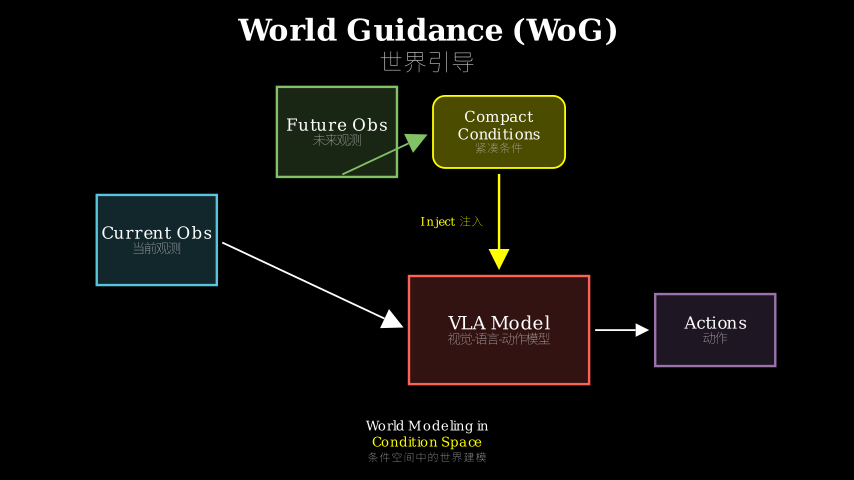
This paper introduces World Guidance (WoG), a framework that addresses a fundamental challenge in Vision-Language-Action (VLA) models: how to leverage future observation modeling to improve action generation without sacrificing efficiency or precision. Traditional approaches struggle to balance compact future representations with the fine-grained information needed for accurate robotic manipulation. WoG solves this by mapping future observations into a compressed condition space that is injected into the action inference pipeline. The model learns to predict both these compact conditions and future actions simultaneously, enabling effective world modeling that guides precise action generation while maintaining computational efficiency and demonstrating strong generalization capabilities across diverse manipulation tasks.
Key Contributions
- Introduction of a novel condition space framework that compresses future observations into compact representations while preserving action-relevant information
- A unified training paradigm where VLA models simultaneously predict compressed future conditions and actions, enabling effective world modeling
- Demonstration that condition space modeling achieves superior generalization compared to direct future observation prediction
- Validation that the approach can effectively learn from large-scale human manipulation video datasets
- Extensive experimental validation across both simulation and real-world robotic environments showing significant performance improvements over existing future prediction methods
Methodology and Technical Approach
The core innovation of WoG lies in its condition space formulation. Rather than directly predicting high-dimensional future observations (which can be computationally expensive and may contain irrelevant details), the framework learns a mapping function that compresses future observations into compact condition vectors. These conditions are then injected into the action generation pipeline through a conditioning mechanism.
The training process involves a dual objective: the model must learn to (1) predict accurate future conditions from current observations and language instructions, and (2) generate appropriate actions conditioned on both current observations and predicted future conditions. This joint training enables the model to learn a condition space that captures precisely the information needed for action generation, filtering out irrelevant details.
The condition injection mechanism allows the model to maintain awareness of future states without the computational burden of processing full future observations. This design choice proves crucial for both training efficiency and inference speed, making the approach practical for real-time robotic control.
Experimental Results and Performance
The experimental validation spans multiple domains, demonstrating the robustness and versatility of the WoG framework. In simulation environments, the method shows consistent improvements over baseline VLA models and competing future prediction approaches. The performance gains are particularly pronounced in tasks requiring long-horizon planning and precise manipulation.
Real-world experiments validate that the simulation results transfer effectively to physical robotic systems. The model demonstrates strong generalization to novel objects, environments, and task variations not seen during training. This generalization capability is attributed to the condition space learning, which captures task-relevant abstractions rather than memorizing specific visual patterns.
Notably, the framework shows effective learning from human demonstration videos, suggesting that the condition space representation aligns well with human manipulation strategies. This opens possibilities for leveraging large-scale video datasets to improve robotic manipulation capabilities.
Implications and Future Directions
WoG represents a significant step forward in bridging world modeling and action generation for embodied AI. The condition space paradigm offers a principled way to incorporate future information into decision-making without the computational and representational challenges of full observation prediction.
The success of this approach suggests several promising research directions. First, the condition space framework could be extended to multi-step future prediction, enabling longer-horizon planning. Second, the learned condition representations might serve as useful intermediate representations for transfer learning across different robotic platforms or task domains.
The ability to learn effectively from human videos indicates potential for scaling up training with internet-scale video data, though careful consideration of domain gaps and safety implications would be necessary. Additionally, investigating the interpretability of learned condition spaces could provide insights into what information is truly essential for robotic manipulation.
Takeaways
- Condition space modeling provides an effective middle ground between ignoring future information and explicitly predicting full future observations
- Joint training of condition prediction and action generation enables learning of task-relevant future representations
- The framework demonstrates superior generalization compared to direct future observation prediction methods
- Effective learning from human manipulation videos suggests alignment with human task understanding
- The approach achieves significant performance improvements in both simulation and real-world robotic manipulation tasks
- Computational efficiency is maintained through compact condition representations, enabling real-time robotic control
论文: 2602.22010 作者: Yue Su, Sijin Chen, Haixin Shi, Mingyu Liu, Zhengshen Zhang, Ningyuan Huang, Weiheng Zhong, Zhengbang Zhu, Yuxiao Liu, Xihui Liu 分类: cs.RO, cs.CV
摘要
本文提出了世界引导(World Guidance, WoG)框架,解决了视觉-语言-动作(VLA)模型中的一个核心挑战:如何利用未来观测建模来改进动作生成,同时不牺牲效率或精度。传统方法难以在紧凑的未来表示和精确机器人操作所需的细粒度信息之间取得平衡。WoG通过将未来观测映射到压缩的条件空间并注入动作推理管道来解决这一问题。模型学习同时预测这些紧凑条件和未来动作,实现了有效的世界建模,在保持计算效率的同时引导精确的动作生成,并在多样化的操作任务中展现出强大的泛化能力。
主要贡献
- 提出了一种新颖的条件空间框架,将未来观测压缩为紧凑表示,同时保留与动作相关的信息
- 设计了统一的训练范式,使VLA模型同时预测压缩的未来条件和动作,实现有效的世界建模
- 证明条件空间建模相比直接未来观测预测具有更优越的泛化能力
- 验证了该方法能够有效地从大规模人类操作视频数据集中学习
- 在仿真和真实机器人环境中进行了广泛的实验验证,显示出相比现有未来预测方法的显著性能提升
方法论与技术路径
WoG的核心创新在于其条件空间表述。该框架不是直接预测高维的未来观测(这在计算上代价高昂且可能包含无关细节),而是学习一个映射函数,将未来观测压缩为紧凑的条件向量。这些条件随后通过条件化机制注入到动作生成管道中。
训练过程涉及双重目标:模型必须学习(1)从当前观测和语言指令预测准确的未来条件,以及(2)基于当前观测和预测的未来条件生成适当的动作。这种联合训练使模型能够学习一个条件空间,该空间精确捕获动作生成所需的信息,过滤掉无关细节。
条件注入机制允许模型在不承担处理完整未来观测的计算负担的情况下保持对未来状态的感知。这一设计选择对训练效率和推理速度都至关重要,使该方法适用于实时机器人控制。
实验结果与性能表现
实验验证跨越多个领域,展示了WoG框架的鲁棒性和通用性。在仿真环境中,该方法相比基线VLA模型和竞争性未来预测方法显示出一致的改进。在需要长期规划和精确操作的任务中,性能提升尤为显著。
真实世界实验验证了仿真结果能够有效迁移到物理机器人系统。模型对训练期间未见过的新物体、环境和任务变化展现出强大的泛化能力。这种泛化能力归因于条件空间学习,它捕获了与任务相关的抽象而非记忆特定的视觉模式。
值得注意的是,该框架展示了从人类演示视频中的有效学习,表明条件空间表示与人类操作策略高度一致。这为利用大规模视频数据集改进机器人操作能力开辟了可能性。
影响与未来方向
WoG代表了在具身智能的世界建模和动作生成之间架起桥梁的重要进步。条件空间范式提供了一种原则性方法,将未来信息纳入决策过程,而无需面对完整观测预测的计算和表示挑战。
该方法的成功指向了几个有前景的研究方向。首先,条件空间框架可以扩展到多步未来预测,实现更长期的规划。其次,学习到的条件表示可能作为跨不同机器人平台或任务领域迁移学习的有用中间表示。
从人类视频中有效学习的能力表明了利用互联网规模视频数据进行扩展训练的潜力,尽管需要仔细考虑领域差距和安全影响。此外,研究学习到的条件空间的可解释性可以提供关于机器人操作真正必需信息的洞察。
要点总结
- 条件空间建模在忽略未来信息和显式预测完整未来观测之间提供了有效的中间方案
- 条件预测和动作生成的联合训练能够学习与任务相关的未来表示
- 该框架相比直接未来观测预测方法展现出更优越的泛化能力
- 从人类操作视频中的有效学习表明与人类任务理解的一致性
- 该方法在仿真和真实机器人操作任务中都实现了显著的性能提升
- 通过紧凑的条件表示保持了计算效率,支持实时机器人控制