Paper: 2605.00796 Authors: Alfredo Madrid-García, Miguel Rujas Categories: cs.CR, cs.AI, cs.CL
The Gap
Medical RAG chatbots are being deployed to patients with promises of privacy and security. Prior work focuses on adversarial prompts (jailbreaking, prompt injection) or theoretical attack surfaces. What’s missing: empirical evidence of how badly real-world deployments fail basic security hygiene—not through sophisticated exploits, but through architectural mistakes visible in plain sight.
Problem: Patient-facing RAG chatbots deployed without security audit
    |
    v
Assumption: Sensitive config/data lives server-side, not client-side
    |
    v
Method: Two-stage assessment (LLM-assisted exploration + manual verification)
    |
    v
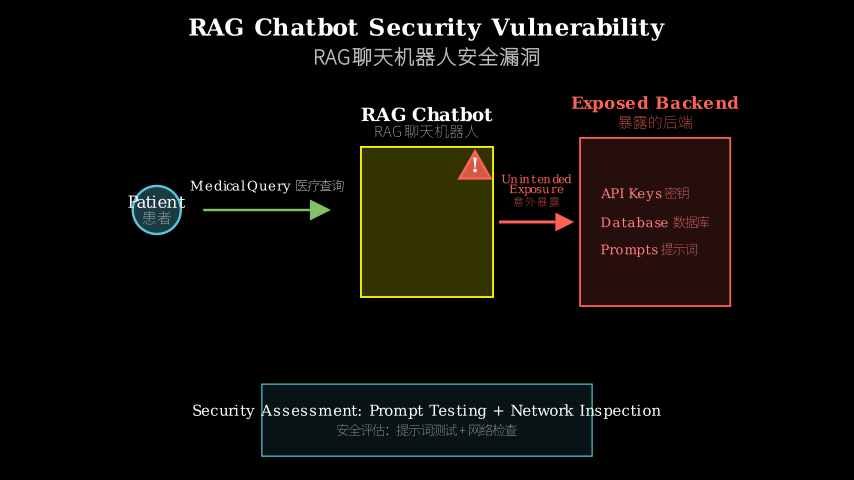
Evidence: System prompt, embeddings, 1000 patient conversations exposed via browser
    |
    v
Conclusion: Deployment failures are trivial to find; governance is broken
The Increment
One sentence: Before this paper, we worried about prompt injection attacks; after, we know some medical chatbots are shipping with their entire backend exposed in the browser’s network tab.
Core Mechanism
The assessment uses a two-stage process. Stage one: Claude Opus 4.6 acts as a hypothesis generator, exploring the chatbot through conversational probing to identify potential vulnerabilities. The LLM suggests what to look for based on common RAG architecture patterns. Stage two: manual verification using Chrome Developer Tools. The researcher inspects network traffic, API payloads, JavaScript objects, and browser storage—no authentication bypass, no exploit code, just reading what the browser already receives.
Stage 1: LLM-Assisted Exploration
    User <--prompt--> Claude Opus 4.6 <--query--> Target Chatbot
                           |
                           v
                   Vulnerability Hypotheses
                           |
                           v
Stage 2: Manual Verification
    Chrome DevTools --> Network Tab --> API Payloads
                    --> Application --> LocalStorage
                    --> Sources --> JS Config Objects
                           |
                           v
                   Confirmed Exposures:
                   - System prompt
                   - Model configs
                   - RAG parameters
                   - 1000 patient conversations
Think of this like a building inspector checking a hospital. Stage one is walking through with an experienced contractor who points out suspicious cracks and odd wiring. Stage two is pulling out the inspection tools—moisture meter, voltage tester—to confirm the walls are actually wet and the circuits are actually live. The contractor (LLM) accelerates hypothesis generation; the inspector (human with DevTools) confirms what’s real. The shocking finding: you don’t need to break through walls. The hospital left blueprints, patient records, and security codes taped to the front door.
Key Concepts
-
Retrieval-Augmented Generation (RAG): Instead of relying solely on an LLM’s training data, RAG systems retrieve relevant documents from a knowledge base and inject them into the prompt. For a medical chatbot, this means fetching relevant medical literature or guidelines, then asking the LLM to answer based on those sources. The promise: grounded, verifiable answers. The risk: if the retrieval pipeline is exposed, attackers see what documents exist, how they’re chunked, and what metadata tags them.
-
Client-side vs Server-side Architecture: In secure web apps, sensitive logic runs on the server; the browser only receives what the user should see. In this chatbot, the opposite happened: system prompts, embedding models, retrieval parameters, and conversation history were sent to the browser as JavaScript objects or API responses. It’s like a bank ATM that displays your PIN, account balance, and the vault combination on the screen instead of keeping them in the backend.
-
LLM-Assisted Security Testing: The paper uses Claude to generate test prompts and hypothesize vulnerabilities. This is a double-edged sword: it lowers the barrier for auditors (good) but also for adversaries (bad). The LLM doesn’t execute exploits; it suggests what to look for. The human verifies using standard tools. The authors tested this under a “false developer persona”—the LLM helped even when told the user was building a similar system, not auditing one.
Framework Shift
Before (assumed secure deployment):        After (this paper's findings):

  Patient                                    Patient
    |                                          |
    v                                          v
  Browser (UI only)                          Browser (UI + full backend state)
    |                                          |
    | encrypted HTTPS                          | encrypted HTTPS (but exposes everything)
    v                                          v
  Server (system prompt, RAG config,         Server (just forwards data)
          embeddings, conversations)           |
    |                                          v
    v                                        Browser receives:
  Knowledge Base                             - System prompt
                                             - Model configs
                                             - RAG parameters
                                             - 1000 patient conversations
                                             - Knowledge base metadata
From “trust the HTTPS lock icon” to “HTTPS encrypts the pipe, not the payload”—the core shift is recognizing that encryption in transit means nothing if sensitive data is intentionally sent to an untrusted client.
Expert Assessment
Problem choice: This is a real gap. The AI safety community obsesses over prompt injection and model alignment, but deployment security gets less attention. The paper picks a high-stakes domain (patient-facing medical advice) where failures have immediate consequences. It’s not manufactured—the chatbot was live and publicly accessible.
Method maturity: The method is deliberately simple, which is the point. Using an LLM to accelerate hypothesis generation is clever but not novel; the contribution is demonstrating that trivial inspection reveals catastrophic failures. The two-stage approach (LLM + manual verification) is sound and reproducible. No sophisticated tooling required.
Experimental integrity: The paper is an anonymized case study, not a controlled experiment. The authors don’t name the chatbot (ethical choice), but this limits reproducibility. The findings are documented with screenshots and network traces, which is good. The “false developer persona” test is interesting but feels like a side note—it doesn’t change the main finding that the system was insecure by design.
Writing quality: The paper is clear and well-structured. The anonymization is appropriate but makes it hard to assess generalizability—is this one bad apple or a systemic problem? The discussion of governance lessons is strong, but the paper could have included a checklist or threat model for RAG deployments. The related work section is thin; more comparison with prior security audits of AI systems would strengthen the framing.
Verdict: weak accept — Important empirical evidence of a real problem, but limited to a single case study. The findings are alarming and the governance recommendations are sound, but the paper doesn’t establish how widespread these failures are.
Takeaways
If you’re deploying a RAG system, audit what your browser receives. Open DevTools, check the Network tab, inspect API responses and JavaScript objects. If you see system prompts, model configs, or user data, you have a problem. The paper’s implicit checklist: (1) system prompts and RAG configs should never leave the server, (2) conversation history should require authentication and be scoped per user, (3) knowledge base metadata should be sanitized before exposure, (4) assume adversaries have LLM assistance. For security researchers: LLMs are useful for generating test cases, but manual verification is non-negotiable. For governance: independent security review should be mandatory before deploying patient-facing AI, and “we use HTTPS” is not a security posture.
论文: 2605.00796 作者: Alfredo Madrid-García, Miguel Rujas 分类: cs.CR, cs.AI, cs.CL
缺口
面向患者的医疗 RAG 聊天机器人正在部署,承诺隐私和安全。
此前的研究聚焦于对抗性提示(越狱、提示注入)或理论攻击面。
缺失的是:真实部署在基本安全卫生上失败得有多惨的实证证据——不是通过复杂的漏洞利用,而是通过肉眼可见的架构错误。
问题:面向患者的 RAG 聊天机器人未经安全审计就部署
    |
    v
假设:敏感配置/数据在服务器端,不在客户端
    |
    v
方法:两阶段评估(LLM 辅助探索 + 人工验证)
    |
    v
证据:系统提示词、嵌入模型、1000 条患者对话通过浏览器暴露
    |
    v
结论:部署失败容易发现;治理已崩溃
增量
一句话: 这篇论文之前,我们担心提示注入攻击;之后,我们知道有些医疗聊天机器人把整个后端暴露在浏览器的网络标签页里。
核心机制
评估采用两阶段流程。
第一阶段:Claude Opus 4.6 充当假设生成器,通过对话探测聊天机器人,识别潜在漏洞。
LLM 根据常见 RAG 架构模式建议要寻找什么。
第二阶段:使用 Chrome 开发者工具进行人工验证。
研究员检查网络流量、API 载荷、JavaScript 对象和浏览器存储——没有绕过认证,没有漏洞利用代码,只是读取浏览器已经收到的内容。
阶段 1:LLM 辅助探索
    用户 <--提示--> Claude Opus 4.6 <--查询--> 目标聊天机器人
                           |
                           v
                   漏洞假设
                           |
                           v
阶段 2:人工验证
    Chrome 开发工具 --> 网络标签 --> API 载荷
                    --> 应用 --> 本地存储
                    --> 源代码 --> JS 配置对象
                           |
                           v
                   确认的暴露:
                   - 系统提示词
                   - 模型配置
                   - RAG 参数
                   - 1000 条患者对话
把这想象成建筑检查员检查医院。
第一阶段是和经验丰富的承包商一起走一遍,他指出可疑的裂缝和奇怪的布线。
第二阶段是拿出检查工具——湿度计、电压测试仪——确认墙壁确实潮湿,电路确实带电。
承包商(LLM)加速假设生成;检查员(带 DevTools 的人)确认什么是真的。
令人震惊的发现:你不需要破墙而入。
医院把蓝图、患者记录和安全密码贴在前门上。
关键概念
- 检索增强生成(RAG): 不仅依赖 LLM 的训练数据,RAG 系统从知识库中检索相关文档并注入提示词。
对于医疗聊天机器人,这意味着获取相关医学文献或指南,然后要求 LLM 基于这些来源回答。
承诺:有根据、可验证的答案。
风险:如果检索管道暴露,攻击者看到存在哪些文档、如何分块、用什么元数据标记。
- 客户端 vs 服务器端架构: 在安全的 Web 应用中,敏感逻辑在服务器上运行;浏览器只接收用户应该看到的内容。
在这个聊天机器人中,情况相反:系统提示词、嵌入模型、检索参数和对话历史作为 JavaScript 对象或 API 响应发送到浏览器。
这就像银行 ATM 在屏幕上显示你的 PIN、账户余额和金库密码,而不是把它们保存在后端。
- LLM 辅助安全测试: 论文使用 Claude 生成测试提示并假设漏洞。
这是一把双刃剑:它降低了审计员的门槛(好),但也降低了对手的门槛(坏)。
LLM 不执行漏洞利用;它建议要寻找什么。
人类使用标准工具验证。
作者在”虚假开发者角色”下测试了这一点——即使告诉 LLM 用户正在构建类似系统而不是审计系统,LLM 也提供了帮助。
框架转变
之前(假设安全部署):                之后(本文发现):

  患者                                    患者
    |                                       |
    v                                       v
  浏览器(仅 UI)                          浏览器(UI + 完整后端状态)
    |                                       |
    | 加密 HTTPS                            | 加密 HTTPS(但暴露一切)
    v                                       v
  服务器(系统提示词、RAG 配置、           服务器(只是转发数据)
          嵌入、对话)                       |
    |                                       v
    v                                     浏览器接收:
  知识库                                  - 系统提示词
                                          - 模型配置
                                          - RAG 参数
                                          - 1000 条患者对话
                                          - 知识库元数据
从”相信 HTTPS 锁图标”到”HTTPS 加密管道,不加密载荷”——核心转变是认识到传输加密在敏感数据被故意发送到不可信客户端时毫无意义。
专家评审
选题眼光: 这是真缺口。
AI 安全社区痴迷于提示注入和模型对齐,但部署安全得到的关注较少。
论文选择了高风险领域(面向患者的医疗建议),失败会立即产生后果。
这不是人造的——聊天机器人是真实的,公开可访问。
方法成熟度: 方法故意简单,这正是重点。
使用 LLM 加速假设生成很聪明但不新颖;贡献在于证明简单检查就能揭示灾难性失败。
两阶段方法(LLM + 人工验证)是合理且可重现的。
不需要复杂工具。
实验诚意: 论文是匿名案例研究,不是对照实验。
作者没有透露聊天机器人名称(道德选择),但这限制了可重现性。
发现用截图和网络追踪记录,这很好。
“虚假开发者角色”测试很有趣,但感觉像旁注——它不改变系统设计不安全的主要发现。
写作功力: 论文清晰且结构良好。
匿名化是合适的,但难以评估普遍性——这是一个坏苹果还是系统性问题?治理教训的讨论很有力,但论文本可以包含 RAG 部署的检查清单或威胁模型。
相关工作部分较薄;与 AI 系统先前安全审计的更多比较会加强框架。
判决: 弱接收 — 真实问题的重要实证证据,但限于单一案例研究。
发现令人震惊,治理建议合理,但论文没有确定这些失败有多普遍。
要点总结
如果你在部署 RAG 系统,审计浏览器接收到什么。
打开 DevTools,检查网络标签,检查 API 响应和 JavaScript 对象。
如果你看到系统提示词、模型配置或用户数据,你有问题了。
论文的隐含检查清单:(1)系统提示词和 RAG 配置永远不应离开服务器,(2)对话历史应需要认证并按用户范围限定,(3)知识库元数据应在暴露前清理,(4)假设对手有 LLM 辅助。
对于安全研究员:LLM 对生成测试用例有用,但人工验证不可协商。
对于治理:在部署面向患者的 AI 之前,独立安全审查应是强制性的,“我们使用 HTTPS”不是安全姿态。