
Paper: 2603.16840 Authors: Moritz Pawlowsky, Antonis Vamvakeros, Alexander Weiss, Anja Bielefeld, Samuel J. Cooper, Ronan Docherty Categories: cs.CV, cond-mat.mtrl-sci
The Gap
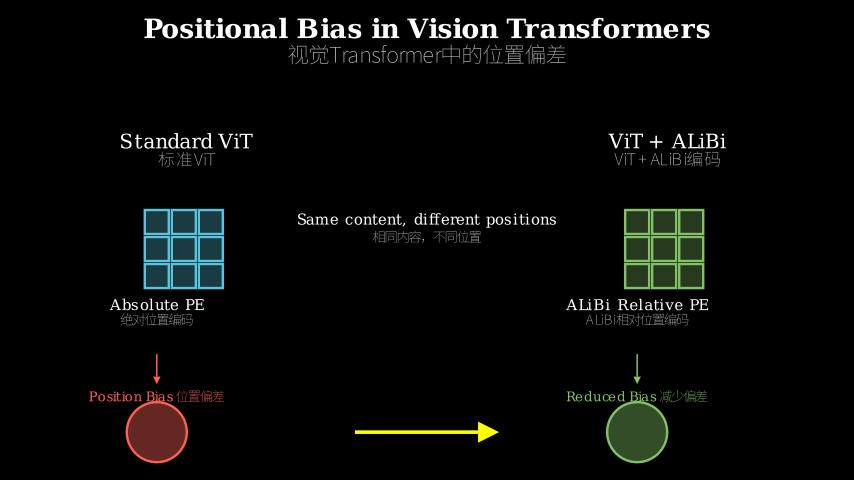
Vision transformers like DINOv2 are supposed to learn “what” things are, not “where” they are. But they secretly encode position information into their features. This is fine for natural images (a sky is usually at the top), but breaks down for material science microscopy where a grain boundary should look the same whether it’s in the corner or center of the image. Prior work has documented positional biases in language models and some vision models, but nobody has systematically measured it across different ViT architectures or shown how to remove it without destroying the model’s semantic understanding.
Problem: ViTs encode position into features
    |
    v
Assumption: Positional encoding choice drives this bias
    |
    v
Method: Replace absolute/learned PE with ALiBi (relative)
    |
    v
Evidence: Linear probes show reduced position prediction
          + Segmentation tasks maintain performance
    |
    v
Conclusion: ALiBi removes positional bias while preserving semantics
The Increment
One sentence: Before this paper, you couldn’t use foundation vision models for zero-shot tasks on rotationally symmetric data (like microscopy) because they leaked position information; after, you can finetune them with ALiBi to get unbiased features that still understand semantics.
Core Mechanism
The method has three stages. First, they measure positional bias by training linear probes on frozen ViT features to predict patch positions. If the probe achieves high accuracy, the features contain positional information. They test this across DINOv2, MAE, and CLIP with different positional encodings (absolute sinusoidal, learned, rotary).
Second, they finetune these models by replacing their positional encoding with ALiBi (Attention with Linear Biases). ALiBi doesn’t add position embeddings to tokens. Instead, it adds a bias directly to the attention scores based on the distance between query and key positions. The bias is negative and grows linearly with distance, so nearby patches attend more to each other.
Third, they validate that the finetuned models retain semantic understanding by testing on segmentation tasks. They use the unbiased features as input to trainable segmentation heads on microscopy images of battery materials and porous media.
Input Image
    |
    v
[Patch Embedding] ---> [ViT Blocks with ALiBi]
    |                        |
    |                   (attention bias = -m * |i-j|)
    |                        |
    v                        v
Features -----> [Linear Probe] ---> Position Prediction
    |                                (should fail if unbiased)
    |
    v
[Segmentation Head] ---> Semantic Output
                         (should succeed if semantics preserved)
Think of it like a restaurant critic who unconsciously rates corner tables higher than center tables. You want them to judge food quality, not seating location. The original ViT is like giving each table a name tag (“Table 7, northwest corner”) that the critic sees. Even if they try to ignore it, the information leaks into their review. ALiBi is like replacing name tags with a simple rule: “Pay slightly more attention to nearby tables when comparing dishes.” The critic still understands food quality (semantics) but can’t tell you which table a dish came from (position).
Key Concepts
-
Positional Encoding: Vision transformers chop images into patches and process them as a sequence. But unlike text, image patches don’t have inherent order. Positional encoding adds information about where each patch came from. Absolute encodings (like sinusoidal or learned vectors) give each position a unique signature. Relative encodings (like ALiBi) only encode the distance between positions. Imagine a classroom where absolute encoding gives each desk a unique ID number, while relative encoding just tells you “this desk is 2 rows behind that one.” For tasks where absolute position shouldn’t matter (like identifying a cell type in microscopy), absolute encodings leak information that biases the model.
-
Linear Probing: A diagnostic tool to measure what information is encoded in learned features. You freeze the model’s weights and train only a simple linear classifier on top. If the classifier succeeds at a task, the frozen features must contain the necessary information. It’s like testing if a locked diary contains secrets by seeing if you can guess the secrets just from the diary’s weight and texture—without opening it. In this paper, they probe whether features encode position by training a linear layer to predict patch coordinates. High accuracy means position leaked into the features.
-
ALiBi (Attention with Linear Biases): A relative positional encoding that modifies attention scores instead of token embeddings. In standard attention, query Q and key K produce a score Q·K. ALiBi adds a penalty: Q·K - m·|i-j|, where i and j are positions and m is a learned slope. Nearby positions get small penalties, distant ones get large penalties. This creates a locality bias without encoding absolute position. It’s like judging a neighborhood by saying “I prefer houses close to mine” rather than memorizing every address. The model learns spatial relationships (this patch is near that one) without learning coordinates (this patch is at row 5, column 3).
Framework Shift
Before (mainstream approach):        After (this paper):

Image --> [Patch + Pos Embed]       Image --> [Patch Embed]
              |                                  |
              v                                  v
         [Transformer]                  [Transformer + ALiBi]
              |                                  |
         (features encode                   (attention biased
          absolute position)                 by relative distance)
              |                                  |
              v                                  v
         Downstream Task                   Downstream Task
         (biased by position)              (unbiased features)
From baking position into the features to baking it into the attention mechanism, the core shift is moving from “where am I?” to “how far apart are we?”
Expert Assessment
Problem choice: Real gap, not manufactured. Material scientists actually face this—microstructure images have no preferred orientation, but foundation models trained on natural images assume they do. The problem sits at the intersection of domain adaptation and architectural choices, which is underexplored territory.
Method maturity: Clever insight, not brute force. ALiBi already existed for language models; applying it to vision and measuring the bias reduction is straightforward but effective. However, they don’t explore why ALiBi specifically works better than other relative encodings (like rotary), or whether simpler solutions (like data augmentation with random rotations) could achieve similar results.
Experimental integrity: Baselines are fair. They test multiple architectures (DINOv2, MAE, CLIP) and positional encodings. The linear probing methodology is sound. One concern: they only test on microscopy images for downstream tasks. Would be stronger to show the unbiased features don’t hurt performance on natural images too. The segmentation results are qualitative (visual comparisons) rather than quantitative metrics, which weakens the claim about preserved semantics.
Writing quality: The paper is clear but front-loads too much motivation about material science. A general computer vision reader might bounce off the intro. The methods section is solid. The results would benefit from ablations—what happens with partial finetuning? How much data is needed? The discussion of why ALiBi works is thin; they could dig deeper into the attention patterns.
Verdict: weak accept — Addresses a real problem with a simple, effective solution, but experimental validation is narrow and lacks depth on why it works.
Takeaways
If you’re adapting foundation models to domains where position shouldn’t matter (medical imaging, satellite imagery, scientific microscopy), try ALiBi positional encoding. The finetuning is cheap and the bias reduction is measurable via linear probing—use that as a diagnostic before deploying. More broadly, this paper shows that architectural choices in foundation models can encode implicit assumptions about data structure. When your domain violates those assumptions, you can often fix it by swapping components (like positional encoding) rather than retraining from scratch. The linear probing technique is also worth stealing: it’s a quick way to audit what information your features contain before you commit to a downstream task.
论文: 2603.16840 作者: Moritz Pawlowsky, Antonis Vamvakeros, Alexander Weiss, Anja Bielefeld, Samuel J. Cooper, Ronan Docherty 分类: cs.CV, cond-mat.mtrl-sci
缺口
像DINOv2这样的视觉transformer本应学习物体”是什么”,而不是”在哪里”。
但它们会偷偷把位置信息编码进特征里。
对自然图像来说这没问题(天空通常在上方),但对材料科学显微镜图像就不行了——晶界无论在图像角落还是中心,看起来都应该一样。
之前的工作记录过语言模型和一些视觉模型的位置偏见,但没人系统地测量过不同ViT架构中的这种偏见,也没人展示过如何在不破坏模型语义理解的前提下消除它。
问题:ViT把位置编码进特征
    |
    v
假设:位置编码的选择导致了这种偏见
    |
    v
方法:用ALiBi(相对位置编码)替换绝对/学习型位置编码
    |
    v
证据:线性探针显示位置预测能力下降
      + 分割任务保持性能
    |
    v
结论:ALiBi消除位置偏见同时保留语义
增量
一句话:这篇论文之前,你无法在旋转对称数据(如显微镜图像)上零样本使用基础视觉模型,因为它们会泄露位置信息;
之后,你可以用ALiBi微调它们,得到无偏特征,同时保留语义理解。
核心机制
方法分三个阶段。
第一阶段,他们通过在冻结的ViT特征上训练线性探针来预测patch位置,以此测量位置偏见。
如果探针达到高准确率,说明特征包含位置信息。
他们在DINOv2、MAE和CLIP上测试了不同的位置编码(绝对正弦、学习型、旋转型)。
第二阶段,他们用ALiBi(带线性偏置的注意力)替换位置编码来微调这些模型。
ALiBi不给token添加位置嵌入。
相反,它根据查询和键位置之间的距离,直接给注意力分数添加偏置。
偏置是负的,随距离线性增长,所以相邻patch会更多地关注彼此。
第三阶段,他们通过在分割任务上测试来验证微调后的模型保留了语义理解。
他们用无偏特征作为输入,在电池材料和多孔介质的显微镜图像上训练分割头。
输入图像
    |
    v
[Patch嵌入] ---> [带ALiBi的ViT块]
    |                   |
    |              (注意力偏置 = -m * |i-j|)
    |                   |
    v                   v
特征 -----> [线性探针] ---> 位置预测
    |                        (如果无偏应该失败)
    |
    v
[分割头] ---> 语义输出
             (如果语义保留应该成功)
把它想象成一个餐厅评论家,会无意识地给角落的桌子打更高分。
你希望他们评判食物质量,而不是座位位置。
原始ViT就像给每张桌子一个名牌(“7号桌,西北角”),评论家能看到。
即使他们试图忽略,信息也会泄露到评论里。
ALiBi就像用一个简单规则替换名牌:“比较菜品时,稍微多关注附近的桌子。
“评论家仍然理解食物质量(语义),但说不出一道菜来自哪张桌子(位置)。
关键概念
- 位置编码:视觉transformer把图像切成patch,作为序列处理。
但与文本不同,图像patch没有固有顺序。
位置编码添加关于每个patch来自哪里的信息。
绝对编码(如正弦或学习向量)给每个位置一个独特签名。
相对编码(如ALiBi)只编码位置之间的距离。
想象一个教室,绝对编码给每张课桌一个唯一ID号,而相对编码只告诉你”这张课桌在那张后面两排”。
对于绝对位置不应该重要的任务(如在显微镜图像中识别细胞类型),绝对编码会泄露使模型产生偏见的信息。
- 线性探针:一种诊断工具,用于测量学习到的特征中编码了什么信息。
你冻结模型权重,只在顶部训练一个简单的线性分类器。
如果分类器在某个任务上成功,冻结的特征必定包含必要信息。
就像测试一本锁着的日记是否包含秘密,方法是看你能否仅从日记的重量和质地猜出秘密——不打开它。
在本文中,他们通过训练线性层预测patch坐标来探测特征是否编码位置。
高准确率意味着位置泄露进了特征。
- ALiBi(带线性偏置的注意力):一种相对位置编码,修改注意力分数而不是token嵌入。
在标准注意力中,查询Q和键K产生分数Q·K。
ALiBi添加惩罚:Q·K - m·|i-j|,其中i和j是位置,m是学习到的斜率。
相邻位置得到小惩罚,远距离位置得到大惩罚。
这创建了局部性偏置,而不编码绝对位置。
就像通过说”我更喜欢离我家近的房子”来评判社区,而不是记住每个地址。
模型学习空间关系(这个patch在那个附近),而不学习坐标(这个patch在第5行第3列)。
框架转变
之前(主流方法):                之后(本文方法):

图像 --> [Patch + 位置嵌入]      图像 --> [Patch嵌入]
            |                            |
            v                            v
       [Transformer]               [Transformer + ALiBi]
            |                            |
       (特征编码                      (注意力被相对
        绝对位置)                      距离偏置)
            |                            |
            v                            v
       下游任务                        下游任务
       (被位置偏置)                    (无偏特征)
从把位置烘焙进特征到把它烘焙进注意力机制,核心转变是从”我在哪里?
“到”我们相距多远?
“
专家评审
选题眼光:真缺口,不是人造的。
材料科学家确实面临这个问题——微观结构图像没有首选方向,但在自然图像上训练的基础模型假设有。
这个问题位于领域适应和架构选择的交叉点,是探索不足的领域。
方法成熟度:巧劲,不是蛮力。
ALiBi已经存在于语言模型中;
将它应用于视觉并测量偏见减少是直接但有效的。
然而,他们没有探索为什么ALiBi比其他相对编码(如旋转型)效果更好,或者更简单的解决方案(如随机旋转的数据增强)是否能达到类似效果。
实验诚意:基线公平。
他们测试了多个架构(DINOv2、MAE、CLIP)和位置编码。
线性探针方法论是可靠的。
一个担忧:他们只在显微镜图像上测试下游任务。
如果能展示无偏特征在自然图像上也不损害性能会更有力。
分割结果是定性的(视觉比较)而非定量指标,这削弱了关于保留语义的主张。
写作功力:论文清晰,但引言部分关于材料科学的动机太多。
一般计算机视觉读者可能会被开头劝退。
方法部分扎实。
结果部分会受益于消融实验——部分微调会怎样?
需要多少数据?
关于ALiBi为什么有效的讨论很薄;
他们可以更深入地挖掘注意力模式。
判决:弱接收——用简单有效的解决方案解决了真实问题,但实验验证范围窄,对为什么有效缺乏深度。
要点总结
如果你要将基础模型适应到位置不应该重要的领域(医学成像、卫星图像、科学显微镜),试试ALiBi位置编码。
微调成本低,偏见减少可通过线性探针测量——在部署前用它作为诊断工具。
更广泛地说,本文展示了基础模型中的架构选择可以编码关于数据结构的隐含假设。
当你的领域违反这些假设时,通常可以通过交换组件(如位置编码)来修复,而不是从头重新训练。
线性探针技术也值得借鉴:它是在你投入下游任务之前,快速审计特征包含什么信息的方法。