
Paper: 2605.15182 Authors: Yifan Wang, Tong He Categories: cs.CV
The Gap
Camera-controlled video generation has reached a point where models can generate videos following prescribed viewpoint trajectories. However, existing methods hit a wall: they either require expensive post-training on large-scale camera-annotated datasets (camera encoders, control branches, attention modifications), or they avoid training but pay the cost at test time through per-video optimization or extra guidance during denoising. The field lacks a method that achieves camera control without training, architectural changes, or test-time overhead.
Problem: Camera control = expensive training OR expensive inference
                |
                v
Observation: Video models already process visual history
                |
                v
Hypothesis: Camera motion ~ geometric transformation of history
                |
                v
Method: Warp past frames → feed as pseudo-history
                |
                v
Evidence: Zero-shot capability + 1-video LoRA generalizes
                |
                v
Conclusion: Camera control can be training-free interface problem
The Increment
One sentence: Before this paper, camera control required either large-scale training or test-time optimization; after, a simple warping interface unlocks zero-shot camera following in frozen models and strong generalization from one training video.
Core Mechanism
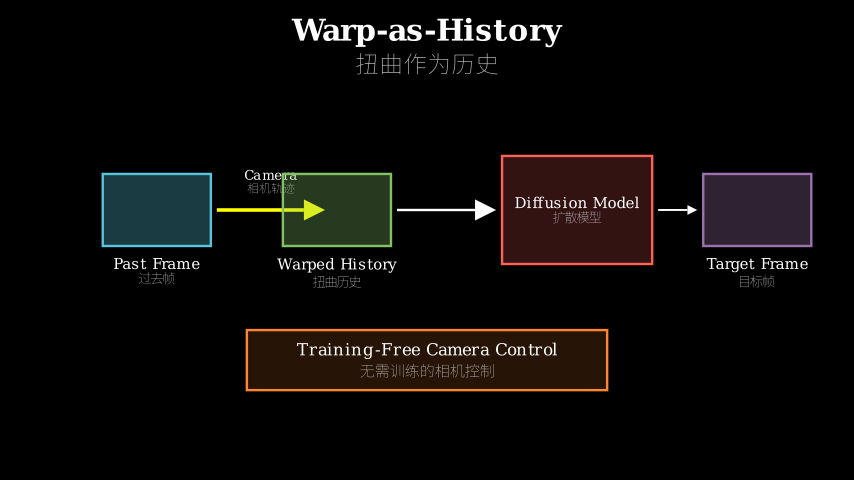
Warp-as-History treats camera control as a history manipulation problem. Given a target camera trajectory, the method takes past observed frames and geometrically warps them according to the camera motion (rotation, translation, zoom). These warped frames become “pseudo-history” — what the past would look like from the target camera’s viewpoint.
The key insight is that video generation models already have a visual-history pathway (they condition on previous frames). Instead of teaching the model about cameras through training, we pre-process the history to match the target viewpoint. Two critical operations make this work: (1) positional encoding alignment — the warped history tokens receive the positional encodings of the target frame being denoised, not their original positions, so the model treats them as spatially aligned with the generation target; (2) visible-token selection — tokens warped from regions without valid source observations (occluded areas, out-of-frame regions) are removed to avoid feeding the model garbage.
Input: Past frames [F_t-1, F_t-2, ...] + Target camera C_target
                |
                v
        Geometric Warp (rotation, translation, zoom)
                |
                v
        Warped frames [F'_t-1, F'_t-2, ...]
                |
                +---> Positional Encoding: Use target frame positions
                |
                +---> Visible Token Selection: Remove invalid regions
                |
                v
        Feed into model's visual-history pathway
                |
                v
        Output: Frame at target viewpoint
Think of it like a film editor’s trick. Imagine you’re making a movie and want to show a scene from a new angle, but you only have footage from the old angle. A naive approach would be to retrain the camera crew (expensive training) or reshoot the scene multiple times until it looks right (test-time optimization). Instead, Warp-as-History is like using perspective correction in post-production: take the existing footage, digitally transform it to approximate the new viewpoint, and feed it to the editing software as if it were shot from that angle. The software doesn’t know you cheated — it just sees “history” that happens to align with your target shot. The positional encoding alignment is like relabeling the footage’s metadata to match the new camera position, and visible-token selection is like masking out the parts where the transformation created artifacts or empty space.
Key Concepts
-
Pseudo-History: In video generation, models typically condition on previous frames (history) to maintain temporal consistency. Pseudo-history is a manufactured version of this history — frames that didn’t actually exist at those viewpoints but are constructed to look like they did. Here, we create pseudo-history by warping real past frames according to camera motion. The model’s history pathway doesn’t distinguish between “real” history and “warped” history; it just processes visual tokens. By feeding warped frames with target-aligned positional encodings, we trick the model into generating content consistent with the target camera viewpoint. It’s like showing someone a photo taken from angle A, then asking them to imagine what angle B would look like — except we pre-warp angle A to approximate angle B before showing it.
-
Positional Encoding Alignment: Video models use positional encodings to tell each token where it sits in space and time. Normally, a token from frame t-1 at position (x, y) gets encoding PE(t-1, x, y). When we warp that frame, the pixel moves to a new position (x’, y’), but we don’t want the model to think it’s still at (x, y) — that would create spatial misalignment with the target frame being generated. Instead, we assign it PE(t, x’, y’), the encoding of the target frame’s position. This alignment is crucial: it tells the model “this warped content belongs at this location in the frame I’m generating now,” enabling spatial coherence between pseudo-history and output.
-
Visible-Token Selection: Geometric warping creates invalid regions — areas where the warp tries to pull information from outside the source frame’s boundaries or from occluded regions. If we feed these invalid tokens to the model, they contain noise or artifacts that corrupt generation. Visible-token selection identifies which warped tokens have valid source observations (pixels that actually existed in the original frame and weren’t occluded) and removes the rest. Think of it like a mask: after warping, we check each token’s provenance — if it came from a real pixel, keep it; if it came from extrapolation or empty space, discard it. This prevents the model from hallucinating based on garbage input.
Framework Shift
Before (mainstream approach):        After (this paper):

Camera params                        Past frames
     |                                    |
     v                                    v
Camera encoder                       Geometric warp
     |                                    |
     v                                    v
Control branch / Attention mod       Pseudo-history
     |                                    |
     v                                    v
Video model (trained)                Video model (frozen)
     |                                    |
     v                                    v
Output video                         Output video

Training: Large-scale dataset        Training: None (or 1 video)
Test-time: Standard inference        Test-time: Standard inference
From “teach the model about cameras through architecture and training” to “pre-process history to match the camera, let the model do what it already does.”
Expert Assessment
Problem choice: Real gap. Camera control is a legitimate bottleneck — existing methods either require prohibitive training data or sacrifice inference efficiency. The observation that video models already process history is obvious in hindsight but underexploited. This sits at a sweet spot: practical problem, elegant solution space.
Method maturity: Clever insight, not brute force. The core idea — warp history instead of training camera encoders — is simple and well-motivated. The two refinements (positional alignment and visible-token selection) are necessary, not ad-hoc. However, the method inherits limitations of geometric warping: it works for camera motion but not for complex scene dynamics or non-rigid deformations. The authors acknowledge this but don’t deeply explore failure modes.
Experimental integrity: Baselines are fair (training-based methods, training-free alternatives). The zero-shot results are impressive, and the 1-video LoRA generalization is the paper’s strongest claim. However, the experiments lean heavily on camera-annotated datasets (RealEstate10K, ACID). Real-world robustness (noisy camera estimates, dynamic scenes) gets less attention. The ablations are thorough for the method’s components but don’t stress-test assumptions (e.g., what happens when warping quality degrades?).
Writing quality: Clear and well-structured. The method section is crisp. The related work could be tighter — it lists many approaches but doesn’t sharply delineate why each fails to solve the problem. The discussion of limitations is honest but brief. Rewriting Section 4.3 (ablations) to lead with insights rather than tables would improve readability.
Verdict: weak accept — Solid contribution with a clean idea and strong empirical results, but the scope is narrower than the framing suggests (camera motion, not general viewpoint synthesis), and real-world robustness needs more scrutiny.
Takeaways
Reframe control as preprocessing: Instead of training models to understand control signals, preprocess inputs to match the desired output structure. This pattern transfers beyond camera control — think audio (warp spectrograms for pitch shift), 3D (warp point clouds for pose change), or text (reorder tokens for style transfer).
Exploit existing pathways: Video models already handle history; image models already handle spatial conditioning. Before adding new modules, check if existing pathways can be repurposed through clever input manipulation.
Positional encoding is a lever: Misaligning positional encodings with content is usually a bug, but here it’s a feature. When you warp or transform data, ask: should the positional encoding follow the content or stay fixed? The answer depends on whether you want the model to see “moved content” or “content at a new location.”
One-shot generalization via LoRA: The 1-video finetuning result is underappreciated. It suggests that lightweight adaptation on minimal data can teach models to generalize structural patterns (here, camera-history relationships) without overfitting. This is a recipe worth stealing for other low-data adaptation problems.
论文: 2605.15182 作者: Yifan Wang, Tong He 分类: cs.CV
缺口
相机控制的视频生成已经发展到模型能够生成遵循预设视点轨迹的视频。
然而,现有方法遇到了瓶颈:要么需要在大规模相机标注数据集上进行昂贵的后训练(相机编码器、控制分支、注意力修改),要么避免训练但在测试时付出代价——通过逐视频优化或去噪时的额外引导。
该领域缺乏一种无需训练、架构修改或测试时开销就能实现相机控制的方法。
问题:相机控制 = 昂贵训练 或 昂贵推理
                |
                v
观察:视频模型已经处理视觉历史
                |
                v
假设:相机运动 ~ 历史的几何变换
                |
                v
方法:扭曲过去帧 → 作为伪历史输入
                |
                v
证据:零样本能力 + 单视频LoRA泛化
                |
                v
结论:相机控制可以是免训练接口问题
增量
一句话: 这篇论文之前,相机控制需要大规模训练或测试时优化;之后,一个简单的扭曲接口就能在冻结模型中解锁零样本相机跟随,并从单个训练视频实现强泛化。
核心机制
Warp-as-History 将相机控制视为历史操纵问题。
给定目标相机轨迹,该方法获取过去观察到的帧,并根据相机运动(旋转、平移、缩放)对它们进行几何扭曲。
这些扭曲后的帧成为”伪历史”——从目标相机视点看过去会是什么样子。
关键洞察是视频生成模型已经有视觉历史路径(它们以先前帧为条件)。
我们不是通过训练教模型理解相机,而是预处理历史以匹配目标视点。
两个关键操作使其工作:(1) 位置编码对齐——扭曲的历史token接收正在去噪的目标帧的位置编码,而不是它们的原始位置,因此模型将它们视为与生成目标空间对齐;(2) 可见token选择——从没有有效源观察的区域(遮挡区域、帧外区域)扭曲的token被移除,以避免向模型输入垃圾。
输入:过去帧 [F_t-1, F_t-2, ...] + 目标相机 C_target
                |
                v
        几何扭曲(旋转、平移、缩放)
                |
                v
        扭曲帧 [F'_t-1, F'_t-2, ...]
                |
                +---> 位置编码:使用目标帧位置
                |
                +---> 可见Token选择:移除无效区域
                |
                v
        输入模型的视觉历史路径
                |
                v
        输出:目标视点的帧
把它想象成电影剪辑师的技巧。
假设你在制作电影,想从新角度展示一个场景,但你只有旧角度的镜头。
天真的方法是重新训练摄制组(昂贵的训练)或多次重拍场景直到看起来正确(测试时优化)。
相反,Warp-as-History 就像在后期制作中使用透视校正:获取现有镜头,数字化地变换它以近似新视点,然后将其输入编辑软件,就好像它是从那个角度拍摄的。
软件不知道你作弊了——它只看到恰好与你的目标镜头对齐的”历史”。
位置编码对齐就像重新标记镜头的元数据以匹配新的相机位置,可见token选择就像遮蔽变换创建伪影或空白空间的部分。
关键概念
- 伪历史: 在视频生成中,模型通常以先前帧(历史)为条件以保持时间一致性。
伪历史是这种历史的人造版本——在那些视点实际上不存在但被构造成看起来存在的帧。
这里,我们通过根据相机运动扭曲真实的过去帧来创建伪历史。
模型的历史路径不区分”真实”历史和”扭曲”历史;它只是处理视觉token。
通过输入带有目标对齐位置编码的扭曲帧,我们欺骗模型生成与目标相机视点一致的内容。
这就像给某人看一张从角度A拍摄的照片,然后让他们想象角度B会是什么样子——只不过我们在展示之前将角度A预扭曲以近似角度B。
- 位置编码对齐: 视频模型使用位置编码告诉每个token它在空间和时间中的位置。
通常,来自帧t-1位置(x, y)的token获得编码PE(t-1, x, y)。
当我们扭曲该帧时,像素移动到新位置(x’, y’),但我们不希望模型认为它仍在(x, y)——那会造成与正在生成的目标帧的空间错位。
相反,我们为它分配PE(t, x’, y’),即目标帧位置的编码。
这种对齐至关重要:它告诉模型”这个扭曲的内容属于我现在生成的帧中的这个位置”,实现伪历史和输出之间的空间连贯性。
- 可见Token选择: 几何扭曲会创建无效区域——扭曲试图从源帧边界外或遮挡区域提取信息的区域。
如果我们将这些无效token输入模型,它们包含的噪声或伪影会破坏生成。
可见token选择识别哪些扭曲token具有有效的源观察(原始帧中实际存在且未被遮挡的像素)并移除其余部分。
把它想象成一个掩码:扭曲后,我们检查每个token的来源——如果它来自真实像素,保留它;如果它来自外推或空白空间,丢弃它。
这防止模型基于垃圾输入产生幻觉。
框架转变
之前(主流方法):              之后(本文方法):

相机参数                        过去帧
     |                              |
     v                              v
相机编码器                      几何扭曲
     |                              |
     v                              v
控制分支/注意力修改             伪历史
     |                              |
     v                              v
视频模型(已训练)              视频模型(冻结)
     |                              |
     v                              v
输出视频                        输出视频

训练:大规模数据集              训练:无(或1个视频)
测试时:标准推理                测试时:标准推理
从”通过架构和训练教模型理解相机”到”预处理历史以匹配相机,让模型做它已经在做的事”。
专家评审
选题眼光: 真实缺口。
相机控制是一个合理的瓶颈——现有方法要么需要高昂的训练数据,要么牺牲推理效率。
视频模型已经处理历史这一观察事后看来显而易见,但未被充分利用。
这处于一个甜蜜点:实际问题,优雅的解决方案空间。
方法成熟度: 巧劲,而非蛮力。
核心思想——扭曲历史而不是训练相机编码器——简单且动机充分。
两个改进(位置对齐和可见token选择)是必要的,而非临时的。
然而,该方法继承了几何扭曲的局限性:它适用于相机运动,但不适用于复杂的场景动态或非刚性变形。
作者承认这一点,但没有深入探索失败模式。
实验诚意: 基线公平(基于训练的方法、免训练替代方案)。
零样本结果令人印象深刻,单视频LoRA泛化是论文最强的主张。
然而,实验严重依赖相机标注数据集(RealEstate10K、ACID)。
真实世界的鲁棒性(噪声相机估计、动态场景)得到的关注较少。
消融实验对方法组件很彻底,但没有压力测试假设(例如,当扭曲质量下降时会发生什么?)。
写作功力: 清晰且结构良好。
方法部分简洁。
相关工作可以更紧凑——它列出了许多方法,但没有明确划分为什么每种方法都无法解决问题。
对局限性的讨论诚实但简短。
重写第4.3节(消融)以洞察而非表格为主导会提高可读性。
判决: 弱接收 — 扎实的贡献,思路清晰,实证结果强劲,但范围比框架所暗示的更窄(相机运动,而非一般视点合成),真实世界鲁棒性需要更多审查。
要点总结
将控制重构为预处理: 与其训练模型理解控制信号,不如预处理输入以匹配所需的输出结构。
这种模式超越相机控制——想想音频(扭曲频谱图进行音高变换)、3D(扭曲点云进行姿态变化)或文本(重新排序token进行风格迁移)。
利用现有路径: 视频模型已经处理历史;图像模型已经处理空间条件。
在添加新模块之前,检查现有路径是否可以通过巧妙的输入操纵重新利用。
位置编码是杠杆: 位置编码与内容错位通常是bug,但在这里是特性。
当你扭曲或变换数据时,问:位置编码应该跟随内容还是保持固定?答案取决于你是否希望模型看到”移动的内容”或”新位置的内容”。
通过LoRA实现单样本泛化: 单视频微调结果被低估了。
它表明,在最少数据上的轻量级适应可以教模型泛化结构模式(这里是相机-历史关系)而不过拟合。
这是一个值得为其他低数据适应问题借鉴的配方。