
Paper: 2605.13846 Authors: Ziheng Zhang, Yunzhong Hou, Naijing Liu, Liang Zheng Categories: cs.CL, cs.AI
The Gap
Modern speech translation systems rely on end-to-end models trained on thousands of hours of paired audio-text data. For endangered languages like Wardaman (spoken by fewer than 10 people), such data doesn’t exist. Existing approaches either fail completely in this regime or produce unusable outputs. The standard playbook—pretrain on high-resource languages, fine-tune on target language—assumes you have enough target data to adapt the model’s representations. With only 6 hours of annotated Wardaman audio, that assumption breaks.
Problem: Endangered language (6h data)
   |
   v
Assumption: End-to-end models need dense supervision
   |
   v
Method: Split task → transcribe (phoneme transfer) → translate (LLM + dictionary)
   |
   v
Evidence: Outperforms unified models & larger systems
   |
   v
Conclusion: Task decomposition + knowledge injection beats data-hungry approaches
The Increment
One sentence: Before this paper, endangered language speech translation required either massive data collection (impractical) or accepting failure; after, a 6-hour dataset can produce usable transcription and translation by splitting the problem and injecting linguistic knowledge strategically.
Core Mechanism
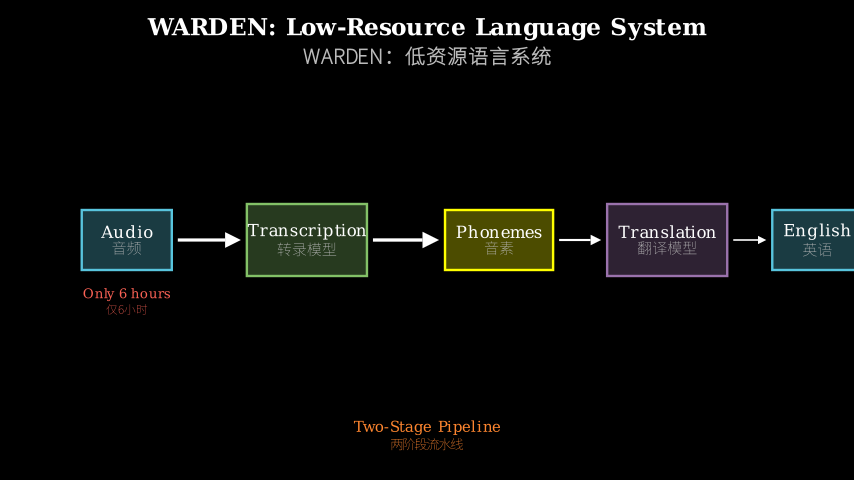
WARDEN operates in two stages. First, a transcription model converts Wardaman audio into phonemic text. This model starts from a Sundanese speech recognizer—Sundanese shares similar phonemes with Wardaman—and fine-tunes on the 6 hours of Wardaman audio. The phonemic output is intentionally kept language-agnostic (representing sounds, not words) to maximize what can be learned from limited data.
Second, a translation model converts phonemic transcription into English. Here, WARDEN doesn’t train a neural translator (too data-hungry). Instead, it uses a large language model (LLM) as a reasoning engine. The system feeds the LLM three inputs: the phonemic transcription, a Wardaman-English dictionary compiled from expert annotations, and a prompt asking it to reason about possible translations. The LLM matches phonemes to dictionary entries, handles morphological variations, and produces English output.
Audio (Wardaman)
   |
   v
[Transcription Model]
(initialized from Sundanese)
   |
   v
Phonemic Text
   |
   v
[LLM Reasoner] <--- Wardaman-English Dictionary
   |
   v
English Translation
Think of WARDEN like a two-person translation team where one person doesn’t speak the target language fluently. The first person (transcription model) listens to Wardaman audio and writes down what they hear using a phonetic alphabet—they’re not trying to understand meaning, just capture sounds accurately. They’ve practiced with a similar language (Sundanese) so their ear is already tuned to the right phoneme inventory. The second person (LLM) can’t hear the audio, but they’re given the phonetic spelling and a dictionary. They reason through possible word boundaries, look up dictionary entries, handle cases where words are inflected or combined, and produce an English sentence. The first person’s job is pure perception; the second person’s job is pure reasoning. Neither needs to do both, which is why the system works with so little data.
Key Concepts
-
Phonemic transcription: Instead of transcribing Wardaman into its standard orthography (written form), WARDEN outputs phonemes—the basic sound units of speech. For example, the English word “cat” has three phonemes: /k/, /æ/, /t/. Phonemic transcription is language-agnostic: the same phoneme inventory can represent sounds across multiple languages. This matters because the transcription model doesn’t need to learn Wardaman’s writing conventions or word boundaries—it just needs to recognize sounds. With only 6 hours of data, learning sounds is feasible; learning orthography, morphology, and syntax simultaneously is not.
-
Cross-lingual initialization: Training a speech recognizer from scratch requires thousands of hours of audio. WARDEN sidesteps this by starting from a model already trained on Sundanese, a language with similar phonemes to Wardaman. The Sundanese model has already learned to distinguish sounds like retroflex consonants and vowel length contrasts that appear in Wardaman. Fine-tuning on 6 hours of Wardaman audio then shifts the model’s representations just enough to handle Wardaman-specific phonetic patterns. It’s like learning to drive a manual transmission car when you already know automatic—the core skill transfers, you’re just adjusting the details.
-
Dictionary-guided reasoning: Instead of training a neural translation model (which would memorize input-output pairs), WARDEN gives an LLM a dictionary and asks it to reason. The LLM receives phonemic text like “/warda/” and a dictionary entry “warda = man”. It matches the phonemes to the entry, checks surrounding context for grammatical markers, and outputs “man”. When phonemes don’t match exactly (due to transcription errors or morphological changes), the LLM uses fuzzy matching and linguistic knowledge to infer the intended word. This approach works because LLMs have internalized linguistic patterns from pretraining—they know how morphology works, how context disambiguates meaning, and how to handle noisy input. The dictionary provides domain-specific knowledge the LLM lacks; the LLM provides reasoning capacity the dictionary lacks.
Framework Shift
Before (end-to-end):                After (WARDEN):

Audio -----> [Big Model] -----> Translation     Audio -----> [Transcription] -----> Phonemes
             (needs 1000h)                                    (6h fine-tune)
                                                                    |
                                                                    v
                                                              [LLM + Dict] -----> Translation
                                                              (zero-shot reasoning)

Single model learns everything                  Split perception from reasoning
Data bottleneck at every stage                  Inject knowledge where data is scarce
One sentence: From monolithic models that need dense supervision at every layer, to decomposed systems where perception is learned (with transfer) and reasoning is injected (via LLMs and dictionaries).
Expert Assessment
Problem choice: Real and urgent. Thousands of languages are disappearing, and most will never have the data budgets that modern NLP assumes. This paper picks a hard instance of a general problem—if the method works for Wardaman, it’s a template for other endangered languages. The 6-hour constraint isn’t artificial; it reflects actual fieldwork limitations.
Method maturity: The two-stage design is pragmatic, not novel. Cross-lingual initialization is standard practice; using LLMs as reasoning engines is increasingly common. What’s clever is the combination: recognizing that transcription and translation have different data requirements, and exploiting that asymmetry. The Sundanese initialization is well-motivated (phoneme overlap), though the paper doesn’t explore how sensitive this is to the choice of source language. The dictionary-guided LLM approach is elegant but underspecified—how much prompt engineering was needed? How does performance degrade as dictionary coverage drops?
Experimental integrity: Baselines are reasonable (Whisper, SeamlessM4T, GPT-4), though the paper doesn’t compare against other low-resource strategies like unsupervised phoneme discovery or active learning. The evaluation uses standard metrics (WER, BLEU), but these are known to be noisy for low-resource settings. The paper reports results on a single test set; without cross-validation or multiple splits, it’s hard to assess variance. The claim that WARDEN “outperforms” larger models is technically true but somewhat misleading—those models weren’t designed for 6-hour regimes, so the comparison isn’t entirely fair.
Writing quality: The abstract and introduction are clear. The method section is rushed—Figure 2 does heavy lifting, but the text doesn’t walk through a concrete example end-to-end. The related work section name-drops techniques without explaining why they don’t apply here. The results section reports numbers but doesn’t analyze failure modes or show qualitative examples. Rewriting Section 4 (Experiments) to include error analysis and ablations would significantly strengthen the paper.
Verdict: Weak accept — Addresses a real problem with a sensible method and demonstrates feasibility, but the experimental evaluation is thin and the method’s generalization beyond Wardaman is unclear. Useful as a baseline and proof-of-concept, not a definitive solution.
Takeaways
Task decomposition for data efficiency: When you have very little labeled data, don’t force a single model to learn everything. Split the task into subtasks with different data requirements. Here, transcription benefits from transfer learning (borrow from a similar language), while translation benefits from symbolic knowledge (inject a dictionary). This pattern applies beyond speech: in low-resource NLP, separate entity recognition from relation extraction; in computer vision, separate detection from classification.
Cross-lingual initialization by phoneme overlap: If you’re working with a low-resource language, find a higher-resource language with similar phonology and initialize from its speech model. The paper uses Sundanese for Wardaman, but the principle generalizes: check phoneme inventories (available in linguistic databases like PHOIBLE), measure overlap, and transfer from the closest match. This is cheaper than collecting more data and often more effective than generic multilingual pretraining.
LLMs as reasoning engines, not learners: When you lack training data but have structured knowledge (dictionaries, grammars, ontologies), use an LLM to reason over that knowledge rather than trying to train a task-specific model. The LLM provides linguistic competence (morphology, syntax, context); the structured knowledge provides domain specificity. This inverts the usual paradigm where models learn from data—here, the model is fixed and knowledge is injected at inference time.
论文: 2605.13846 作者: Ziheng Zhang, Yunzhong Hou, Naijing Liu, Liang Zheng 分类: cs.CL, cs.AI
缺口
现代语音翻译系统依赖端到端模型,需要数千小时的配对音频-文本数据训练。
对于像 Wardaman 这样的濒危语言(使用者不到 10 人),这样的数据根本不存在。
现有方法要么在这种数据量下完全失效,要么产生无法使用的输出。
标准做法——在高资源语言上预训练,在目标语言上微调——假设你有足够的目标数据来调整模型的表示。
只有 6 小时标注的 Wardaman 音频时,这个假设就崩溃了。
问题:濒危语言(6小时数据)
   |
   v
假设:端到端模型需要密集监督
   |
   v
方法:拆分任务 → 转录(音素迁移)→ 翻译(LLM + 字典)
   |
   v
证据:超越统一模型和更大系统
   |
   v
结论:任务分解 + 知识注入胜过数据饥渴型方法
增量
一句话:这篇论文之前,濒危语言语音翻译要么需要大规模数据收集(不现实),要么接受失败;
之后,6 小时数据集就能通过拆分问题和策略性注入语言学知识,产生可用的转录和翻译。
核心机制
WARDEN 分两个阶段运作。
第一阶段,转录模型将 Wardaman 音频转换为音素文本。
这个模型从 Sundanese 语音识别器开始——Sundanese 与 Wardaman 共享相似的音素——然后在 6 小时 Wardaman 音频上微调。
音素输出刻意保持语言无关性(表示声音,而非单词),以最大化从有限数据中学到的内容。
第二阶段,翻译模型将音素转录转换为英语。
这里 WARDEN 不训练神经翻译器(太饥渴数据)。
相反,它使用大语言模型(LLM)作为推理引擎。
系统向 LLM 输入三样东西:音素转录、从专家标注编译的 Wardaman-英语字典、以及一个提示词要求它推理可能的翻译。
LLM 将音素匹配到字典条目,处理形态变化,产生英语输出。
音频(Wardaman)
   |
   v
[转录模型]
(从 Sundanese 初始化)
   |
   v
音素文本
   |
   v
[LLM 推理器] <--- Wardaman-英语字典
   |
   v
英语翻译
把 WARDEN 想象成一个两人翻译团队,其中一人不流利说目标语言。
第一个人(转录模型)听 Wardaman 音频,用音标字母写下他们听到的——他们不试图理解意思,只是准确捕捉声音。
他们练习过类似的语言(Sundanese),所以耳朵已经调到了正确的音素库。
第二个人(LLM)听不到音频,但他们拿到音标拼写和字典。
他们推理可能的词边界,查字典条目,处理词形变化或组合的情况,产生英语句子。
第一个人的工作是纯感知;
第二个人的工作是纯推理。
两人都不需要同时做两件事,这就是为什么系统用这么少数据就能工作。
关键概念
- 音素转录:WARDEN 不把 Wardaman 转录成标准正字法(书面形式),而是输出音素——语音的基本声音单元。
比如英语单词 “cat” 有三个音素:/k/、/æ/、/t/。
音素转录是语言无关的:同一套音素库可以表示多种语言的声音。
这很重要,因为转录模型不需要学习 Wardaman 的书写惯例或词边界——它只需要识别声音。
只有 6 小时数据时,学习声音是可行的;
同时学习正字法、形态学和句法是不可行的。
- 跨语言初始化:从零训练语音识别器需要数千小时音频。
WARDEN 绕过这一点,从已经在 Sundanese 上训练的模型开始,Sundanese 与 Wardaman 有相似的音素。
Sundanese 模型已经学会区分像卷舌辅音和元音长度对比这样在 Wardaman 中出现的声音。
在 6 小时 Wardaman 音频上微调,然后将模型的表示调整到刚好能处理 Wardaman 特定的语音模式。
这就像你已经会开自动挡车,现在学手动挡——核心技能迁移,你只是调整细节。
- 字典引导推理:WARDEN 不训练神经翻译模型(会记忆输入-输出对),而是给 LLM 一本字典并要求它推理。
LLM 收到像 “/warda/” 这样的音素文本和字典条目 “warda = man”。
它将音素匹配到条目,检查周围上下文的语法标记,输出 “man”。
当音素不完全匹配时(由于转录错误或形态变化),LLM 使用模糊匹配和语言学知识推断预期的词。
这种方法有效是因为 LLM 从预训练中内化了语言模式——它们知道形态学如何工作,上下文如何消歧,如何处理噪声输入。
字典提供 LLM 缺乏的领域特定知识;
LLM 提供字典缺乏的推理能力。
框架转变
之前(端到端):                        之后(WARDEN):

音频 -----> [大模型] -----> 翻译         音频 -----> [转录] -----> 音素
            (需要1000小时)                         (6小时微调)
                                                          |
                                                          v
                                                    [LLM + 字典] -----> 翻译
                                                    (零样本推理)

单一模型学习一切                          拆分感知与推理
每个阶段都有数据瓶颈                      在数据稀缺处注入知识
一句话:从需要每层密集监督的单体模型,到感知被学习(通过迁移)、推理被注入(通过 LLM 和字典)的分解系统。
专家评审
选题眼光:真实且紧迫。
数千种语言正在消失,大多数永远不会有现代 NLP 假设的数据预算。
这篇论文选择了一个通用问题的困难实例——如果方法对 Wardaman 有效,它就是其他濒危语言的模板。
6 小时约束不是人为的;
它反映了实际田野调查的限制。
方法成熟度:两阶段设计务实,但不新颖。
跨语言初始化是标准做法;
使用 LLM 作为推理引擎越来越常见。
巧妙之处在于组合:认识到转录和翻译有不同的数据需求,并利用这种不对称性。
Sundanese 初始化动机充分(音素重叠),但论文没有探索这对源语言选择的敏感度。
字典引导的 LLM 方法优雅但规格不足——需要多少提示工程?
字典覆盖率下降时性能如何退化?
实验诚意:基线合理(Whisper、SeamlessM4T、GPT-4),但论文没有与其他低资源策略比较,如无监督音素发现或主动学习。
评估使用标准指标(WER、BLEU),但这些在低资源设置中已知噪声大。
论文在单个测试集上报告结果;
没有交叉验证或多次划分,很难评估方差。
声称 WARDEN “超越”更大模型在技术上是真的,但有些误导——那些模型不是为 6 小时数据量设计的,所以比较不完全公平。
写作功力:摘要和引言清晰。
方法部分仓促——图 2 承担重任,但文本没有端到端走一遍具体例子。
相关工作部分点名技术但不解释为什么它们不适用。
结果部分报告数字但不分析失败模式或展示定性例子。
重写第 4 节(实验)加入错误分析和消融实验会显著加强论文。
判决:弱接收 — 用合理方法解决真实问题并展示可行性,但实验评估单薄,方法在 Wardaman 之外的泛化性不清楚。
作为基线和概念验证有用,不是最终解决方案。
要点总结
任务分解提升数据效率:当标注数据很少时,不要强迫单一模型学习一切。
将任务拆分成数据需求不同的子任务。
这里,转录受益于迁移学习(从相似语言借用),翻译受益于符号知识(注入字典)。
这种模式超越语音:在低资源 NLP 中,分离实体识别和关系抽取;
在计算机视觉中,分离检测和分类。
通过音素重叠跨语言初始化:如果你在处理低资源语言,找一个音系相似的高资源语言,从它的语音模型初始化。
论文对 Wardaman 使用 Sundanese,但原则可泛化:检查音素库(在 PHOIBLE 等语言学数据库中可用),测量重叠,从最接近的匹配迁移。
这比收集更多数据便宜,通常比通用多语言预训练更有效。
LLM 作为推理引擎,而非学习器:当你缺乏训练数据但有结构化知识(字典、语法、本体)时,使用 LLM 对该知识推理,而不是试图训练任务特定模型。
LLM 提供语言能力(形态学、句法、上下文);
结构化知识提供领域特异性。
这颠倒了模型从数据学习的常规范式——这里,模型是固定的,知识在推理时注入。