Paper: 2606.02564 Authors: Junhao Cheng, Liang Hou, Tianxiong Zhong, Xin Tao, Pengfei Wan, Kun Gai, Jing Liao Categories: cs.CV
The Gap
Video reasoning tasks require generating temporally coherent sequences that follow complex rules—think physics simulations, logic puzzles, or constraint-satisfaction problems. Current Video Generation Models (VGMs) excel at visual fidelity but fail at logical consistency. The field tried using Vision-Language Models (VLMs) as planners to write better text prompts for VGMs, but text can’t capture fine-grained spatiotemporal constraints, and VGMs ignore long-tail instructions anyway. VLMs are weak solvers but strong evaluators. No one exploited this asymmetry.
Problem: VGMs generate beautiful but logically broken videos
         |
         v
Prior approach: VLM writes better text instructions
                |
                +---> Text loses spatial details
                +---> VGM ignores complex instructions
         |
         v
This paper: VLM evaluates outputs + guides VGM via gradients
            |
            +---> Differentiable reward from rule satisfaction
            +---> Test-time LoRA optimization per task
            |
            v
Evidence: +16.7 pts vs baseline, +0.4 vs VLM-solver, +2.2 vs Best-of-N
          |
          v
Conclusion: VLMs work better as adaptive teachers than planners
The Increment
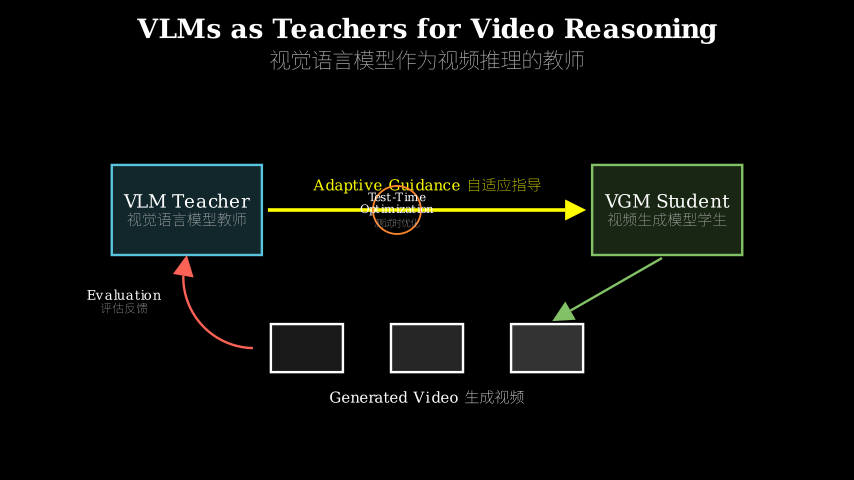
One sentence: Before, VLMs wrote instructions that VGMs couldn’t follow; now, VLMs grade VGM outputs and steer generation through backpropagated reward signals.
Core Mechanism
The method has three stages. First, the VLM extracts task rules from the problem description and formulates them as differentiable reward functions—for example, “no collision” becomes a spatial overlap penalty, “reach goal” becomes a distance metric. Second, during test time, the VGM generates a video through a lightweight LoRA adapter (frozen base model). Third, the VLM evaluates each frame against the rules, computes rewards, and backpropagates gradients through the LoRA weights. This loop repeats for multiple optimization steps per test instance.
Input Problem
     |
     v
[VLM: Extract Rules] --> Differentiable Reward Functions
     |                        (collision, goal-reach, etc.)
     v
[VGM + LoRA: Generate Video]
     |
     v
[VLM: Evaluate Frames] --> Reward Scores
     |                       |
     |<----------------------+ (Backprop)
     v
[Update LoRA Weights]
     |
     v
Repeat --> Final Video
Think of it as a driving instructor teaching a student driver. The student (VGM) has muscle memory for smooth steering and acceleration (visual generation) but doesn’t know the rules of the road (task constraints). The instructor (VLM) doesn’t grab the wheel—instead, they sit in the passenger seat and give real-time feedback: “too close to the curb,” “forgot to signal,” “good, maintain speed.” The student adjusts their grip (LoRA weights) based on this feedback. By the end of the lesson (test-time optimization), the student can navigate this specific route (task instance) correctly. The instructor never drives, and the student never gets a manual—just continuous, situated correction.
Key Concepts
-
Test-Time Optimization: Most models are trained once and frozen at deployment. Test-time optimization means you continue adjusting model parameters for each new test input. Here, the VGM’s LoRA adapter is updated during inference to satisfy the specific rules of each problem. It’s like a chef tasting and adjusting seasoning while cooking a dish, rather than following a fixed recipe. The cost: extra compute per test case. The benefit: the model adapts to constraints it never saw during pre-training.
-
Differentiable Reward: A reward is a score measuring how well an output satisfies a goal. Differentiable means you can compute gradients—how small changes to the model’s weights would change the reward. The VLM looks at generated frames and calculates rewards (e.g., “collision penalty = overlap area between objects”). These rewards are expressed as smooth mathematical functions, so you can use gradient descent to push the VGM toward higher rewards. It’s the difference between a judge holding up a score card (non-differentiable: you see the number but not how to improve) versus a coach pointing to your elbow angle and saying “rotate 10 degrees” (differentiable: you know exactly what to adjust).
-
VLM as Teacher vs Solver: Prior work asked VLMs to solve the problem—write a step-by-step plan, then hand it to the VGM. This paper asks VLMs to grade the VGM’s work instead. Why? VLMs are bad at multi-step forward planning (they hallucinate, lose track of constraints) but excellent at perception (evaluating whether a generated frame violates a rule). It’s the difference between asking someone to write a novel versus asking them to edit one. Editing leverages their strengths (spotting inconsistencies, checking constraints) without exposing their weaknesses (maintaining long-term coherence).
Framework Shift
Before (VLM-as-Solver):              After (VLM-as-Teacher):

Problem --> [VLM]                    Problem --> [VLM]
               |                                    |
           Text Plan                           Rule Extractor
               |                                    |
               v                                    v
          [VGM Generate]                  [VGM Generate + LoRA]
               |                                    |
               v                                    v
        Final Video (hope                  [VLM Evaluate Frames]
         it followed plan)                          |
                                                Rewards
                                                    |
                                         (Backprop to LoRA)
                                                    |
                                            Repeat N steps
                                                    |
                                                    v
                                           Optimized Video
From feedforward planning to closed-loop steering, the core shift is replacing one-shot text instructions with iterative gradient-based correction.
Expert Assessment
Problem choice: Real gap. The “reasoning with video” paradigm has momentum, but logical failures are a documented blocker. The VLM-as-planner approach is a natural first attempt, and its limitations (text bottleneck, VGM non-compliance) are well-motivated. This sits at the intersection of video generation and structured reasoning, both active areas.
Method maturity: Clever reframing. The insight—VLMs evaluate better than they plan—is not obvious but feels right in hindsight. The execution is straightforward: LoRA for efficiency, standard reward-based optimization. No major technical novelty, but the conceptual contribution is clean. A simpler baseline might be rejection sampling (generate many, pick best), but the paper includes this (Best-of-N) and shows test-time optimization wins by adapting rather than just sampling.
Experimental integrity: Benchmarks are purpose-built (VBVR-Bench, RULER-Bench), which raises external validity questions—do gains transfer to other reasoning tasks? Baselines are reasonable (VLM-solver, Best-of-N, ablations), but missing comparisons to fine-tuned VGMs or reinforcement learning methods that could also adapt at test time. The 16.7-point gain is large but contextual; absolute scores aren’t reported, so we don’t know if this lifts performance from 20% to 37% or 80% to 97%. Ablations are thorough (reward design, LoRA rank, optimization steps).
Writing quality: Abstract and intro are crisp. The method section buries key details (how are rewards formulated? what’s the optimization objective?) in appendices. Figure 1 is busy; a clearer pipeline diagram would help. The “teacher” framing is memorable but occasionally overextended—calling VLMs “teachers” works as metaphor, less so as technical category. Section 4.3 (qualitative results) adds little beyond figures. If rewritten to unpack reward function design with concrete examples, it would clarify what makes a “good” reward and how domain knowledge gets encoded.
Verdict: weak accept — Solid conceptual contribution (VLM role shift) with strong empirical gains, but limited scope (custom benchmarks) and missing ablations against adaptive baselines. Worthy of publication, unlikely to be a landmark.
Takeaways
Asymmetric capability exploitation: When a model has uneven strengths (VLMs: strong perception, weak long-horizon planning), design systems that lean into the strengths and avoid the weaknesses. Don’t force a square peg into a round hole.
Test-time adaptation as a runtime strategy: If your model fails on complex, rare constraints, consider lightweight online optimization (LoRA) rather than massive pre-training on exhaustive data. This is especially viable when inference latency isn’t critical and test distributions are narrow.
Differentiable rewards from declarative rules: If you have task constraints expressible in logic (no collision, reach target), try converting them to smooth, differentiable objectives. This lets you use gradient-based methods instead of discrete search. The trick: finding mathematical proxies for Boolean conditions (e.g., soft collision via IoU, goal distance via L2 norm).
Closed-loop generation over open-loop prompting: For structured generation tasks, iterative feedback (generate, evaluate, correct) often beats one-shot prompting. The cost is more compute; the payoff is correctness.
论文: 2606.02564 作者: Junhao Cheng, Liang Hou, Tianxiong Zhong, Xin Tao, Pengfei Wan, Kun Gai, Jing Liao 分类: cs.CV
缺口
视频推理任务要求生成遵循复杂规则的时序连贯序列——比如物理模拟、逻辑谜题或约束满足问题。
当前的视频生成模型(VGM)在视觉保真度上表现出色,但在逻辑一致性上失败。
该领域尝试将视觉语言模型(VLM)用作规划器,为 VGM 编写更好的文本提示,但文本无法捕捉细粒度的时空约束,而且 VGM 会忽略长尾指令。
VLM 是弱求解器但强评估器。
此前没人利用这种不对称性。
问题:VGM 生成视觉精美但逻辑错误的视频
      |
      v
先前方法:VLM 写更好的文本指令
          |
          +---> 文本丢失空间细节
          +---> VGM 忽略复杂指令
      |
      v
本文方法:VLM 评估输出 + 通过梯度引导 VGM
          |
          +---> 从规则满足度计算可微奖励
          +---> 每个任务的测试时 LoRA 优化
          |
          v
证据:相比基线 +16.7 分,相比 VLM-求解器 +0.4,相比 Best-of-N +2.2
      |
      v
结论:VLM 作为自适应教师比规划器更有效
增量
一句话:之前 VLM 写的指令 VGM 无法遵循;现在 VLM 给 VGM 输出打分,通过反向传播的奖励信号引导生成。
核心机制
该方法分三个阶段。
首先,VLM 从问题描述中提取任务规则,并将其表述为可微奖励函数——例如”无碰撞”变成空间重叠惩罚,“到达目标”变成距离度量。
其次,在测试时,VGM 通过轻量级 LoRA 适配器生成视频(基础模型冻结)。
第三,VLM 根据规则评估每一帧,计算奖励,并通过 LoRA 权重反向传播梯度。
该循环在每个测试实例上重复多个优化步骤。
输入问题
    |
    v
[VLM:提取规则] --> 可微奖励函数
    |                 (碰撞、目标到达等)
    v
[VGM + LoRA:生成视频]
    |
    v
[VLM:评估帧] --> 奖励分数
    |              |
    |<-------------+ (反向传播)
    v
[更新 LoRA 权重]
    |
    v
重复 --> 最终视频
把它想象成驾驶教练教学员开车。
学员(VGM)有平稳转向和加速的肌肉记忆(视觉生成),但不知道交规(任务约束)。
教练(VLM)不会抓方向盘——而是坐在副驾驶座上实时反馈:“离路缘太近了”、“忘记打转向灯了”、“很好,保持速度”。
学员根据反馈调整操作(LoRA 权重)。
到课程结束时(测试时优化),学员就能正确驾驶这条特定路线(任务实例)。
教练从不开车,学员也没拿到驾驶手册——只有持续的情境化纠正。
关键概念
- 测试时优化:大多数模型训练一次后在部署时冻结。
测试时优化意味着对每个新测试输入继续调整模型参数。
这里,VGM 的 LoRA 适配器在推理期间更新,以满足每个问题的特定规则。
这就像厨师在烹饪时边尝边调味,而不是遵循固定配方。
代价是:每个测试用例的额外计算。
好处是:模型能适应预训练期间从未见过的约束。
- 可微奖励:奖励是衡量输出满足目标程度的分数。
可微意味着可以计算梯度——模型权重的微小变化会如何改变奖励。
VLM 查看生成的帧并计算奖励(例如”碰撞惩罚 = 物体间重叠面积”)。
这些奖励表达为平滑的数学函数,因此可以使用梯度下降推动 VGM 朝着更高奖励前进。
这是裁判举起分数牌(不可微:你看到数字但不知如何改进)与教练指着你的肘部角度说”旋转 10 度”(可微:你确切知道该调整什么)之间的区别。
- VLM 作为教师 vs 求解器:先前工作要求 VLM 解决问题——写出逐步计划,然后交给 VGM。
本文要求 VLM 为 VGM 的工作打分。
为什么?VLM 在多步前向规划上很差(会产生幻觉,失去对约束的追踪),但在感知上很出色(评估生成的帧是否违反规则)。
这是要求某人写小说与要求他们编辑小说之间的区别。
编辑利用了他们的优势(发现不一致、检查约束),而不暴露他们的弱点(保持长期连贯性)。
框架转变
之前(VLM-作为-求解器):        之后(VLM-作为-教师):

问题 --> [VLM]                   问题 --> [VLM]
           |                                |
       文本计划                         规则提取器
           |                                |
           v                                v
    [VGM 生成]                    [VGM 生成 + LoRA]
           |                                |
           v                                v
    最终视频(希望                    [VLM 评估帧]
     遵循计划)                             |
                                         奖励
                                            |
                                  (反向传播到 LoRA)
                                            |
                                      重复 N 步
                                            |
                                            v
                                      优化后视频
从前馈式规划到闭环引导,核心转变是用迭代的基于梯度的纠正取代一次性文本指令。
专家评审
选题眼光:真实缺口。
“用视频推理”范式有发展势头,但逻辑失败是已记录的阻碍因素。
VLM-作为-规划器方法是自然的首次尝试,其局限性(文本瓶颈、VGM 不遵守)动机充分。
这处于视频生成和结构化推理的交叉点,两者都是活跃领域。
方法成熟度:巧妙的重新框架。
洞察——VLM 评估优于规划——事后看来不明显但感觉正确。
执行很直接:用 LoRA 提高效率,标准的基于奖励的优化。
没有重大技术创新,但概念贡献很清晰。
更简单的基线可能是拒绝采样(生成多个,选最好的),但论文包含了这个(Best-of-N)并显示测试时优化通过适应而非仅采样获胜。
实验诚意:基准是定制构建的(VBVR-Bench、RULER-Bench),这引发了外部有效性问题——收益能否迁移到其他推理任务?基线合理(VLM-求解器、Best-of-N、消融实验),但缺少与微调 VGM 或也能在测试时适应的强化学习方法的比较。
16.7 分的收益很大但有语境;未报告绝对分数,所以我们不知道这是将性能从 20% 提升到 37% 还是从 80% 提升到 97%。
消融实验很彻底(奖励设计、LoRA 秩、优化步骤)。
写作功力:摘要和引言简洁。
方法部分将关键细节(奖励如何表述?优化目标是什么?)埋在附录中。
图 1 很繁忙;更清晰的流程图会有帮助。
“教师”框架令人难忘但偶尔过度延伸——将 VLM 称为”教师”作为比喻有效,作为技术类别则不然。
第 4.3 节(定性结果)除了图表外几乎没增加内容。
如果重写以用具体例子展开奖励函数设计,将阐明什么构成”好”奖励以及如何编码领域知识。
判决:弱接收 — 扎实的概念贡献(VLM 角色转变)和强劲的实证收益,但范围有限(定制基准)且缺少与自适应基线的消融实验。
值得发表,但不太可能成为里程碑。
要点总结
不对称能力利用:当模型具有不均衡的优势(VLM:强感知,弱长期规划)时,设计系统要倾向优势并避免劣势。
不要把方桩硬塞进圆孔。
测试时适应作为运行时策略:如果你的模型在复杂、罕见约束上失败,考虑轻量级在线优化(LoRA)而不是在详尽数据上进行大规模预训练。
当推理延迟不关键且测试分布狭窄时,这尤其可行。
从声明式规则到可微奖励:如果你有可用逻辑表达的任务约束(无碰撞、到达目标),尝试将它们转换为平滑、可微的目标。
这让你可以使用基于梯度的方法而不是离散搜索。
技巧是:为布尔条件找到数学代理(例如通过 IoU 的软碰撞,通过 L2 范数的目标距离)。
闭环生成优于开环提示:对于结构化生成任务,迭代反馈(生成、评估、纠正)通常胜过一次性提示。
代价是更多计算;回报是正确性。