Paper: 2604.28185 Authors: Keming Wu, Zuhao Yang, Kaichen Zhang, Shizun Wang, Haowei Zhu, Sicong Leng, Zhongyu Yang, Qijie Wang, Sudong Wang, Ziting Wang Categories: cs.CV
The Gap
Current visual generation models (Stable Diffusion, DALL-E, Sora) excel at photorealism and instruction following but fail at spatial reasoning, temporal consistency, and causal understanding. They can paint a beautiful scene but cannot maintain object permanence across frames, understand physical constraints, or reason about cause and effect. The field optimizes for perceptual quality while ignoring structural coherence.
Prior work treats visual generation as a mapping problem: text → pixels, with increasingly sophisticated conditioning mechanisms. This paper argues the paradigm itself is insufficient. The gap is not in rendering fidelity but in the absence of world knowledge, persistent state, and causal models.
Problem: Models render plausible frames but lack world understanding
   |
   v
Assumption: Visual generation needs structured knowledge, not just better pixels
   |
   v
Method: Five-level taxonomy from atomic rendering to world modeling
   |
   v
Evidence: Stress tests reveal spatial/temporal/causal failures in SOTA models
   |
   v
Conclusion: Field must shift from appearance synthesis to intelligent generation
The Increment
One sentence: Before this paper, visual generation was evaluated on photorealism; after, the field has a structured framework distinguishing appearance synthesis from intelligent world modeling.
Core Mechanism
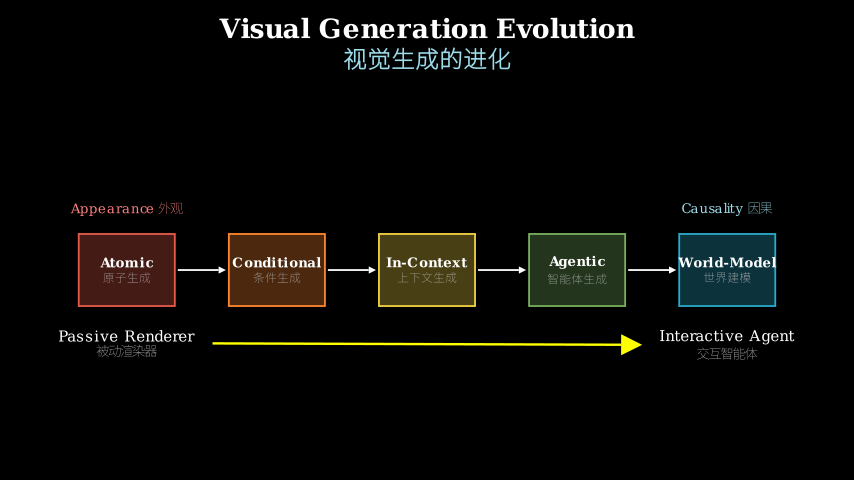
This is not a new model but a conceptual framework. The authors propose five capability levels:
Level 1 (Atomic): Unconditional generation from noise, no external control.
Level 2 (Conditional): Text/image-conditioned generation, but each output is independent.
Level 3 (In-Context): Multi-turn generation maintaining local consistency through context, but no explicit world state.
Level 4 (Agentic): Goal-directed generation with planning, tool use, and iterative refinement.
Level 5 (World-Modeling): Persistent 3D/4D state, physics simulation, causal reasoning, counterfactual generation.
The framework maps technical components to capability levels. Flow matching and diffusion enable Levels 1-2. Unified understanding-generation models and improved visual representations push toward Level 3. Post-training, reward modeling, and synthetic data enable Level 4. World models, neural scene representations, and physics-grounded priors are needed for Level 5.
Level 1: Noise --[Diffusion]--> Image
         (atomic, no control)

Level 2: Text --[Conditional Model]--> Image
         (one-shot, stateless)

Level 3: Context --[Autoregressive]--> Frame_t
         (local consistency, no global state)

Level 4: Goal --[Agent]--> Plan --[Tools]--> Refined Output
         (iterative, goal-driven)

Level 5: State_t --[World Model]--> State_t+1 --[Render]--> Frame_t+1
         (persistent 3D/4D state, physics, causality)
Think of it like video game graphics evolution. Level 1 is a random texture generator. Level 2 is a sprite renderer that draws what you ask for. Level 3 is a cutscene engine that maintains visual continuity within a scene. Level 4 is a procedural content generator that adapts to player goals. Level 5 is a full physics engine with persistent world state—objects have mass, gravity works, actions have consequences. The paper argues current models are stuck at Level 2-3, rendering pretty frames without understanding the world behind them.
Key Concepts
-
World Modeling: Not just predicting the next frame, but maintaining an internal representation of 3D structure, object permanence, physical properties, and causal relations. If a ball rolls behind a couch, a world model knows it still exists and can predict where it emerges. Current models often “forget” occluded objects or violate physics because they lack this persistent state. World modeling means the generator has a mental map of the scene, not just a pixel buffer.
-
Agentic Generation: The model acts as an agent with goals, not a passive renderer. Given “make the room brighter,” an agentic system plans (open curtains? turn on lights?), uses tools (image editing, 3D manipulation), evaluates results, and iterates. It’s the difference between a paintbrush (you control every stroke) and a collaborator (you state intent, it figures out how). Requires planning, tool use, and reward-driven refinement.
-
Causal Understanding: Knowing that action A causes effect B, and being able to reason counterfactually (“what if I hadn’t opened the door?”). Current models correlate visual patterns but don’t model causality. They might generate a broken vase next to a baseball, but they don’t understand the baseball *caused the break. Causal understanding enables intervention (“remove the baseball”) and counterfactual generation (“show the scene if the vase hadn’t broken”).
Framework Shift
Before (mainstream approach):        After (this paper):

Text Prompt                          Goal / Task
    |                                    |
    v                                    v
Conditional Model                    Agent (Plan + Tools)
    |                                    |
    v                                    v
Image (stateless)                    World Model (persistent state)
                                         |
                                         v
                                     Rendered Frame

One-shot mapping                     Iterative, state-aware generation
No memory between outputs            Persistent 3D/4D representation
Appearance-focused                   Structure + causality-focused
From stateless pixel synthesis to stateful world simulation, the core shift is treating generation as rendering from an internal world model rather than direct text-to-pixel mapping.
Expert Assessment
Problem choice: Real gap. The field has hit diminishing returns on photorealism while ignoring structural failures. The authors correctly identify that current benchmarks (FID, CLIP score) miss spatial, temporal, and causal errors. This is a well-timed intervention.
Method maturity: This is a position paper, not a technical contribution. The taxonomy is useful for framing, but the levels are somewhat arbitrary (why five? why these boundaries?). The technical survey is comprehensive but doesn’t propose novel methods. The value is in reframing the conversation, not in algorithmic innovation.
Experimental integrity: The paper doesn’t present new experiments but reviews existing benchmarks and proposes stress tests. The critique of current evaluation is valid—perceptual metrics do overestimate progress. However, the proposed “expert-constrained case studies” are vague. What makes an expert? How do you scale qualitative evaluation?
Writing quality: The taxonomy section is clear, but the technical survey (Section 3) reads like a literature review without a strong narrative thread. The paper would benefit from concrete failure cases upfront to motivate the framework. The conclusion oversells the impact—this is a roadmap, not a breakthrough.
Verdict: weak accept — Useful framing for the field, but lacks technical depth and actionable evaluation protocols.
Takeaways
For practitioners: Use the five-level taxonomy to audit your system’s capabilities. If you’re building a video generator, ask: does it maintain object permanence (Level 5)? Can it iteratively refine based on feedback (Level 4)? Or does it just render independent frames (Level 2)? This framework helps diagnose where your model fails.
For researchers: The paper’s critique of evaluation is the most actionable part. Stop reporting only FID and CLIP scores. Add spatial reasoning tests (object counting, occlusion handling), temporal consistency metrics (object tracking across frames), and causal probes (intervention experiments). The field needs benchmarks that penalize structural failures, not just perceptual artifacts.
For system designers: If you’re building agentic systems, the Level 4 → Level 5 transition is the key challenge. Agentic generation (planning, tool use) is achievable with current LLMs + vision models. World modeling (persistent 3D state, physics) requires integrating neural scene representations (NeRF, 3D Gaussians) with generative models. The technical path is clear but engineering-heavy.
论文: 2604.28185 作者: Keming Wu, Zuhao Yang, Kaichen Zhang, Shizun Wang, Haowei Zhu, Sicong Leng, Zhongyu Yang, Qijie Wang, Sudong Wang, Ziting Wang 分类: cs.CV
缺口
当前的视觉生成模型(Stable Diffusion、DALL-E、Sora)在照片级真实感和指令遵循上表现出色,但在空间推理、时间一致性和因果理解上失败了。
它们能画出漂亮的场景,却无法在帧间维持物体永久性,无法理解物理约束,也无法推理因果关系。
该领域优化感知质量,却忽视结构连贯性。
先前工作将视觉生成视为映射问题:文本→像素,用越来越复杂的条件机制。
本文认为这个范式本身不够。
缺口不在渲染保真度,而在于缺乏世界知识、持久状态和因果模型。
问题:模型渲染合理的帧,但缺乏世界理解
   |
   v
假设:视觉生成需要结构化知识,而非更好的像素
   |
   v
方法:从原子渲染到世界建模的五层分类法
   |
   v
证据:压力测试揭示SOTA模型的空间/时间/因果失败
   |
   v
结论:领域必须从外观合成转向智能生成
增量
一句话: 这篇论文之前,视觉生成按照片级真实感评估;之后,领域有了区分外观合成与智能世界建模的结构化框架。
核心机制
这不是新模型,而是概念框架。
作者提出五个能力层级:
层级1(原子级): 从噪声无条件生成,无外部控制。
层级2(条件级): 文本/图像条件生成,但每个输出独立。
层级3(上下文级): 多轮生成通过上下文维持局部一致性,但无显式世界状态。
层级4(智能体级): 目标导向生成,带规划、工具使用和迭代优化。
层级5(世界建模级): 持久3D/4D状态、物理模拟、因果推理、反事实生成。
框架将技术组件映射到能力层级。
流匹配和扩散实现层级1-2。
统一理解-生成模型和改进的视觉表示推向层级3。
后训练、奖励建模和合成数据实现层级4。
世界模型、神经场景表示和物理先验是层级5所需。
层级1: 噪声 --[扩散]--> 图像
       (原子级,无控制)

层级2: 文本 --[条件模型]--> 图像
       (一次性,无状态)

层级3: 上下文 --[自回归]--> 帧_t
       (局部一致性,无全局状态)

层级4: 目标 --[智能体]--> 计划 --[工具]--> 优化输出
       (迭代,目标驱动)

层级5: 状态_t --[世界模型]--> 状态_t+1 --[渲染]--> 帧_t+1
       (持久3D/4D状态,物理,因果)
想象电子游戏图形的进化。
层级1是随机纹理生成器。
层级2是精灵渲染器,画你要求的东西。
层级3是过场动画引擎,在场景内维持视觉连续性。
层级4是程序化内容生成器,适应玩家目标。
层级5是完整物理引擎,带持久世界状态——物体有质量,重力起作用,行动有后果。
本文认为当前模型卡在层级2-3,渲染漂亮的帧却不理解背后的世界。
关键概念
- 世界建模: 不只是预测下一帧,而是维护3D结构、物体永久性、物理属性和因果关系的内部表示。
如果球滚到沙发后面,世界模型知道它仍然存在,能预测它从哪里出现。
当前模型常”忘记”被遮挡的物体或违反物理,因为缺乏这种持久状态。
世界建模意味着生成器有场景的心智地图,而非只有像素缓冲区。
- 智能体生成: 模型作为有目标的智能体,而非被动渲染器。
给定”让房间更亮”,智能体系统规划(拉开窗帘?开灯?),使用工具(图像编辑、3D操作),评估结果,迭代。
这是画笔(你控制每一笔)和协作者(你陈述意图,它想办法)的区别。
需要规划、工具使用和奖励驱动的优化。
- 因果理解: 知道行动A导致效果B,能反事实推理(“如果我没开门会怎样?”)。
当前模型关联视觉模式但不建模因果。
它们可能生成棒球旁的碎花瓶,但不理解棒球导致了破碎。
因果理解支持干预(“移除棒球”)和反事实生成(“展示花瓶没碎的场景”)。
框架转变
之前(主流方法):                之后(本文方法):

文本提示                          目标 / 任务
    |                                |
    v                                v
条件模型                          智能体(规划+工具)
    |                                |
    v                                v
图像(无状态)                    世界模型(持久状态)
                                     |
                                     v
                                  渲染帧

一次性映射                        迭代、状态感知生成
输出间无记忆                      持久3D/4D表示
外观聚焦                          结构+因果聚焦
从无状态像素合成到有状态世界模拟,核心转变是将生成视为从内部世界模型渲染,而非直接文本到像素映射。
专家评审
选题眼光: 真缺口。
领域在照片级真实感上遇到收益递减,却忽视结构性失败。
作者正确识别出当前基准(FID、CLIP分数)遗漏空间、时间和因果错误。
这是时机恰当的干预。
方法成熟度: 这是立场论文,非技术贡献。
分类法对框架有用,但层级有些武断(为何五层?为何这些边界?)。
技术综述全面但未提出新方法。
价值在重构对话,而非算法创新。
实验诚意: 论文未呈现新实验,而是回顾现有基准并提出压力测试。
对当前评估的批评有效——感知指标确实高估进展。
然而,提出的”专家约束案例研究”模糊。
什么构成专家?如何扩展定性评估?
写作功力: 分类法部分清晰,但技术综述(第3节)读起来像文献综述,缺乏强叙事线。
论文若在开头放具体失败案例来激发框架会更好。
结论夸大影响——这是路线图,非突破。
判决: 弱接收 — 对领域有用的框架,但缺乏技术深度和可操作的评估协议。
要点总结
对实践者: 用五层分类法审计系统能力。
如果你在构建视频生成器,问:它维持物体永久性吗(层级5)?能基于反馈迭代优化吗(层级4)?还是只渲染独立帧(层级2)?这个框架帮助诊断模型失败之处。
对研究者: 论文对评估的批评是最可操作的部分。
停止只报告FID和CLIP分数。
加入空间推理测试(物体计数、遮挡处理)、时间一致性指标(跨帧物体跟踪)和因果探测(干预实验)。
领域需要惩罚结构性失败的基准,而非只惩罚感知伪影。
对系统设计者: 如果你在构建智能体系统,层级4→层级5的转换是关键挑战。
智能体生成(规划、工具使用)用当前LLM+视觉模型可实现。
世界建模(持久3D状态、物理)需要整合神经场景表示(NeRF、3D高斯)与生成模型。
技术路径清晰但工程量大。