
Paper: 2604.09531 Authors: Guanyu Zhou, Yida Yin, Wenhao Chai, Shengbang Tong, Xingyu Fu, Zhuang Liu Categories: cs.CV, cs.AI, cs.CL
The Gap
Vision-language models like GPT-4V and Gemini can describe images fluently but stumble on basic visual perception: which object is closer? What’s the viewpoint angle? Prior work assumed this weakness came from model architecture or insufficient scale. This paper argues the real culprit is data starvation for low-level visual skills. Natural image datasets (COCO, ImageNet) contain rich semantic content but sparse supervision for spatial relationships, depth ordering, or viewpoint geometry. Existing synthetic data approaches require reference images, 3D models, or extensive human annotation, making them expensive and domain-specific.
Problem: VLMs fail at spatial reasoning
   |
   v
Hypothesis: Natural datasets lack low-level visual supervision
   |
   v
Method: Generate task-targeted synthetic data from keywords alone
   |
   v
Evidence: +7% MMVP, +10% CV-Bench-3D with 10K synthetic examples
   |
   v
Conclusion: Targeted synthetic supervision addresses the bottleneck
The Increment
One sentence: Before this paper, fixing VLM perception required expensive human annotation or domain-specific 3D assets; after, you can generate targeted training data from a task name alone.
Core Mechanism
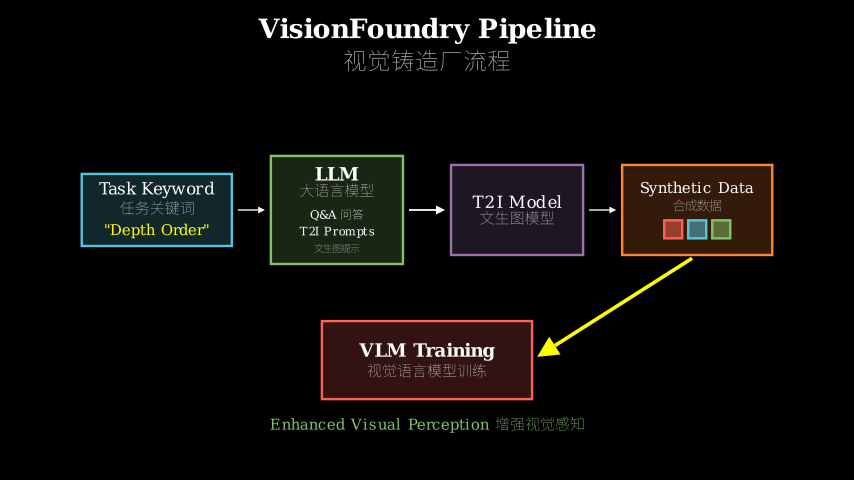
VisionFoundry is a four-stage pipeline. Stage 1: An LLM takes a task keyword (e.g., “Depth Order”) and generates diverse question-answer pairs about that visual skill. Stage 2: The same LLM converts each QA pair into a text-to-image prompt that, when rendered, should produce an image where the answer is verifiable. Stage 3: A text-to-image model (FLUX) generates the image. Stage 4: A proprietary VLM (GPT-4o) verifies consistency—does the generated image actually support the intended answer? Only verified triples enter the dataset.
Task Keyword --> [LLM] --> QA Pairs
                            |
                            v
                    [LLM] --> T2I Prompts
                            |
                            v
                    [FLUX] --> Synthetic Images
                            |
                            v
                    [GPT-4o] --> Verified Triples
                                      |
                                      v
                              VisionFoundry-10K
Think of VisionFoundry as a custom textbook printing press. You tell the press what skill you want to teach (the task keyword). The press’s editor (LLM) writes practice problems and answer keys. The illustrator (T2I model) draws diagrams for each problem. The quality control inspector (verification VLM) checks that each diagram actually matches its problem—if the problem asks “which ball is closer?” but the diagram shows them equidistant, it’s rejected. Only verified pages go into the textbook. The student (target VLM) learns by working through these custom-made exercises.
Key Concepts
-
Task-aware synthesis: Traditional synthetic data generation starts with 3D scenes or templates, then derives questions. VisionFoundry inverts this: start with the question type you want to teach, then generate images that answer it. This ensures every training example directly targets the skill gap. It’s like designing a workout routine for a specific muscle group rather than doing random exercises and hoping they help.
-
Self-verification loop: The pipeline uses a strong VLM (GPT-4o) to filter out inconsistent examples where the image doesn’t support the answer. This is crucial because text-to-image models don’t guarantee spatial accuracy—FLUX might generate “red ball in front of blue ball” with reversed depth. The verification step catches these failures without human review. Empirically, about 60% of generated triples pass verification, which is high enough to be practical.
Framework Shift
Before (mainstream approach):        After (this paper):

Natural Images                       Task Keyword
     |                                    |
     v                                    v
Human Annotation                     LLM Generation
     |                                    |
     v                                    v
Generic VQA Dataset                  T2I Synthesis
     |                                    |
     v                                    v
Train VLM                            VLM Verification
     |                                    |
     v                                    v
Hope perception improves             Targeted Dataset
                                          |
                                          v
                                     Train VLM
                                          |
                                          v
                                  Measured perception gains
From passive data collection to active curriculum design, the core shift is treating data generation as a teaching problem, not a sampling problem.
Expert Assessment
Problem choice: This is a real gap. The observation that VLMs struggle with spatial reasoning despite strong semantic understanding has been documented (MMVP benchmark, CV-Bench), but the field defaulted to “scale up pretraining” rather than questioning data composition. The hypothesis that natural images provide insufficient low-level supervision is plausible and testable.
Method maturity: The pipeline is straightforward—chain LLMs and T2I models with a verification step. The cleverness is in the problem formulation, not the technique. However, there’s a dependency on proprietary models (GPT-4o for verification, FLUX for generation) that limits reproducibility. The paper doesn’t explore whether open-source alternatives (Llama, SDXL) would work, which feels like a missed opportunity.
Experimental integrity: Baselines are fair. They compare against natural data (VQAv2) and show that synthetic data alone outperforms it on perception tasks while preserving general capabilities (MMBench, SEED-Bench). The scaling experiments (1K to 10K examples) show consistent improvement, which strengthens the claim. One concern: the verification step uses GPT-4o, and the target models are also trained to align with GPT-4o’s judgments. This could introduce circularity—are we teaching perception or teaching “what GPT-4o thinks is correct perception”?
Writing quality: The paper is clear and well-structured. The weakest section is the related work—it lists prior synthetic data efforts but doesn’t deeply engage with why they failed to address this specific gap. The ablation studies (Section 4.3) are thorough, testing each pipeline component. The failure case analysis (Section 4.4) is honest about limitations, which is refreshing.
Verdict: weak accept — The core insight (targeted synthetic supervision for low-level vision) is valuable and the results are convincing, but the reliance on proprietary models and potential circularity in verification warrant caution.
Takeaways
For practitioners: If you’re training a VLM and notice it fails on a specific visual skill (e.g., counting, occlusion reasoning), don’t just add more general data. Use this pipeline structure: (1) generate targeted QA pairs for that skill, (2) synthesize images with T2I models, (3) verify consistency with a strong model. Even a few thousand targeted examples can outperform millions of generic ones.
For researchers: The verification step is the unsung hero. Without it, T2I model errors would poison the dataset. This suggests a broader principle: when using generative models for data augmentation, always close the loop with a verification mechanism. The paper shows 60% pass rate is practical; below 30% you’re wasting compute.
Transferable technique: The “task keyword → LLM → synthetic data” pattern works beyond vision. You could apply this to generate targeted training data for any skill where you can programmatically verify correctness: logical reasoning (verify with a theorem prover), code generation (verify with unit tests), or structured prediction (verify with constraint checkers).
论文: 2604.09531 作者: Guanyu Zhou, Yida Yin, Wenhao Chai, Shengbang Tong, Xingyu Fu, Zhuang Liu 分类: cs.CV, cs.AI, cs.CL
缺口
GPT-4V 和 Gemini 这类视觉语言模型能流畅描述图像,却在基础视觉感知上栽跟头:哪个物体更近? 视角是什么角度? 以往研究认为这是模型架构或规模不足导致的。 本文提出真正的罪魁祸首是低层次视觉技能的数据饥荒。 自然图像数据集(COCO、ImageNet)包含丰富的语义内容,但对空间关系、深度顺序或视角几何的监督信号稀疏。 现有的合成数据方法需要参考图像、3D 模型或大量人工标注,成本高且局限于特定领域。
问题:VLM 在空间推理上失败
   |
   v
假设:自然数据集缺乏低层次视觉监督
   |
   v
方法:仅从关键词生成任务针对性合成数据
   |
   v
证据:用 10K 合成样本在 MMVP 上 +7%,CV-Bench-3D 上 +10%
   |
   v
结论:针对性合成监督解决了瓶颈
增量
一句话: 这篇论文之前,修复 VLM 感知能力需要昂贵的人工标注或特定领域的 3D 资产;之后,你只需一个任务名称就能生成针对性训练数据。
核心机制
VisionFoundry 是一个四阶段流水线。 阶段 1:LLM 接收任务关键词(如”深度顺序”),生成关于该视觉技能的多样化问答对。 阶段 2:同一个 LLM 将每个问答对转换为文生图提示词,渲染后应产生一张答案可验证的图像。 阶段 3:文生图模型(FLUX)生成图像。 阶段 4:专有 VLM(GPT-4o)验证一致性——生成的图像是否真的支持预期答案? 只有通过验证的三元组才进入数据集。
任务关键词 --> [LLM] --> 问答对
                         |
                         v
                 [LLM] --> 文生图提示词
                         |
                         v
                 [FLUX] --> 合成图像
                         |
                         v
                 [GPT-4o] --> 验证三元组
                                   |
                                   v
                           VisionFoundry-10K
把 VisionFoundry 想象成一台定制教材印刷机。 你告诉印刷机你想教什么技能(任务关键词)。 印刷机的编辑(LLM)编写练习题和答案。 插画师(文生图模型)为每道题画配图。 质检员(验证 VLM)检查每张配图是否真的匹配题目——如果题目问”哪个球更近?“但配图显示它们等距,就会被拒绝。 只有通过验证的页面才进入教材。 学生(目标 VLM)通过做这些定制练习来学习。
关键概念
-
任务感知合成: 传统合成数据生成从 3D 场景或模板开始,然后推导问题。 VisionFoundry 反过来:从你想教的问题类型开始,然后生成能回答它的图像。 这确保每个训练样本都直接针对技能缺口。 就像为特定肌肉群设计锻炼计划,而不是做随机运动然后希望有帮助。
-
自验证循环: 流水线使用强 VLM(GPT-4o)过滤掉图像不支持答案的不一致样本。 这很关键,因为文生图模型不保证空间准确性——FLUX 可能生成”红球在蓝球前面”时深度反了。 验证步骤无需人工审查就能捕获这些失败。 实验显示约 60% 的生成三元组通过验证,这个比例足够实用。
框架转变
之前(主流方法):              之后(本文方法):

自然图像                        任务关键词
   |                               |
   v                               v
人工标注                        LLM 生成
   |                               |
   v                               v
通用 VQA 数据集                 文生图合成
   |                               |
   v                               v
训练 VLM                        VLM 验证
   |                               |
   v                               v
期望感知能力提升                针对性数据集
                                    |
                                    v
                                训练 VLM
                                    |
                                    v
                            可测量的感知提升
从被动数据收集到主动课程设计,核心转变是把数据生成当作教学问题,而非采样问题。
专家评审
选题眼光: 这是真缺口。 VLM 在空间推理上挣扎但语义理解强的观察已有记录(MMVP 基准、CV-Bench),但领域默认”扩大预训练规模”而非质疑数据组成。 自然图像提供的低层次监督不足这一假设合理且可测试。
方法成熟度: 流水线直截了当——串联 LLM 和文生图模型加验证步骤。 巧妙之处在问题表述,而非技术。 但依赖专有模型(GPT-4o 验证、FLUX 生成)限制了可复现性。 论文没探索开源替代品(Llama、SDXL)是否可行,这是个遗憾。
实验诚意: 基线公平。 他们与自然数据(VQAv2)对比,显示合成数据单独在感知任务上优于它,同时保持通用能力(MMBench、SEED-Bench)。 扩展实验(1K 到 10K 样本)显示一致改进,强化了主张。 一个担忧:验证步骤用 GPT-4o,目标模型也训练成与 GPT-4o 的判断对齐。 这可能引入循环性——我们在教感知还是教”GPT-4o 认为正确的感知”?
写作功力: 论文清晰且结构良好。 最弱的部分是相关工作——列举了先前的合成数据工作但没深入探讨它们为何未能解决这个特定缺口。 消融研究(4.3 节)彻底,测试了每个流水线组件。 失败案例分析(4.4 节)坦诚面对局限,这很难得。
判决: 弱接收 — 核心洞见(针对低层次视觉的合成监督)有价值且结果令人信服,但对专有模型的依赖和验证中的潜在循环性值得警惕。
要点总结
给实践者: 如果你在训练 VLM 时发现它在特定视觉技能上失败(如计数、遮挡推理),别只是加更多通用数据。 用这个流水线结构:(1) 为该技能生成针对性问答对,(2) 用文生图模型合成图像,(3) 用强模型验证一致性。 即使几千个针对性样本也能胜过数百万通用样本。
给研究者: 验证步骤是无名英雄。 没有它,文生图模型的错误会污染数据集。 这提示一个更广泛的原则:用生成模型做数据增强时,总要用验证机制闭环。 论文显示 60% 通过率是实用的;低于 30% 就是浪费算力。
可迁移技术: “任务关键词 → LLM → 合成数据”模式超越视觉。 你可以把它应用到任何能程序化验证正确性的技能的针对性训练数据生成:逻辑推理(用定理证明器验证)、代码生成(用单元测试验证)或结构化预测(用约束检查器验证)。