Paper: 2605.18740 Authors: Qianhao Yuan, Jie Lou, Xing Yu, Hongyu Lin, Le Sun, Xianpei Han, Yaojie Lu Categories: cs.CV, cs.AI, cs.CL, cs.LG
The Gap
Multimodal LLMs like GPT-4V and LLaVA handle coarse visual questions well but stumble on fine-grained tasks where the answer hinges on small details—counting objects in a crowd, reading tiny text, identifying subtle differences. Prior work assumed this was a recognition problem: the model’s vision encoder lacks resolution or the architecture can’t extract fine features. Solutions involved scaling up vision encoders, adding high-resolution pathways, or building agentic systems that zoom and crop at inference time.
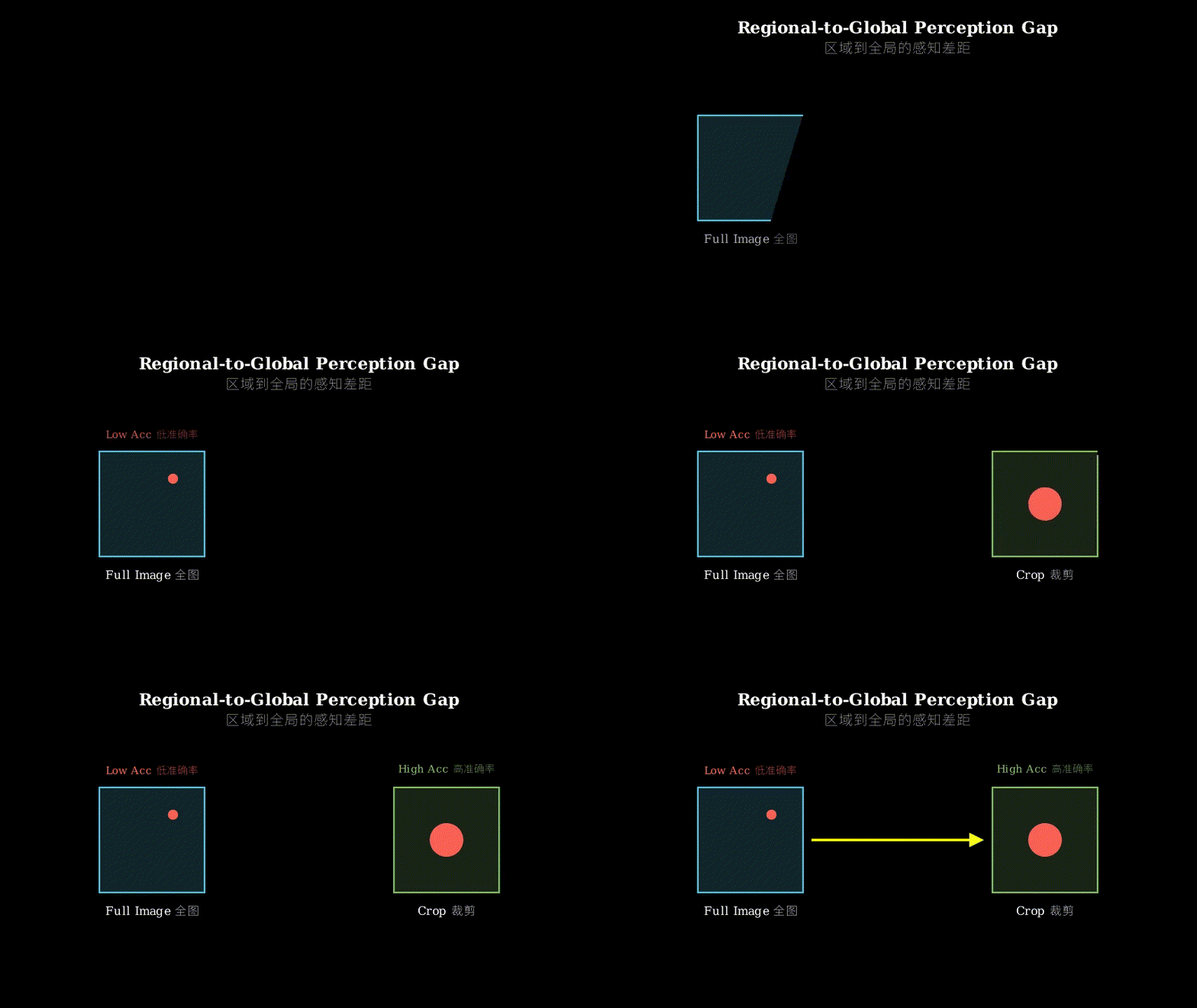
This paper identifies a different bottleneck: attention allocation, not recognition capacity. The same MLLM answers fine-grained questions correctly when given a cropped region centered on the evidence, but fails when shown the full image containing that same region. The model can see the details—it just doesn’t know where to look. Existing approaches either require expensive inference-time tool use (dynamic cropping agents) or external supervision (distillation from larger models, ground-truth labels for attention).
Problem: MLLMs fail fine-grained tasks on full images
                    |
                    v
Observation: Same model succeeds on evidence-centered crops
                    |
                    v
Hypothesis: Gap is attention allocation, not recognition
                    |
                    v
Method: Self-distill from crop policy to full-image policy
                    |
                    v
Evidence: Matches or beats larger models without tools
                    |
                    v
Conclusion: Regional-to-global transfer works via on-policy distillation
The Increment
One sentence: Before Vision-OPD, fine-grained visual understanding required either massive models, external teachers, or inference-time tool use; after Vision-OPD, a model learns to focus on relevant details by distilling knowledge from its own crop-conditioned responses during training.
Core Mechanism
Vision-OPD creates two conditional policies from a single MLLM. The teacher policy receives evidence-centered crops—regions containing the visual information needed to answer a question. The student policy receives full images. Both policies share the same model weights; only the visual input differs.
During training, the student generates a response to a question given the full image (an “on-policy rollout”). At each token position in this rollout, Vision-OPD computes the teacher’s next-token distribution conditioned on the crop and the student’s distribution conditioned on the full image. The training objective minimizes the KL divergence between these distributions, pulling the student’s full-image behavior toward the teacher’s crop-based behavior. Crucially, the student’s own rollout determines which tokens to align—this is on-policy distillation, not behavior cloning from a fixed dataset.
The crop teacher acts as a privileged oracle: it sees exactly the region that matters, so its predictions are more confident and accurate. By aligning the student to this oracle along the student’s own generation trajectory, the model learns to implicitly attend to the right regions in full images without needing explicit attention supervision or inference-time cropping.
Full Image -----> [Student Policy] -----> Token Rollout
                        |                       |
                        |                       v
                        |              Compute next-token dist
                        |                       |
                        v                       v
Crop (evidence) -> [Teacher Policy] -> Compare distributions
                                              |
                                              v
                                      Minimize KL divergence
Think of Vision-OPD as training a pilot using a flight simulator with a cheat mode. The student pilot flies the plane with a normal cockpit view (full image). The teacher pilot flies the same route but with a heads-up display that highlights exactly where to look (crop). During training, whenever the student makes a control decision, the system checks what the teacher would have done with the cheat display and nudges the student’s instincts toward that. Over time, the student internalizes the teacher’s focus strategy and no longer needs the cheat display. The key: the student flies the route (on-policy rollout), and the teacher only provides guidance along that specific trajectory, not a pre-recorded flight path.
Key Concepts
-
Regional-to-global perception gap: The same model exhibits different accuracy on the same question depending on whether it sees a cropped region or the full image. This gap reveals that failures often stem from attention allocation (where to look) rather than recognition capacity (what is visible). If a model can answer correctly when given a crop, the visual information is accessible—the full-image failure indicates the model didn’t focus on the right region.
-
On-policy distillation: Traditional distillation trains a student to mimic a teacher’s outputs on a fixed dataset. On-policy distillation trains the student to mimic the teacher along the student’s own generated trajectories. The student generates a response token-by-token, and at each step, the training signal comes from comparing the student’s next-token distribution to the teacher’s. This prevents distribution mismatch: the student learns to recover from its own mistakes rather than only imitating perfect teacher behavior. It’s the difference between learning to drive by watching an expert versus having an expert sit beside you and correct your actual driving decisions in real time.
-
Crop-conditioned teacher as privileged information: The teacher policy receives crops centered on the visual evidence needed to answer the question. This is “privileged” because it’s only available during training, not inference. The crop acts as a soft attention mask: by conditioning on it, the teacher naturally focuses on relevant details. The student must learn to achieve similar focus without this privilege, internalizing the attention strategy rather than relying on external cropping.
Framework Shift
Before (mainstream approach):          After (Vision-OPD):

Full Image                             Full Image + Crop
    |                                      |         |
    v                                      v         v
[Vision Encoder]                      [Student] [Teacher]
    |                                      |         |
    v                                      |    (privileged)
[LLM Decoder]                              |         |
    |                                      v         v
    v                                  Rollout   Guidance
Answer                                     |         |
                                           +----<----+
(Scale up or add tools)                        |
                                               v
                                           Answer

                                    (Self-distill focus)
From scaling vision encoders or adding inference-time tools to self-distilling attention allocation from the model’s own crop-based policy, the core shift is internalizing privileged regional perception during training rather than compensating for attention failures at inference time.
Expert Assessment
Problem choice: This is a real gap with practical implications. The observation that models succeed on crops but fail on full images is empirically grounded and challenges the assumption that fine-grained failures are purely recognition problems. The problem sits at the intersection of efficient inference (no tool use) and self-improvement (no external teachers), which is timely given the cost of agentic systems.
Method maturity: The core idea—distilling from crop-conditioned to full-image-conditioned policies—is elegant and well-motivated. However, the method assumes access to evidence-centered crops during training, which requires either ground-truth bounding boxes or a heuristic cropping strategy. The paper doesn’t deeply explore failure modes when crops are misaligned or when multiple regions contain relevant evidence. The on-policy formulation is a strength, but the reliance on privileged crop information limits applicability to domains where such crops are hard to obtain.
Experimental integrity: Baselines include strong open-source models (LLaVA, InternVL) and closed-source models (GPT-4V, Gemini). The benchmarks (TextVQA, ChartQA, DocVQA, etc.) are standard for fine-grained understanding. Results show consistent improvements, and ablations isolate the contribution of on-policy distillation versus behavior cloning. One concern: the paper doesn’t report training cost or convergence speed compared to baselines, which matters for practical adoption. The comparison to “Thinking-with-Images” agentic models is valuable but limited to a few benchmarks.
Writing quality: The paper is well-structured and the core idea is communicated clearly. The regional-to-global perception gap is introduced with strong empirical motivation. However, the related work section is dense and could better position Vision-OPD relative to prior self-distillation and privileged information methods. The ablation section is thorough but buried—moving key ablations earlier would strengthen the narrative. The discussion of limitations is brief; a deeper analysis of when the method fails (e.g., ambiguous crops, multi-region reasoning) would elevate the work.
Verdict: weak accept — The method addresses a real problem with a principled approach and demonstrates strong empirical results, but the reliance on privileged crop information and limited analysis of failure modes leave questions about generalization and practical deployment.
Takeaways
Self-distillation from privileged views: The idea of creating a teacher from the same model by conditioning on privileged information (crops, auxiliary modalities, oracle signals) transfers beyond vision. In code generation, a model could distill from a policy that sees execution traces. In dialogue, a policy with access to user intent annotations could guide a policy that only sees text.
On-policy distillation for distribution matching: Training a student to match a teacher along the student’s own rollouts rather than a fixed dataset prevents compounding errors. This technique applies anywhere a student must learn to recover from its own mistakes—imitation learning, interactive agents, multi-step reasoning.
Attention allocation as a bottleneck: The observation that models fail not because they can’t recognize details but because they don’t know where to look suggests that attention mechanisms in current MLLMs are undertrained. Explicitly supervising attention (via crops, saliency maps, or gaze data) during training could be more effective than scaling model size.
论文: 2605.18740 作者: Qianhao Yuan, Jie Lou, Xing Yu, Hongyu Lin, Le Sun, Xianpei Han, Yaojie Lu 分类: cs.CV, cs.AI, cs.CL, cs.LG
缺口
像 GPT-4V 和 LLaVA 这样的多模态大模型能很好地处理粗粒度的视觉问题,但在细粒度任务上却表现不佳——比如在人群中数物体、读取微小文字、识别细微差异。
此前的研究认为这是识别问题:模型的视觉编码器分辨率不够,或者架构无法提取精细特征。
解决方案包括扩大视觉编码器、添加高分辨率通路,或构建在推理时进行缩放和裁剪的智能体系统。
本文识别出了一个不同的瓶颈:注意力分配,而非识别能力。
同一个多模态大模型在给定以证据为中心的裁剪区域时能正确回答细粒度问题,但在显示包含相同区域的完整图像时却失败了。
模型能看到细节——它只是不知道该看哪里。
现有方法要么需要昂贵的推理时工具使用(动态裁剪智能体),要么需要外部监督(从更大模型蒸馏、注意力的真值标签)。
问题:多模态大模型在完整图像上细粒度任务失败
                    |
                    v
观察:同一模型在以证据为中心的裁剪图上成功
                    |
                    v
假设:差距在于注意力分配,而非识别能力
                    |
                    v
方法:从裁剪策略自蒸馏到完整图像策略
                    |
                    v
证据:无需工具即可匹敌或超越更大模型
                    |
                    v
结论:区域到全局迁移通过在线策略蒸馏实现
增量
一句话: Vision-OPD 之前,细粒度视觉理解需要巨型模型、外部教师或推理时工具;Vision-OPD 之后,模型通过在训练时从自己的裁剪条件响应中蒸馏知识,学会聚焦相关细节。
核心机制
Vision-OPD 从单个多模态大模型创建两个条件策略。
教师策略接收以证据为中心的裁剪图——包含回答问题所需视觉信息的区域。
学生策略接收完整图像。
两个策略共享相同的模型权重;只有视觉输入不同。
训练时,学生在给定完整图像的情况下生成对问题的响应(“在线策略展开”)。
在这个展开的每个词元位置,Vision-OPD 计算教师基于裁剪图的下一词元分布和学生基于完整图像的分布。
训练目标是最小化这些分布之间的 KL 散度,将学生的完整图像行为拉向教师的裁剪图行为。
关键是,学生自己的展开决定了要对齐哪些词元——这是在线策略蒸馏,而非从固定数据集的行为克隆。
裁剪图教师充当特权预言机:它恰好看到重要的区域,因此其预测更自信、更准确。
通过沿着学生自己的生成轨迹将学生与这个预言机对齐,模型学会在完整图像中隐式地关注正确区域,无需显式的注意力监督或推理时裁剪。
完整图像 -----> [学生策略] -----> 词元展开
                    |                   |
                    |                   v
                    |          计算下一词元分布
                    |                   |
                    v                   v
裁剪图(证据) -> [教师策略] -> 比较分布
                                    |
                                    v
                              最小化 KL 散度
把 Vision-OPD 想象成用带作弊模式的飞行模拟器训练飞行员。
学生飞行员用正常驾驶舱视角(完整图像)驾驶飞机。
教师飞行员飞同一条航线,但有平视显示器精确高亮该看哪里(裁剪图)。
训练时,每当学生做出控制决策,系统检查教师用作弊显示器会怎么做,并将学生的直觉推向那个方向。
久而久之,学生内化了教师的聚焦策略,不再需要作弊显示器。
关键:学生飞航线(在线策略展开),教师只沿着那条特定轨迹提供指导,而非预录的飞行路径。
关键概念
- 区域到全局感知差距:同一模型在同一问题上表现出不同的准确率,取决于它看到的是裁剪区域还是完整图像。
这个差距揭示了失败往往源于注意力分配(该看哪里)而非识别能力(什么是可见的)。
如果模型在给定裁剪图时能正确回答,视觉信息是可访问的——完整图像上的失败表明模型没有聚焦正确区域。
- 在线策略蒸馏:传统蒸馏训练学生在固定数据集上模仿教师的输出。
在线策略蒸馏训练学生沿着学生自己生成的轨迹模仿教师。
学生逐词元生成响应,每一步的训练信号来自比较学生的下一词元分布和教师的分布。
这防止了分布不匹配:学生学会从自己的错误中恢复,而非只模仿完美的教师行为。
这就像学开车时看专家演示和让专家坐在你旁边实时纠正你的实际驾驶决策之间的区别。
- 裁剪条件教师作为特权信息:教师策略接收以回答问题所需视觉证据为中心的裁剪图。
这是”特权”的,因为它只在训练时可用,推理时不可用。
裁剪图充当软注意力掩码:通过以它为条件,教师自然聚焦相关细节。
学生必须学会在没有这个特权的情况下实现类似的聚焦,内化注意力策略而非依赖外部裁剪。
框架转变
之前(主流方法):                之后(Vision-OPD):

完整图像                          完整图像 + 裁剪图
    |                                 |         |
    v                                 v         v
[视觉编码器]                      [学生]    [教师]
    |                                 |         |
    v                                 |    (特权)
[LLM 解码器]                          |         |
    |                                 v         v
    v                              展开      指导
答案                                  |         |
                                      +----<----+
(扩大规模或添加工具)                       |
                                          v
                                       答案

                                 (自蒸馏聚焦)
从扩大视觉编码器或添加推理时工具到从模型自己的裁剪图策略自蒸馏注意力分配,核心转变是在训练时内化特权区域感知,而非在推理时补偿注意力失败。
专家评审
选题眼光:这是一个有实际意义的真实缺口。
模型在裁剪图上成功但在完整图像上失败的观察有实证基础,挑战了细粒度失败纯粹是识别问题的假设。
这个问题处于高效推理(无工具使用)和自我改进(无外部教师)的交叉点,考虑到智能体系统的成本,这很及时。
方法成熟度:核心思想——从裁剪条件策略蒸馏到完整图像条件策略——优雅且动机充分。
然而,该方法假设训练时能访问以证据为中心的裁剪图,这需要真值边界框或启发式裁剪策略。
论文没有深入探讨裁剪图未对齐或多个区域包含相关证据时的失败模式。
在线策略表述是优势,但对特权裁剪图信息的依赖限制了在难以获得此类裁剪图的领域的适用性。
实验诚意:基线包括强大的开源模型(LLaVA、InternVL)和闭源模型(GPT-4V、Gemini)。
基准测试(TextVQA、ChartQA、DocVQA 等)是细粒度理解的标准。
结果显示一致的改进,消融实验隔离了在线策略蒸馏相对于行为克隆的贡献。
一个担忧:论文没有报告与基线相比的训练成本或收敛速度,这对实际采用很重要。
与”Thinking-with-Images”智能体模型的比较有价值但仅限于几个基准。
写作功力:论文结构良好,核心思想传达清晰。
区域到全局感知差距以强有力的实证动机引入。
然而,相关工作部分密集,可以更好地定位 Vision-OPD 相对于先前自蒸馏和特权信息方法的位置。
消融部分很彻底但被埋没——将关键消融提前会加强叙事。
对局限性的讨论简短;对方法何时失败(例如模糊裁剪图、多区域推理)的更深入分析会提升工作。
判决:弱接收 — 该方法用原则性方法解决了真实问题并展示了强大的实证结果,但对特权裁剪图信息的依赖和对失败模式的有限分析留下了关于泛化和实际部署的问题。
要点总结
从特权视角自蒸馏:通过以特权信息(裁剪图、辅助模态、预言机信号)为条件从同一模型创建教师的想法可迁移到视觉之外。
在代码生成中,模型可以从看到执行轨迹的策略蒸馏。
在对话中,能访问用户意图标注的策略可以指导只看到文本的策略。
用于分布匹配的在线策略蒸馏:训练学生沿着学生自己的展开而非固定数据集匹配教师可防止错误累积。
这种技术适用于学生必须学会从自己的错误中恢复的任何地方——模仿学习、交互式智能体、多步推理。
注意力分配作为瓶颈:模型失败不是因为它们无法识别细节而是因为它们不知道该看哪里的观察表明,当前多模态大模型中的注意力机制训练不足。
在训练时显式监督注意力(通过裁剪图、显著性图或注视数据)可能比扩大模型规模更有效。