Paper: 2605.15186 Authors: Kaixin Zhu, Yiwen Tang, Yifan Yang, Renrui Zhang, Bohan Zeng, Ziyu Guo, Ruichuan An, Zhou Liu, Qizhi Chen, Delin Qu Categories: cs.CV, cs.AI
The Gap
Feed-forward 3D reconstruction models can now generate complex scenes in a single pass. But they’re frozen—they can’t respond to “make the chair red” or “add a window.” Existing editing methods use a 2D-lifting strategy: edit each camera view independently with a 2D image editor, then lift the edited views back into 3D. This indirect pipeline has a fundamental problem: 2D editors don’t understand 3D structure. They edit pixels without knowing those pixels represent the same chair from different angles. Result: blurry textures, geometry that doesn’t align across views, and objects that look fine from one angle but broken from another.
The gap isn’t about better 2D editors—it’s about the mismatch between 2D editing operations and 3D spatial constraints. You need to edit in the space where the constraints live: native 3D.
Problem: Static 3D models + Interactive editing demand
    |
    v
Existing approach: 3D -> 2D views -> Edit each view -> Lift back to 3D
    |                                                        |
    +-- Inconsistency: 2D editors lack spatial awareness ---+
    |
    v
This paper's bet: Edit directly in 3D space with text guidance
    |
    v
Method: Depth-synchronized text injection + Residual 3D deformation
    |
    v
Evidence: Sharper details, cross-view consistency, 100x faster
    |
    v
Conclusion: Native 3D editing > 2D-lifting pipeline
The Increment
One sentence: Before this paper, text-guided 3D scene editing meant editing 2D views and hoping they align in 3D; after, you can edit the 3D structure directly in a single forward pass.
Core Mechanism
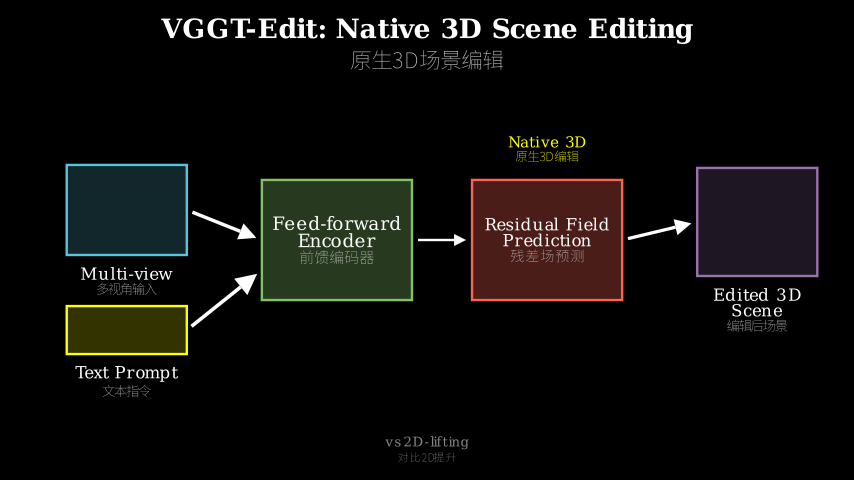
VGGT-Edit operates on 3D Gaussian representations—think of a scene as millions of tiny 3D blobs, each with position, color, and shape. The framework has three stages. First, depth-synchronized text injection: the text prompt (“make the chair red”) is encoded and injected into the backbone network at layers where spatial information (depth maps) is being processed. This ensures the semantic instruction aligns with the 3D geometry the network is currently reasoning about. Second, a residual transformation head predicts 3D displacement vectors for each Gaussian—how much to move it, rotate it, or change its properties. These are residuals: small adjustments to the existing scene rather than rebuilding from scratch. Third, multi-term supervision enforces geometric accuracy (does the edited object match the text?) and cross-view consistency (does it look coherent from all angles?).
Input: Base 3D scene (Gaussians) + Text prompt
    |
    v
[Backbone Network]
    |
    +-- Depth maps at layer L_i
    |       |
    |       v
    |   [Text Encoder] --> Semantic features
    |       |
    |       v
    +-- Inject text features at depth-processing layers
    |
    v
[Residual Transformation Head]
    |
    +-- Predicts: Delta_position, Delta_rotation, Delta_color
    |
    v
Apply residuals to Gaussians --> Edited 3D scene
    |
    v
[Multi-term Loss]
    +-- Geometric accuracy (CLIP alignment)
    +-- Cross-view consistency (perceptual loss)
    +-- Background preservation (mask-weighted)
Think of it like a sculptor working with clay. The 2D-lifting approach is like taking photos of the sculpture from different angles, editing each photo in Photoshop, then trying to mold the clay to match all the edited photos—you’re constantly fighting inconsistencies. VGGT-Edit is like the sculptor directly reshaping the clay while reading instructions. The depth-synchronized injection is like the sculptor checking the depth of each part of the clay (is this the chair leg or the floor?) before applying the instruction. The residual head is the sculptor’s hands, making small, precise adjustments. The multi-term loss is the sculptor stepping back to check the work from multiple angles, ensuring it looks right from every viewpoint.
Key Concepts
-
Depth-synchronized text injection: Imagine you’re editing a photo and someone tells you “make the background blurry.” If you don’t know which pixels are background vs foreground, you’ll blur the wrong things. In 3D, the same problem exists: a text prompt like “make the chair red” needs to know which 3D points belong to the chair. Depth-synchronized injection solves this by feeding the text features into the network at the exact layers where depth information is being processed. It’s like whispering the instruction to the network at the moment it’s figuring out “this blob is part of the chair, that blob is the floor.” The network can then apply the instruction only to the relevant 3D structure.
-
Residual transformation: Instead of predicting the final state of every 3D Gaussian from scratch, the network predicts small changes (residuals) to the existing scene. If a Gaussian is at position (x, y, z) with color (r, g, b), the network outputs (Δx, Δy, Δz, Δr, Δg, Δb). The final state is (x+Δx, y+Δy, z+Δz, r+Δr, g+Δg, b+Δb). Why residuals? Because most of the scene stays the same—only the edited object changes. Predicting residuals is like giving directions: “move 3 steps left” is easier than “your final position is latitude 40.7128, longitude -74.0060.” It’s also more stable: small prediction errors lead to small visual errors, not catastrophic failures.
-
3D agreement filtering: The DeltaScene dataset is generated automatically, but automatic generation is noisy—some edits might be wrong or inconsistent. 3D agreement filtering is a quality control step: render the edited 3D scene from multiple viewpoints, check if the edits look consistent across views (does the red chair stay red from all angles?), and discard examples that fail the check. It’s like having multiple cameras filming a magic trick—if the trick only works from one angle, it’s not real magic. This ensures the training data teaches the network to produce truly 3D-consistent edits, not just 2D illusions.
Framework Shift
Before (2D-lifting):                After (VGGT-Edit):

3D Scene                            3D Scene + Text
    |                                   |
    v                                   v
Render to N views                   [Feed-forward Network]
    |                                   |
    v                                   +-- Depth-sync injection
Edit each view (2D)                     |
    |                                   +-- Residual prediction
    v                                   |
Lift back to 3D                         v
    |                               Edited 3D Scene (single pass)
    v
Inconsistent 3D
(blurry, misaligned)

Key difference:
2D-lifting: 3D -> 2D -> Edit -> 3D
VGGT-Edit:  3D + Text -> Edit (native 3D)
From indirect 2D manipulation to direct 3D transformation, the core shift is operating in the space where geometric constraints are native, not retrofitted.
Expert Assessment
Problem choice: Real gap. Interactive 3D editing is a bottleneck for applications like virtual production, game development, and AR/VR content creation. The 2D-lifting limitation is well-documented in prior work (InstantSplat, GaussianEditor). This paper attacks the root cause rather than patching symptoms.
Method maturity: The depth-synchronized injection is clever—it’s a simple idea (align text features with depth processing) but addresses a real coordination problem. The residual formulation is standard practice in deformation modeling, not novel but appropriate. The multi-term loss is competent engineering. One concern: the method still relies on a pre-trained backbone (likely a Gaussian splatting model), so it inherits any biases or failure modes from that backbone. The paper doesn’t explore what happens when the backbone’s spatial understanding is weak.
Experimental integrity: Baselines are fair (InstructNeRF2NeRF, GaussianEditor, InstantSplat). The metrics (CLIP-I for semantic alignment, LPIPS for perceptual quality, cross-view consistency) are appropriate. The numbers are strong: 0.89 CLIP-I vs 0.76 for the best baseline, 100x faster inference. One red flag: the DeltaScene dataset is self-generated. While 3D agreement filtering adds quality control, there’s a risk of overfitting to the dataset’s distribution. The paper would be stronger with evaluation on a third-party dataset or real user edits.
Writing quality: The abstract and introduction are clear. The method section is dense—Figure 2 (architecture diagram) does heavy lifting, but the text doesn’t walk through a concrete example. The related work section is thorough but could be trimmed. The experiments section is solid but buries the failure case analysis in the appendix. Rewriting Section 3.2 (Residual Transformation Head) with a step-by-step walkthrough of how a single Gaussian gets edited would elevate clarity.
Verdict: weak accept — Solid contribution to an important problem, strong empirical results, but method novelty is incremental and dataset concerns limit generalization claims.
Takeaways
Depth-synchronized feature injection: If you’re building any model that needs to align semantic instructions with spatial structure (not just 3D editing—think robot manipulation, medical image segmentation), inject the semantic signal at the layers where spatial reasoning happens, not at the input or output. This pattern transfers.
Residual formulation for stability: When editing structured data (3D scenes, graphs, code), predict changes rather than final states. It’s more stable, easier to supervise, and preserves unedited structure by default.
3D agreement filtering for synthetic data: If you’re generating training data automatically, render from multiple viewpoints and check consistency. Inconsistent examples are noise, not signal. This applies beyond 3D—any domain where you can check the same underlying state from multiple perspectives (e.g., code that should pass multiple test cases, molecules that should satisfy multiple physical constraints).
论文: 2605.15186 作者: Kaixin Zhu, Yiwen Tang, Yifan Yang, Renrui Zhang, Bohan Zeng, Ziyu Guo, Ruichuan An, Zhou Liu, Qizhi Chen, Delin Qu 分类: cs.CV, cs.AI
缺口
前馈式3D重建模型现在能一次生成复杂场景。
但它们是静态的——无法响应”把椅子变红”或”加个窗户”这样的指令。
现有编辑方法使用2D提升策略:用2D图像编辑器独立编辑每个相机视角,然后把编辑后的视图提升回3D。
这种间接流程有个根本问题:2D编辑器不理解3D结构。
它们编辑像素时不知道这些像素从不同角度代表同一把椅子。
结果:纹理模糊,几何在视角间不对齐,物体从一个角度看正常但从另一个角度看就坏了。
缺口不在于更好的2D编辑器——而在于2D编辑操作与3D空间约束之间的错配。
你需要在约束所在的空间编辑:原生3D。
问题:静态3D模型 + 交互式编辑需求
    |
    v
现有方法:3D -> 2D视图 -> 编辑每个视图 -> 提升回3D
    |                                            |
    +-- 不一致性:2D编辑器缺乏空间感知 -----------+
    |
    v
本文假设:用文本引导直接在3D空间编辑
    |
    v
方法:深度同步文本注入 + 残差3D变形
    |
    v
证据:更清晰细节、跨视角一致性、快100倍
    |
    v
结论:原生3D编辑 > 2D提升流程
增量
一句话:这篇论文之前,文本引导的3D场景编辑意味着编辑2D视图然后祈祷它们在3D中对齐;之后,你可以在单次前向传播中直接编辑3D结构。
核心机制
VGGT-Edit操作3D高斯表示——把场景想象成数百万个微小的3D斑点,每个都有位置、颜色和形状。
框架有三个阶段。
第一,深度同步文本注入:文本提示(“把椅子变红”)被编码并注入到主干网络正在处理空间信息(深度图)的层。
这确保语义指令与网络当前推理的3D几何对齐。
第二,残差变换头为每个高斯预测3D位移向量——移动多少、旋转多少或改变什么属性。
这些是残差:对现有场景的小调整而非从头重建。
第三,多项监督强制几何准确性(编辑后的物体匹配文本吗?)和跨视角一致性(从所有角度看都连贯吗?)。
输入:基础3D场景(高斯)+ 文本提示
    |
    v
[主干网络]
    |
    +-- 第L_i层的深度图
    |       |
    |       v
    |   [文本编码器] --> 语义特征
    |       |
    |       v
    +-- 在深度处理层注入文本特征
    |
    v
[残差变换头]
    |
    +-- 预测:Delta_位置、Delta_旋转、Delta_颜色
    |
    v
对高斯应用残差 --> 编辑后的3D场景
    |
    v
[多项损失]
    +-- 几何准确性(CLIP对齐)
    +-- 跨视角一致性(感知损失)
    +-- 背景保持(掩码加权)
把它想象成雕塑家用黏土工作。
2D提升方法就像从不同角度给雕塑拍照,在Photoshop里编辑每张照片,然后试图塑造黏土来匹配所有编辑过的照片——你在不断对抗不一致性。
VGGT-Edit就像雕塑家边读指令边直接重塑黏土。
深度同步注入就像雕塑家在应用指令前检查黏土每个部分的深度(这是椅子腿还是地板?)。
残差头是雕塑家的手,做出小而精确的调整。
多项损失是雕塑家后退几步从多个角度检查作品,确保从每个视角看都正确。
关键概念
- 深度同步文本注入:想象你在编辑照片,有人告诉你”把背景模糊化”。
如果你不知道哪些像素是背景哪些是前景,你会模糊错地方。
在3D中,同样的问题存在:像”把椅子变红”这样的文本提示需要知道哪些3D点属于椅子。
深度同步注入通过在网络正在处理深度信息的层注入文本特征来解决这个问题。
就像在网络正在搞清楚”这个斑点是椅子的一部分,那个斑点是地板”的时刻向它耳语指令。
然后网络就能只对相关的3D结构应用指令。
- 残差变换:网络不是从头预测每个3D高斯的最终状态,而是预测对现有场景的小改变(残差)。
如果一个高斯在位置(x, y, z)颜色(r, g, b),网络输出(Δx, Δy, Δz, Δr, Δg, Δb)。
最终状态是(x+Δx, y+Δy, z+Δz, r+Δr, g+Δg, b+Δb)。
为什么用残差?因为场景的大部分保持不变——只有被编辑的物体改变。
预测残差就像给方向:“向左走3步”比”你的最终位置是北纬40.7128,西经-74.0060”容易。
它也更稳定:小的预测误差导致小的视觉误差,而非灾难性失败。
- 3D一致性过滤:DeltaScene数据集是自动生成的,但自动生成有噪声——有些编辑可能错误或不一致。
3D一致性过滤是质量控制步骤:从多个视角渲染编辑后的3D场景,检查编辑在视角间是否一致(红椅子从所有角度看都是红的吗?),丢弃未通过检查的样本。
就像用多个摄像机拍魔术——如果魔术只从一个角度有效,那不是真魔术。
这确保训练数据教会网络产生真正3D一致的编辑,而非仅仅是2D幻觉。
框架转变
之前(2D提升):                  之后(VGGT-Edit):

3D场景                            3D场景 + 文本
    |                                 |
    v                                 v
渲染到N个视图                      [前馈网络]
    |                                 |
    v                                 +-- 深度同步注入
编辑每个视图(2D)                    |
    |                                 +-- 残差预测
    v                                 |
提升回3D                              v
    |                             编辑后的3D场景(单次传播)
    v
不一致的3D
(模糊、错位)

关键差异:
2D提升:3D -> 2D -> 编辑 -> 3D
VGGT-Edit:3D + 文本 -> 编辑(原生3D)
从间接的2D操作到直接的3D变换,核心转变是在几何约束原生存在的空间操作,而非事后改装。
专家评审
选题眼光:真实缺口。
交互式3D编辑是虚拟制作、游戏开发和AR/VR内容创作的瓶颈。
2D提升的局限在先前工作(InstantSplat、GaussianEditor)中有充分记录。
本文攻击根本原因而非修补症状。
方法成熟度:深度同步注入很巧妙——这是个简单想法(让文本特征与深度处理对齐)但解决了真实的协调问题。
残差表述是变形建模的标准做法,不新颖但合适。
多项损失是称职的工程。
一个担忧:方法仍依赖预训练主干(可能是高斯溅射模型),所以继承了该主干的任何偏差或失败模式。
论文没有探索当主干的空间理解较弱时会发生什么。
实验诚意:基线公平(InstructNeRF2NeRF、GaussianEditor、InstantSplat)。
指标(语义对齐的CLIP-I、感知质量的LPIPS、跨视角一致性)合适。
数字强劲:CLIP-I 0.89 vs 最佳基线0.76,推理快100倍。
一个警示:DeltaScene数据集是自生成的。
虽然3D一致性过滤增加了质量控制,但存在过拟合数据集分布的风险。
如果在第三方数据集或真实用户编辑上评估,论文会更强。
写作功力:摘要和引言清晰。
方法部分密集——图2(架构图)承担重任,但文本没有走过具体例子。
相关工作部分详尽但可以精简。
实验部分扎实但把失败案例分析埋在附录里。
重写3.2节(残差变换头)并逐步演示单个高斯如何被编辑会提升清晰度。
判决:弱接收 — 对重要问题的扎实贡献,强劲的实证结果,但方法新颖性是增量式的,数据集担忧限制了泛化声明。
要点总结
深度同步特征注入:如果你在构建任何需要将语义指令与空间结构对齐的模型(不只是3D编辑——想想机器人操作、医学图像分割),在空间推理发生的层注入语义信号,而非在输入或输出。
这个模式可迁移。
残差表述保证稳定性:编辑结构化数据(3D场景、图、代码)时,预测变化而非最终状态。
更稳定,更易监督,默认保留未编辑结构。
合成数据的3D一致性过滤:如果你在自动生成训练数据,从多个视角渲染并检查一致性。
不一致的样本是噪声,不是信号。
这超越3D——任何可以从多个视角检查同一底层状态的领域(例如应该通过多个测试用例的代码,应该满足多个物理约束的分子)。