
Paper: 2604.04917 Authors: Gabriel Sarch, Linrong Cai, Qunzhong Wang, Haoyang Wu, Danqi Chen, Zhuang Liu Categories: cs.CV, cs.AI, cs.CL
The Gap
Vision-language models like GPT-4V and Gemini show impressive visual reasoning across diverse tasks—charts, diagrams, spatial puzzles, science questions. But their training recipes are locked behind proprietary RL pipelines with undisclosed data. Open-weight models exist, but they either use small-scale RL datasets (tens of thousands of samples) or lack systematic coverage across reasoning types. The result: a 5-10 point performance gap on challenging benchmarks, and no clear path for the research community to close it.
The core question: Can you build a generalist visual reasoner with fully open data and methods?
Problem: Proprietary VLMs dominate visual reasoning
   |
   v
Gap: Open models lack scale + diversity in RL data
   |
   v
Hypothesis: Broad task coverage matters more than task-specific depth
   |
   v
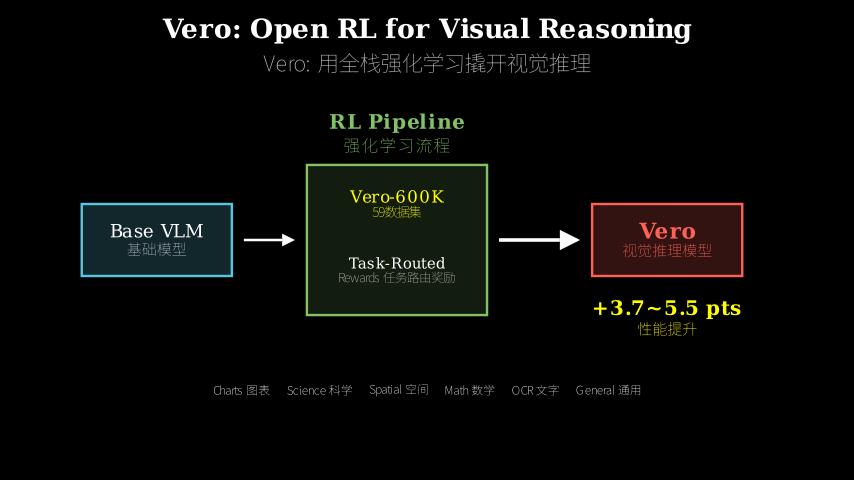
Method: Vero-600K (59 datasets, 6 categories) + task-routed rewards
   |
   v
Evidence: +3.7-5.5 pts over base models, beats existing open RL datasets
   |
   v
Conclusion: Data breadth drives RL scaling for visual reasoning
The Increment
One sentence: Before Vero, open visual reasoning models either used narrow RL data or no RL at all; after Vero, there’s a public 600K-sample recipe that matches proprietary performance across six reasoning categories.
Core Mechanism
Vero’s training pipeline has three stages. First, collect 600K visual reasoning samples from 59 datasets spanning six categories: charts, science diagrams, spatial reasoning, document understanding, general VQA, and math. Second, design task-routed reward models—instead of one monolithic reward, route each sample to a category-specific reward that handles heterogeneous answer formats (multiple choice vs. free-form vs. numeric). Third, run standard RL (they use GRPO, a policy gradient method) to optimize the VLM policy against these rewards.
The key architectural choice: rewards are routed by task category, not learned end-to-end. For charts, the reward checks if the extracted number matches ground truth. For science diagrams, it uses a verifier model trained on that domain. For spatial reasoning, it evaluates geometric correctness. This modular design lets them scale across diverse formats without reward hacking.
Data flow: raw image-question pairs → category classifier → task-specific reward model → RL loss → updated VLM policy. The category classifier is a simple rule-based router (dataset name → category), not a learned model.
Input: (image, question, answer_format)
   |
   v
[Category Router] ---> charts / science / spatial / docs / VQA / math
   |                      |
   v                      v
[Task Reward Model]   [Verifier / Exact Match / Semantic Sim]
   |
   v
[RL Update (GRPO)] ---> Updated VLM Policy
Think of Vero like a restaurant kitchen with specialized stations. You don’t train one chef to handle sushi, pastries, and grilling simultaneously—you route dishes to the right station. The head chef (category router) looks at the order (task type) and sends it to the sushi station (chart reward), pastry station (science reward), or grill (spatial reward). Each station has its own quality control (task-specific verifier). The RL process is the feedback loop: customers rate dishes, and chefs adjust recipes. The insight: trying to train one universal quality checker across all cuisines leads to mediocre results everywhere. Specialization at the reward level, generalization at the policy level.
Key Concepts
-
Task-routed rewards: Instead of training one reward model to judge all answer types (multiple choice, free-form text, numeric values), Vero routes each sample to a category-specific reward. Why? Answer formats are heterogeneous. A chart question expects a number; a science diagram expects a label; a spatial puzzle expects a coordinate. A single reward model either overfits to common formats or fails on rare ones. Task routing sidesteps this by using domain-appropriate verifiers. Concrete example: for a chart asking “What’s the value in 2020?”, the reward checks exact numeric match. For a science diagram asking “Label this cell part,” it uses a trained verifier that understands biological terminology. No single model does both well.
-
Broad data coverage hypothesis: Vero’s core claim is that RL scaling for visual reasoning requires breadth, not depth. Their ablation: training on one category (e.g., only charts) improves that category by 8 points but barely transfers to others. Training on all six categories improves each by 3-5 points. The math: 6 categories × 3 points
> 1category × 8 points when you care about general reasoning. This contradicts the intuition that specialization wins. The explanation: different reasoning types elicit distinct cognitive patterns (spatial vs. numerical vs. semantic), and the model needs exposure to all patterns to build robust reasoning circuits.
Framework Shift
Before (existing open VLMs):        After (Vero):

[Base VLM]                          [Base VLM]
    |                                   |
    v                                   v
[Small RL data]                     [Vero-600K: 59 datasets]
 (10-50K samples)                    (6 categories, 600K samples)
    |                                   |
    v                                   v
[Single reward model]               [Task-routed rewards]
    |                                   |   |   |   |   |   |
    v                                   v   v   v   v   v   v
[Narrow improvement]               Chart Sci Spatial Doc VQA Math
 (+2 pts on 1-2 tasks)                  |___|___|___|___|___|
                                              |
                                              v
                                        [Broad improvement]
                                         (+3.7-5.5 pts across 30 benchmarks)
From monolithic reward to modular routing, the core shift is recognizing that visual reasoning isn’t one skill but a portfolio of skills requiring specialized feedback.
Expert Assessment
Problem choice: Real gap. The proprietary-open divide in VLMs is a legitimate bottleneck for research. Vero targets the right lever: RL data scale and diversity, not model architecture. This is where the field needs transparency.
Method maturity: Mostly engineering, not algorithmic novelty. Task-routed rewards are sensible but not groundbreaking—it’s careful dataset curation and reward design. The GRPO algorithm is off-the-shelf. The contribution is showing that scale + breadth works, which is valuable but not intellectually surprising. No simpler approach is overlooked; this is the straightforward path.
Experimental integrity: Baselines are fair. They compare against existing open RL datasets (e.g., RLAIF-V) and show Vero-600K wins across categories. The ablation isolating breadth vs. depth is convincing. One concern: they don’t report compute costs or training time, which matters for reproducibility. The 30-benchmark eval suite (VeroEval) is comprehensive, though some benchmarks are saturated (>95% accuracy).
Writing quality: The paper front-loads results and buries dataset construction details in the appendix. Section 3 (data collection) should be expanded—how they filtered 59 datasets, handled annotation quality, and balanced categories is the real recipe. The ablation section (4.3) is the strongest part; it should come earlier. The related work is perfunctory.
Verdict: Weak accept — solid engineering contribution with full open release, but limited conceptual novelty; the value is in execution and transparency, not new ideas.
Takeaways
For practitioners building VLMs: Don’t unify your reward model across task types—route by category and use domain-specific verifiers. The performance gain from specialization outweighs the complexity cost.
For RL researchers: Breadth beats depth in multi-task RL when tasks require qualitatively different reasoning. If your domains don’t transfer well in isolation (Vero shows <1 point cross-category transfer), you need coverage, not concentration.
For dataset builders: The 59-dataset curation process (Appendix A) is a template for large-scale RL data construction. Key insight: balance category representation (100K samples per category) rather than chasing the largest single dataset.
Steal this: The task-routed reward architecture. It’s a simple design pattern that generalizes beyond vision—any multi-domain RL problem with heterogeneous outputs benefits from modular reward routing instead of monolithic reward models.
论文: 2604.04917 作者: Gabriel Sarch, Linrong Cai, Qunzhong Wang, Haoyang Wu, Danqi Chen, Zhuang Liu 分类: cs.CV, cs.AI, cs.CL
缺口
GPT-4V和Gemini这类视觉语言模型在图表、图示、空间谜题、科学问答等多样化任务上展现出惊人的视觉推理能力。
但它们的训练配方锁在专有的强化学习管线里,数据不公开。
开源权重模型虽然存在,但要么用小规模强化学习数据集(几万样本),要么缺乏跨推理类型的系统覆盖。
结果:在高难度基准上有5-10分的性能差距,研究社区没有明确路径去缩小这个差距。
核心问题:能否用完全开放的数据和方法构建通用视觉推理器?
问题:专有VLM主导视觉推理
   |
   v
缺口:开源模型缺乏规模+多样性的强化学习数据
   |
   v
假设:广泛的任务覆盖比任务专精更重要
   |
   v
方法:Vero-600K(59数据集,6类别)+ 任务路由奖励
   |
   v
证据:比基础模型高3.7-5.5分,超越现有开源强化学习数据集
   |
   v
结论:数据广度驱动视觉推理的强化学习扩展
增量
一句话: Vero之前,开源视觉推理模型要么用窄域强化学习数据要么完全不用强化学习;
Vero之后,有了一个公开的60万样本配方,在六个推理类别上匹敌专有系统性能。
核心机制
Vero的训练管线分三阶段。
第一,从59个数据集收集60万视觉推理样本,覆盖六个类别:图表、科学图示、空间推理、文档理解、通用视觉问答、数学。
第二,设计任务路由奖励模型——不用一个整体奖励,而是把每个样本路由到类别专用奖励,处理异构答案格式(选择题 vs 自由文本 vs 数值)。
第三,跑标准强化学习(他们用GRPO,一种策略梯度方法)来优化VLM策略对抗这些奖励。
关键架构选择:奖励按任务类别路由,不是端到端学习。
对图表,奖励检查提取的数字是否匹配真值。
对科学图示,用该领域训练的验证器模型。
对空间推理,评估几何正确性。
这种模块化设计让他们能跨多样格式扩展而不出现奖励黑客。
数据流:原始图像-问题对 → 类别分类器 → 任务专用奖励模型 → 强化学习损失 → 更新的VLM策略。
类别分类器是简单的基于规则的路由器(数据集名→类别),不是学习模型。
输入:(图像, 问题, 答案格式)
   |
   v
[类别路由器] ---> 图表 / 科学 / 空间 / 文档 / VQA / 数学
   |                      |
   v                      v
[任务奖励模型]         [验证器 / 精确匹配 / 语义相似度]
   |
   v
[强化学习更新(GRPO)] ---> 更新的VLM策略
把Vero想象成有专业分工站点的餐厅厨房。
你不会训练一个厨师同时处理寿司、糕点和烧烤——你把菜品路由到对的站点。
主厨(类别路由器)看订单(任务类型)然后送到寿司站(图表奖励)、糕点站(科学奖励)或烧烤站(空间奖励)。
每个站点有自己的质检(任务专用验证器)。
强化学习过程是反馈循环:顾客给菜品打分,厨师调整配方。
洞见:试图训练一个通用质检员跨所有菜系会导致处处平庸。
在奖励层面专业化,在策略层面泛化。
关键概念
- 任务路由奖励: 不训练一个奖励模型来评判所有答案类型(选择题、自由文本、数值),Vero把每个样本路由到类别专用奖励。
为什么?
答案格式是异构的。
图表问题期待数字;
科学图示期待标签;
空间谜题期待坐标。
单一奖励模型要么过拟合常见格式要么在罕见格式上失败。
任务路由通过使用领域适配的验证器绕过这个问题。
具体例子:对图表问”2020年的值是多少?“,奖励检查精确数值匹配。
对科学图示问”标注这个细胞部分”,用理解生物术语的训练验证器。
没有单一模型能同时做好两者。
- 广泛数据覆盖假设: Vero的核心主张是视觉推理的强化学习扩展需要广度而非深度。
他们的消融实验:在一个类别上训练(比如只有图表)能让该类别提升8分但几乎不迁移到其他类别。
在全部六个类别上训练能让每个类别提升3-5分。
算术:6类别 × 3分 > 1类别 × 8分,当你关心通用推理时。
这与专业化获胜的直觉相悖。
解释:不同推理类型引发不同认知模式(空间 vs 数值 vs 语义),模型需要接触所有模式来构建鲁棒推理回路。
框架转变
之前(现有开源VLM):              之后(Vero):

[基础VLM]                          [基础VLM]
    |                                   |
    v                                   v
[小规模强化学习数据]                [Vero-600K: 59数据集]
 (1-5万样本)                         (6类别,60万样本)
    |                                   |
    v                                   v
[单一奖励模型]                      [任务路由奖励]
    |                                   |   |   |   |   |   |
    v                                   v   v   v   v   v   v
[窄域提升]                         图表 科学 空间 文档 VQA 数学
 (1-2任务+2分)                          |___|___|___|___|___|
                                              |
                                              v
                                        [广域提升]
                                         (30基准+3.7-5.5分)
从整体奖励到模块化路由,核心转变是认识到视觉推理不是一项技能而是需要专业反馈的技能组合。
专家评审
选题眼光: 真实缺口。
VLM的专有-开源鸿沟是研究的合理瓶颈。
Vero瞄准了正确的杠杆:强化学习数据规模和多样性,而非模型架构。
这是领域需要透明度的地方。
方法成熟度: 主要是工程,不是算法创新。
任务路由奖励合理但不突破——是细致的数据集整理和奖励设计。
GRPO算法是现成的。
贡献在于展示规模+广度有效,这有价值但智识上不意外。
没有被忽略的更简单方法;
这是直接路径。
实验诚意: 基线公平。
他们对比现有开源强化学习数据集(如RLAIF-V)并展示Vero-600K跨类别获胜。
隔离广度vs深度的消融实验有说服力。
一个担忧:他们没报告计算成本或训练时间,这对可复现性重要。
30基准评估套件(VeroEval)全面,虽然有些基准饱和(>95%准确率)。
写作功力: 论文前置结果把数据集构建细节埋在附录。
第3节(数据收集)应该扩展——他们如何筛选59数据集、处理标注质量、平衡类别才是真正的配方。
消融部分(4.3)是最强部分;
应该提前。
相关工作敷衍。
判决: 弱接收 — 扎实的工程贡献加完全开放发布,但概念新颖性有限;
价值在执行和透明度,不在新想法。
要点总结
对构建VLM的实践者: 不要统一你的奖励模型跨任务类型——按类别路由并使用领域专用验证器。
专业化带来的性能增益超过复杂度成本。
对强化学习研究者: 当任务需要质的不同推理时,多任务强化学习中广度胜过深度。
如果你的领域孤立时迁移不好(Vero显示<1分跨类别迁移),你需要覆盖而非集中。
对数据集构建者: 59数据集整理过程(附录A)是大规模强化学习数据构建的模板。
关键洞见:平衡类别表示(每类别10万样本)而非追逐最大单一数据集。
偷这个: 任务路由奖励架构。
这是简单的设计模式,泛化到视觉之外——任何有异构输出的多领域强化学习问题都受益于模块化奖励路由而非整体奖励模型。