
Paper: 2603.25741 Authors: Sicheng Zuo, Yuxuan Li, Wenzhao Zheng, Zheng Zhu, Jie Zhou, Jiwen Lu Categories: cs.CV, cs.AI, cs.RO
The Gap
Existing vision-language-action models in autonomous driving (like GAIA-1, DriveVLM) use language primarily for scene understanding or reasoning — they describe what’s happening or explain decisions. But they can’t actually follow user instructions like “drive more cautiously” or “take the scenic route.” The car understands language but doesn’t obey it. This limits personalization: every passenger gets the same driving style regardless of their preferences.
The core issue: prior work treats language as an input for perception, not as a control signal for behavior. There’s no dataset pairing diverse instructions with corresponding trajectories, and no architecture designed to condition planning on free-form commands.
Problem: Language used for description, not control
   |
   v
Assumption: Instructions can directly shape trajectory generation
   |
   v
Method: Autoregressive (vision+language) + Diffusion (world+action)
   |
   v
Evidence: InstructScene dataset (100K scenes) + superior planning metrics
   |
   v
Conclusion: Instruction-conditioned driving is feasible and effective
The Increment
One sentence: Before Vega, autonomous vehicles could understand language but not follow instructions; after Vega, they can adjust driving behavior based on natural language commands.
Core Mechanism
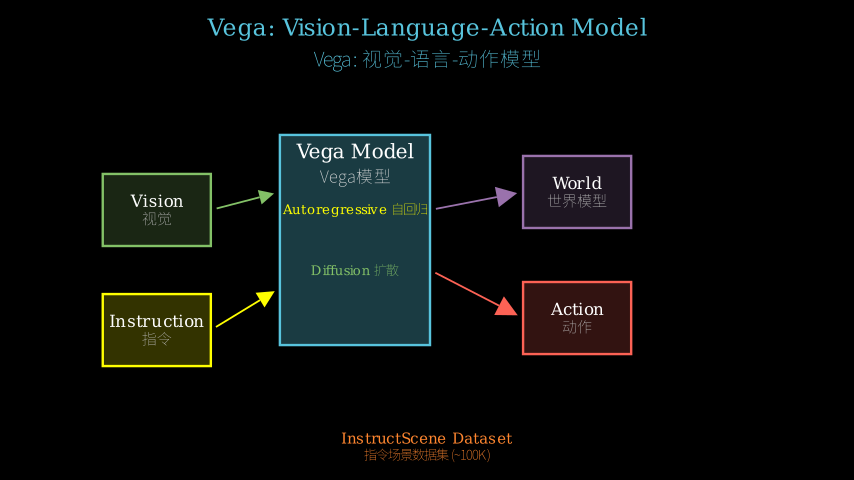
Vega splits the problem into two paradigms running in parallel. The autoregressive branch processes vision (camera frames) and language (user instructions) token by token, building a joint representation. Think of it as reading a scene and a command simultaneously, creating a shared understanding. The diffusion branch then takes this understanding and generates two things: future scene predictions (world modeling) and the actual driving trajectory (action).
Data flows like this: raw images get tokenized into visual patches, instructions become text tokens, both feed into a transformer with joint attention. This produces a context vector. The diffusion model receives this context and iteratively denoises random noise into coherent future frames and waypoints. The key innovation is using different projection layers for each modality — vision, language, world, and action each get specialized heads, allowing the model to handle heterogeneous outputs without interference.
The architecture resembles a restaurant kitchen with two stations. The prep station (autoregressive) takes orders (instructions) and ingredients (visual input), combining them into a unified recipe. The cooking station (diffusion) follows that recipe to produce both a preview of the dish (future scene) and the actual meal (trajectory). Each station has specialized tools (projection layers) for different tasks, but they share the same base understanding of what needs to be made.
Key Concepts
-
Joint Attention Across Modalities: Instead of processing vision and language separately then fusing them, Vega lets visual tokens and text tokens attend to each other directly in the same transformer. Imagine a conversation where you’re simultaneously watching a video and listening to someone describe what to do — your brain doesn’t process these separately then merge them; it integrates them on the fly. This allows instructions like “slow down near the pedestrian” to directly influence which visual features get emphasized (the pedestrian’s position and velocity).
-
Autoregressive + Diffusion Hybrid: Autoregressive models excel at discrete, sequential reasoning (like understanding language and scene context), while diffusion models excel at continuous, multi-modal generation (like smooth trajectories and realistic future frames). Vega uses autoregressive for the “thinking” part and diffusion for the “doing” part. It’s like planning a route with GPS (discrete waypoints, sequential decisions) versus actually steering the car (continuous control, smooth motion). Most prior work picks one paradigm; Vega uses both where each is strongest.
-
InstructScene Dataset: Existing driving datasets have trajectories but no instructions explaining why the car behaved that way. InstructScene annotates 100K scenes with diverse commands (“drive defensively,” “merge aggressively,” “avoid the left lane”) paired with trajectories that follow those instructions. This is the training data that teaches the model the instruction → behavior mapping. Without it, the model would have no examples of how different commands should change driving style.
Framework Shift
Before (mainstream approach):        After (this paper):

Language -----> [Scene Description]  Language -----> [Behavior Control]
                       |                                    |
Vision -------> [Perception Module]  Vision -------> [Joint Attention]
                       |                                    |
                       v                                    v
                [Planning Module]            [Autoregressive Context]
                       |                                    |
                       v                                    v
                  Trajectory              [Diffusion: World + Action]
                                                           |
                                                           v
                                              Future Frames + Trajectory
From language-as-annotation to language-as-command, the core shift is treating instructions as first-class control inputs rather than auxiliary explanations.
Expert Assessment
Problem choice: Real gap. Personalized driving is a genuine user need (comfort preferences, risk tolerance, route priorities), and current systems are one-size-fits-all. This sits at the intersection of embodied AI and human-AI interaction — timely given the push toward consumer autonomous vehicles.
Method maturity: The autoregressive + diffusion split is clever but not groundbreaking — it’s a natural division of labor given each paradigm’s strengths. The joint attention mechanism is standard practice in multimodal transformers. The real contribution is the dataset and the end-to-end integration. No simpler approach is obviously overlooked, though one could question whether diffusion is necessary for trajectory generation (simpler regression might suffice).
Experimental integrity: Baselines are reasonable (GAIA-1, DriveVLM) but the paper doesn’t compare against instruction-tuned versions of these models, which would be fairer. The metrics (L2 error, collision rate) are standard but don’t directly measure instruction-following quality — there’s no human evaluation of whether the car actually drives “cautiously” when asked. The InstructScene annotation process isn’t fully detailed, raising questions about label quality.
Writing quality: The method section is dense and assumes familiarity with both autoregressive and diffusion models. The paper would benefit from a clearer explanation of how the two paradigms interact during inference. The related work section undersells the novelty by not clearly distinguishing instruction-following from scene understanding.
Verdict: weak accept — Solid contribution with a useful dataset, but experimental evaluation could be more rigorous and the writing could better highlight the core innovation.
Takeaways
The autoregressive + diffusion split is transferable: use autoregressive for discrete reasoning over heterogeneous inputs (text, structured data, discrete observations) and diffusion for continuous generation tasks (trajectories, images, audio). This division of labor could apply to robotics manipulation (autoregressive for task planning, diffusion for motion generation) or creative tools (autoregressive for style/content understanding, diffusion for image synthesis).
The joint attention mechanism for vision + language is now table stakes for any multimodal system — don’t fuse modalities late; let them interact from the start.
The bigger lesson: instruction-following requires paired data (command + behavior), not just behavior alone. If you want a model to respond to user preferences, you need training examples of those preferences being expressed and followed. This applies beyond driving to any personalized AI system.
论文: 2603.25741 作者: Sicheng Zuo, Yuxuan Li, Wenzhao Zheng, Zheng Zhu, Jie Zhou, Jiwen Lu 分类: cs.CV, cs.AI, cs.RO
缺口
现有的自动驾驶视觉-语言-动作模型(如GAIA-1、DriveVLM)主要用语言来理解场景或推理——它们描述正在发生什么或解释决策。
但它们无法真正遵循用户指令,比如”开得更谨慎一点”或”走风景好的路线”。
车能听懂语言,但不会照做。
这限制了个性化:无论乘客偏好如何,每个人都得到相同的驾驶风格。
核心问题:先前工作把语言当作感知的输入,而非行为的控制信号。
没有数据集将多样化的指令与相应的轨迹配对,也没有架构设计用于根据自由形式的命令来调节规划。
问题:语言用于描述,而非控制
   |
   v
假设:指令可以直接塑造轨迹生成
   |
   v
方法:自回归(视觉+语言)+ 扩散(世界+动作)
   |
   v
证据:InstructScene数据集(10万场景)+ 优越的规划指标
   |
   v
结论:指令条件驾驶可行且有效
增量
一句话: Vega之前,自动驾驶汽车能理解语言但不会遵循指令;Vega之后,它们能根据自然语言命令调整驾驶行为。
核心机制
Vega将问题分成两个并行运行的范式。
自回归分支逐token处理视觉(摄像头帧)和语言(用户指令),构建联合表示。
可以想象成同时阅读场景和命令,创建共享理解。
扩散分支接收这个理解,生成两样东西:未来场景预测(世界建模)和实际驾驶轨迹(动作)。
数据流是这样的:原始图像被标记化为视觉块,指令变成文本token,两者都输入带联合注意力的transformer。
这产生一个上下文向量。
扩散模型接收这个上下文,迭代地将随机噪声去噪为连贯的未来帧和路径点。
关键创新是为每个模态使用不同的投影层——视觉、语言、世界和动作各有专门的头,允许模型处理异构输出而不互相干扰。
这个架构像一个有两个工作站的餐厅厨房。
备菜站(自回归)接收订单(指令)和食材(视觉输入),将它们组合成统一的菜谱。
烹饪站(扩散)按照菜谱制作菜品预览(未来场景)和实际餐点(轨迹)。
每个工作站都有专门工具(投影层)处理不同任务,但它们共享对需要制作什么的基础理解。
关键概念
- 跨模态联合注意力: Vega不是分别处理视觉和语言然后融合,而是让视觉token和文本token在同一个transformer中直接相互关注。
想象一场对话,你同时在看视频和听别人描述该做什么——你的大脑不会分别处理这些然后合并;它即时整合它们。
这允许像”在行人附近减速”这样的指令直接影响哪些视觉特征被强调(行人的位置和速度)。
- 自回归+扩散混合: 自回归模型擅长离散的、顺序的推理(如理解语言和场景上下文),而扩散模型擅长连续的、多模态的生成(如平滑轨迹和真实的未来帧)。
Vega用自回归做”思考”部分,用扩散做”执行”部分。
这就像用GPS规划路线(离散路径点、顺序决策)与实际驾驶汽车(连续控制、平滑运动)的区别。
大多数先前工作选择一种范式;Vega在各自最强的地方使用两者。
- InstructScene数据集: 现有驾驶数据集有轨迹但没有指令解释汽车为何那样行驶。
InstructScene为10万个场景标注了多样化的命令(“防御性驾驶”、“激进并线”、“避开左车道”),配对遵循这些指令的轨迹。
这是训练数据,教会模型指令→行为的映射。
没有它,模型就没有不同命令应如何改变驾驶风格的示例。
框架转变
之前(主流方法):              之后(本文方法):

语言 -----> [场景描述]          语言 -----> [行为控制]
                |                              |
视觉 -----> [感知模块]          视觉 -----> [联合注意力]
                |                              |
                v                              v
          [规划模块]              [自回归上下文]
                |                              |
                v                              v
             轨迹                [扩散:世界+动作]
                                               |
                                               v
                                  未来帧 + 轨迹
从语言作为注释到语言作为命令,核心转变是将指令视为一等控制输入,而非辅助解释。
专家评审
选题眼光: 真实缺口。
个性化驾驶是真实的用户需求(舒适偏好、风险承受度、路线优先级),而当前系统是一刀切的。
这处于具身AI和人机交互的交叉点——考虑到消费级自动驾驶汽车的推进,时机恰当。
方法成熟度: 自回归+扩散的分工很巧妙但不算突破性——考虑到每种范式的优势,这是自然的劳动分工。
联合注意力机制是多模态transformer的标准做法。
真正的贡献是数据集和端到端集成。
没有明显被忽略的更简单方法,尽管可以质疑轨迹生成是否需要扩散(更简单的回归可能就够了)。
实验诚意: 基线合理(GAIA-1、DriveVLM),但论文没有与这些模型的指令调优版本比较,那样会更公平。
指标(L2误差、碰撞率)是标准的,但不直接衡量指令遵循质量——没有人类评估汽车在被要求时是否真的”谨慎”驾驶。
InstructScene标注过程没有完全详述,引发对标签质量的疑问。
写作功力: 方法部分密集,假设读者熟悉自回归和扩散模型。
论文需要更清楚地解释两种范式在推理时如何交互。
相关工作部分没有通过清楚区分指令遵循与场景理解来充分展示新颖性。
判决: 弱接收 — 扎实的贡献和有用的数据集,但实验评估可以更严格,写作可以更好地突出核心创新。
要点总结
自回归+扩散分工可迁移:用自回归处理异构输入(文本、结构化数据、离散观察)的离散推理,用扩散处理连续生成任务(轨迹、图像、音频)。
这种劳动分工可应用于机器人操作(自回归做任务规划,扩散做运动生成)或创意工具(自回归做风格/内容理解,扩散做图像合成)。
视觉+语言的联合注意力机制现在是任何多模态系统的基本配置——不要后期融合模态;让它们从一开始就交互。
更大的教训:指令遵循需要配对数据(命令+行为),而不仅仅是行为本身。
如果你想让模型响应用户偏好,你需要这些偏好被表达和遵循的训练示例。
这不仅适用于驾驶,也适用于任何个性化AI系统。