
Paper: 2603.03283 Authors: Yujia Zhang, Xiaoyang Wu, Yunhan Yang, Xianzhe Fan, Han Li, Yuechen Zhang, Zehao Huang, Naiyan Wang, Hengshuang Zhao Categories: cs.CV
The Gap
Point cloud encoders today are domain specialists. PointNet++ dominates indoor scenes, RandLA-Net owns outdoor LiDAR, Point-BERT handles CAD models. Each domain trains its own model because the data looks fundamentally different: satellite point clouds are sparse and cover kilometers, indoor RGB-D is dense and cluttered, CAD models are clean geometry. The assumption has been that these differences are too large to bridge—you need domain-specific architectures and training recipes.
But this specialization creates fragmentation. A model trained on indoor scenes can’t leverage outdoor driving data. Robotics applications can’t benefit from the geometric priors in CAD models. We’re training dozens of models when the underlying task—understanding 3D structure—is the same.
Domain Fragmentation
    |
    v
Assumption: Domains too different to unify
    |
    v
Method: Single encoder + multi-domain self-supervised learning
    |
    v
Evidence: Consistent representations across 5 domains
    |
    v
Conclusion: Unification improves perception + enables emergent behaviors
The Increment
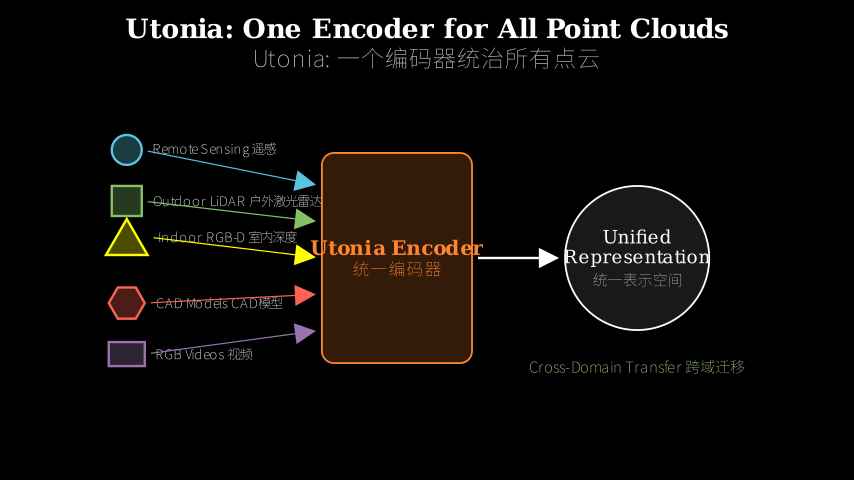
One sentence: Before Utonia, each point cloud domain trained its own encoder; after Utonia, one encoder learns from all domains simultaneously and transfers knowledge between them.
Core Mechanism
Utonia is a point transformer encoder trained with masked autoencoding across five domains: remote sensing (satellite/aerial scans), outdoor LiDAR (autonomous driving), indoor RGB-D (room scans), object-centric CAD models, and point clouds lifted from monocular video. The architecture itself is standard—a hierarchical point transformer with local attention—but the training strategy is what matters.
During pre-training, Utonia sees batches mixing all five domains. For each point cloud, it masks out random patches (like BERT masks words), then tries to reconstruct the masked points’ positions and features. The loss function is domain-agnostic: predict XYZ coordinates and any available features (colors, normals, etc.). No domain-specific heads, no separate training stages—just one encoder learning to compress all point cloud types into a shared representation space.
The key insight is that self-supervised reconstruction forces the model to learn geometric structure, which is universal across domains. A corner in a room looks different from a tree in LiDAR, but both are local geometric patterns. By training on all domains jointly, the encoder learns to extract these patterns regardless of density, scale, or sensor type.
Input: Mixed-domain batches
    |
    v
[Point Transformer Encoder]
    |
    +---> Mask random patches (15-30%)
    |
    +---> Encode visible points
    |
    +---> Decode masked points
    |
    v
Loss: Reconstruct XYZ + features
    |
    v
Output: Shared representation space
Think of Utonia like a polyglot translator learning five languages at once. Each language (domain) has different vocabulary (point density) and grammar (geometric priors), but they all express the same underlying concepts (3D structure). By learning all languages simultaneously, the translator discovers universal patterns—“corner” in English maps to “角” in Chinese, just as a building corner in LiDAR maps to a furniture corner in RGB-D. The reconstruction task is like fill-in-the-blank exercises: given context, predict the missing word. The model can’t memorize domain-specific tricks; it must learn the deep structure that works everywhere.
Key Concepts
-
Masked Autoencoding for Point Clouds: Imagine you’re looking at a 3D scan of a room, but 20% of the points are hidden. Your job is to guess where those missing points should be based on the visible ones. If you see three corners of a table, you can infer the fourth. This is masked autoencoding—the model learns to predict masked regions by understanding geometric relationships. Unlike images where you predict pixel colors, point clouds require predicting 3D positions, which forces the model to learn spatial structure rather than texture patterns.
-
Cross-Domain Transfer: When you learn to ride a bicycle, that skill helps you learn to ride a motorcycle—the balance and steering intuition transfer. Cross-domain transfer in Utonia works similarly: geometric patterns learned from dense indoor scans (like wall-floor boundaries) help recognize similar structures in sparse outdoor LiDAR (like road-sidewalk boundaries). The model doesn’t just memorize each domain; it discovers shared abstractions that apply everywhere.
-
Emergent Behaviors: When you mix ingredients in cooking, sometimes you get unexpected flavors that none of the ingredients had alone. Utonia exhibits emergent behaviors—capabilities that appear only when training on multiple domains jointly, not when training on each domain separately. For example, the model becomes better at handling scale variations (tiny CAD parts vs. kilometer-wide satellite scans) because it sees both extremes during training. These behaviors aren’t programmed; they emerge from the interaction of diverse data.
Framework Shift
Before (mainstream approach):        After (this paper):

Domain 1 --> Encoder_1               Domain 1 ----+
Domain 2 --> Encoder_2               Domain 2 ----+
Domain 3 --> Encoder_3               Domain 3 ----+--> [Utonia] --> Shared Space
Domain 4 --> Encoder_4               Domain 4 ----+
Domain 5 --> Encoder_5               Domain 5 ----+

(Separate silos)                     (Unified learning)
From domain-specific specialists to a single generalist, the core shift is training one model on all data simultaneously rather than partitioning by domain.
Expert Assessment
Problem choice: This is a real gap, not manufactured. The field has been stuck in domain silos for years—every new sensor or application spawns a new model. The timing is right: we have enough compute and data diversity to attempt unification, and the success of foundation models in NLP/vision makes this a natural next step for 3D. It’s ambitious but not premature.
Method maturity: Mostly brute force with one clever insight. The architecture is standard point transformer; the magic is in the training recipe—just throw all domains together and let masked autoencoding do the work. There’s elegance in the simplicity, but I wonder if they’re leaving performance on the table. Domain-specific augmentations, adaptive masking ratios, or curriculum learning (easy domains first) might help. The paper doesn’t explore these, which feels like a missed opportunity.
Experimental integrity: The baselines are fair—they compare against domain-specific SOTA models and ablate the multi-domain training. The numbers are solid across perception tasks (segmentation, detection, classification). However, I’m skeptical about the “emergent behaviors” claims. They show qualitative examples but don’t quantify how much better joint training is compared to simply ensembling domain-specific models. The robotics and VLM experiments are interesting but feel tacked on—more proof-of-concept than rigorous evaluation.
Writing quality: The abstract oversells (“dream of a future”) and the introduction is too philosophical. The method section is clear but could be more detailed—what’s the exact masking strategy? How do they handle domain imbalance in batches? The experiments section is comprehensive but drowns in tables. If they rewrote the introduction to be more direct and added a “design choices” subsection explaining why they didn’t try X/Y/Z, the paper would be much stronger.
Verdict: weak accept — Solid execution of an important idea, but the method is straightforward and the emergent behaviors need better quantification.
Takeaways
For practitioners building multi-modal 3D systems: Don’t train separate models for each sensor or domain. Utonia shows that a single encoder can handle wildly different point cloud types if you use domain-agnostic self-supervised learning. The key is masked autoencoding with a simple reconstruction loss—no need for complex domain adaptation techniques.
For researchers working on foundation models: Self-supervised learning on diverse data creates emergent capabilities that single-domain training misses. The paper doesn’t fully characterize these emergent behaviors, which is an open research direction. What other capabilities appear when you scale to 10 or 20 domains?
Specific technique to steal: The mixed-domain batching strategy. Instead of training on one domain per epoch or using complex sampling schemes, just randomly sample from all domains uniformly. It’s dead simple and forces the model to learn domain-invariant features. This likely transfers to other multi-modal learning problems (e.g., training on images + videos + 3D scans).
What’s missing: The paper doesn’t provide the pre-trained model or training code, which limits reproducibility. They also don’t explore how much data from each domain is needed—can you get 80% of the benefit with 20% of the data? These practical questions matter for real deployments.
论文: 2603.03283 作者: Yujia Zhang, Xiaoyang Wu, Yunhan Yang, Xianzhe Fan, Han Li, Yuechen Zhang, Zehao Huang, Naiyan Wang, Hengshuang Zhao 分类: cs.CV
缺口
今天的点云编码器都是领域专家。
PointNet++统治室内场景,RandLA-Net拥有户外激光雷达,Point-BERT处理CAD模型。
每个领域训练自己的模型,因为数据看起来根本不同:卫星点云稀疏且覆盖数公里,室内RGB-D密集且杂乱,CAD模型是干净的几何体。
假设一直是这些差异太大无法弥合——你需要领域特定的架构和训练配方。
但这种专业化造成了碎片化。
在室内场景上训练的模型无法利用户外驾驶数据。
机器人应用无法从CAD模型中的几何先验中受益。
我们在训练几十个模型,而底层任务——理解3D结构——是相同的。
领域碎片化
    |
    v
假设:领域差异太大无法统一
    |
    v
方法:单一编码器 + 多领域自监督学习
    |
    v
证据:跨5个领域的一致表征
    |
    v
结论:统一改善感知 + 启用涌现行为
增量
一句话: Utonia之前,每个点云领域训练自己的编码器;Utonia之后,一个编码器同时从所有领域学习并在它们之间迁移知识。
核心机制
Utonia是一个点Transformer编码器,通过跨五个领域的掩码自编码训练:遥感(卫星/航空扫描)、户外激光雷达(自动驾驶)、室内RGB-D(房间扫描)、以对象为中心的CAD模型,以及从单目视频提升的点云。
架构本身是标准的——带有局部注意力的层次化点Transformer——但训练策略才是关键。
在预训练期间,Utonia看到混合所有五个领域的批次。
对于每个点云,它掩盖随机补丁(像BERT掩盖单词),然后尝试重建被掩盖点的位置和特征。
损失函数与领域无关:预测XYZ坐标和任何可用特征(颜色、法线等)。
没有领域特定的头,没有单独的训练阶段——只有一个编码器学习将所有点云类型压缩到共享表征空间。
关键洞察是自监督重建迫使模型学习几何结构,这在各领域中是通用的。
房间里的角落看起来与激光雷达中的树不同,但两者都是局部几何模式。
通过在所有领域上联合训练,编码器学会提取这些模式,无论密度、尺度或传感器类型如何。
输入:混合领域批次
    |
    v
[点Transformer编码器]
    |
    +---> 掩盖随机补丁(15-30%)
    |
    +---> 编码可见点
    |
    +---> 解码被掩盖点
    |
    v
损失:重建XYZ + 特征
    |
    v
输出:共享表征空间
把Utonia想象成一个同时学习五种语言的多语翻译者。
每种语言(领域)有不同的词汇(点密度)和语法(几何先验),但它们都表达相同的底层概念(3D结构)。
通过同时学习所有语言,翻译者发现通用模式——英语中的”corner”映射到中文中的”角”,就像激光雷达中的建筑角落映射到RGB-D中的家具角落。
重建任务就像填空练习:给定上下文,预测缺失的词。
模型无法记忆领域特定的技巧;它必须学习在任何地方都有效的深层结构。
关键概念
- 点云的掩码自编码: 想象你正在看一个房间的3D扫描,但20%的点被隐藏了。
你的工作是根据可见的点猜测那些缺失的点应该在哪里。
如果你看到桌子的三个角,你可以推断出第四个。
这就是掩码自编码——模型通过理解几何关系来学习预测被掩盖的区域。
与预测像素颜色的图像不同,点云需要预测3D位置,这迫使模型学习空间结构而不是纹理模式。
- 跨域迁移: 当你学会骑自行车时,这项技能帮助你学会骑摩托车——平衡和转向的直觉会迁移。
Utonia中的跨域迁移以类似方式工作:从密集室内扫描中学到的几何模式(如墙-地板边界)有助于识别稀疏户外激光雷达中的类似结构(如道路-人行道边界)。
模型不只是记忆每个领域;它发现适用于任何地方的共享抽象。
- 涌现行为: 当你在烹饪中混合配料时,有时你会得到任何单一配料都没有的意外风味。
Utonia表现出涌现行为——只有在多个领域上联合训练时才出现的能力,而不是在每个领域上单独训练时。
例如,模型在处理尺度变化(微小的CAD零件vs公里宽的卫星扫描)方面变得更好,因为它在训练期间看到了两个极端。
这些行为不是编程的;它们从多样化数据的交互中涌现。
框架转变
之前(主流方法):                  之后(本文方法):

领域1 --> 编码器_1               领域1 ----+
领域2 --> 编码器_2               领域2 ----+
领域3 --> 编码器_3               领域3 ----+--> [Utonia] --> 共享空间
领域4 --> 编码器_4               领域4 ----+
领域5 --> 编码器_5               领域5 ----+

(独立孤岛)                       (统一学习)
从领域特定专家到单一通才,核心转变是在所有数据上同时训练一个模型,而不是按领域分区。
专家评审
选题眼光: 这是一个真实的缺口,不是人造的。
该领域多年来一直困在领域孤岛中——每个新传感器或应用都会产生一个新模型。
时机恰当:我们有足够的计算和数据多样性来尝试统一,NLP/视觉中基础模型的成功使这成为3D的自然下一步。
这很有野心但不是过早。
方法成熟度: 主要是蛮力加一个巧妙的洞察。
架构是标准的点Transformer;魔力在于训练配方——只需将所有领域放在一起,让掩码自编码完成工作。
简单性中有优雅,但我怀疑他们是否在性能上留有余地。
领域特定的增强、自适应掩码比率或课程学习(先简单领域)可能有帮助。
论文没有探索这些,这感觉像是一个错失的机会。
实验诚意: 基线是公平的——他们与领域特定的SOTA模型进行比较,并消融多领域训练。
数字在感知任务(分割、检测、分类)上是可靠的。
然而,我对”涌现行为”的说法持怀疑态度。
他们展示了定性示例,但没有量化联合训练比简单集成领域特定模型好多少。
机器人和VLM实验很有趣,但感觉是附加的——更像是概念验证而不是严格评估。
写作功力: 摘要过度推销(“梦想未来”),引言过于哲学化。
方法部分清晰但可以更详细——确切的掩码策略是什么?他们如何处理批次中的领域不平衡?实验部分全面但淹没在表格中。
如果他们重写引言使其更直接,并添加一个”设计选择”小节解释为什么他们没有尝试X/Y/Z,论文会强得多。
判决: 弱接收 — 重要想法的扎实执行,但方法很直接,涌现行为需要更好的量化。
要点总结
对于构建多模态3D系统的实践者: 不要为每个传感器或领域训练单独的模型。
Utonia表明,如果你使用与领域无关的自监督学习,单个编码器可以处理截然不同的点云类型。
关键是带有简单重建损失的掩码自编码——不需要复杂的领域适应技术。
对于研究基础模型的研究人员: 在多样化数据上的自监督学习创造了单领域训练所缺少的涌现能力。
论文没有完全表征这些涌现行为,这是一个开放的研究方向。
当你扩展到10或20个领域时,还会出现哪些其他能力?
可偷的具体技术: 混合领域批处理策略。
不是每个epoch在一个领域上训练或使用复杂的采样方案,而是从所有领域均匀随机采样。
这非常简单,并迫使模型学习领域不变特征。
这可能迁移到其他多模态学习问题(例如,在图像+视频+3D扫描上训练)。
缺失的部分: 论文没有提供预训练模型或训练代码,这限制了可重复性。
他们也没有探索每个领域需要多少数据——你能用20%的数据获得80%的收益吗?这些实际问题对真实部署很重要。