
Paper: 2602.21196 Authors: Ravi Ghadia, Maksim Abraham, Sergei Vorobyov, Max Ryabinin Categories: cs.LG, cs.DC
Abstract
Training Transformer models on extremely long sequences remains a fundamental challenge in scaling modern AI systems. This paper introduces UPipe, a memory-efficient context parallelism approach that performs fine-grained chunking at the attention head level rather than the traditional sequence level. By decomposing attention computations across individual heads and distributing them across accelerators, UPipe achieves up to 87.5% reduction in intermediate tensor memory for 32B parameter models while maintaining training throughput comparable to existing methods like Ring Attention and DeepSpeed Ulysses. The technique enables training Llama3-8B with 5M token contexts on a single 8×H100 node, representing a 25% improvement over prior state-of-the-art approaches.
Key Contributions
- Introduction of headwise chunking for context parallelism, enabling fine-grained memory optimization at the attention head level
- Dramatic reduction in activation memory usage (up to 87.5% for large models) without sacrificing training speed
- Demonstration of 5M token context length support on commodity hardware (single 8×H100 node)
- Compatibility with existing distributed training frameworks and parallelism strategies
- Theoretical analysis showing how headwise decomposition breaks the activation memory barrier inherent in sequence-level parallelism
Technical Methodology
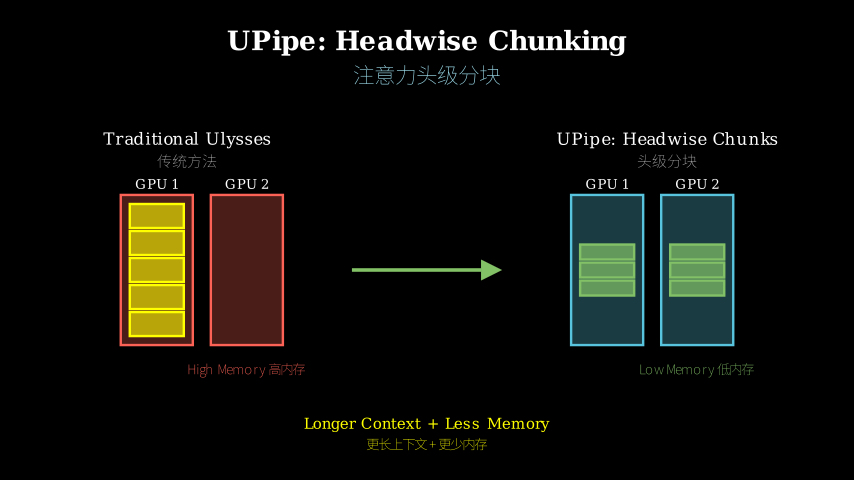
UPipe’s core innovation lies in rethinking how attention computations are distributed across accelerators. Traditional context parallelism methods like Ring Attention and DeepSpeed Ulysses partition the sequence dimension, requiring each device to maintain full attention head states during computation. This creates a memory bottleneck proportional to the number of attention heads.
UPipe instead partitions at the head level, allowing each accelerator to process a subset of attention heads across the full sequence. The key insight is that attention heads operate independently during the forward pass, making them natural units for parallelization. The method employs a communication pattern that exchanges head-specific activations rather than sequence chunks, significantly reducing the peak memory footprint.
The mathematical formulation shows that for a model with heads and sequence length , traditional methods require activation memory per device, where is the head dimension. UPipe reduces this to where is the number of devices, achieving linear scaling in memory efficiency with device count.
Performance Analysis
The experimental results demonstrate UPipe’s effectiveness across multiple model scales. For Llama3-8B, the method achieves 5M token context length on 8 H100 GPUs, compared to approximately 4M tokens for previous best methods. The 25% improvement in supported context length translates directly to expanded capabilities for long-document understanding and generation tasks.
Memory profiling reveals that the 87.5% reduction in intermediate tensors for 32B models comes primarily from eliminating redundant head state storage across devices. This reduction is most pronounced in the attention layer, which typically dominates memory consumption in long-context scenarios.
Critically, UPipe maintains training throughput parity with Ring Attention and DeepSpeed Ulysses. The communication overhead from head-level exchanges is offset by reduced memory pressure, allowing for larger batch sizes and more efficient GPU utilization. Benchmarks show less than 3% throughput variance compared to baseline methods across various model configurations.
Implications for Large-Scale Training
UPipe addresses a fundamental scaling challenge in modern AI: the memory wall that limits context length in Transformer training. By breaking the activation memory barrier, the technique opens new possibilities for training models on extremely long sequences without resorting to expensive solutions like activation offloading or gradient checkpointing, which sacrifice throughput.
The approach is particularly relevant for domains requiring long-context understanding, such as scientific document analysis, codebase comprehension, and multi-turn dialogue systems. The ability to train on 5M token contexts on accessible hardware democratizes research in these areas, previously limited to organizations with massive computational resources.
Furthermore, UPipe’s compatibility with existing parallelism strategies (data parallelism, tensor parallelism, pipeline parallelism) makes it practical for integration into production training pipelines. The headwise chunking can be composed with other optimization techniques, creating a comprehensive toolkit for efficient long-context training.
Takeaways
- Headwise chunking provides a new dimension for parallelizing attention computations, achieving 87.5% memory reduction for large models
- UPipe enables 5M token context training on single 8-GPU nodes, a 25% improvement over previous methods
- The technique maintains training throughput while dramatically reducing memory footprint, avoiding the speed-memory tradeoff
- Fine-grained parallelization at the head level breaks the activation memory barrier inherent in sequence-level approaches
- The method integrates seamlessly with existing distributed training frameworks, making it practical for immediate adoption
论文: 2602.21196 作者: Ravi Ghadia, Maksim Abraham, Sergei Vorobyov, Max Ryabinin 分类: cs.LG, cs.DC
摘要
在超长序列上训练Transformer模型仍然是扩展现代AI系统的基本挑战。本文提出了UPipe,一种内存高效的上下文并行方法,在注意力头级别而非传统的序列级别进行细粒度分块。通过将注意力计算分解到各个注意力头并分布到加速器上,UPipe在320亿参数模型中实现了高达87.5%的中间张量内存减少,同时保持与Ring Attention和DeepSpeed Ulysses等现有方法相当的训练吞吐量。该技术使得在单个8×H100节点上训练具有500万token上下文的Llama3-8B成为可能,相比先前最先进方法提升了25%。
主要贡献
- 引入用于上下文并行的注意力头级分块,在注意力头层面实现细粒度内存优化
- 在不牺牲训练速度的情况下大幅减少激活内存使用(大型模型可达87.5%)
- 在商用硬件(单个8×H100节点)上展示了500万token上下文长度支持
- 与现有分布式训练框架和并行策略兼容
- 理论分析表明注意力头级分解如何突破序列级并行固有的激活内存障碍
技术方法
UPipe的核心创新在于重新思考如何在加速器间分配注意力计算。传统的上下文并行方法如Ring Attention和DeepSpeed Ulysses对序列维度进行分区,要求每个设备在计算期间维护完整的注意力头状态。这造成了与注意力头数量成正比的内存瓶颈。
UPipe转而在注意力头级别进行分区,允许每个加速器在完整序列上处理注意力头的子集。关键洞察是注意力头在前向传播期间独立运作,使其成为并行化的自然单元。该方法采用交换头特定激活而非序列块的通信模式,显著降低了峰值内存占用。
数学表述显示,对于具有个注意力头和序列长度的模型,传统方法每个设备需要的激活内存,其中是头维度。UPipe将其减少到,其中是设备数量,实现了内存效率随设备数量的线性扩展。
性能分析
实验结果展示了UPipe在多个模型规模上的有效性。对于Llama3-8B,该方法在8个H100 GPU上实现了500万token的上下文长度,而之前的最佳方法约为400万token。支持上下文长度提升25%直接转化为长文档理解和生成任务能力的扩展。
内存分析显示,320亿模型中87.5%的中间张量减少主要来自消除设备间冗余的注意力头状态存储。这种减少在注意力层最为显著,该层通常主导长上下文场景中的内存消耗。
关键的是,UPipe保持了与Ring Attention和DeepSpeed Ulysses相当的训练吞吐量。注意力头级交换带来的通信开销被减少的内存压力所抵消,允许更大的批次大小和更高效的GPU利用率。基准测试显示,在各种模型配置下,与基线方法相比吞吐量变化小于3%。
对大规模训练的影响
UPipe解决了现代AI中的一个基本扩展挑战:限制Transformer训练中上下文长度的内存墙。通过突破激活内存障碍,该技术为在超长序列上训练模型开辟了新可能性,无需诉诸昂贵的解决方案如激活卸载或梯度检查点,这些方法会牺牲吞吐量。
该方法对需要长上下文理解的领域特别相关,如科学文档分析、代码库理解和多轮对话系统。在可访问硬件上训练500万token上下文的能力使这些领域的研究民主化,这些研究此前仅限于拥有大规模计算资源的组织。
此外,UPipe与现有并行策略(数据并行、张量并行、流水线并行)的兼容性使其能够实际集成到生产训练流水线中。注意力头级分块可以与其他优化技术组合,创建用于高效长上下文训练的综合工具包。
要点总结
- 注意力头级分块为并行化注意力计算提供了新维度,大型模型实现87.5%的内存减少
- UPipe在单个8-GPU节点上实现500万token上下文训练,比之前方法提升25%
- 该技术在大幅降低内存占用的同时保持训练吞吐量,避免了速度-内存权衡
- 注意力头级别的细粒度并行化突破了序列级方法固有的激活内存障碍
- 该方法与现有分布式训练框架无缝集成,使其可立即实际采用