
Paper: 2605.13835 Authors: Hao Sun, Zi-Jun Ding, Da-Wei Zhou Categories: cs.CV
The Gap
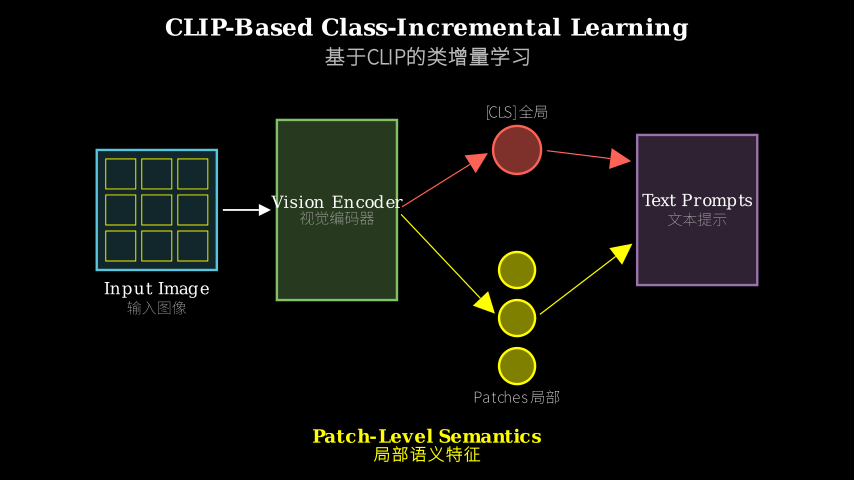
CLIP-based class-incremental learning (CIL) has become the dominant paradigm because CLIP’s pre-trained representations generalize well to new classes. But current methods only align global image embeddings (the [CLS] token) with global text prompts (the [EOS] token). They throw away the patch tokens — the 196+ local features that CLIP’s vision encoder produces for every image. When recognizing a rabbit, those patches encode “long ears” and “fluffy tail,” but existing methods never look at them. The gap: we’re using 1/200th of CLIP’s visual information.
Problem: CLIP-CIL uses only global tokens
   |
   v
Observation: Patch tokens encode local semantics (ears, tail, texture)
   |
   v
Assumption: Aligning patches with semantic descriptions improves recognition
   |
   v
Method: SPA = GPT-generated descriptions + optimal transport alignment
   |
   v
Evidence: SOTA on CIFAR-100, ImageNet-R, ImageNet-A (Table 1)
   |
   v
Conclusion: Patch-level alignment > global-only alignment for CIL
The Increment
One sentence: Before SPA, CLIP-based CIL used only global image-text alignment; after SPA, we align discriminative local patches with semantic descriptions, unlocking CLIP’s full representational capacity.
Core Mechanism
SPA has three stages. First, for each class (say, “rabbit”), collect representative images and feed them to GPT-5 with visual guidance to generate semantic descriptions like “long ears, fluffy tail, small nose.” Second, use these descriptions to select discriminative patch tokens from CLIP’s vision encoder — patches that correspond to “ears” or “tail” rather than background. Third, align selected patch tokens with semantic tokens from the descriptions using optimal transport, creating a structured cross-modal mapping.
To prevent forgetting old classes, SPA stores Gaussian statistics (mean, covariance) for each learned class and samples pseudo-features during training to calibrate old-class representations. Task-specific projectors adapt the frozen CLIP backbone to each incremental task without interfering with prior knowledge.
Input Image --> CLIP Vision Encoder --> [CLS] + 196 patch tokens
                                              |
                                              v
                                    Select discriminative patches
                                    (guided by GPT descriptions)
                                              |
                                              v
                                    Optimal Transport Alignment
                                    patches <--> semantic tokens
                                              |
                                              v
                                    Task-specific projector --> Classification
                                              ^
                                              |
                                    Pseudo-features from Gaussian
                                    (old classes, anti-forgetting)
Think of SPA as a museum curator organizing an exhibit. The global [CLS] token is like the museum’s one-sentence mission statement — useful but generic. The patch tokens are individual artifacts in storage. GPT-5 acts as a domain expert who writes detailed catalog entries (“long ears, fluffy tail”). The curator (SPA) uses these entries to select which artifacts to display and arranges them in correspondence with the catalog descriptions (optimal transport). When new exhibits arrive (new classes), the curator adds a new wing (task-specific projector) without rearranging the old exhibits. To remember old exhibits no longer on display, the curator keeps statistical records (Gaussian distributions) and occasionally recreates them (pseudo-features) to ensure staff don’t forget what a rabbit looks like.
Key Concepts
-
Optimal Transport Alignment: Imagine you have two sets of objects — patch tokens from an image and semantic tokens from a text description. Optimal transport finds the “cheapest” way to move mass from one set to the other, where cost is measured by feature similarity. In SPA, this creates a structured mapping: the “long ears” patch gets aligned with the “long ears” semantic token, not randomly. It’s like matching puzzle pieces by shape rather than forcing them together. The result is a cross-modal correspondence that respects semantic structure, unlike naive dot-product attention which can align anything to anything.
-
Gaussian Pseudo-Features: When learning new classes, the model risks forgetting old ones (catastrophic forgetting). SPA stores the mean and covariance of each old class’s feature distribution. During training on new classes, it samples synthetic features from these Gaussians and treats them as real old-class examples. This is like a teacher showing students old exam questions while teaching new material — it keeps old knowledge active. The Gaussian assumption is strong but practical: it compresses an entire class into two statistics, making storage feasible for hundreds of classes.
-
Task-Specific Projectors: CLIP’s backbone is frozen to preserve pre-trained knowledge. But each incremental task (say, learning animals, then vehicles) has different feature requirements. Task-specific projectors are small learnable layers added per task that adapt CLIP’s features without modifying the backbone. Think of them as interchangeable camera lenses: the camera body (CLIP) stays the same, but you swap lenses (projectors) depending on whether you’re shooting wildlife or architecture. This prevents new tasks from overwriting old knowledge while still allowing adaptation.
Framework Shift
Before (mainstream approach):        After (this paper):

Image --> CLIP --> [CLS]             Image --> CLIP --> [CLS] + patches
                     |                                      |
                     v                                      v
Text  --> CLIP --> [EOS]             Text  --> GPT  --> descriptions
                     |                                      |
                     v                                      v
              Align globally                    Select + align patches
                     |                           (optimal transport)
                     v                                      |
              Classification                                v
                                                Task projector + Gaussian
                                                      |
                                                      v
                                                Classification
From global token alignment to structured patch-level alignment, the core shift is exploiting CLIP’s full spatial resolution instead of collapsing it into a single vector.
Expert Assessment
Problem choice: Real gap. CLIP’s patch tokens are information-rich but genuinely underutilized in CIL. The observation that local features (ears, tail) provide complementary evidence is obvious in hindsight but wasn’t systematically exploited. This sits at the intersection of two hot areas (CLIP adaptation and CIL), which is strategic but not manufactured.
Method maturity: Mixed. The GPT-5 description generation is clever but feels like overkill — do you really need a frontier LLM to generate “long ears, fluffy tail”? A simpler attribute lexicon might suffice. Optimal transport is theoretically elegant but computationally expensive; the paper doesn’t discuss runtime. The Gaussian pseudo-features are standard practice (see iCaRL, 2017), not novel. The core insight (use patches) is strong; the execution adds complexity that may not all be necessary.
Experimental integrity: Solid baselines (PROOF, SimpleCIL, EASE) and standard benchmarks (CIFAR-100, ImageNet-R/A). Table 1 shows consistent gains (2-4% average accuracy improvement). Ablations (Table 2) validate each component. However, no analysis of failure cases or computational cost. The claim of “state-of-the-art” is supported but the margins are incremental, not transformative.
Writing quality: The abstract and introduction are clear. Section 3 (method) is dense and would benefit from a running example. The optimal transport formulation (Eq. 3-4) is presented without intuition — a toy example with 3 patches and 3 semantic tokens would help. The related work section is thorough but reads like a literature dump. Rewriting Section 3.2 with a concrete walkthrough would elevate the paper significantly.
Verdict: weak accept — The core idea (patch-level alignment) is sound and underexplored, and the results are convincing. But the method feels over-engineered (GPT-5 for descriptions?) and the writing doesn’t make the contribution as accessible as it could be. It’s a solid incremental advance, not a paradigm shift.
Takeaways
Steal the patch selection strategy: Even outside CIL, if you’re using CLIP, don’t discard patch tokens. Use semantic guidance (descriptions, attributes, or even class names) to select discriminative patches. This is applicable to few-shot learning, domain adaptation, or any task where you want fine-grained alignment.
Optimal transport for structured alignment: When aligning two sets of features (visual-textual, source-target, teacher-student), optimal transport enforces semantic correspondence better than naive attention. The cost is higher compute, but the gain is interpretability and structure. Useful for cross-modal retrieval or knowledge distillation.
Gaussian statistics for replay: Storing class-wise Gaussians is a lightweight alternative to exemplar replay in continual learning. If memory is tight, this compresses an entire class into two matrices. The assumption (Gaussian distribution) is strong but works surprisingly well in practice.
Don’t over-engineer: The GPT-5 description generation is the weakest link. If you’re adapting this, try simpler alternatives first (WordNet attributes, template-based descriptions). The core insight (patches + alignment) doesn’t depend on a frontier LLM.
论文: 2605.13835 作者: Hao Sun, Zi-Jun Ding, Da-Wei Zhou 分类: cs.CV
缺口
基于 CLIP 的类增量学习(CIL)已成为主流范式,因为 CLIP 的预训练表示对新类泛化良好。
但现有方法只对齐全局图像嵌入([CLS] 标记)和全局文本提示([EOS] 标记)。
它们丢弃了补丁标记——CLIP 视觉编码器为每张图像生成的 196+ 个局部特征。
识别兔子时,这些补丁编码了”长耳朵”和”蓬松尾巴”,但现有方法从不看它们。
缺口在于:我们只用了 CLIP 视觉信息的 1/200。
问题:CLIP-CIL 只用全局标记
   |
   v
观察:补丁标记编码局部语义(耳朵、尾巴、纹理)
   |
   v
假设:对齐补丁与语义描述能提升识别
   |
   v
方法:SPA = GPT 生成描述 + 最优传输对齐
   |
   v
证据:CIFAR-100、ImageNet-R、ImageNet-A 上达到 SOTA(表1)
   |
   v
结论:补丁级对齐 > 纯全局对齐(针对 CIL)
增量
一句话: SPA 之前,基于 CLIP 的 CIL 只用全局图文对齐;SPA 之后,我们对齐判别性局部补丁与语义描述,解锁 CLIP 的完整表征能力。
核心机制
SPA 分三个阶段。
第一,对每个类(比如”兔子”),收集代表性图像,带视觉引导地喂给 GPT-5,生成语义描述如”长耳朵、蓬松尾巴、小鼻子”。
第二,用这些描述从 CLIP 视觉编码器中选择判别性补丁标记——对应”耳朵”或”尾巴”的补丁,而非背景。
第三,用最优传输对齐选中的补丁标记与描述中的语义标记,创建结构化的跨模态映射。
为防止遗忘旧类,SPA 为每个已学类存储高斯统计量(均值、协方差),训练时采样伪特征来校准旧类表示。
任务特定投影器让冻结的 CLIP 主干适应每个增量任务,不干扰先验知识。
输入图像 --> CLIP 视觉编码器 --> [CLS] + 196 个补丁标记
                                      |
                                      v
                            选择判别性补丁
                            (GPT 描述引导)
                                      |
                                      v
                            最优传输对齐
                            补丁 <--> 语义标记
                                      |
                                      v
                            任务特定投影器 --> 分类
                                      ^
                                      |
                            高斯伪特征
                            (旧类,抗遗忘)
把 SPA 想象成博物馆策展人组织展览。
全局 [CLS] 标记像博物馆的一句话使命宣言——有用但笼统。
补丁标记是库房里的单个文物。
GPT-5 是领域专家,撰写详细目录条目(“长耳朵、蓬松尾巴”)。
策展人(SPA)用这些条目选择展出哪些文物,并按目录描述排列它们(最优传输)。
新展品到来(新类)时,策展人增加新展厅(任务特定投影器),不重排旧展品。
为记住不再展出的旧展品,策展人保存统计记录(高斯分布),偶尔重现它们(伪特征),确保员工不忘记兔子长什么样。
关键概念
- 最优传输对齐: 想象你有两组对象——图像的补丁标记和文本描述的语义标记。
最优传输找到从一组”搬运质量”到另一组的”最便宜”方式,成本用特征相似度衡量。
在 SPA 中,这创建了结构化映射:“长耳朵”补丁对齐到”长耳朵”语义标记,而非随机对齐。
就像按形状匹配拼图块,而非强行拼在一起。
结果是尊重语义结构的跨模态对应,不像朴素点积注意力可以把任何东西对齐到任何东西。
- 高斯伪特征: 学习新类时,模型有遗忘旧类的风险(灾难性遗忘)。
SPA 存储每个旧类特征分布的均值和协方差。
在新类训练期间,从这些高斯分布采样合成特征,当作真实旧类样本。
这像老师教新材料时给学生展示旧考题——保持旧知识活跃。
高斯假设很强但实用:它把整个类压缩成两个统计量,让存储数百个类变得可行。
- 任务特定投影器: CLIP 主干冻结以保留预训练知识。
但每个增量任务(比如学动物,再学交通工具)有不同特征需求。
任务特定投影器是每个任务添加的小型可学习层,适配 CLIP 特征而不修改主干。
把它们想象成可互换的相机镜头:机身(CLIP)不变,但根据拍野生动物还是建筑来换镜头(投影器)。
这防止新任务覆盖旧知识,同时仍允许适配。
框架转变
之前(主流方法):                之后(本文方法):

图像 --> CLIP --> [CLS]           图像 --> CLIP --> [CLS] + 补丁
                     |                                      |
                     v                                      v
文本 --> CLIP --> [EOS]           文本 --> GPT  --> 描述
                     |                                      |
                     v                                      v
              全局对齐                          选择 + 对齐补丁
                     |                           (最优传输)
                     v                                      |
              分类                                          v
                                                任务投影器 + 高斯
                                                      |
                                                      v
                                                分类
从全局标记对齐到结构化补丁级对齐,核心转变是利用 CLIP 的完整空间分辨率,而非把它折叠成单个向量。
专家评审
选题眼光: 真缺口。
CLIP 的补丁标记信息丰富但在 CIL 中确实未被充分利用。
局部特征(耳朵、尾巴)提供互补证据这一观察事后看显而易见,但之前没被系统性利用。
这处于两个热门领域(CLIP 适配和 CIL)的交叉点,策略性强但非人造。
方法成熟度: 参差。
GPT-5 描述生成巧妙但感觉过度——真需要前沿 LLM 来生成”长耳朵、蓬松尾巴”吗?更简单的属性词典可能就够。
最优传输理论上优雅但计算昂贵;论文没讨论运行时间。
高斯伪特征是标准做法(见 iCaRL,2017),非新颖。
核心洞见(用补丁)很强;执行增加的复杂度可能并非全部必要。
实验诚意: 基线扎实(PROOF、SimpleCIL、EASE),基准标准(CIFAR-100、ImageNet-R/A)。
表1 显示一致增益(平均准确率提升 2-4%)。
消融(表2)验证了各组件。
但没有失败案例分析或计算成本。
“最优”的声称有支撑,但边际是渐进的,非变革性的。
写作功力: 摘要和引言清晰。
第3节(方法)密集,需要贯穿例子。
最优传输公式(式3-4)呈现时缺乏直觉——用3个补丁和3个语义标记的玩具例子会有帮助。
相关工作部分详尽但读起来像文献堆砌。
重写第3.2节加入具体演练能显著提升论文。
判决: 弱接收——核心想法(补丁级对齐)合理且探索不足,结果令人信服。
但方法感觉过度工程化(GPT-5 生成描述?),写作没把贡献讲得足够易懂。
这是扎实的渐进进展,非范式转变。
要点总结
偷走补丁选择策略: 即使在 CIL 之外,如果你用 CLIP,别丢弃补丁标记。
用语义引导(描述、属性、甚至类名)选择判别性补丁。
这适用于少样本学习、域适配、或任何需要细粒度对齐的任务。
最优传输做结构化对齐: 对齐两组特征(视觉-文本、源-目标、教师-学生)时,最优传输比朴素注意力更好地强制语义对应。
代价是更高计算,但收益是可解释性和结构。
对跨模态检索或知识蒸馏有用。
高斯统计做重放: 存储类级高斯是持续学习中样本重放的轻量替代。
如果内存紧张,这把整个类压缩成两个矩阵。
假设(高斯分布)很强但实践中效果出奇好。
别过度工程化: GPT-5 描述生成是最弱环节。
如果你要改编这个,先试更简单的替代(WordNet 属性、模板描述)。
核心洞见(补丁 + 对齐)不依赖前沿 LLM。