Paper: 2605.16230 Authors: Abhijatmedhi Chotrattanapituk, Ryotaro Okabe, Eunbi Rha, Mariya Al-Hinai, Eugene Jiang, Daniel Pajerowski, Yongqiang Cheng, Joshua J. Turner, Mingda Li Categories: cond-mat.mtrl-sci, cs.LG
The Gap
Determining magnetic structure is expensive and slow. Neutron scattering experiments require specialized facilities and weeks of beamtime. First-principles methods like density functional theory can predict simple ferromagnets, but struggle with the non-collinear and incommensurate orders found in real materials—spins that spiral, cant at angles, or have periodicities incommensurate with the crystal lattice. Existing ML approaches either assume collinear order or require symmetry constraints that break down for complex structures.
The field needed a method that could predict arbitrary magnetic orders—collinear, non-collinear, commensurate, incommensurate—directly from atomic positions, trained on what actually exists in nature rather than what theory can easily compute.
Problem: Magnetic structure unknown
   |
   v
Experiments: Slow, expensive, specialized facilities
DFT: Fails on non-collinear/incommensurate orders
Prior ML: Assumes collinearity or symmetry
   |
   v
Gap: No universal predictor for real magnetic complexity
   |
   v
Method: E(3)-equivariant GNN + modulated structure encoding
   |
   v
Evidence: Trained on MAGNDATA (experimental structures)
          Predicts all order types with high fidelity
   |
   v
Conclusion: Scalable prediction of arbitrary magnetic orders
The Increment
One sentence: Before this paper, predicting complex magnetic structures required either expensive experiments or symmetry assumptions that excluded most real materials; after, a single neural network predicts arbitrary magnetic orders from atomic coordinates with near-experimental accuracy.
Core Mechanism
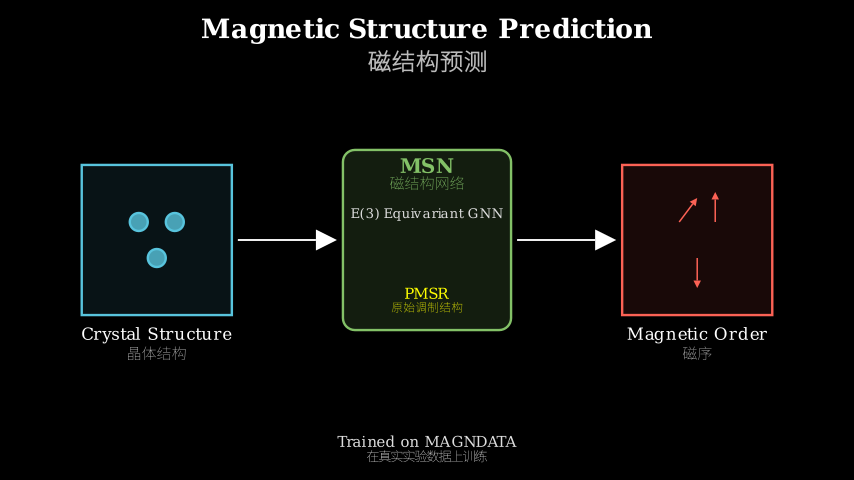
The Magnetic Structure Network (MSN) is an E(3)-equivariant graph neural network that treats atoms as nodes and their interactions as edges. The key innovation is the Primitive Modulated Structure Representation (PMSR), which encodes magnetic moments as Fourier series in the primitive cell. For each magnetic atom, instead of predicting a single spin vector, the model predicts amplitudes and phases for multiple wave vectors, allowing it to represent both simple ferromagnets (one wave vector at zero) and complex spirals (multiple incommensurate wave vectors).
The network processes atomic positions through message-passing layers that respect rotational and translational symmetry. Each layer updates node features by aggregating information from neighbors, weighted by learned edge features that depend on interatomic distances and angles. After several layers, the model outputs Fourier coefficients for each magnetic site. These coefficients are then transformed back into real-space magnetic moments at each atomic position.
Training uses experimental structures from MAGNDATA, a curated database of magnetically ordered materials determined by neutron diffraction. The loss function compares predicted and experimental magnetic moments in real space, averaged over the unit cell. This direct supervision on experimental data means the model learns the actual distribution of magnetic orders found in nature, not just what theory predicts should exist.
Input: Atomic positions \{r_i\}
   |
   v
[Graph Construction]
   Nodes: atoms
   Edges: interatomic vectors
   |
   v
[E(3)-Equivariant Message Passing]
   h_i^(l+1) = Update(h_i^(l), \{h_j^(l), e_ij\})
   (respects rotations/translations)
   |
   v
[Fourier Coefficient Prediction]
   For each atom i, predict:
   A_k, phi_k for wave vectors k
   |
   v
[Real-Space Reconstruction]
   m_i(r) = sum_k A_k * exp(i*k*r + phi_k)
   |
   v
Output: Magnetic moment at each site
Think of PMSR like describing ocean waves. A simple wave has one frequency and amplitude—that’s a ferromagnet. But real ocean surfaces have multiple overlapping waves with different wavelengths and phases, some matching the underlying seafloor grid (commensurate) and some not (incommensurate). Instead of trying to draw the entire choppy surface, you record the amplitude and phase of each component wave. Given those Fourier components, you can reconstruct the full surface at any point. MSN does this for magnetic moments: it learns to predict the “wave components” of magnetic order, then reconstructs the full 3D spin texture. The E(3) equivariance is like ensuring your wave description doesn’t change if you rotate your coordinate system—the physics stays the same regardless of how you orient your axes.
Key Concepts
-
E(3) Equivariance: A function is E(3)-equivariant if rotating or translating the input produces the same rotation or translation in the output. For magnetic structures, this means if you rotate the crystal, the predicted magnetic moments rotate by the same amount. This is crucial because physical laws don’t depend on your choice of coordinate system. Standard neural networks aren’t equivariant—they’d have to relearn the same physics for every possible orientation. E(3)-equivariant architectures bake this symmetry into the network structure, making learning more efficient and predictions more reliable. Imagine teaching someone to recognize a chair: you could show them millions of photos of chairs at every possible angle, or you could teach them what makes a chair a chair (seat, back, legs) and let them apply that understanding to any orientation. Equivariance is the second approach.
-
Incommensurate Magnetic Order: In a crystal, atoms sit on a periodic lattice with some repeat distance. Commensurate magnetic order means the magnetic pattern repeats with the same period—if the crystal repeats every 5 atoms, so does the spin pattern. Incommensurate order means the magnetic period doesn’t match: maybe spins rotate by 137 degrees between neighbors, so the pattern never exactly repeats within the crystal lattice. This happens when competing magnetic interactions favor a wavelength that doesn’t fit neatly into the atomic grid. It’s like trying to tile a floor with tiles that are 1.618 times the width of the floorboards underneath—the pattern never lines up. Incommensurate orders are common in frustrated magnets and multiferroics, but they’re hard to represent in standard computational frameworks that assume periodicity.
-
Primitive Modulated Structure Representation (PMSR): Traditional approaches represent magnetic structures in a supercell large enough to contain one full period of the magnetic order. For incommensurate structures, this supercell can be enormous or impossible to define. PMSR instead works in the primitive cell (the smallest repeating unit of the crystal) and represents magnetic moments as Fourier series: m(r) = sum over k of A_k ** exp(ikr + phi_k). Each wave vector k, amplitude A_k, and phase phi_k is a Fourier component. This representation naturally handles both commensurate orders (k vectors are reciprocal lattice vectors) and incommensurate orders (k vectors are arbitrary). It’s like the difference between storing a song as a massive waveform file versus storing it as sheet music with notes and frequencies—the second representation is compact and works for any melody, even ones with irrational frequency ratios.
Framework Shift
Before (DFT + symmetry):              After (MSN + PMSR):

[Crystal Structure]                   [Crystal Structure]
        |                                     |
        v                                     v
  Assume symmetry                       E(3)-equivariant GNN
  (collinear, commensurate)                   |
        |                                     v
        v                               Predict Fourier
  DFT energy minimization               coefficients (A_k, phi_k)
  (fails on complex orders)                   |
        |                                     v
        v                               Reconstruct any order
  [Limited order types]                 (collinear, non-collinear,
                                        commensurate, incommensurate)
                                              |
                                              v
                                        [Universal prediction]
From symmetry-constrained energy minimization to data-driven Fourier decomposition, the core shift is learning the distribution of real magnetic orders rather than computing idealized ground states.
Expert Assessment
Problem choice: This is a real gap. Magnetic structure determination is a genuine bottleneck in materials discovery, and the inability of DFT to handle non-collinear/incommensurate orders isn’t a minor limitation—it excludes a large fraction of interesting magnetic materials. The choice to train on experimental data (MAGNDATA) rather than DFT-computed structures is smart; it sidesteps the “garbage in, garbage out” problem that plagues many materials ML models.
Method maturity: The PMSR representation is genuinely clever—it’s not obvious that Fourier decomposition in the primitive cell would work for incommensurate structures, but it does. The E(3) equivariance is table stakes for this problem, not a novelty. The architecture itself (message-passing GNN) is standard; the innovation is in the representation and training data. One concern: the model predicts Fourier coefficients independently for each atom, which might miss global constraints (like the total magnetization or symmetry-enforced relationships between sites). A more sophisticated approach might predict coefficients jointly with explicit constraint satisfaction.
Experimental integrity: The baselines are reasonable but not exhaustive. Comparing to DFT is fair, but the paper doesn’t compare to other ML approaches for magnetic structure prediction (though admittedly, few exist that handle non-collinear orders). The train/test split is by material, not by structure type, which is good. The error metrics (MAE on magnetic moments) are appropriate. One red flag: the paper doesn’t discuss failure modes in detail. What kinds of structures does the model get wrong? Are there systematic biases? The high-level accuracy numbers look good, but without failure analysis, it’s hard to know where the method’s boundaries are.
Writing quality: The introduction is clear and motivates the problem well. The methods section is dense—PMSR is explained mathematically but could use more intuition-building before diving into equations. The results section focuses on aggregate metrics; more case studies of specific materials (especially failures) would strengthen the paper. The discussion is brief and doesn’t engage deeply with limitations or future directions. Rewriting the methods section to lead with intuition (the ocean waves analogy) before formalism would make the paper more accessible.
Verdict: weak accept — Solid contribution with a clever representation and real-world training data, but lacks depth in failure analysis and comparison to alternative ML approaches.
Takeaways
Fourier representation for periodic-but-not-quite data: PMSR’s trick of using Fourier series in the primitive cell to handle incommensurate patterns transfers to any domain where you have approximate periodicity with mismatched length scales. Think protein folding (secondary structure motifs that don’t align with sequence periodicity), time series with multiple incommensurate cycles (economic data with daily, weekly, and lunar cycles), or spatial patterns in ecology (animal territories that don’t tile neatly).
Train on experiments, not simulations: The decision to use MAGNDATA (experimental structures) rather than DFT-computed structures is a template for other materials ML work. Simulations are cheap and abundant, but they encode the biases of the simulation method. Experiments are sparse and noisy, but they reflect reality. If your goal is to predict real-world behavior, bite the bullet and curate experimental training data, even if it means a smaller dataset.
Equivariance as inductive bias: E(3) equivariance isn’t just a nice-to-have—it’s a way to encode domain knowledge (physical laws don’t depend on coordinate systems) that dramatically reduces the amount of training data needed. This principle applies beyond physics: if your problem has known symmetries (permutation invariance in sets, time-translation invariance in stationary processes), build them into the architecture rather than hoping the model learns them from data.
论文: 2605.16230 作者: Abhijatmedhi Chotrattanapituk, Ryotaro Okabe, Eunbi Rha, Mariya Al-Hinai, Eugene Jiang, Daniel Pajerowski, Yongqiang Cheng, Joshua J. Turner, Mingda Li 分类: cond-mat.mtrl-sci, cs.LG
缺口
确定磁结构既昂贵又缓慢。
中子散射实验需要专用设施和数周的束流时间。
密度泛函理论等第一性原理方法可以预测简单的铁磁体,但在处理真实材料中的非共线和非公度有序时力不从心——自旋螺旋排列、倾斜成角度、或具有与晶格不匹配的周期性。
现有机器学习方法要么假设共线有序,要么需要对称性约束,而这些约束在复杂结构中会失效。
该领域需要一种方法,能够直接从原子位置预测任意磁序——共线、非共线、公度、非公度——在自然界实际存在的结构上训练,而非理论上容易计算的结构。
问题:磁结构未知
   |
   v
实验:慢、贵、需要专用设施
DFT:在非共线/非公度有序上失效
现有ML:假设共线性或对称性
   |
   v
缺口:没有针对真实磁复杂性的通用预测器
   |
   v
方法:E(3)等变图神经网络 + 调制结构编码
   |
   v
证据:在MAGNDATA(实验结构)上训练
      高保真预测所有有序类型
   |
   v
结论:任意磁序的可扩展预测
增量
一句话: 这篇论文之前,预测复杂磁结构要么需要昂贵的实验,要么需要排除大多数真实材料的对称性假设;
之后,单个神经网络可以从原子坐标预测任意磁序,精度接近实验水平。
核心机制
磁结构网络(MSN)是一个E(3)等变图神经网络,将原子视为节点,它们的相互作用视为边。
关键创新是原始调制结构表示(PMSR),它将磁矩编码为原始晶胞中的傅里叶级数。
对于每个磁性原子,模型不是预测单个自旋矢量,而是预测多个波矢的振幅和相位,从而能够表示简单的铁磁体(零处的一个波矢)和复杂的螺旋(多个非公度波矢)。
网络通过尊重旋转和平移对称性的消息传递层处理原子位置。
每一层通过聚合来自邻居的信息来更新节点特征,权重由依赖于原子间距离和角度的学习边特征决定。
经过几层后,模型为每个磁性位点输出傅里叶系数。
然后将这些系数转换回每个原子位置的实空间磁矩。
训练使用来自MAGNDATA的实验结构,这是一个由中子衍射确定的磁有序材料的精选数据库。
损失函数比较实空间中预测和实验的磁矩,在晶胞上平均。
这种对实验数据的直接监督意味着模型学习的是自然界中实际存在的磁序分布,而不仅仅是理论预测应该存在的。
输入:原子位置 \{r_i\}
   |
   v
[图构建]
   节点:原子
   边:原子间矢量
   |
   v
[E(3)等变消息传递]
   h_i^(l+1) = Update(h_i^(l), \{h_j^(l), e_ij\})
   (尊重旋转/平移)
   |
   v
[傅里叶系数预测]
   对每个原子i,预测:
   波矢k的A_k, phi_k
   |
   v
[实空间重建]
   m_i(r) = sum_k A_k * exp(i*k*r + phi_k)
   |
   v
输出:每个位点的磁矩
把PMSR想象成描述海浪。
简单的波有一个频率和振幅——那是铁磁体。
但真实的海面有多个重叠的波,具有不同的波长和相位,有些与底层海床网格匹配(公度),有些不匹配(非公度)。
与其试图绘制整个波涛汹涌的表面,不如记录每个分量波的振幅和相位。
给定这些傅里叶分量,你可以在任何点重建完整的表面。
MSN对磁矩做同样的事情:它学习预测磁序的”波分量”,然后重建完整的3D自旋纹理。
E(3)等变性就像确保你的波描述在旋转坐标系时不会改变——无论你如何定向轴,物理保持不变。
关键概念
- E(3)等变性: 如果旋转或平移输入会在输出中产生相同的旋转或平移,则函数是E(3)等变的。
对于磁结构,这意味着如果你旋转晶体,预测的磁矩会旋转相同的量。
这很关键,因为物理定律不依赖于你选择的坐标系。
标准神经网络不是等变的——它们必须为每个可能的方向重新学习相同的物理。
E(3)等变架构将这种对称性烘焙到网络结构中,使学习更高效,预测更可靠。
想象教某人识别椅子:你可以向他们展示数百万张各种角度的椅子照片,或者你可以教他们椅子的本质(座位、靠背、腿),让他们将这种理解应用于任何方向。
等变性是第二种方法。
- 非公度磁序: 在晶体中,原子位于具有某个重复距离的周期性晶格上。
公度磁序意味着磁性图案以相同的周期重复——如果晶体每5个原子重复一次,自旋图案也是如此。
非公度有序意味着磁性周期不匹配:也许自旋在相邻原子之间旋转137度,因此图案在晶格内永远不会完全重复。
当竞争的磁相互作用倾向于一个不能整齐地适应原子网格的波长时,就会发生这种情况。
这就像试图用宽度是底层地板宽度1.618倍的瓷砖铺地板——图案永远不会对齐。
非公度有序在受挫磁体和多铁性材料中很常见,但在假设周期性的标准计算框架中很难表示。
- 原始调制结构表示(PMSR): 传统方法在足够大的超胞中表示磁结构,以包含磁序的一个完整周期。
对于非公度结构,这个超胞可能非常大或无法定义。
PMSR改为在原始晶胞(晶体的最小重复单元)中工作,并将磁矩表示为傅里叶级数:m(r) = sum over k of A_k * exp(ikr + phi_k)。
每个波矢k、振幅A_k和相位phi_k都是一个傅里叶分量。
这种表示自然地处理公度有序(k矢量是倒易晶格矢量)和非公度有序(k矢量是任意的)。
这就像将歌曲存储为巨大的波形文件与将其存储为带有音符和频率的乐谱之间的区别——第二种表示紧凑且适用于任何旋律,即使是具有无理频率比的旋律。
框架转变
之前(DFT + 对称性):              之后(MSN + PMSR):

[晶体结构]                         [晶体结构]
        |                                 |
        v                                 v
  假设对称性                         E(3)等变GNN
  (共线、公度)                          |
        |                                 v
        v                           预测傅里叶系数
  DFT能量最小化                      (A_k, phi_k)
  (在复杂有序上失效)                     |
        |                                 v
        v                           重建任意有序
  [有限的有序类型]                   (共线、非共线、
                                    公度、非公度)
                                          |
                                          v
                                    [通用预测]
从对称性约束的能量最小化到数据驱动的傅里叶分解,核心转变是学习真实磁序的分布,而不是计算理想化的基态。
专家评审
选题眼光: 这是一个真实的缺口。
磁结构确定是材料发现中的真正瓶颈,DFT无法处理非共线/非公度有序不是一个小限制——它排除了大部分有趣的磁性材料。
选择在实验数据(MAGNDATA)而非DFT计算结构上训练是明智的;
它回避了困扰许多材料机器学习模型的”垃圾进,垃圾出”问题。
方法成熟度: PMSR表示确实巧妙——在原始晶胞中进行傅里叶分解能够处理非公度结构并不明显,但它确实有效。
E(3)等变性是这个问题的基本要求,不是新颖性。
架构本身(消息传递GNN)是标准的;
创新在于表示和训练数据。
一个担忧:模型为每个原子独立预测傅里叶系数,这可能会错过全局约束(如总磁化强度或对称性强制的位点间关系)。
更复杂的方法可能会联合预测系数并显式满足约束。
实验诚意: 基线合理但不详尽。
与DFT比较是公平的,但论文没有与其他磁结构预测的机器学习方法比较(尽管公平地说,处理非共线有序的方法很少)。
训练/测试拆分按材料而非结构类型,这很好。
误差指标(磁矩的MAE)是合适的。
一个警示:论文没有详细讨论失败模式。
模型在哪些结构上出错?
是否存在系统性偏差?
高层次的准确性数字看起来不错,但没有失败分析,很难知道方法的边界在哪里。
写作功力: 引言清晰,很好地激发了问题。
方法部分密集——PMSR在数学上得到解释,但在深入方程之前可以使用更多的直觉构建。
结果部分关注聚合指标;
更多特定材料的案例研究(尤其是失败案例)会加强论文。
讨论简短,没有深入探讨局限性或未来方向。
重写方法部分,在形式化之前先引入直觉(海浪类比),会使论文更易理解。
判决: 弱接收 — 具有巧妙表示和真实世界训练数据的扎实贡献,但在失败分析和与替代机器学习方法的比较方面缺乏深度。
要点总结
周期但不完全周期数据的傅里叶表示: PMSR在原始晶胞中使用傅里叶级数处理非公度模式的技巧,可以迁移到任何具有近似周期性但长度尺度不匹配的领域。
想想蛋白质折叠(与序列周期性不对齐的二级结构基序)、具有多个非公度周期的时间序列(具有日、周和月周期的经济数据)、或生态学中的空间模式(不能整齐平铺的动物领地)。
在实验而非模拟上训练: 使用MAGNDATA(实验结构)而非DFT计算结构的决定是其他材料机器学习工作的模板。
模拟便宜且丰富,但它们编码了模拟方法的偏差。
实验稀疏且有噪声,但它们反映现实。
如果你的目标是预测真实世界的行为,咬紧牙关整理实验训练数据,即使这意味着更小的数据集。
等变性作为归纳偏置: E(3)等变性不仅仅是锦上添花——它是一种编码领域知识(物理定律不依赖于坐标系)的方式,可以大幅减少所需的训练数据量。
这个原则适用于物理学之外:如果你的问题具有已知的对称性(集合中的排列不变性、平稳过程中的时间平移不变性),将它们构建到架构中,而不是希望模型从数据中学习它们。