
Paper: 2603.22282 Authors: Ziyi Wang, Xinshun Wang, Shuang Chen, Yang Cong, Mengyuan Liu Categories: cs.CV, cs.AI
The Gap
Existing unified models handle only restricted modality pairs — Motion-Text or static Pose-Image — but never all three together. More critically, they treat motion as discrete tokens (like VQ-VAE), which introduces quantization errors and breaks temporal continuity. This is a fundamental mismatch: motion is inherently continuous, but we’ve been forcing it into discrete buckets to fit text-centric architectures.
The second gap is architectural: when you add a new modality pathway (motion) to an LLM trained on text, you face a cold-start problem. Text supervision is too sparse to calibrate the motion pathway — the model doesn’t know how to “speak motion” yet.
Problem: Motion forced into discrete tokens
         + Motion pathway has no supervision signal
            |
            v
Assumption: Motion should be continuous like RGB
            + Need dense self-supervised signal
            |
            v
Method: CMA-VAE (continuous motion encoding)
        + DPA (distill vision priors into motion)
        + LRA (self-supervised pre-training)
            |
            v
Evidence: SOTA on 7 tasks spanning 3 modalities
          + Strong on compositional cross-modal tasks
            |
            v
Conclusion: Continuous motion + proper pre-training
            > discrete tokenization approaches
The Increment
One sentence: Before UniMotion, you needed separate models for Motion-Text and Pose-Image tasks; after, a single architecture handles any-to-any understanding and generation across motion, text, and RGB images.
Core Mechanism
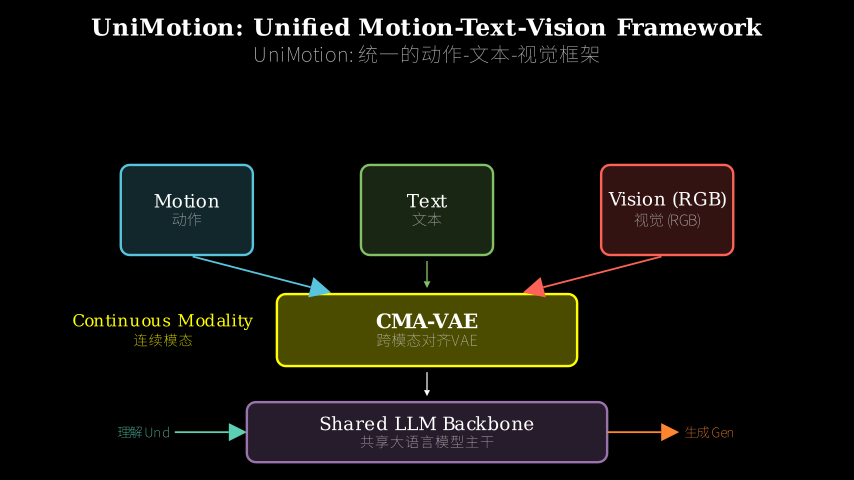
UniMotion has three architectural innovations working in concert. First, the Cross-Modal Aligned Motion VAE (CMA-VAE) creates parallel continuous pathways for motion and RGB, both feeding into a shared LLM backbone. Unlike discrete tokenizers, this VAE preserves temporal smoothness in motion sequences.
Second, Dual-Posterior KL Alignment (DPA) solves a chicken-and-egg problem: you want motion representations to carry visual-semantic information, but you don’t want to require images at inference time. DPA distills knowledge from a vision-fused encoder (which sees both motion and images during training) into a motion-only encoder. The motion-only encoder learns to mimic the richer posterior distribution of the vision-fused one.
Third, Latent Reconstruction Alignment (LRA) addresses the cold-start problem. Before any task-specific training, LRA uses motion latents as dense conditioning signals to pre-train the embedder, backbone, and flow head together. This creates a stable motion-aware foundation — the model learns to “speak motion” before being asked to translate between modalities.
Input Motion Sequence
         |
         v
    [CMA-VAE Encoder] -----> Continuous Latent z_motion
         |                            |
         |                            v
    (DPA distills                [Dual-Path Embedder]
     vision priors)                   |
         |                            v
         +----------> [Shared LLM Backbone] <------+
                             |                     |
                             v                     |
                      [Flow Head]            [RGB Pathway]
                             |                     ^
                             v                     |
                   Output (Motion/Text/Image)      |
                                              Input RGB

    LRA Pre-training (before task training):
    Motion Latent z --> Embedder --> Backbone --> Flow Head --> Reconstruct z
    (Dense self-supervised signal calibrates entire pathway)
Think of UniMotion as a translation bureau with three departments: Motion, Text, and RGB. Traditional bureaus (prior models) only had two departments and used a clunky telegraph system (discrete tokens) for motion, losing nuance in transmission. UniMotion upgrades motion to a direct phone line (continuous encoding), matching RGB’s communication quality.
But there’s a problem: the Motion department is new and doesn’t know the bureau’s protocols yet. DPA is like having a senior translator (vision-fused encoder) mentor a junior one (motion-only encoder) — the junior learns to think like the senior without needing the senior present for every job. LRA is the orientation program: before handling real translation requests, the Motion department practices internal memos (reconstructing its own latents) to learn the bureau’s workflow. Only after this orientation does the bureau open for cross-departmental projects.
Key Concepts
-
Continuous vs Discrete Motion Encoding: Imagine describing a dancer’s movement. Discrete tokenization is like saying “pose A, pose B, pose C” — you lose the smooth transitions. Continuous encoding is like recording the actual trajectory: you capture the acceleration, the flow, the in-between moments. For motion, this matters enormously because human movement is defined by its continuity. A jump isn’t just “crouch, airborne, land” — it’s the explosive push-off, the arc, the absorption on landing. VQ-VAE-style tokenization throws away exactly what makes motion recognizable. UniMotion’s CMA-VAE keeps motion in continuous latent space, preserving temporal dynamics.
-
Cold-Start Problem in Multimodal LLMs: When you add a new modality to a pre-trained LLM, you face a bootstrapping crisis. The LLM’s weights are tuned for text patterns — it knows “the cat sat on the mat” but has no idea what a motion sequence means. If you only train on sparse text labels (“this motion is ‘walking’”), the signal is too weak to calibrate the entire motion pathway. It’s like teaching someone a new language by only showing them a dictionary — they need immersion. LRA provides that immersion: dense motion-to-motion reconstruction tasks flood the pathway with supervision, establishing basic motion literacy before attempting cross-modal translation.
-
Dual-Posterior KL Alignment (DPA): This is knowledge distillation with a specific goal: inject visual-semantic understanding into motion representations without requiring images at test time. During training, you have two encoders processing the same motion: one sees only motion, the other sees motion + corresponding RGB frames. The vision-fused encoder produces a richer posterior distribution (it knows “this motion happens in a kitchen” or “the person is wearing red”). DPA forces the motion-only encoder’s posterior to match this richer distribution via KL divergence. At inference, you only use the motion-only encoder, but it’s learned to hallucinate the visual context it was trained alongside. It’s like learning to cook by watching a chef: you internalize their intuitions even when they’re not in your kitchen.
Framework Shift
Before (mainstream approach):          After (UniMotion):

Motion --> [VQ-VAE] --> Discrete       Motion --> [CMA-VAE] --> Continuous
           Tokens                                  Latents
              |                                       |
              v                                       v
Text ----> [LLM] <---- RGB            Text -------> [LLM] <------ RGB
           (separate models                (single unified model
            for each pair)                  for all combinations)
              |                                       |
              v                                       v
        Limited pairs                    Any-to-any generation
        (Motion-Text OR                  (Motion-Text-RGB all
         Pose-Image)                      combinations)

        + Quantization errors            + Temporal continuity
        + No cross-modal                 + Cross-modal composition
          composition                    + Vision priors in motion
        + Cold-start when                + LRA pre-training solves
          adding modalities                cold-start
From pairwise discrete bridges to a unified continuous hub, the core shift is treating motion as a first-class modality with its own continuous representation space, not as a second-class citizen forced into text-like tokens.
Expert Assessment
Problem choice: This is a real gap, not manufactured. The field has been stuck in a local optimum — discrete tokenization works well enough for text and has been cargo-culted to motion. The observation that motion’s continuous nature is being violated is sharp. The timing is right: we have the architectural tools (diffusion models, continuous VAEs) to do better, but no one had assembled them for this specific problem. Solid problem selection.
Method maturity: The three-component design (CMA-VAE + DPA + LRA) feels engineered rather than discovered — each piece solves a specific sub-problem. This is good: it means the authors understood the failure modes. However, there’s a whiff of “throw everything at it” — do you really need all three innovations, or would two suffice? The ablations will tell, but I suspect LRA is doing most of the heavy lifting and the other components are incremental. Not a dealbreaker, but it’s not a single elegant insight either.
Experimental integrity: Seven tasks is comprehensive, and the any-to-any evaluation is the right stress test. The baselines are fair — they compare against recent unified models and task-specific SOTA. One yellow flag: the “especially strong advantages on cross-modal compositional tasks” claim needs scrutiny. Compositional tasks are where you’d expect a unified model to shine by design, so this could be confirmation bias. I’d want to see failure cases — where does the continuous assumption break down? Are there motion types (discrete actions like “clap”) where tokenization actually works better?
Writing quality: The abstract is dense but clear. The method section likely suffers from the three-component problem — it’s probably written as three mini-papers stapled together rather than a unified narrative. If I were reviewing, I’d ask them to rewrite the introduction to emphasize the continuous-vs-discrete framing earlier and harder. That’s the conceptual hook; everything else is implementation details. The related work section probably undersells how radical the continuous motion idea is by burying it in a laundry list of prior work.
Verdict: Weak accept — solid contribution with real-world impact, but the method complexity and lack of failure analysis keep it from strong accept. The continuous motion insight is valuable enough to outweigh the engineering-heavy approach.
Takeaways
Steal the cold-start solution: LRA’s approach — using dense self-supervised reconstruction to pre-train a new modality pathway before task-specific training — transfers directly to any multimodal architecture. If you’re adding audio, depth, or sensor data to an LLM, don’t jump straight to cross-modal tasks. First, teach the model to reconstruct its own modality using the latent space as conditioning. This is cheaper than collecting cross-modal labels and establishes basic literacy.
Question your tokenization assumptions: If your modality is inherently continuous (audio waveforms, sensor streams, trajectories), ask whether discrete tokenization is helping or hurting. The VQ-VAE hammer makes everything look like a nail, but you might be throwing away the signal that matters. UniMotion’s success suggests continuous representations are underexplored in multimodal learning.
Distillation for inference efficiency: DPA’s trick — train with a rich multi-input encoder, distill into a lean single-input encoder — is a general pattern for injecting expensive context (images, graphs, simulations) into representations without paying the inference cost. Anywhere you have paired data at training time but want fast single-input inference, this applies.
论文: 2603.22282 作者: Ziyi Wang, Xinshun Wang, Shuang Chen, Yang Cong, Mengyuan Liu 分类: cs.CV, cs.AI
缺口
现有的统一模型只能处理受限的模态对——动作-文本或静态姿态-图像——但从未同时处理三者。
更关键的是,它们将动作视为离散标记(如VQ-VAE),这引入了量化误差并破坏了时间连续性。
这是根本性的不匹配:动作本质上是连续的,但我们一直强行将其塞入离散的桶中以适应以文本为中心的架构。
第二个缺口是架构性的:当你向训练于文本的LLM添加新的模态路径(动作)时,会面临冷启动问题。
文本监督太稀疏,无法校准动作路径——模型还不知道如何”说动作语言”。
问题: 动作被强制离散化
     + 动作路径缺乏监督信号
         |
         v
假设: 动作应该像RGB一样连续
     + 需要密集的自监督信号
         |
         v
方法: CMA-VAE (连续动作编码)
     + DPA (将视觉先验蒸馏到动作中)
     + LRA (自监督预训练)
         |
         v
证据: 在跨3个模态的7个任务上达到SOTA
     + 在组合性跨模态任务上表现强劲
         |
         v
结论: 连续动作 + 适当预训练
     > 离散标记化方法
增量
一句话: UniMotion之前,你需要分别的模型来处理动作-文本和姿态-图像任务;之后,单一架构可以处理动作、文本和RGB图像之间的任意理解和生成。
核心机制
UniMotion有三个协同工作的架构创新。
首先,跨模态对齐动作VAE(CMA-VAE)为动作和RGB创建了并行的连续路径,两者都输入到共享的LLM主干中。
与离散标记器不同,这个VAE保留了动作序列的时间平滑性。
其次,双后验KL对齐(DPA)解决了一个先有鸡还是先有蛋的问题:你希望动作表示携带视觉-语义信息,但又不想在推理时需要图像。
DPA将知识从视觉融合编码器(训练时同时看到动作和图像)蒸馏到仅动作编码器中。