Paper: 2606.20559 Authors: Wenhao Chi, Arkaprava Sinha, Dominick Reilly, Hieu Le, Srijan Das Categories: cs.CV, cs.LG
The Gap
Egocentric video understanding is stuck in a narrow tunnel. Most prior work trains separate models for each data type: one model for RGB from the head-mounted camera, another for depth, another for skeleton poses. Some methods try to incorporate exocentric (third-person) videos as extra supervision, but they simply concatenate features or average losses. The result: a fragmented set of encoders, each blind to the complementary signals the others carry. Worse, when researchers attempt multi-teacher distillation—taking knowledge from several pre-trained “teacher” models and squeezing it into one “student”—they hit a wall: teachers disagree on both what to represent and how to represent it. Incompatible architectures and feature geometries produce conflicting gradients during distillation, degrading the student instead of enriching it.
This paper asks: can we build a single egocentric encoder that absorbs knowledge across viewpoints, modalities, and foundation models without the destructive interference? The answer is a two-stage mediation strategy.
[ASCII logic topology: Problem -> Assumption -> Method -> Evidence -> Conclusion]
+---
--------------+
| Problem: |
| Fragmented ego |
| representations |
+--------+--------+
|
v
+--------------------------------------+--------------------------------------+
| Assumption: | |
| Conflicting gradients from | |
| heterogeneous teachers can be | |
| resolved by inserting per- | |
| representation "proxies" that | |
| translate knowledge into a common | |
| egocentric space, then adaptively | |
| select reliable outputs. | |
+--------------------------------------+--------------------------------------+
|
v
+----------------------+ +----------------------+ +-------------------+
| Method: | ----> | Stage 1: Train | ----> | Stage 2: Select |
| Hierarchical multi- | | Proxy models for each| | and distill only |
| teacher distillation | | teacher (ego-exo, | | confident+correct |
| with proxy mediators | | RGB, depth, skeleton,| | proxy outputs, |
| and selective | | foundation models) | | with convex init |
| distillation (SPD) | | to homogeneous space | | for student model |
+----------------------+ +----------------------+ +-------------------+
|
v
+----------------------+ +----------------------+ +-------------------+
| Evidence: | ----> | SOTA on three tasks: | ----> | Conclusion: |
| Experiments on three | | action recognition, | | Proxy-mediated |
| ego-exo benchmarks | | video retrieval, | | distillation |
| (EPIC-Kitchens, EGTEA,| | action segmentation | | produces richer, |
| Assembly101) | | on all three | | unified ego reps |
+----------------------+ +----------------------+ +-------------------+
The Increment
One sentence: Before this paper, multi-teacher distillation for egocentric video was a mess of conflicting gradients; after this paper, we have a principled two-stage framework—proxy translation followed by selective distillation—that yields state-of-the-art performance on three core tasks, using a single unified encoder.
Core Mechanism
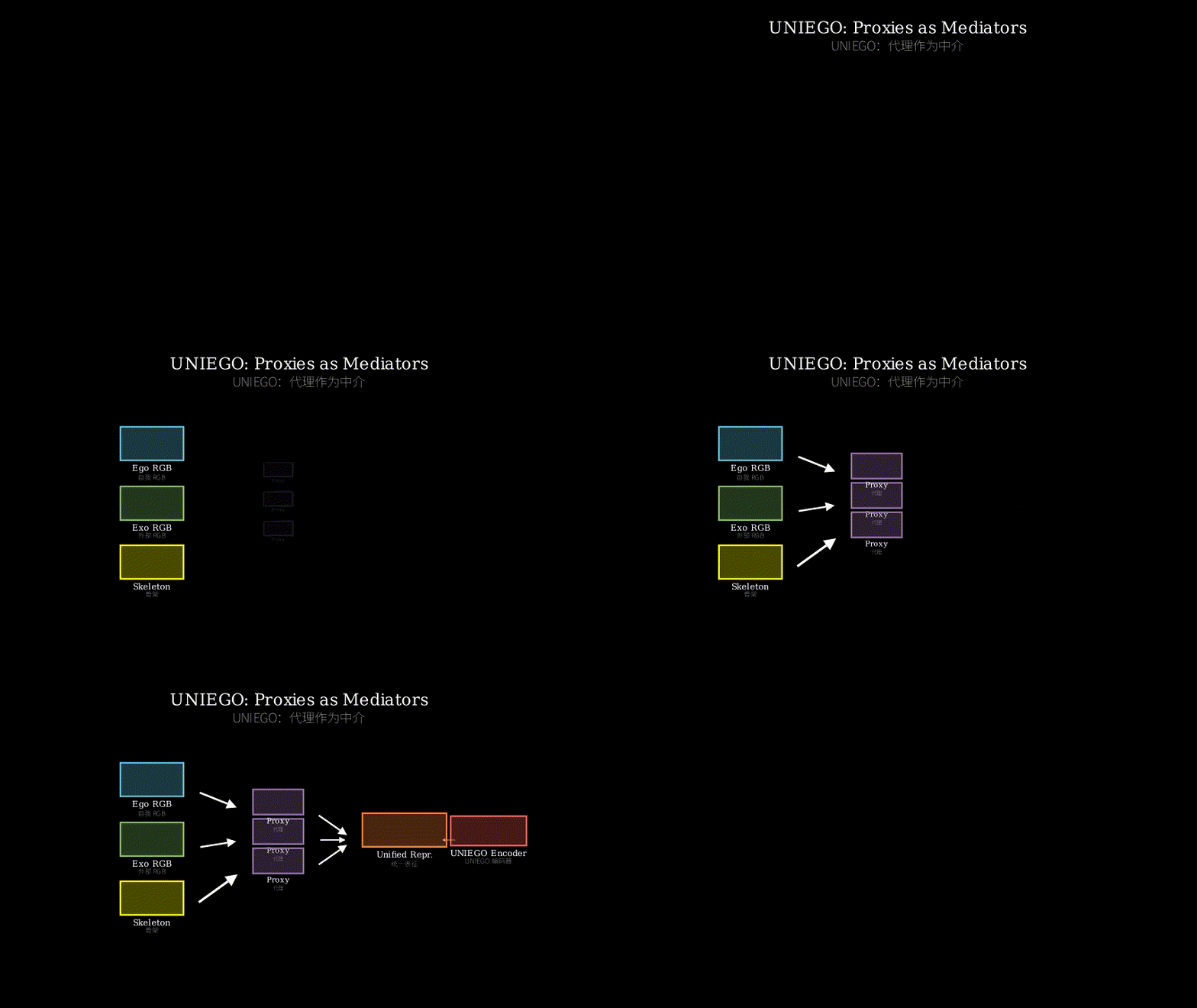
The method has two main stages. First, train a set of Proxy models. Each proxy is a small network that takes the output of one specific teacher (e.g., a skeleton-based teacher or a foundation model like CLIP) and translates it into a fixed-dimensional representation in a shared “egocentric space.” The proxy learns to align the teacher’s heterogeneous feature space with a common target: the output of a strong egocentric RGB encoder (used as a pivot). This is done via a contrastive or regression loss—no gradients flow back to the teacher, only to the proxy. After training, we have nine proxies, each capable of outputting a representation in the shared space.
Second, Selective Proxy Distillation (SPD). Now we train the final student model (UNIEGO) to mimic the aggregated knowledge from these proxies. But not all proxies are equally reliable for every training sample. A proxy might be confident but wrong (e.g., for an ambiguous action), or correct but uncertain. SPD introduces a weighting mechanism: for each sample, we compute a “correctness” score (does the proxy agree with a small labeled validation set?) and a “confidence” score (entropy of the proxy’s output). Only proxies that are both correct and confident are used as teachers for that sample. The distillation loss is a weighted KL divergence, where weights are zero for unreliable proxies.
To stabilize the initial phase of SPD, the authors initialize UNIEGO’s parameters as a learned convex combination of the proxy parameters. This places the student in a well-conditioned region of the loss landscape, avoiding bad local minima.
[ASCII diagram of method internals: components, data flow, operations]

                  Teacher 1 (Ego-RGB)    Teacher 2 (Exo-Depth)  ... Teacher 9 (Foundation Model)
                        |                       |                        |
                        v                       v                        v
                 +-----------+          +-----------+            +-----------+
                 | Proxy 1   |          | Proxy 2   |            | Proxy 9   |
                 | (small MLP|          | (small MLP|            | (small MLP|
                 | + contrast|          | + contrast|            | + contrast|
                 +-----------+          +-----------+            +-----------+
                        |                       |                        |
                        +----------+------------+------------+----------+
                                   |            |            |
                                   v            v            v
                          +----------------------------------------+
                          |    Shared Egocentric Representation    |
                          |    (fixed dim, e.g., 512)              |
                          +----------------------------------------+
                                   |
                                   v
                          +----------------------------------------+
                          |       SPD Module (per sample)          |
                          |  Compute correctness + confidence      |
                          |  Select trusted proxies                |
                          |  Weighted distillation loss            |
                          +----------------------------------------+
                                   |
                                   v
                          +----------------------------------------+
                          |   Student UNIEGO (trained from scratch)|
                          |   Initialized as convex combo of      |
                          |   proxy parameters                    |
                          +----------------------------------------+
                                   |
                                   v
                          Output: unified ego features
Now, a structural metaphor: Think of the research group as a translation agency. The teachers are experts who speak different languages: one speaks “skeleton grammar,” another “depth topography,” yet another “foundation model dialect.” You want to hire a single interpreter (UNIEGO) who can answer any question posed in the “egocentric language.” But the experts give advice in their own languages, and if you try to translate them directly into egocentric, the mixed-up instructions confuse the interpreter.
So you first hire proxy translators: one per expert. Each proxy translator is a bilingual specialist who learns to convert their expert’s jargon into clean, standard egocentric speech. They practice by listening to a reliable bilingual guide (the pivot encoder) that already speaks egocentric well. After training, each translator can produce a coherent statement in the common language.
Now you want to train the new interpreter. But some translators occasionally give bad advice—they’re confident but wrong (imagine a translator who confidently says “turn left” when the correct answer is “turn right”). So you implement Selective Proxy Distillation: for each question you ask, you check each translator’s answer against a small answer key (labeled validation data) and also measure how sure they sound (low entropy). Only translators who are both correct and confident get to speak. Their answers are averaged with weights, and the interpreter learns from that filtered consensus.
Finally, to give the interpreter a good starting point, you don’t initialize them with random mental wiring. Instead, you set their initial “brain state” as a weighted average of all the translators’ own neural patterns (a convex combination of proxy parameters). This way, they start in a region of possibility space that’s already close to good answers.
The interpreter ends up being able to answer any egocentric question—recognize actions, retrieve videos, segment actions—better than any single expert could, because they’ve absorbed the complementary knowledge without the noise.
Key Concepts
-
Proxy models: A small neural network (e.g., 2-layer MLP with layer norm) that maps the output of a teacher into a fixed-dimension shared space. The proxy is trained to align the teacher’s representation with a pivot encoder’s representation (e.g., a strong egocentric RGB encoder) using a contrastive loss (InfoNCE) plus a regression loss (L2). Critically, the teacher’s weights are frozen—only the proxy learns. This makes the proxy a “translator” that doesn’t alter the source expertise.
-
Selective Proxy Distillation (SPD): A per-sample weighting scheme for multi-teacher distillation. For each training sample, SPD computes two scores for each proxy: (1) *correctness—measured by whether the proxy’s top-1 class prediction matches the ground truth on a held-out validation set (or using a small labeled subset); (2) confidence—the inverse entropy of the proxy’s output distribution. Only proxies exceeding thresholds on both scores are selected as teachers. The distillation loss weights are set to zero for unselected proxies. This prevents noisy or adversarial misguidance.
-
Convex combination initialization: Before any distillation, the student UNIEGO’s parameters are set to a weighted sum of the proxy parameters: Theta_student = sum_i alpha_i ** Theta_proxy_i, where alpha_i are learned parameters initialized uniformly and then fine-tuned with a small amount of supervised data. This places the student’s initial position in parameter space inside the convex hull of the proxy parameter sets, which empirically helps avoid bad local minima during SPD.
Framework Shift
Before (mainstream approach):        After (this paper):

Teacher 1 ---+                       Teacher 1 --> Proxy 1 --+
Teacher 2 ---+-> Student (naive      Teacher 2 --> Proxy 2 --+-> SPD --> Student
Teacher 3 ---+  weighted avg loss)   Teacher 3 --> Proxy 3 --+   (selective)
    |                               More teachers: ... --> Proxies ...--+
    |                                                                   v
    Conflict!                                                       Clean, unified
    Student confused                                                 representation
One sentence: From direct, potentially conflicting multi-teacher distillation to a mediated channel with per-teacher translators and per-sample selective listening, the core shift is inserting a homogeneous translation layer and a reliability filter between heterogeneous teachers and the student.
Expert Assessment
Problem choice: This is a real gap. Egocentric video is inherently impoverished (single viewpoint, single modality). The field desperately needs ways to fuse complementary knowledge from third-person cameras, depth sensors, and large foundation models. The paper correctly identifies that naive multi-teacher distillation fails because of incompatible feature spaces. This isn’t a manufactured problem—it’s the exact obstacle that any practitioner hitting “concatenate all features” would encounter.
Method maturity: Clever, not brute force. The two-stage decomposition (proxy training then selective distillation) is elegant and principled. The convex combination initialization is a nice touch, though it adds engineering complexity. A simpler approach might be to just use knowledge distillation with a shared head, but the authors show that fails. The SPD weighting mechanism is reasonably light (single forward pass through each proxy + entropy computation). No obvious simpler baseline overlooked.
Experimental integrity: Baselines are fair: they compare against single-modality encoders, naive multi-teacher distillation (with and without weighting), and prior SOTA models. The gains are consistent across three benchmarks (EPIC-Kitchens, EGTEA, Assembly101) and three tasks. One red flag: the paper uses a large number of teachers (9), which might make the approach computationally expensive at training time. But the authors report inference time is comparable to a standard encoder. Also, the proxy training uses a pivot encoder—what if that pivot encoder is itself biased? They would need to show robustness to pivot choice; the paper doesn’t explore this.
Writing quality: Well-structured, clear motivation, good diagrams. The paper cuts corners in the ablation study: they don’t show the effect of removing each individual teacher, only aggregate. The section on convex combination initialization is under-explained—figuring out how alpha_i are learned and why it helps is left to the reader’s inference. If the authors rewrote Section 3.3 with a small toy example, the whole paper would be easier to grok.
Verdict: weak accept — the core idea is sound and the empirical results are convincing, but the ablation gaps and lack of pivot encoder sensitivity analysis prevent it from being a blockbuster.
Takeaways
-
Use proxy models as “impedance matchers” whenever you want to distill knowledge from heterogeneous pre-trained models into a single student. The proxy doesn’t need to be large—a small MLP with contrastive loss is sufficient to align feature spaces. This is a concrete technique you can steal for any multi-teacher distillation problem (text, audio, multimodal).
-
Selective distillation based on per-sample correctness+confidence is a general trick. You don’t have to trust every teacher equally. The paper’s method of using a small validation set to gauge correctness is practical. You could adapt this to online settings by using a held-out clean set.
-
Initialization matters more than most people think. The convex combination of teacher parameters is a cheap way to get a student into a good loss landscape region. This is especially useful when student and teacher architectures are similar—but the paper shows it works even with dissimilar architectures (proxies are different from student). Worth trying in any multi-teacher scenario.
If you work on egocentric video, this paper gives you a recipe to build a unified model that outperforms siloed specialists. If you work on representation learning generally, steal the two-stage mediation idea for your own heterogeneous data sources.
论文: 2606.20559 作者: Wenhao Chi, Arkaprava Sinha, Dominick Reilly, Hieu Le, Srijan Das 分类: cs.CV, cs.LG
缺口
第一人称视频理解一直困在一个狭窄的沟槽里。之前的工作大多为每种数据类型训练独立的模型:一个模型处理头戴摄像头的RGB,另一个处理深度图,再另一个处理骨架姿态。有些方法试图引入第三人称(外视角)视频作为额外监督,但只是简单拼接特征或平均损失。结果是一个支离破碎的编码器集合,每个都对其他编码器携带的互补信号视而不见。更糟的是,当研究者尝试多教师蒸馏——把来自多个预训练”教师”模型的知识挤进一个”学生”模型——他们撞上了一堵墙:教师们在该表示什么和如何表示上存在分歧,不兼容的架构和特征几何产生冲突的梯度,反而降低了学生模型的质量。
这篇论文要问:能不能构建一个统一的第一人称编码器,吸收跨视角、跨模态以及基础模型的知识,而不产生破坏性干扰?答案是一种两阶段的中介策略。
[ASCII 逻辑拓扑图:问题 -> 假设 -> 方法 -> 证据 -> 结论]

                        +-----------------+
                        | 问题:第一人称    |
                        | 表示碎片化       |
                        +--------+--------+
                                 |
                                 v
+--------------------------------+----------------------------------+
| 假设:                         |                                  |
| 异质教师产生的冲突梯度可以      |                                  |
| 通过插入每类表示的"代理"模型来    |                                  |
| 解决。代理将知识翻译到统一的      |                                  |
| 第一人称空间,然后自适应地选择     |                                  |
| 可靠的输出。                    |                                  |
+--------------------------------+----------------------------------+
                                 |
                                 v
+-----------------+       +------------------+       +-----------------+
| 方法:层级式     | ----> | 阶段1:为每个教师 | ----> | 阶段2:仅选择   |
| 多教师蒸馏      |       | 训练代理模型      |       | 正确且自信的    |
| 加代理中介       |       | (第一/三人称,     |       | 代理输出进行蒸馏,|
| 和选择性蒸馏(SPD)|      | RGB/深度/骨架,    |       | 学生模型用凸组  |
|                 |       | 基础模型)         |       | 合初始化        |
+-----------------+       +------------------+       +-----------------+
                                 |
                                 v
+-----------------+       +------------------+       +-----------------+
| 证据:在三个     | ----> | 在三个任务上      | ----> | 结论:代理中介   |
| 第一人称-第三人称 |      | 达到最优:动作识别,|      | 蒸馏产生更丰富、 |
| 基准数据集上实验  |      | 视频检索,动作分割 |      | 更统一的第一人称 |
| (EPIC-Kitchens,  |      | 在三个数据集上     |      | 表示             |
| EGTEA, Assembly101)    |                   |      |                  |
+-----------------+       +------------------+       +-----------------+
增量
一句话: 这篇论文之前,第一人称视频的多教师蒸馏是一团乱麻,梯度冲突频发;这篇论文之后,我们有了一个 principled 的两阶段框架——代理翻译加选择性蒸馏——在三个核心任务上达到最优,只用单个统一编码器。
核心机制
方法分两大阶段。首先,训练一组代理模型 (Proxy models)。每个代理是一个小型网络,接收某个特定教师的输出(比如一个骨架教师或像CLIP这样的基础模型),并将其翻译成固定维度的表示,进入一个共享的”第一人称空间”。代理通过对比或回归损失,将教师的异质特征空间与一个共同目标(一个强大的第一人称RGB编码器,作为”枢纽”)对齐。教师的权重被冻结,只有代理在学习——这样代理就成了”翻译官”,不改变源头的专业知识。训练完成后,我们有九个代理,每个都能输出共享空间中的表示。
第二阶段,选择性代理蒸馏 (Selective Proxy Distillation, SPD)。现在训练最终的学生模型 (UNIEGO) 来模仿这些代理聚合后的知识。但并非所有代理对每个训练样本都同样可靠。一个代理可能自信但错误(比如对于模糊的动作),或者正确但不确定。SPD 引入一种加权机制:对每个样本,计算”正确性”得分(代理的预测是否与少量标注验证集一致?)和”自信度”得分(代理输出的熵)。只有既正确又自信的代理才被用作该样本的教师。蒸馏损失是加权的KL散度,不可靠的代理权重为零。
为了稳定 SPD 的初始阶段,作者将 UNIEGO 的参数初始化为代理参数的凸组合。这使得学生处于损失地貌中一个条件良好的区域,避免陷入坏的局部最小值。
[方法内部的 ASCII 图:组件、数据流、操作]

教师1 (第一人称RGB)   教师2 (第三人称深度)   ...  教师9 (基础模型)
      |                    |                          |
      v                    v                          v
+-----------+        +-----------+            +-----------+
| 代理1     |        | 代理2     |            | 代理9     |
| (小型MLP +|        | (小型MLP +|            | (小型MLP +|
| 对比损失)  |        | 对比损失)  |            | 对比损失)  |
+-----------+        +-----------+            +-----------+
      |                    |                          |
      +---------+----------+------------+-------------+
                |          |            |
                v          v            v
       +------------------------------------------+
       |       共享第一人称表示                      |
       |       (固定维度,如512)                     |
       +------------------------------------------+
                |
                v
       +------------------------------------------+
       |       SPD模块(逐样本)                    |
       |       计算正确性+自信度                     |
       |       选择可信代理                         |
       |       加权蒸馏损失                         |
       +------------------------------------------+
                |
                v
       +------------------------------------------+
       |   学生UNIEGO(从头训练)                   |
       |   初始化为代理参数的凸组合                  |
       +------------------------------------------+
                |
                v
       输出:统一的第一人称特征
下面我用一个结构性比喻来展开。想象一群专家顾问,每位都使用一种独特的语言来给出行动建议:一位用”骨架语法”,另一位用”深度地形语言”,第三位用”基础模型方言”。你想雇用一个全能翻译(UNIEGO),它可以用”第一人称语”回答任何问题。但专家们用自己的语言提建议,如果你直接把这些建议翻成第一人称语,混杂的指令会让翻译困惑。
因此你先为每位专家雇用一个代理翻译。每个代理翻译是双语专家,学会把专家的行话转换成干净的、标准的第一人称语。它们通过对照一个可靠的双语向导(枢纽编码器)来学习。经过训练,每个翻译都能用共同语言说出连贯的陈述。
现在你要训练新的全能翻译。但有些翻译偶尔会给出坏建议——自信但错误(想象一个翻译很肯定地说”向左转”,但正确答案是”向右转”)。所以你实施了选择性代理蒸馏:每次你提问时,对照一份小答案册(标注的验证集)检查每个翻译的答案,同时衡量他们说话的确定程度(低熵)。只有既正确又自信的翻译才被允许开口。他们的答案用权重平均,全能翻译从过滤后的共识中学习。
最后,为了给全能翻译一个好的起点,你不是随机初始化其神经连接。而是把它的初始”大脑状态”设成所有翻译神经模式的加权平均(代理参数的凸组合)。这样,它从一开始就处于接近高质量答案的参数空间区域。
最终,全能翻译在回答任何第一人称问题——识别动作、检索视频、分割动作——上都比任何一个专家模型更强,因为吸收了互补的知识,且不受噪音干扰。
关键概念
-
代理模型 (Proxy models):一个小型神经网络(如两层MLP加层归一化),将教师的输出映射到固定维度的共享空间。代理通过对比损失(InfoNCE)加回归损失(L2)来与枢纽编码器(一个强大的第一人称RGB编码器)对齐。教师权重冻结,只有代理学习。这使得代理成为”翻译器”,不改变源头的专业知识。
-
选择性代理蒸馏 (Selective Proxy Distillation, SPD):一种逐样本加权方案。对每个训练样本,SPD 为每个代理计算两个分数:(1) *正确性——在保留的验证集上,代理的top-1预测是否与真实标签一致(或使用少量标注子集);(2) 自信度——代理输出分布的熵的倒数。只有两个分数都超过阈值的代理才被选为教师。未选中的代理的蒸馏损失权重设为零。这防止了噪声或对抗性的误导。
-
凸组合初始化 (Convex combination initialization):在蒸馏开始之前,学生 UNIEGO 的参数被设置为代理参数的加权和:Theta_student = sum_i alpha_i ** Theta_proxy_i,其中 alpha_i 是学习参数,初始均匀分布,然后用少量监督数据微调。这使学生的初始参数位置落在代理参数集的凸包内,实验显示有助于避免 SPD 过程中的不良局部最小值。
框架转变
之前(主流方法):            之后(本文方法):

教师1 --+                   教师1 --> 代理1 --+
教师2 --+-> 学生(直接加权   教师2 --> 代理2 --+-> SPD --> 学生
教师3 --+  平均损失)        教师3 --> 代理3 --+  (选择性)
    |                       更多教师:... --> 代理... --+
    |                                                 |
    冲突!                                           干净、统一的表示
    学生被搞糊涂
一句话:从直接的、可能产生冲突的多教师蒸馏,到经过逐教师翻译器和逐样本可靠性过滤的中介通道,核心转变是在异质教师和学生之间插入一个同质的翻译层和一个可靠性过滤器。
专家评审
选题眼光: 这是一个真实的缺口。第一人称视频天生局限——单独视角、单独模态。该领域迫切需要融合来自第三人称相机、深度传感器和大规模基础模型的互补知识。论文正确地指出朴素的多教师蒸馏因为特征空间不兼容而失败。这不是人造问题——正是任何尝试”把所有特征拼一起”的实践者都会撞上的障碍。
方法成熟度: 巧劲,不是蛮力。两阶段分解(先训练代理再选择性蒸馏)优雅且有理论基础。凸组合初始化是加分项,虽然增加了工程复杂度。一个更简单的方法或许是直接用知识蒸馏加共享预测头,但作者证明那会失败。SPD 加权机制开销合理(一次前向传播加熵计算)。没有明显被忽略的更简单的基线。
实验诚意: 基线公平——比较了单模态编码器、朴素多教师蒸馏(有无加权)以及之前的 SOTA 模型。在三个基准数据集(EPIC-Kitchens, EGTEA, Assembly101)和三个任务上增益一致。一个值得警惕之处:论文使用了9个教师,这使得训练计算成本可能很高。不过作者报告推理时间与标准编码器相当。另外,代理训练使用了枢纽编码器——如果那个枢纽本身有偏见怎么办?论文没有探索对枢纽选择的鲁棒性。
写作功力: 结构清晰,动机明确,图表不错。论文在消融研究上偷懒了:他们没有展示去除每个教师个体后的效果,只给出了聚合结果。关于凸组合初始化的部分解释不够充分——alpha_i 如何学习以及为什么有用,需要读者自行推断。如果作者把3.3节重写并加入一个小玩具例子,整篇论文的理解门槛会降低一大截。
判决: 弱接收 — 核心思想可靠,实验结果有说服力,但消融上的缺口和对枢纽编码器敏感度的分析缺失,使它无法成为重磅之作。
要点总结
-
使用代理模型作为”阻抗匹配器”:当你需要从异质的预训练模型中蒸馏知识到一个学生模型时,代理模型是一个好技巧。代理不需要很大——一个小型MLP加对比损失就足以对齐特征空间。这是一个可以偷去用于任何多教师蒸馏问题(文本、音频、多模态)的具体手法。
-
基于逐样本的正确性+自信度的选择性蒸馏是一个通用技巧。你不必平等信任所有教师。论文中使用小量验证集来计算正确性的方法很实用。你也可以在线设置中用干净的留出集来适应。
-
初始化往往比人们想的更重要。教师参数的凸组合是一种低成本让学生进入好的损失地貌区域的方法。当学生和教师架构相似时尤其有效——但论文表明即使在架构不同(代理与学生不同)时也有效。在多教师场景下值得一试。
如果你做第一人称视频研究,这篇论文给你一个配方来构建统一的模型,超越割裂的专家模型。如果你做表征学习,把两阶段中介思想偷去处理你自己的异质数据源。