
Paper: 2605.04044 Authors: Prajnan Goswami, Tianye Ding, Feng Liu, Huaizu Jiang Categories: cs.CV
The Gap
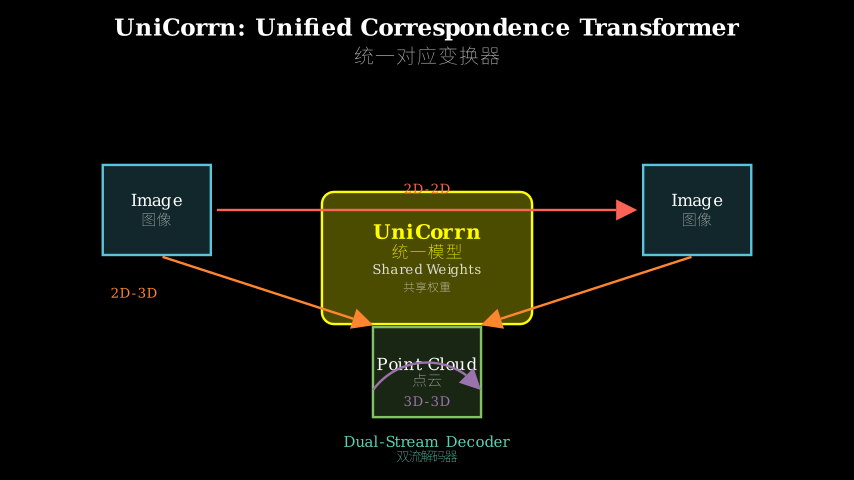
Visual correspondence — finding matching points across images and 3D point clouds — is fundamental to SLAM, 3D reconstruction, and AR. Existing methods treat each modality pair as a separate problem: LoFTR for image-to-image, 2D3D-MatchNet for image-to-point cloud, GeoTransformer for point cloud-to-point cloud. Each uses custom architectures, separate training pipelines, and isolated datasets. This fragmentation wastes engineering effort and prevents knowledge transfer across tasks that share the same underlying structure: finding geometric correspondences.
The core question: Can a single model with shared weights handle all three correspondence tasks without sacrificing performance?
Problem: Fragmented correspondence methods
   |
   v
Observation: All tasks find geometric matches
   |
   +---> Assumption: Transformer attention can capture
   |                 cross-modal similarity uniformly
   |
   v
Method: Dual-stream decoder (appearance + position)
        + modality-agnostic encoder
   |
   v
Evidence: Competitive on 2D-2D, +8% on 2D-3D (7Scenes),
          +10% on 3D-3D (3DLoMatch) registration recall
   |
   v
Conclusion: Unified architecture viable across modalities
The Increment
One sentence: Before UniCorrn, correspondence methods required separate models per modality pair; after, a single model with shared weights handles 2D-2D, 2D-3D, and 3D-3D matching competitively.
Core Mechanism
UniCorrn uses modality-specific backbones (CNN for images, sparse convolution for point clouds) to extract initial features, then feeds them into a shared Transformer encoder-decoder. The key innovation is the dual-stream decoder: one stream processes appearance features (color, texture), the other processes positional features (coordinates, geometry). Each decoder layer applies self-attention within streams and cross-attention between modalities.
For correspondence estimation, the model uses a query-based approach. Given a point in one modality, it becomes a query that attends to all points in the target modality. The decoder outputs similarity scores, and the highest-scoring target point is the predicted match. This works identically whether querying from image to image, image to point cloud, or point cloud to point cloud.
Training combines real 3D correspondence datasets (ScanNet, 3DMatch) with pseudo point clouds generated from depth maps of 2D datasets (MegaDepth). The model learns to align features across modalities by jointly optimizing on all three tasks, with losses weighted to balance dataset sizes.
Input A (image/cloud)  Input B (image/cloud)
        |                      |
        v                      v
  Backbone A              Backbone B
  (modality-specific)     (modality-specific)
        |                      |
        +----------+-----------+
                   |
                   v
          Shared Transformer Encoder
          (cross-modal attention)
                   |
                   v
          Dual-Stream Decoder
          /                  \
   Appearance Stream    Position Stream
   (color, texture)     (coords, geometry)
          \                  /
           +-------+--------+
                   |
                   v
          Query-based Matching
          (point A -> best match in B)
                   |
                   v
          Correspondence Pairs
Think of UniCorrn as a universal translator at an international conference. The modality-specific backbones are interpreters who convert each language (images, point clouds) into a common intermediate language. The shared encoder is the conference hall where everyone can understand each other. The dual-stream decoder is like having two simultaneous conversations: one about what things look like (appearance) and one about where things are (position). When someone asks “where is the matching point?” (query), the decoder searches both conversations simultaneously and returns the best answer. Whether you’re translating English-to-French, English-to-Mandarin, or Mandarin-to-French, the same conference hall and conversation structure work — you just swap the interpreters at the entrance.
Key Concepts
-
Dual-stream decoding: Traditional correspondence methods mix appearance and geometry into a single feature vector. UniCorrn separates them into parallel streams. Why? Appearance features (RGB values, texture patterns) and positional features (XYZ coordinates, surface normals) have different invariances. Appearance should be invariant to rotation and translation; position should encode spatial relationships. By keeping them separate, each stream can specialize. During matching, both streams vote: “this point looks similar” (appearance) and “this point is geometrically consistent” (position). The final match requires agreement from both. Concrete example: matching a red cube in two images. Appearance stream finds all red regions; position stream finds all cube-shaped geometry. Only their intersection is the correct match.
-
Query-based correspondence: Instead of computing a dense similarity matrix between all points (which scales quadratically), UniCorrn treats correspondence as a retrieval problem. Pick a point in source modality → it becomes a query → decoder attends to all target points → outputs a ranked list. This is like searching a database: you don’t compare your query to every document exhaustively; you use an index (the learned attention mechanism) to retrieve the best matches. For 2D-3D matching, an image pixel queries the point cloud; for 3D-3D, a point in cloud A queries cloud B. Same mechanism, different inputs.
Framework Shift
Before (task-specific models):

Image A ---> [LoFTR] ---> Image B
                |
              Custom architecture,
              separate training

Image A ---> [2D3D-MatchNet] ---> Cloud B
                |
              Different architecture,
              different training

Cloud A ---> [GeoTransformer] ---> Cloud B
                |
              Yet another architecture,
              isolated training


After (UniCorrn):

Image/Cloud A ----+
                  |
                  v
            [Modality Backbone]
                  |
                  v
            [Shared Encoder]
                  |
                  v
            [Dual-Stream Decoder]
                  ^
                  |
            [Modality Backbone]
                  |
Image/Cloud B ----+

Same weights for all three tasks,
joint training on mixed data
From task-specific architectures to modality-agnostic processing, the core shift is treating correspondence as a unified geometric reasoning problem rather than three separate engineering challenges.
Expert Assessment
Problem choice: Real gap. The fragmentation of correspondence methods is a genuine engineering pain point — maintaining three codebases, three training pipelines, three sets of hyperparameters. The unification is not just conceptually elegant; it has practical value for deployment and maintenance.
Method maturity: The dual-stream decoder is a clever insight, not brute force. Separating appearance and position is well-motivated by their different invariance properties. However, the reliance on pseudo point clouds from depth maps for 2D training is a workaround, not a principled solution. The paper doesn’t deeply explore why this works or when it might fail.
Experimental integrity: Baselines are fair and comprehensive. The +8% on 7Scenes and +10% on 3DLoMatch are solid improvements, not marginal noise. However, the 2D-2D results are only “competitive,” not state-of-the-art — the unified model trades some specialization for generality. The ablation studies are thorough, showing that both streams and joint training contribute meaningfully.
Writing quality: The method section is clear, but the related work undersells the novelty. The paper spends too much time listing prior work and not enough explaining why dual-stream decoding is the right design choice. The supplementary material is strong, with detailed architecture diagrams and failure case analysis.
Verdict: weak accept — Solid contribution with practical value, but the 2D-2D performance plateau and reliance on pseudo data prevent this from being a strong accept. The unification is real, but not yet dominant across all tasks.
Takeaways
Dual-stream processing for heterogeneous features: When your task involves features with different invariance properties (e.g., appearance vs. geometry, content vs. style, semantic vs. spatial), consider parallel processing streams that specialize before fusing. This pattern transfers to multimodal learning, image editing, and any domain where you’re matching across feature types.
Query-based matching scales better than dense similarity: If you’re computing correspondences or retrievals, frame it as “query one, attend to many” rather than “compare all to all.” This is especially useful when one modality is much larger than the other (e.g., matching a small image patch to a large point cloud).
Joint training on mixed data can work: The paper shows that mixing real 3D data with pseudo 3D data (from depth maps) doesn’t degrade performance. If you’re data-constrained in one modality, consider synthetic augmentation from related modalities rather than treating them as separate problems.
论文: 2605.04044 作者: Prajnan Goswami, Tianye Ding, Feng Liu, Huaizu Jiang 分类: cs.CV
缺口
视觉对应——在图像和三维点云之间找到匹配点——是 SLAM、三维重建和 AR 的基础。
现有方法把每对模态当作独立问题:LoFTR 做图像到图像,2D3D-MatchNet 做图像到点云,GeoTransformer 做点云到点云。
每个都用定制架构、独立训练流程、隔离的数据集。
这种碎片化浪费工程精力,也阻止了知识在本质相同的任务间迁移:找几何对应。
核心问题:一个共享权重的模型能否处理全部三种对应任务而不牺牲性能?
问题:碎片化的对应方法
   |
   v
观察:所有任务都在找几何匹配
   |
   +---> 假设:Transformer 注意力可以统一捕获
   |           跨模态相似性
   |
   v
方法:双流解码器(外观 + 位置)
      + 模态无关编码器
   |
   v
证据:2D-2D 持平,2D-3D (7Scenes) +8%,
      3D-3D (3DLoMatch) 配准召回率 +10%
   |
   v
结论:统一架构在跨模态上可行
增量
一句话: UniCorrn 之前,对应方法需要每对模态一个独立模型;
之后,单个共享权重模型就能胜任 2D-2D、2D-3D、3D-3D 匹配。
核心机制
UniCorrn 用模态专用主干(图像用 CNN,点云用稀疏卷积)提取初始特征,然后送入共享的 Transformer 编码器-解码器。
关键创新是双流解码器:一条流处理外观特征(颜色、纹理),另一条流处理位置特征(坐标、几何)。
每个解码器层在流内做自注意力,在模态间做交叉注意力。
对应估计用基于查询的方法。
给定一个模态中的点,它成为查询,注意到目标模态的所有点。
解码器输出相似度分数,得分最高的目标点就是预测匹配。
无论是图像到图像、图像到点云,还是点云到点云,机制完全相同。
训练结合真实三维对应数据集(ScanNet、3DMatch)和从二维数据集(MegaDepth)深度图生成的伪点云。
模型通过在三个任务上联合优化来学习跨模态特征对齐,损失加权以平衡数据集大小。
输入 A (图像/点云)  输入 B (图像/点云)
        |                      |
        v                      v
    主干 A                  主干 B
  (模态专用)              (模态专用)
        |                      |
        +----------+-----------+
                   |
                   v
          共享 Transformer 编码器
          (跨模态注意力)
                   |
                   v
            双流解码器
          /                  \
     外观流                位置流
   (颜色、纹理)          (坐标、几何)
          \                  /
           +-------+--------+
                   |
                   v
          基于查询的匹配
          (点 A -> B 中最佳匹配)
                   |
                   v
            对应点对
把 UniCorrn 想象成国际会议上的通用翻译系统。
模态专用主干是口译员,把各种语言(图像、点云)转换成通用中间语言。
共享编码器是会议大厅,大家都能互相理解。
双流解码器像同时进行两场对话:一场关于东西长什么样(外观),一场关于东西在哪里(位置)。
当有人问”匹配点在哪?“(查询),解码器同时搜索两场对话,返回最佳答案。
无论你翻译英语到法语、英语到中文,还是中文到法语,同样的会议大厅和对话结构都能用——只需在入口换口译员。
关键概念
- 双流解码: 传统对应方法把外观和几何混进单一特征向量。
UniCorrn 把它们分成并行流。
为什么?
外观特征(RGB 值、纹理模式)和位置特征(XYZ 坐标、表面法线)有不同的不变性。
外观应该对旋转和平移不变;
位置应该编码空间关系。
分开后,每条流可以专门化。
匹配时,两条流投票:“这个点看起来相似”(外观)和”这个点几何一致”(位置)。
最终匹配需要两者同意。
具体例子:在两张图像中匹配红色立方体。
外观流找所有红色区域;
位置流找所有立方体形状的几何。
只有它们的交集才是正确匹配。
- 基于查询的对应: 不计算所有点之间的密集相似度矩阵(二次方复杂度),UniCorrn 把对应当作检索问题。
选源模态中的一个点 → 它成为查询 → 解码器注意到所有目标点 → 输出排序列表。
这像搜索数据库:你不会把查询和每个文档详尽比较;
你用索引(学到的注意力机制)检索最佳匹配。
对于 2D-3D 匹配,图像像素查询点云;
对于 3D-3D,云 A 中的点查询云 B。
同样机制,不同输入。
框架转变
之前(任务专用模型):

图像 A ---> [LoFTR] ---> 图像 B
                |
              定制架构,
              独立训练

图像 A ---> [2D3D-MatchNet] ---> 点云 B
                |
              不同架构,
              不同训练

点云 A ---> [GeoTransformer] ---> 点云 B
                |
              又一个架构,
              隔离训练


之后(UniCorrn):

图像/点云 A ----+
                |
                v
          [模态主干]
                |
                v
          [共享编码器]
                |
                v
          [双流解码器]
                ^
                |
          [模态主干]
                |
图像/点云 B ----+

三个任务用同样权重,
混合数据联合训练
从任务专用架构到模态无关处理,核心转变是把对应当作统一的几何推理问题,而非三个独立的工程挑战。
专家评审
选题眼光: 真缺口。
对应方法的碎片化是真实的工程痛点——维护三套代码、三条训练流程、三组超参数。
统一不只是概念优雅;
对部署和维护有实际价值。
方法成熟度: 双流解码器是巧劲,不是蛮力。
分离外观和位置有充分动机,因为它们的不变性属性不同。
但依赖从深度图生成伪点云来训练 2D 任务是权宜之计,不是原则性解决方案。
论文没有深入探讨这为什么有效或何时可能失败。
实验诚意: 基线公平且全面。
7Scenes 上 +8% 和 3DLoMatch 上 +10% 是扎实的提升,不是边际噪声。
但 2D-2D 结果只是”持平”,不是最优——统一模型为通用性牺牲了一些专门化。
消融研究充分,显示双流和联合训练都有实质贡献。
写作功力: 方法部分清晰,但相关工作低估了新颖性。
论文花太多时间列举前人工作,不够解释为什么双流解码是正确设计选择。
补充材料强,有详细架构图和失败案例分析。
判决: 弱接收 — 有实际价值的扎实贡献,但 2D-2D 性能平台期和对伪数据的依赖阻止了这成为强接收。
统一是真的,但还没在所有任务上占主导。
要点总结
异构特征的双流处理: 当任务涉及不变性属性不同的特征(如外观 vs 几何、内容 vs 风格、语义 vs 空间),考虑并行处理流,在融合前各自专门化。
这个模式可迁移到多模态学习、图像编辑,以及任何跨特征类型匹配的领域。
基于查询的匹配扩展性更好: 如果你在计算对应或检索,把它框架为”查询一个,注意多个”而非”全部比全部”。
当一个模态比另一个大得多时(如匹配小图像块到大点云)尤其有用。
混合数据联合训练可行: 论文显示混合真实三维数据和伪三维数据(从深度图)不会降低性能。
如果你在某个模态上数据受限,考虑从相关模态合成增强,而非把它们当独立问题。