
Paper: 2603.09964 Authors: Jazmin Collins, Sharon Y Lin, Tianqi Liu, Andrea Stevenson Won, Shiri Azenkot Categories: cs.HC, cs.AI, cs.ET
The Gap
VR accessibility research has proposed AI “sighted guides” to help blind and low vision (BLV) users navigate virtual spaces, but these remained theoretical concepts. No one had actually built one and watched real users interact with it in social VR contexts. The prior work stopped at “this could work” without testing whether it actually does, or how users would treat such a guide when other people are around.
Problem: BLV users excluded from social VR
    |
    v
Assumption: AI guide could help (but untested)
    |
    v
Method: Build LLM guide + 16 BLV users + confederates
    |
    v
Evidence: Interaction style shifts with social context
    |
    v
Conclusion: Guides work, but need social awareness
The Increment
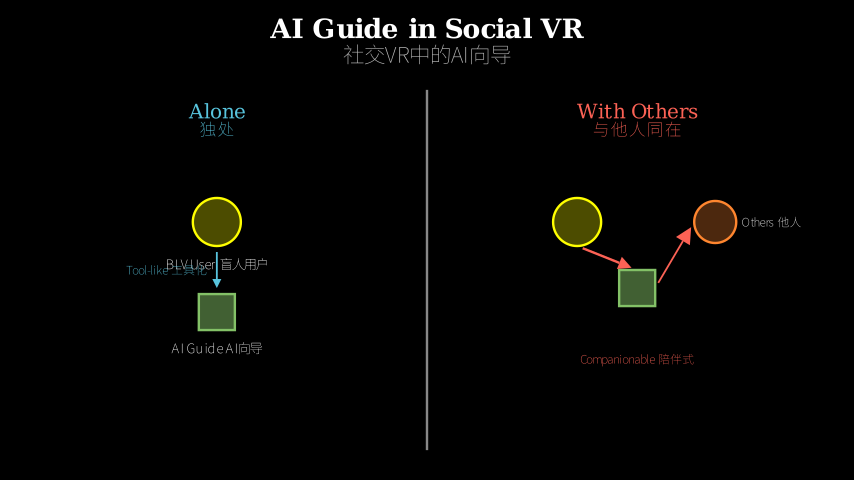
One sentence: Before this paper, AI VR guides were design proposals; after it, we know BLV users treat the same guide as a tool when alone but as a social companion when others are present.
Core Mechanism
The system is an LLM-powered conversational agent embedded in social VR environments. It responds to voice commands, answers questions about the virtual space, and provides navigation assistance. The study placed 16 BLV participants in VR scenarios with confederates (researchers posing as other users) to observe natural interaction patterns.
The data flow is straightforward: user speaks → LLM processes query → guide responds with spatial information or answers. But the interesting mechanism isn’t technical—it’s behavioral. The researchers discovered that the same AI, with identical capabilities, triggered completely different interaction patterns depending on whether the user was alone or with others.
Solo Context:              Social Context:

User -----> Guide         User -----> Guide
     query         answer       |         ^
     answer        query        |         |
                                v         |
[Functional]              Confederate <---+
[Tool-like]               [Companionable]
[Efficient]               [Nicknamed, rationalized]
Think of it like having a Swiss Army knife. When you’re alone fixing something, you treat it as a tool—open the blade, use it, close it, done. But if you’re camping with friends and pull out your knife, suddenly it has a name (“Old Reliable”), you show it off, you explain why this particular model is great, you let others try it. The knife didn’t change—your social context did. The LLM guide is the same: alone, participants issued commands efficiently (“Where’s the door?”). With others present, they gave it nicknames, made excuses for its mistakes (“Well, it’s just a floating orb, it can’t see everything”), and encouraged confederates to interact with it. The guide became a social prop, not just a navigation tool.
Key Concepts
-
Sighted Guide: In the physical world, this is a trained person who helps BLV individuals navigate by offering their arm and providing verbal descriptions of the environment. The BLV person holds the guide’s elbow, walking slightly behind, while the guide warns of obstacles and describes surroundings. It’s a collaborative navigation method built on trust and communication. This paper translates that concept into VR using an AI instead of a human.
-
Social Context Effect: Your behavior changes when others are watching, even if the task is identical. You might hum while cooking alone but stay quiet if someone’s in the kitchen. This isn’t about performance anxiety—it’s about social presentation. The paper shows this applies to human-AI interaction too: BLV users treated the guide more “humanly” when confederates were present, not because the AI changed, but because they were managing social impressions.
-
Anthropomorphization in Situ: Treating non-human things as human-like (giving your car a name, apologizing to your Roomba). The paper reveals this isn’t just about the object’s design—it’s situational. The same guide got nicknamed and defended in social settings but treated purely functionally when users were alone. The anthropomorphization emerged from social dynamics, not from the AI’s appearance or capabilities.
Framework Shift
Before (mainstream approach):        After (this paper):

AI Guide = Accessibility Tool        AI Guide = Context-Sensitive Agent

    User                                 User (alone)
     |                                    |
     v                                    v
  [Guide]                              [Guide] <-- Tool mode
     |
  Function                             User (with others)
                                          |
                                          v
                                       [Guide] <-- Companion mode
                                          |
                                     Social prop
From designing AI guides as static accessibility tools to recognizing them as socially-aware agents that users treat differently based on who’s present.
Expert Assessment
Problem choice: This is a genuine gap. VR accessibility is understudied, and the leap from “let’s propose AI guides” to “let’s see if they actually work” is necessary and overdue. The social context angle wasn’t the original research question but emerged from the data—that’s good science.
Method maturity: Straightforward user study with confederates. Nothing fancy, but appropriate for exploratory HCI research. The 16-participant sample is modest but reasonable for qualitative findings. The confederate design is clever—it creates controlled social contexts without requiring actual strangers, though it does introduce some artificiality.
Experimental integrity: No major red flags. The study design is transparent about using confederates. The findings are observational and qualitative, so there’s no statistical sleight of hand to worry about. The main limitation is generalizability—would this hold with actual strangers instead of confederates? Probably, but we don’t know for sure.
Writing quality: The abstract and introduction are solid. The related work section likely does the standard HCI literature review dance. The results section is where the paper earns its keep—the social context finding is well-documented with participant quotes. The discussion could probably be tightened; HCI papers often over-explain implications that are already clear from the results.
Verdict: weak accept — Solid empirical contribution to an understudied area, with a genuinely interesting finding about social context effects, though the technical novelty is limited and the sample size is modest.
Takeaways
For AI designers: Don’t build one interaction mode—build context-aware modes. If your AI assistant might be used in social settings, give it a “social mode” that acknowledges the presence of others and adjusts its behavior accordingly. This isn’t about being more chatty; it’s about recognizing that users will treat your AI differently when others are watching.
For accessibility researchers: Social context isn’t just a confound to control for—it’s a design dimension. Assistive technologies that work great in solo testing might behave unexpectedly in real social situations. Test your tools in both contexts.
For anyone building conversational AI: Users will anthropomorphize your system more in social settings, even if you don’t design for it. This means they’ll also rationalize its failures more charitably (“it’s just an orb, it can’t see everything”). You can’t prevent this, but you can design for it—make sure your AI’s limitations are clear so users’ rationalizations don’t create false mental models.
The transferable insight: Human-AI interaction isn’t just about the human and the AI—it’s about who else is in the room. Design for the social context, not just the user.
论文: 2603.09964 作者: Jazmin Collins, Sharon Y Lin, Tianqi Liu, Andrea Stevenson Won, Shiri Azenkot 分类: cs.HC, cs.AI, cs.ET
缺口
VR无障碍研究曾提出用AI”明眼向导”帮助盲人和低视力(BLV)用户导航虚拟空间,但这些一直停留在理论概念。
没人真正造出一个,然后观察真实用户在社交VR场景中如何与之互动。
先前的工作止步于”这可能有用”,没有测试它是否真的有用,或者当其他人在场时用户会如何对待这样的向导。
问题:BLV用户被排除在社交VR之外
    |
    v
假设:AI向导可能有帮助(但未经测试)
    |
    v
方法:构建LLM向导 + 16名BLV用户 + 同盟者
    |
    v
证据:互动风格随社交情境变化
    |
    v
结论:向导有效,但需要社交意识
增量
一句话:这篇论文之前,AI VR向导是设计提案;
之后,我们知道BLV用户独处时将同一个向导视为工具,但在他人面前则将其视为社交伙伴。
核心机制
该系统是一个嵌入社交VR环境的LLM驱动对话代理。
它响应语音命令,回答关于虚拟空间的问题,并提供导航辅助。
研究将16名BLV参与者置于有同盟者(扮演其他用户的研究人员)的VR场景中,以观察自然互动模式。
数据流很直接:用户说话 → LLM处理查询 → 向导用空间信息或答案回应。
但有趣的机制不是技术性的——而是行为性的。
研究人员发现,同一个AI,具有相同的能力,却根据用户是独处还是与他人在一起,触发了完全不同的互动模式。
独处情境:              社交情境:

用户 -----> 向导         用户 -----> 向导
     查询        回答         |         ^
     回答        查询         |         |
                             v         |
[功能性的]              同盟者 <-------+
[工具式的]              [伙伴式的]
[高效的]                [有昵称,被合理化]
想象一下拥有一把瑞士军刀。
当你独自修东西时,你把它当工具——打开刀片,使用,合上,完事。
但如果你和朋友露营时掏出刀,突然它就有了名字(“老可靠”),你会炫耀它,解释为什么这个特定型号很棒,让别人试试。
刀没变——你的社交情境变了。
LLM向导也一样:独处时,参与者高效地发出命令(“门在哪?”)。
有他人在场时,他们给它起昵称,为它的错误找借口(“嗯,它只是个漂浮的球体,看不到所有东西”),并鼓励同盟者与它互动。
向导变成了社交道具,而不仅仅是导航工具。
关键概念
- 明眼向导:在物理世界中,这是一个受过训练的人,通过提供手臂和口头描述环境来帮助BLV个体导航。
BLV者握住向导的肘部,稍微走在后面,而向导警告障碍物并描述周围环境。
这是一种建立在信任和沟通基础上的协作导航方法。
本文使用AI而非人类将这一概念转化到VR中。
- 社交情境效应:即使任务相同,当他人在看时你的行为也会改变。
你可能独自做饭时哼歌,但如果有人在厨房就保持安静。
这不是关于表现焦虑——而是关于社交呈现。
论文显示这也适用于人机交互:当同盟者在场时,BLV用户更”人性化”地对待向导,不是因为AI变了,而是因为他们在管理社交印象。
- 情境化拟人化:将非人类事物视为类人(给你的车起名字,向你的扫地机器人道歉)。
论文揭示这不仅仅关于物体的设计——它是情境性的。
同一个向导在社交场合被起昵称和辩护,但在用户独处时被纯粹功能性地对待。
拟人化源于社交动态,而非AI的外观或能力。
框架转变
之前(主流方法):              之后(本文方法):

AI向导 = 无障碍工具            AI向导 = 情境敏感代理

    用户                             用户(独处)
     |                                |
     v                                v
  [向导]                            [向导] <-- 工具模式
     |
  功能                             用户(与他人)
                                      |
                                      v
                                   [向导] <-- 伙伴模式
                                      |
                                   社交道具
从将AI向导设计为静态无障碍工具,到认识到它们是社交感知代理,用户根据在场者不同而不同对待。
专家评审
选题眼光:这是一个真实的缺口。
VR无障碍研究不足,从”让我们提出AI向导”到”让我们看看它们是否真的有效”的跨越是必要且早该进行的。
社交情境角度不是最初的研究问题,而是从数据中浮现的——这是好的科学。
方法成熟度:带同盟者的直接用户研究。
没什么花哨的,但适合探索性HCI研究。
16名参与者的样本量不大,但对定性发现来说合理。
同盟者设计很巧妙——它创造了受控的社交情境而不需要真正的陌生人,尽管确实引入了一些人为性。
实验诚意:没有重大问题。
研究设计对使用同盟者是透明的。
发现是观察性和定性的,所以没有统计上的花招需要担心。
主要局限是可推广性——如果是真正的陌生人而非同盟者,这会成立吗?
可能会,但我们不确定。
写作功力:摘要和引言扎实。
相关工作部分可能做了标准的HCI文献综述舞蹈。
结果部分是论文赚取价值的地方——社交情境发现用参与者引语记录得很好。
讨论部分可能可以收紧;
HCI论文经常过度解释从结果中已经清楚的含义。
判决:弱接收 — 对研究不足领域的扎实实证贡献,关于社交情境效应有真正有趣的发现,尽管技术新颖性有限且样本量不大。
要点总结
对AI设计师:不要构建一种互动模式——构建情境感知模式。
如果你的AI助手可能在社交场合使用,给它一个”社交模式”,承认他人的存在并相应调整行为。
这不是关于更健谈;
而是关于认识到当他人在看时用户会不同地对待你的AI。
对无障碍研究者:社交情境不仅仅是要控制的混淆因素——它是一个设计维度。
在单独测试中效果很好的辅助技术在真实社交情境中可能表现出意外行为。
在两种情境中测试你的工具。
对任何构建对话AI的人:用户在社交场合会更多地拟人化你的系统,即使你没有为此设计。
这意味着他们也会更宽容地合理化其失败(“它只是个球体,看不到所有东西”)。
你无法阻止这一点,但可以为此设计——确保你的AI的局限性清晰,这样用户的合理化不会创造错误的心智模型。
可迁移的洞见:人机交互不仅仅关于人和AI——还关于房间里还有谁。
为社交情境设计,而不仅仅为用户。