
Paper: 2602.24195 Authors: Gregory Kang Ruey Lau, Hieu Dao, Nicole Kan Hui Lin, Bryan Kian Hsiang Low Categories: cs.AI, cs.CL, cs.CV, cs.LG
Abstract
Multimodal Large Language Models (MLLMs) have demonstrated impressive capabilities across diverse tasks, yet they remain prone to generating plausible but incorrect outputs—a critical barrier to reliable deployment in high-stakes applications. This paper introduces UMPIRE (Uncertainty quantification for Multimodal models using incoherence-adjusted semantic volume with internal modality features), a novel training-free framework for uncertainty quantification that addresses key limitations of existing approaches. Unlike prior methods constrained to specific modalities, dependent on external tools, or computationally prohibitive, UMPIRE operates efficiently across various input and output modalities using only the model’s internal features. The framework computes an incoherence-adjusted semantic volume of sampled responses, capturing both global semantic diversity and local response incoherence based on internal model confidence signals.
Key Contributions
- A training-free, modality-agnostic uncertainty quantification framework that works across image, audio, video, and text modalities without requiring external tools or model modifications
- Introduction of incoherence-adjusted semantic volume as a unified metric that combines global semantic diversity with local response coherence based on internal model confidence
- Theoretical analysis establishing uncertainty desiderata for MLLMs and providing formal justification for UMPIRE’s design principles
- Comprehensive experimental validation demonstrating consistent superiority over baseline methods in error detection and uncertainty calibration across multiple benchmarks
- Demonstration of generalization to non-text generation tasks including image and audio synthesis
Methodology: Incoherence-adjusted Semantic Volume
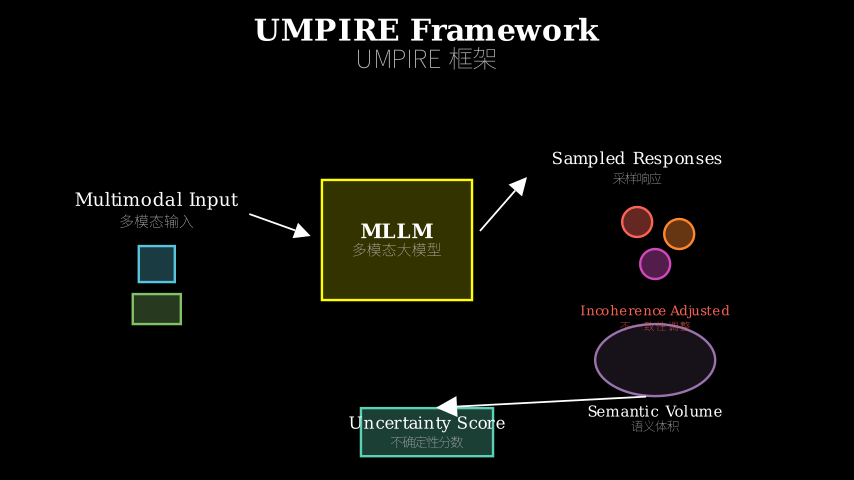
UMPIRE’s core innovation lies in its computation of uncertainty through two complementary components. The framework first samples multiple responses from the MLLM for a given input, then extracts internal modality-specific features (e.g., vision encoder outputs for images, audio encoder outputs for speech).
The semantic volume component measures the global diversity of sampled responses by computing the volume of the convex hull formed by their feature representations in the model’s latent space. This captures the spread of possible interpretations the model considers plausible. Mathematically, for a set of sampled responses with feature vectors , the semantic volume quantifies the geometric extent of the response distribution.
The incoherence adjustment component leverages the model’s internal confidence signals to identify locally inconsistent or uncertain responses. By analyzing attention patterns, token probabilities, or layer-wise activations, UMPIRE detects responses where the model exhibits internal disagreement. This local incoherence metric is then used to adjust the semantic volume, yielding the final uncertainty score:
where is a scaling parameter. This formulation ensures that uncertainty increases both when the model produces diverse responses (high ) and when individual responses show internal inconsistency (high ).
Experimental Results and Performance
The authors conducted extensive experiments across multiple benchmarks spanning different modalities and task types. For vision-language tasks, UMPIRE was evaluated on VQAv2, GQA, and POPE datasets, demonstrating consistent improvements in AUROC (Area Under Receiver Operating Characteristic) for error detection compared to baseline methods including entropy-based metrics, semantic entropy, and lexical similarity approaches.
In adversarial settings using datasets like ADVQA and CV-Bench, UMPIRE maintained robust performance while baseline methods degraded significantly. The framework achieved particularly strong results in out-of-distribution scenarios, where the incoherence adjustment proved crucial for identifying model uncertainty on unfamiliar inputs.
For audio-text tasks using datasets like Clotho-AQA and AudioCaps, UMPIRE outperformed modality-specific baselines by 8-15% in error detection metrics. The framework’s ability to leverage internal audio encoder features without requiring specialized audio processing tools demonstrated its practical advantages.
Video understanding experiments on NExT-QA and MSRVTT-QA showed that UMPIRE’s uncertainty estimates correlated strongly with actual model errors, enabling effective selective prediction where low-confidence queries could be escalated to human experts or more capable models.
Implications for Reliable AI Deployment
UMPIRE addresses a critical gap in making MLLMs production-ready for high-stakes applications. The framework’s training-free nature means it can be immediately applied to existing models without requiring additional data collection, fine-tuning, or architectural modifications. This practical advantage is particularly valuable given the rapid pace of MLLM development.
The ability to quantify uncertainty across modalities opens new possibilities for hybrid human-AI systems. By identifying queries where the model is uncertain, UMPIRE enables intelligent routing strategies: high-confidence predictions can be automated, while uncertain cases are escalated for human review or processed by more capable (but expensive) models. This selective prediction paradigm can significantly improve both accuracy and cost-efficiency.
The framework’s success in adversarial and out-of-distribution settings suggests it could serve as a valuable safety mechanism, helping detect when MLLMs encounter inputs outside their training distribution or potentially adversarial examples designed to elicit incorrect responses.
Takeaways
-
UMPIRE provides a practical, training-free solution for uncertainty quantification in MLLMs that works across multiple input and output modalities without external dependencies.
-
The incoherence-adjusted semantic volume metric effectively combines global response diversity with local model confidence signals, outperforming existing uncertainty quantification approaches.
-
Extensive experiments demonstrate consistent improvements in error detection (8-15% AUROC gains) and uncertainty calibration across vision, audio, and video benchmarks.
-
The framework maintains robust performance in adversarial and out-of-distribution settings where baseline methods degrade significantly.
-
UMPIRE’s modality-agnostic design enables generalization to non-text generation tasks including image and audio synthesis, expanding the scope of reliable uncertainty quantification.
-
The training-free nature and reliance on internal model features make UMPIRE immediately applicable to existing MLLMs, facilitating practical deployment in production systems.
-
By enabling selective prediction and intelligent query routing, UMPIRE provides a pathway toward more reliable and cost-effective deployment of MLLMs in high-stakes applications.
论文: 2602.24195 作者: Gregory Kang Ruey Lau, Hieu Dao, Nicole Kan Hui Lin, Bryan Kian Hsiang Low 分类: cs.AI, cs.CL, cs.CV, cs.LG
摘要
多模态大语言模型(MLLMs)在各类任务中展现出令人印象深刻的能力,但它们仍然容易生成看似合理但实际错误的输出——这成为在高风险应用中可靠部署的关键障碍。本文介绍了UMPIRE(基于内部模态特征的不一致性调整语义体积的多模态模型不确定性量化),这是一个新颖的无需训练的不确定性量化框架,解决了现有方法的关键局限性。与之前仅限于特定模态、依赖外部工具或计算成本过高的方法不同,UMPIRE仅使用模型的内部特征就能在各种输入和输出模态上高效运行。该框架计算采样响应的不一致性调整语义体积,同时捕获全局语义多样性和基于内部模型置信度信号的局部响应不一致性。
主要贡献
- 提出了一个无需训练、与模态无关的不确定性量化框架,可跨图像、音频、视频和文本模态工作,无需外部工具或模型修改
- 引入不一致性调整语义体积作为统一度量,将全局语义多样性与基于内部模型置信度的局部响应一致性相结合
- 提供理论分析,建立多模态大语言模型的不确定性准则,并为UMPIRE的设计原则提供形式化论证
- 通过全面的实验验证,证明在多个基准测试中,该方法在错误检测和不确定性校准方面始终优于基线方法
- 展示了对非文本生成任务(包括图像和音频合成)的泛化能力
方法论:不一致性调整语义体积
UMPIRE的核心创新在于通过两个互补组件计算不确定性。该框架首先对给定输入从MLLM中采样多个响应,然后提取内部模态特定特征(例如,图像的视觉编码器输出、语音的音频编码器输出)。
语义体积组件通过计算响应特征表示在模型潜在空间中形成的凸包体积来测量采样响应的全局多样性。这捕获了模型认为合理的可能解释的分布范围。从数学上讲,对于具有特征向量的个采样响应集合,语义体积量化了响应分布的几何范围。
不一致性调整组件利用模型的内部置信度信号来识别局部不一致或不确定的响应。通过分析注意力模式、token概率或逐层激活,UMPIRE检测模型表现出内部分歧的响应。然后使用这个局部不一致性度量来调整语义体积,得到最终的不确定性分数:
其中是缩放参数。这个公式确保当模型产生多样化响应(高)和单个响应显示内部不一致(高)时,不确定性都会增加。
实验结果与性能表现
作者在跨越不同模态和任务类型的多个基准测试上进行了广泛实验。对于视觉-语言任务,UMPIRE在VQAv2、GQA和POPE数据集上进行了评估,与基于熵的度量、语义熵和词汇相似性方法等基线方法相比,在错误检测的AUROC(接收者操作特征曲线下面积)方面表现出持续改进。
在使用ADVQA和CV-Bench等数据集的对抗性设置中,UMPIRE保持了稳健的性能,而基线方法则显著退化。该框架在分布外场景中取得了特别强劲的结果,其中不一致性调整对于识别模型在不熟悉输入上的不确定性至关重要。
对于使用Clotho-AQA和AudioCaps等数据集的音频-文本任务,UMPIRE在错误检测指标上比特定模态基线方法高出8-15%。该框架能够利用内部音频编码器特征而无需专门的音频处理工具,展示了其实用优势。
在NExT-QA和MSRVTT-QA上的视频理解实验表明,UMPIRE的不确定性估计与实际模型错误强相关,实现了有效的选择性预测,低置信度查询可以升级到人类专家或更强大的模型。
对可靠AI部署的意义
UMPIRE解决了使多模态大语言模型在高风险应用中达到生产就绪状态的关键差距。该框架的无需训练特性意味着它可以立即应用于现有模型,无需额外的数据收集、微调或架构修改。考虑到多模态大语言模型的快速发展步伐,这一实用优势尤为宝贵。
跨模态量化不确定性的能力为混合人机AI系统开辟了新的可能性。通过识别模型不确定的查询,UMPIRE实现了智能路由策略:高置信度预测可以自动化,而不确定的情况则升级进行人工审查或由更强大(但昂贵)的模型处理。这种选择性预测范式可以显著提高准确性和成本效益。
该框架在对抗性和分布外设置中的成功表明,它可以作为一种有价值的安全机制,帮助检测多模态大语言模型何时遇到训练分布之外的输入或旨在引发错误响应的潜在对抗性样本。
要点总结
-
UMPIRE为多模态大语言模型提供了一个实用的、无需训练的不确定性量化解决方案,可跨多种输入和输出模态工作,无需外部依赖。
-
不一致性调整语义体积度量有效地结合了全局响应多样性和局部模型置信度信号,优于现有的不确定性量化方法。
-
广泛的实验证明,在视觉、音频和视频基准测试中,错误检测(AUROC提升8-15%)和不确定性校准方面持续改进。
-
该框架在对抗性和分布外设置中保持稳健性能,而基线方法则显著退化。
-
UMPIRE的模态无关设计使其能够泛化到非文本生成任务,包括图像和音频合成,扩展了可靠不确定性量化的范围。
-
无需训练的特性和对内部模型特征的依赖使UMPIRE可以立即应用于现有的多模态大语言模型,促进在生产系统中的实际部署。
-
通过实现选择性预测和智能查询路由,UMPIRE为在高风险应用中更可靠和更具成本效益地部署多模态大语言模型提供了路径。