
Paper: 2603.03279 Authors: Xialin He, Sirui Xu, Xinyao Li, Runpei Dong, Liuyu Bian, Yu-Xiong Wang, Liang-Yan Gui Categories: cs.RO, cs.CV
The Gap
Humanoid control has hit a wall. Methods like motion retargeting (e.g., Peng et al.’s work on physics-based character animation) and imitation learning can make robots track human mocap data, but they’re stuck in playback mode. You need a reference motion at test time — “walk like this,” “reach like that.” The robot can’t improvise. Worse, retargeted data from human mocap often breaks physics when contact happens (feet sliding, unbalanced forces), and scaling to hundreds of skills means collecting hundreds of clean reference motions. The core problem: existing systems are motion trackers, not task solvers.
Problem: Humanoids can't act autonomously from sparse goals
   |
   v
Assumption: If we (1) fix retargeting physics and
            (2) compress skills into a latent space,
            then we can condition on goals instead of dense references
   |
   v
Method: Physics-driven retargeting + unified multimodal controller
   |
   v
Evidence: Sim + real robot tests show goal-conditioned behavior
          outperforms tracking-only baselines
   |
   v
Conclusion: Humanoids can now generate whole-body actions from
            high-level intent without test-time reference motions
The Increment
One sentence: Before ULTRA, humanoids needed frame-by-frame motion references to act; after ULTRA, they generate coordinated whole-body behavior from sparse goals like “pick up that object” using only egocentric vision.
Core Mechanism
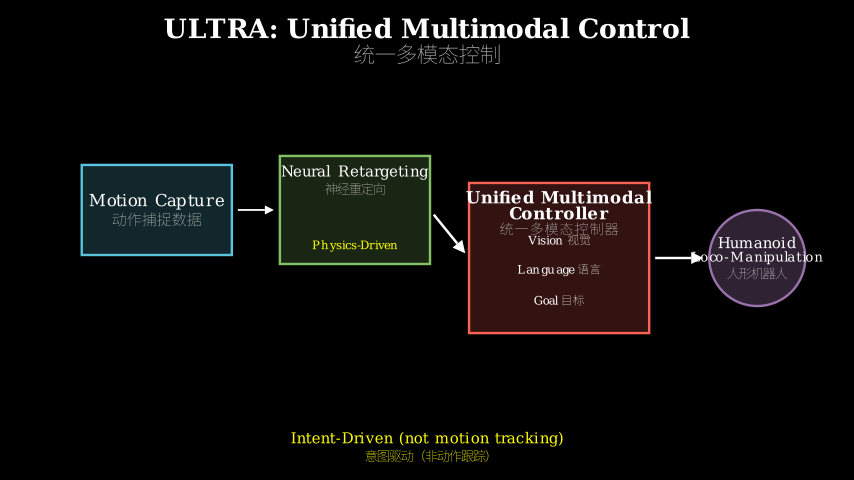
ULTRA has two stages. First, a physics-driven neural retargeting module takes human mocap and translates it to the humanoid’s body while respecting contact forces and balance constraints. This produces a large library of physically plausible reference motions. Second, a unified controller learns to track these motions, then compresses the tracking skill into a compact latent space (think of it as a “motor skill embedding”). During training, the controller sees both dense motion references and sparse task specifications (like goal positions). Reinforcement learning finetuning then expands the controller’s coverage beyond the original mocap distribution, making it robust to novel situations.
At test time, you don’t feed the controller a reference motion. Instead, you give it a high-level goal and noisy egocentric visual input (RGB-D from a head-mounted camera). The controller decodes the appropriate motor skill from its latent space and generates joint commands that achieve the goal while maintaining balance and handling contacts.
                    [Human Mocap Data]
                            |
                            v
                  +-------------------+
                  | Physics Retarget  |  <-- Preserves contact forces
                  +-------------------+
                            |
                            v
                  [Plausible Reference Motions]
                            |
                            v
          +--------------------------------------+
          |   Unified Multimodal Controller     |
          |                                      |
          |  [Tracking Policy] --> [Latent Space]|
          |         |                    ^       |
          |         v                    |       |
          |  [RL Finetuning] ---------> |       |
          +--------------------------------------+
                            |
                            v
          Input: Sparse goal + egocentric vision
          Output: Joint commands (whole-body action)
Think of ULTRA like a jazz musician learning to improvise. First, you practice scales and standard songs (tracking reference motions) until the patterns are internalized (compressed into latent space). Then you learn music theory and harmony (RL finetuning to understand task structure). Now, when someone calls out “play something in C minor about rain,” you don’t need sheet music — you generate a performance from the intent. The retargeting step is like transcribing piano music for guitar: you preserve the melody and harmony (physics) even though the instrument is different (humanoid body vs human body). The latent space is your internalized vocabulary of musical phrases, and the multimodal controller is your ability to respond to both detailed instructions (“play this exact riff”) and vague prompts (“something upbeat”).
Key Concepts
-
Physics-driven retargeting: Imagine you’re a puppeteer controlling a marionette. If you just copy your own arm movements to the puppet’s strings, the puppet will flail — its weight distribution, joint limits, and string tensions are different from your body. Physics-driven retargeting solves this by asking: “What motion would this specific puppet need to perform to achieve the same effect?” It optimizes for physically consistent forces (no floating, no penetration) while matching the original motion’s intent. Concretely, if a human mocap shows a foot firmly planted during a push, the retargeted humanoid motion ensures ground reaction forces balance the push, even if the humanoid’s foot is shaped differently.
-
Latent motor skill space: Instead of storing thousands of “if goal X, play motion Y” rules, ULTRA learns a continuous space where nearby points represent similar motor patterns. It’s like how colors work: you don’t memorize every possible shade; you learn that “reddish-orange” lives between red and orange. During training, the controller sees many reference motions and learns to encode them as points in this space. At test time, given a goal, it finds the right point in latent space and decodes it into joint commands. This compression is what lets the robot generalize — a goal it’s never seen might land between two training examples, and the latent space smoothly interpolates.
-
Multimodal conditioning: The controller accepts two types of input: dense (full reference motion, every joint angle at every timestep) and sparse (just a goal position, or a visual observation). Training on both teaches the controller to “fill in the blanks.” If you only train on dense references, the robot becomes a motion player. If you only train on sparse goals, it has no motion priors and flails randomly. Training on both means the robot learns the structure of good motion from dense examples, then learns to activate that structure from sparse cues. It’s like learning to cook: first you follow recipes exactly (dense), then you learn to improvise from “I want something spicy and quick” (sparse).
Framework Shift
Before (mainstream approach):        After (this paper):

Test time:                           Test time:
  [Reference Motion]                   [Sparse Goal: "pick cup"]
         |                                      |
         v                                      v
  +-------------+                        +-----------+
  |   Tracker   |                        | Generator |
  +-------------+                        +-----------+
         |                                      |
         v                                      v
  [Joint Commands]                       [Joint Commands]

Limitation: Need motion                 Capability: Synthesize
for every task                          from intent
From motion playback to motion synthesis, the core shift is replacing test-time reference dependence with learned generative control conditioned on task semantics.
Expert Assessment
Problem choice: This is a real gap. The field has been stuck in the “imitation learning + tracking” paradigm for years, and it genuinely limits deployment. You can’t hand-author motions for every object, every surface, every disturbance. The problem sits at the frontier of making humanoids useful outside labs — it’s not incremental polishing.
Method maturity: The physics retargeting is clever but not revolutionary (it’s an optimization problem with contact constraints, well-trodden ground). The real contribution is the unified controller architecture that bridges dense and sparse conditioning. However, I’m skeptical about the latent space compression — it’s essentially a VAE-style bottleneck, and the paper doesn’t deeply analyze what structure it learns or whether simpler skill primitives (like DMPs or movement primitives) could achieve similar results with more interpretability. The RL finetuning feels like a patch to cover distribution gaps rather than a principled design.
Experimental integrity: The baselines are fair but limited. They compare against tracking-only methods, which is the right comparison, but I’d want to see ablations on the latent space size, the impact of RL finetuning vs just supervised learning, and failure mode analysis. The real robot experiments on Unitree G1 are encouraging but brief — no quantitative metrics on success rates across diverse tasks, just qualitative demos. The sim-to-real transfer claims need more scrutiny: how much domain randomization? How sensitive to calibration errors?
Writing quality: The abstract and intro are strong, but the method section is dense and assumes familiarity with prior work (e.g., AMP, ASE). The retargeting algorithm description is buried and hard to parse — it should be a standalone subsection with pseudocode. The experimental section lacks depth on failure cases and edge conditions. Rewriting the “Unified Controller” section with clearer notation and a step-by-step training procedure would elevate the paper significantly.
Verdict: weak accept — Addresses a real problem with a reasonable solution, but the method feels like an engineering integration of existing techniques rather than a conceptual breakthrough, and the evaluation could be more rigorous.
Takeaways
-
Multimodal training for generalization: Training a controller on both dense supervision (full trajectories) and sparse supervision (goals only) is a transferable pattern. If you’re building any sequential decision-making system, consider mixing detailed examples with high-level objectives during training — it teaches the model both “how” and “what.”
-
Physics as a regularizer for retargeting: When adapting data from one embodiment to another (human to robot, sim to real, one robot to another), don’t just minimize kinematic error. Add physics constraints (contact forces, balance, torque limits) as soft or hard constraints in your optimization. This prevents physically implausible solutions that look right but fail on contact.
-
Latent skill spaces for scalability: If you’re facing a combinatorial explosion of skills (hundreds of motions, thousands of objects), compressing them into a continuous latent space lets you interpolate and generalize. The key is ensuring the latent space is structured (nearby points = similar skills) through the right training objective (reconstruction + regularization).
论文: 2603.03279 作者: Xialin He, Sirui Xu, Xinyao Li, Runpei Dong, Liuyu Bian, Yu-Xiong Wang, Liang-Yan Gui 分类: cs.RO, cs.CV
缺口
人形机器人控制遇到了瓶颈。
动作重定向(如 Peng 等人的物理角色动画工作)和模仿学习能让机器人跟踪人类动捕数据,但它们困在”播放模式”里。
测试时你必须提供参考动作——“这样走”、“那样伸手”。
机器人无法即兴发挥。
更糟的是,从人类动捕重定向的数据在接触时常常违反物理规律(脚滑动、力不平衡),扩展到数百个技能意味着要收集数百个干净的参考动作。
核心问题:现有系统是动作跟踪器,不是任务解决器。
问题:人形机器人无法从稀疏目标自主行动
   |
   v
假设:如果我们 (1) 修复重定向的物理问题
            (2) 将技能压缩到隐空间
      那么就能以目标为条件而非密集参考
   |
   v
方法:物理驱动重定向 + 统一多模态控制器
   |
   v
证据:仿真和实体机器人测试显示目标条件行为
      优于纯跟踪基线
   |
   v
结论:人形机器人现在能从高层意图生成全身动作
      无需测试时参考动作
增量
一句话: ULTRA 之前,人形机器人需要逐帧动作参考才能行动;ULTRA 之后,它们仅用第一人称视觉就能从稀疏目标(如”拿起那个物体”)生成协调的全身行为。
核心机制
ULTRA 分两个阶段。
首先,物理驱动的神经重定向模块接收人类动捕数据,将其转换到人形机器人身体上,同时尊重接触力和平衡约束。
这产生了一个大型物理合理参考动作库。
其次,统一控制器学习跟踪这些动作,然后将跟踪技能压缩到紧凑的隐空间(可以理解为”运动技能嵌入”)。
训练期间,控制器同时看到密集动作参考和稀疏任务规范(如目标位置)。
强化学习微调随后扩展控制器的覆盖范围,超越原始动捕分布,使其对新情况具有鲁棒性。
测试时,你不给控制器参考动作。
相反,你给它一个高层目标和带噪声的第一人称视觉输入(头戴相机的 RGB-D)。
控制器从其隐空间解码出合适的运动技能,生成关节命令,在保持平衡和处理接触的同时实现目标。
                    [人类动捕数据]
                            |
                            v
                  +-------------------+
                  | 物理重定向        |  <-- 保持接触力
                  +-------------------+
                            |
                            v
                  [合理的参考动作]
                            |
                            v
          +--------------------------------------+
          |   统一多模态控制器                   |
          |                                      |
          |  [跟踪策略] --> [隐空间]             |
          |         |                    ^       |
          |         v                    |       |
          |  [强化学习微调] ----------> |       |
          +--------------------------------------+
                            |
                            v
          输入:稀疏目标 + 第一人称视觉
          输出:关节命令(全身动作)
把 ULTRA 想象成学习即兴演奏的爵士乐手。
首先,你练习音阶和标准曲目(跟踪参考动作),直到模式内化(压缩到隐空间)。
然后你学习乐理和和声(强化学习微调以理解任务结构)。
现在,当有人说”用 C 小调演奏关于雨的东西”,你不需要乐谱——你从意图生成演奏。
重定向步骤就像把钢琴曲改编给吉他:你保留旋律和和声(物理),即使乐器不同(人形机器人身体 vs 人类身体)。
隐空间是你内化的音乐短语词汇表,多模态控制器是你对详细指令(“弹这个确切的即兴段”)和模糊提示(“来点欢快的”)都能响应的能力。
关键概念
- 物理驱动重定向: 想象你是操纵木偶的人。
如果你只是把自己的手臂动作复制到木偶的线上,木偶会乱摆——它的重量分布、关节限制和线张力与你的身体不同。
物理驱动重定向通过问”这个特定木偶需要什么动作才能达到相同效果?“来解决这个问题。
它优化物理一致的力(不悬浮、不穿透),同时匹配原始动作的意图。
具体来说,如果人类动捕显示推动时脚牢牢着地,重定向的人形机器人动作确保地面反作用力平衡推力,即使人形机器人的脚形状不同。
- 隐运动技能空间: ULTRA 不存储数千条”如果目标 X,播放动作 Y”规则,而是学习一个连续空间,其中相邻点代表相似的运动模式。
就像颜色的工作方式:你不记住每个可能的色调;你学到”橙红色”位于红色和橙色之间。
训练期间,控制器看到许多参考动作,学习将它们编码为这个空间中的点。
测试时,给定目标,它在隐空间中找到正确的点并解码为关节命令。
这种压缩让机器人能够泛化——一个从未见过的目标可能落在两个训练样本之间,隐空间平滑插值。
- 多模态条件: 控制器接受两种输入:密集(完整参考动作,每个时间步的每个关节角度)和稀疏(只有目标位置,或视觉观察)。
对两者训练教会控制器”填空”。
如果只在密集参考上训练,机器人变成动作播放器。
如果只在稀疏目标上训练,它没有动作先验,会随机乱动。
对两者训练意味着机器人从密集样本学习良好动作的结构,然后学习从稀疏线索激活该结构。
就像学做饭:先完全按食谱(密集),然后学会从”我想要辣的快手菜”即兴发挥(稀疏)。
框架转变
之前(主流方法):                之后(本文方法):

测试时:                           测试时:
  [参考动作]                         [稀疏目标:"拿杯子"]
         |                                      |
         v                                      v
  +-------------+                        +-----------+
  |   跟踪器    |                        |  生成器   |
  +-------------+                        +-----------+
         |                                      |
         v                                      v
  [关节命令]                             [关节命令]

局限:每个任务需要动作                 能力:从意图合成
从动作回放到动作合成,核心转变是用基于任务语义的学习生成控制替代测试时参考依赖。
专家评审
选题眼光: 这是真缺口。
该领域多年来困在”模仿学习+跟踪”范式中,这确实限制了部署。
你无法为每个物体、每个表面、每个扰动手工编写动作。
这个问题处于让人形机器人在实验室外有用的前沿——不是渐进式打磨。
方法成熟度: 物理重定向很巧妙但不革命性(这是带接触约束的优化问题,已被充分探索)。
真正的贡献是桥接密集和稀疏条件的统一控制器架构。
然而,我对隐空间压缩持怀疑态度——本质上是 VAE 式瓶颈,论文没有深入分析它学到了什么结构,或者更简单的技能原语(如 DMP 或运动原语)是否能以更好的可解释性实现类似结果。
强化学习微调感觉像是覆盖分布差距的补丁,而非原则性设计。
实验诚意: 基线公平但有限。
他们与纯跟踪方法比较,这是正确的比较,但我想看到隐空间大小的消融、强化学习微调 vs 纯监督学习的影响,以及失败模式分析。
Unitree G1 上的实体机器人实验令人鼓舞但简短——没有跨多样任务成功率的定量指标,只有定性演示。
仿真到现实的迁移声明需要更多审查:多少域随机化?对校准误差有多敏感?
写作功力: 摘要和引言很强,但方法部分密集,假设读者熟悉先前工作(如 AMP、ASE)。
重定向算法描述被埋没且难以解析——应该是带伪代码的独立小节。
实验部分缺乏对失败案例和边界条件的深度。
用更清晰的符号和逐步训练过程重写”统一控制器”部分会显著提升论文。
判决: 弱接收——用合理解决方案解决真实问题,但方法感觉像现有技术的工程集成而非概念突破,评估可以更严格。
要点总结
- 泛化的多模态训练: 在密集监督(完整轨迹)和稀疏监督(仅目标)上训练控制器是可迁移的模式。
如果你在构建任何序列决策系统,考虑在训练期间混合详细样本和高层目标——它教会模型”如何做”和”做什么”。
- 物理作为重定向的正则化器: 当从一个实体适配数据到另一个(人到机器人、仿真到现实、一个机器人到另一个)时,不要只最小化运动学误差。
在优化中添加物理约束(接触力、平衡、扭矩限制)作为软或硬约束。
这防止看起来对但接触时失败的物理不合理解。
- 可扩展性的隐技能空间: 如果你面临技能的组合爆炸(数百个动作、数千个物体),将它们压缩到连续隐空间让你能插值和泛化。
关键是通过正确的训练目标(重建+正则化)确保隐空间有结构(相邻点=相似技能)。