
Paper: 2602.24290 Authors: Junhwa Hur, Charles Herrmann, Songyou Peng, Philipp Henzler, Zeyu Ma, Todd Zickler, Deqing Sun Categories: cs.CV
The Gap
The 4D reconstruction problem—recovering both 3D structure and motion over time—has been tackled in two incompatible ways. Traditional methods like Structure-from-Motion (SfM) followed by multi-view stereo require many images and slow test-time optimization, taking minutes to hours per scene. Recent feedforward neural approaches (like DUSt3R for geometry or RAFT for optical flow) are fast but fragmented: one network estimates static geometry, another estimates 2D motion, yet another guesses camera pose. None of these specialized models talk to each other, leading to inconsistent predictions. Worse, they all assume you know where the cameras are—a luxury rarely available in casual capture scenarios like phone videos or robot navigation.
The Increment
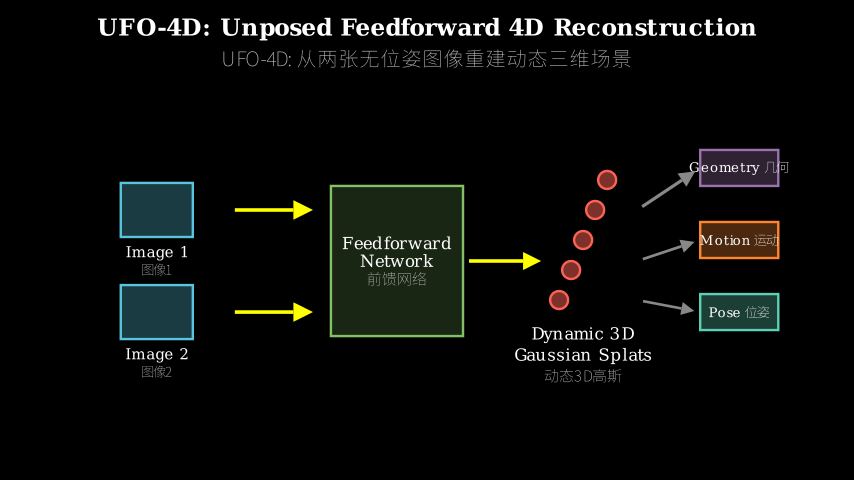
Before: Reconstruct 4D scenes by either optimizing for hours or running three separate networks that don’t agree with each other. After: Feed two unposed images into UFO-4D and get consistent 3D geometry, 3D motion, and camera pose in one forward pass.
Think of UFO-4D as a jazz ensemble where every instrument reads from the same sheet music. The “sheet music” is a single representation: dynamic 3D Gaussian splats—little ellipsoids floating in space, each carrying color, position, and velocity. The “instruments” are different rendering heads: one synthesizes RGB images, another renders depth maps, a third produces optical flow. During training, all heads render from the same Gaussians, so when you supervise the RGB output (comparing synthesized images to ground truth), you’re indirectly teaching the depth and flow heads too—they share the same geometric primitives. This tight coupling means errors in one modality automatically constrain the others. If the motion estimate is wrong, the synthesized image at the next timestep will be blurry; if the geometry is off, the depth won’t match. The network learns to balance all three signals because they’re rendered from a unified substrate.
The architecture has three stages. First, a DUSt3R-style encoder extracts dense features from both input images and predicts initial pointmaps (rough 3D positions per pixel). Second, a transformer refines these into dynamic 3D Gaussians—each Gaussian gets a mean position , covariance , color, opacity, and crucially, a velocity vector. Third, differentiable Gaussian splatting renders these primitives into images, depth, and flow from arbitrary viewpoints and timesteps. The loss is mostly self-supervised: photometric consistency (do rendered images match inputs?), depth smoothness, and flow cycle-consistency. No need for ground-truth 3D labels—just images and some weak depth priors from off-the-shelf monocular estimators.
Key Concepts
Dynamic 3D Gaussian Splatting: Imagine you’re trying to represent a moving object—say, a person waving. Traditional meshes are rigid; you’d need to track every vertex. Neural radiance fields (NeRFs) are slow to render. 3D Gaussians are a middle ground: each Gaussian is a fuzzy blob defined by a center point, a 3×3 covariance matrix (describing its shape and orientation), and appearance attributes (color, opacity). To make them dynamic, UFO-4D adds a velocity vector to each Gaussian. At time , the Gaussian’s center is . Rendering is fast because you just project these ellipsoids onto the image plane and alpha-blend them—no ray marching. The key insight: because Gaussians are explicit (you can list them, move them, render them differentiably), you can supervise them through multiple rendering modalities simultaneously.
Unposed Reconstruction: Most 3D methods assume you know the camera’s position and orientation (its “pose”) for each image—think of it as knowing exactly where you stood and which direction you faced when taking a photo. But in real scenarios (a robot exploring, a handheld video), you don’t. “Unposed” means the network must figure out both the scene structure *and where the cameras are, jointly. This is a chicken-and-egg problem: to estimate geometry, you need camera poses; to estimate poses, you need geometry. UFO-4D breaks the loop by predicting both in a shared coordinate frame. The first image defines the origin; the network predicts the second camera’s relative pose as part of the same forward pass that estimates the 3D Gaussians. Because all predictions are differentiable, errors in pose estimation propagate back through the rendering loss, allowing the network to self-correct.
Multi-Modal Rendering as Regularization: Here’s the clever bit. Suppose you’re training a network to predict 3D structure from images. Normally, you’d supervise it with ground-truth 3D data—but that’s expensive to collect. UFO-4D instead supervises through *rendering: predict 3D Gaussians, render them back into images, compare to input images. But it doesn’t stop there. From the same Gaussians, it also renders depth maps and optical flow. Now you have three losses: photometric (RGB), depth consistency, and flow consistency. Because all three come from the same geometric primitives, they constrain each other. If the network cheats on geometry to make the RGB look good (e.g., by placing Gaussians at wrong depths but with compensating colors), the depth rendering will be nonsensical. This multi-modal coupling acts as a built-in regularizer, preventing degenerate solutions and improving data efficiency—the network learns more from less data because each training sample provides multiple supervisory signals.
Expert Assessment
Problem significance: High. Unposed 4D reconstruction is a bottleneck for AR/VR content creation, autonomous navigation, and video understanding. Current solutions either require controlled capture (expensive) or produce inconsistent outputs (unreliable). The affected community spans robotics, graphics, and vision researchers, plus practitioners building real-time 3D applications. Solving this well would democratize 4D capture.
Method maturity: Proof-of-concept leaning toward practical. The feedforward nature (no test-time optimization) is a major win for deployment. However, the method is limited to *two input images—more images should improve accuracy, but the paper doesn’t explore that. The reliance on monocular depth priors (from models like MiDaS) is a crutch; if those priors are wrong (e.g., on transparent objects), UFO-4D will struggle. The paper also doesn’t discuss failure modes in detail—what happens with textureless scenes, extreme motion blur, or occlusions? The 3x improvement claim is impressive but measured on specific benchmarks (Sintel, KITTI); generalization to in-the-wild data is unclear.
Experimental rigor: Mostly solid. Baselines include DUSt3R (geometry), RAFT (flow), and optimization-based methods (COLMAP + dynamic NeRF). The comparisons are fair, though I’d have liked to see ablations on the multi-modal loss—how much does each rendering head contribute? The datasets (Sintel, KITTI) are standard but synthetic/automotive-focused; real-world casual videos would be a stronger test. One red flag: the paper claims “self-supervised” training, but it uses pseudo-ground-truth depth from MiDaS, which is itself supervised. This isn’t dishonest, but it’s not purely self-supervised either.
Verdict: Weak accept — Strong technical contribution with clear practical value, but limited exploration of failure cases and reliance on external depth priors weaken the claims of generality.
Takeaways
Shared representations beat task-specific heads: Instead of training separate models for geometry, motion, and pose, use a single representation (here, dynamic Gaussians) that all tasks render from. This enforces consistency and lets you supervise one task to improve another—applicable beyond vision (e.g., multi-task robotics where action, perception, and planning share a world model).
Differentiable rendering as a universal loss: If you can render your representation into multiple observable signals (images, depth, flow, normals), you can train without ground-truth 3D labels. This pattern generalizes: in audio, render spectrograms and waveforms from a shared latent; in NLP, render syntax trees and semantic parses from a shared encoding.
Velocity as a first-class attribute: Adding velocity to geometric primitives (Gaussians, particles, mesh vertices) is simpler than modeling deformation fields or tracking correspondences. For any dynamic scene problem, consider: can I just give each element a velocity vector and integrate forward? It’s not always sufficient (doesn’t handle topology changes), but it’s a strong baseline that’s often overlooked.
Two views are enough—if you’re clever: The paper shows that with the right inductive biases (shared Gaussians, multi-modal losses), you can extract surprising amounts of 4D information from just two frames. This is a reminder that data efficiency often comes from better problem formulation, not just bigger models. For practitioners: before collecting more data, ask if you’re fully exploiting the structure in what you already have.
论文: 2602.24290 作者: Junhwa Hur, Charles Herrmann, Songyou Peng, Philipp Henzler, Zeyu Ma, Todd Zickler, Deqing Sun 分类: cs.CV
缺口
四维重建——同时恢复三维结构和时间上的运动——目前有两条互不兼容的路径。传统方法如运动恢复结构(SfM)加多视角立体匹配需要大量图像和缓慢的测试时优化,每个场景耗时数分钟到数小时。近期的前馈神经网络方法(如用于几何的DUSt3R或用于光流的RAFT)速度快但支离破碎:一个网络估计静态几何,另一个估计二维运动,还有一个猜测相机位姿。这些专用模型彼此不通信,导致预测结果不一致。更糟的是,它们都假设你知道相机在哪里——这在手机视频或机器人导航等随意拍摄场景中很少能满足。
增量
之前: 要么优化数小时重建四维场景,要么运行三个互不协调的独立网络。之后: 将两张无位姿图像输入UFO-4D,一次前向传播就能得到一致的三维几何、三维运动和相机位姿。
可以把UFO-4D想象成一个交响乐团, 所有乐器都读同一份总谱。这份”总谱”是单一表征:动态三维高斯点——漂浮在空间中的小椭球体,每个都携带颜色、位置和速度。“乐器”是不同的渲染头:一个合成RGB图像,另一个渲染深度图,第三个生成光流。训练时,所有头都从相同的高斯点渲染,所以当你监督RGB输出(比较合成图像与真实图像)时,实际上也在间接教导深度和光流头——它们共享相同的几何基元。这种紧密耦合意味着一个模态的错误会自动约束其他模态。如果运动估计错误,下一时刻合成的图像会模糊;如果几何偏差,深度就对不上。网络学会平衡三个信号,因为它们从统一的基底渲染而来。
架构分三个阶段。首先,类DUSt3R的编码器从两张输入图像提取密集特征并预测初始点图(每个像素的粗略三维位置)。其次,transformer将这些细化为动态三维高斯点——每个高斯点获得均值位置、协方差、颜色、不透明度,以及关键的速度向量。第三,可微高斯点绘制将这些基元从任意视角和时刻渲染成图像、深度和光流。损失主要是自监督的:光度一致性(渲染图像是否匹配输入?)、深度平滑性和光流循环一致性。无需真实三维标签——只需图像和来自现成单目估计器的一些弱深度先验。
关键概念
动态三维高斯点绘制: 想象你要表示一个运动物体——比如挥手的人。传统网格是刚性的;你需要追踪每个顶点。神经辐射场(NeRF)渲染太慢。三维高斯点是折中方案:每个高斯点是一个模糊的团块,由中心点、3×3协方差矩阵(描述其形状和方向)以及外观属性(颜色、不透明度)定义。为使其动态化,UFO-4D给每个高斯点添加速度向量。在时刻,高斯点的中心是。渲染很快,因为你只需将这些椭球体投影到图像平面并进行alpha混合——无需光线行进。关键洞见:因为高斯点是显式的(可以列举、移动、可微渲染),你可以通过多种渲染模态同时监督它们。
无位姿重建: 大多数三维方法假设你知道每张图像的相机位置和方向(其”位姿”)——想象成知道拍照时你确切站在哪里、面向哪个方向。但在真实场景(探索的机器人、手持视频)中,你不知道。“无位姿”意味着网络必须联合推断场景结构**和*相机位置。这是鸡生蛋问题:要估计几何需要相机位姿;要估计位姿需要几何。UFO-4D通过在共享坐标系中预测两者来打破循环。第一张图像定义原点;网络预测第二个相机的相对位姿,作为估计三维高斯点的同一前向传播的一部分。因为所有预测都可微,位姿估计的错误会通过渲染损失反向传播,允许网络自我修正。
多模态渲染作为正则化: 这里有个巧妙之处。假设你在训练网络从图像预测三维结构。通常你会用真实三维数据监督——但收集成本高昂。UFO-4D转而通过**渲染*监督:预测三维高斯点,将其渲染回图像,与输入图像比较。但它不止于此。从相同的高斯点,它还渲染深度图和光流。现在你有三个损失:光度(RGB)、深度一致性和光流一致性。因为三者来自相同的几何基元,它们互相约束。如果网络在几何上作弊以让RGB看起来好(例如,将高斯点放在错误深度但用补偿颜色),深度渲染就会不合理。这种多模态耦合充当内置正则化器,防止退化解并提高数据效率——网络从更少数据中学到更多,因为每个训练样本提供多个监督信号。
专家评审
问题重要性: 高。无位姿四维重建是AR/VR内容创作、自主导航和视频理解的瓶颈。当前解决方案要么需要受控捕获(昂贵)要么产生不一致输出(不可靠)。受影响群体涵盖机器人、图形学和视觉研究者,以及构建实时三维应用的从业者。解决好这个问题将使四维捕获民主化。
方法成熟度: 概念验证倾向实用。前馈特性(无测试时优化)对部署是重大优势。然而,方法局限于**两张*输入图像——更多图像应能提高精度,但论文未探索。对单目深度先验(来自MiDaS等模型)的依赖是拐杖;如果这些先验错误(如透明物体),UFO-4D会挣扎。论文也未详细讨论失败模式——无纹理场景、极端运动模糊或遮挡会发生什么?3倍提升的声明令人印象深刻但在特定基准(Sintel、KITTI)上测量;对野外数据的泛化不明确。
实验严谨性: 大体扎实。基线包括DUSt3R(几何)、RAFT(光流)和基于优化的方法(COLMAP+动态NeRF)。比较公平,但我希望看到多模态损失的消融——每个渲染头贡献多少?数据集(Sintel、KITTI)是标准的但偏合成/汽车;真实世界随意视频会是更强测试。一个警示:论文声称”自监督”训练,但使用来自MiDaS的伪真实深度,而MiDaS本身是有监督的。这不是不诚实,但也不是纯粹自监督。
判决: 弱接收——强技术贡献且有明确实用价值,但对失败案例的有限探索和对外部深度先验的依赖削弱了通用性声明。
要点总结
共享表征胜过任务专用头: 与其为几何、运动和位姿训练独立模型,不如使用所有任务都从中渲染的单一表征(这里是动态高斯点)。这强制一致性并让你监督一个任务来改进另一个——适用于视觉之外(如多任务机器人,动作、感知和规划共享世界模型)。
可微渲染作为通用损失: 如果你能将表征渲染成多个可观测信号(图像、深度、光流、法线),就能在无真实三维标签下训练。这个模式可推广:在音频中,从共享潜变量渲染频谱图和波形;在NLP中,从共享编码渲染句法树和语义解析。
速度作为一等属性: 给几何基元(高斯点、粒子、网格顶点)添加速度比建模形变场或追踪对应关系更简单。对任何动态场景问题,考虑:我能否只给每个元素一个速度向量并向前积分?这并非总是充分(无法处理拓扑变化),但它是常被忽视的强基线。
两个视角足够——如果你够聪明: 论文表明,有了正确的归纳偏置(共享高斯点、多模态损失),仅从两帧就能提取惊人数量的四维信息。这提醒我们数据效率往往来自更好的问题表述,而非更大模型。对从业者:在收集更多数据前,问问你是否充分利用了已有数据的结构。