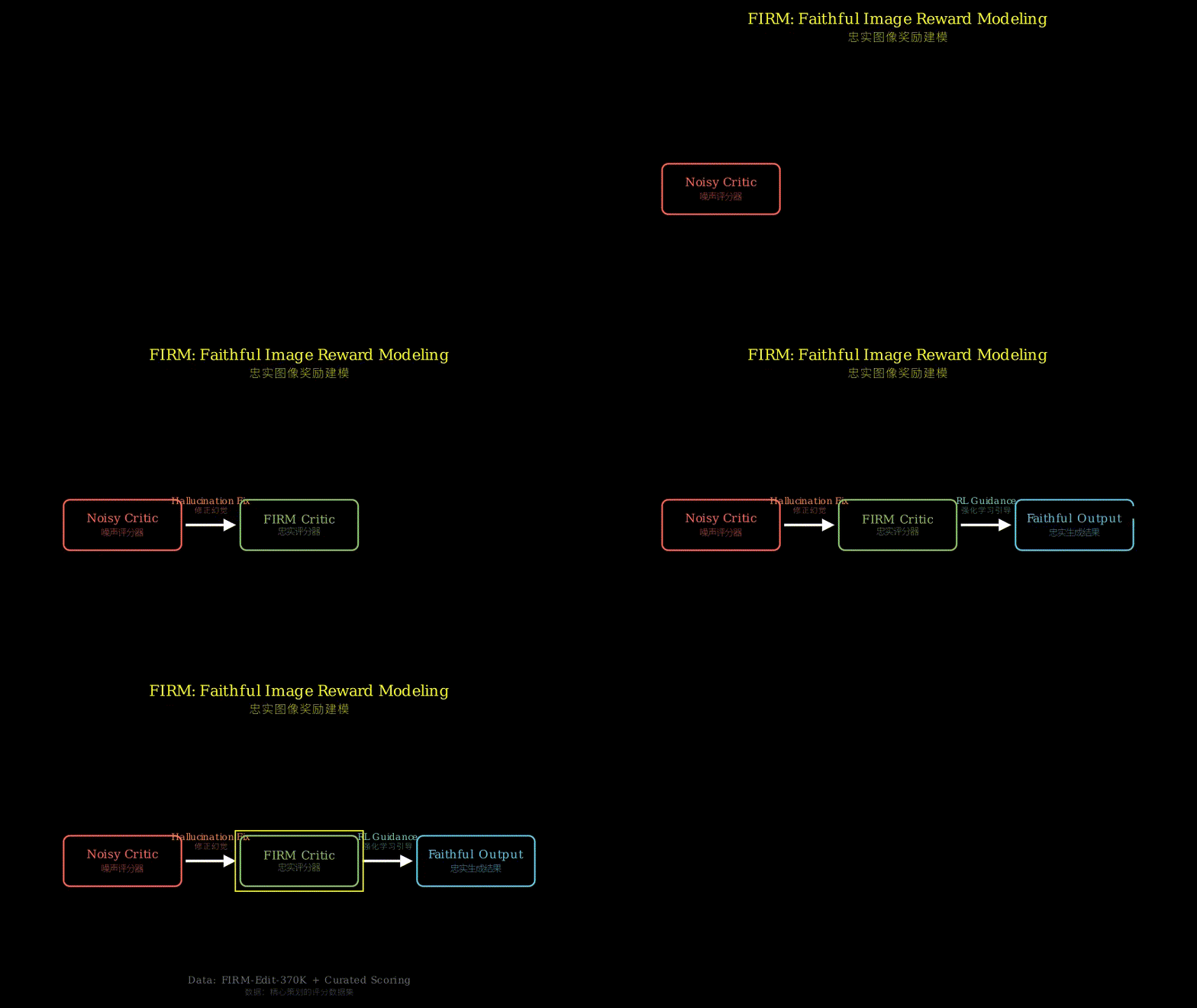
Paper: 2603.12247 Authors: Xiangyu Zhao, Peiyuan Zhang, Junming Lin, Tianhao Liang, Yuchen Duan, Shengyuan Ding, Changyao Tian, Yuhang Zang, Junchi Yan, Xue Yang Categories: cs.CV
The Gap
The RL-for-vision pipeline has a dirty secret: the reward model is usually an afterthought. Prior work like InstructPix2Pix, RLHF-Diffusion, and various GRPO-based image editors all assume that if you have a VLM-based scorer (CLIP, ImageReward, GPT-4V prompting), it’s good enough to guide optimization. It isn’t.
The specific failure mode is hallucination in scoring. A reward model might give a high score to an edited image that looks plausible but ignores the instruction, or penalize a generation that’s actually correct because the background changed. These noisy signals don’t average out — they compound. The generator learns to game a broken critic, and you end up with a model that’s optimized for the wrong thing.
The gap: nobody has systematically addressed reward model robustness before throwing it into the RL loop. The assumption has been “better VLM = better reward model,” but that’s not how it works. A VLM trained for general understanding doesn’t automatically become a reliable judge of instruction following.
Problem: RL-based image editing uses unreliable reward models
         Reward hallucination -> generator learns wrong objective
    |
    v
Assumption: Reward models need explicit robustness training
            before being used for RL optimization
    |
    v
Method: FIRM - train reward model with contrastive pairs
        + adversarial negatives + calibration
    |
    v
Evidence: Improved correlation with human judgments
          Better downstream RL performance
    |
    v
Conclusion: Robust reward modeling is a prerequisite,
            not an afterthought
The Increment
One sentence: Before FIRM, reward models for image editing were trained like classifiers and used like judges — after it, they’re trained explicitly to be robust critics before entering the RL loop.
Core Mechanism
FIRM trains the reward model in three stages. First, contrastive learning on (instruction, original image, edited image) triplets where the model learns to score correct edits higher than incorrect ones. Second, adversarial negative mining where the system generates plausible-looking but instruction-violating edits and trains the reward model to reject them. Third, calibration to ensure the score distribution is well-behaved and doesn’t have pathological peaks that the generator can exploit.
The key insight is that a reward model needs to see failure modes during training, not just positive examples. Standard VLM training shows the model what good looks like; FIRM shows it what almost-good-but-actually-wrong looks like.
Training Pipeline:
  Instruction + Image pairs
        |
        v
  Generate edits (correct + adversarial negatives)
        |
        v
  Contrastive training: score(correct) > score(wrong)
        |
        v
  Calibration: smooth score distribution
        |
        v
  Robust Reward Model
        |
        v
  Use in RL loop for image editing
Think of it like training a wine judge. You don’t just have them taste good wines — you give them wines with subtle flaws (corked, oxidized, over-oaked) and train them to detect the difference. FIRM does the same for image editing: it trains the reward model on near-misses and plausible failures, not just clear successes.
Key Concepts
-
Reward Hallucination: When a reward model assigns high scores to outputs that superficially match the instruction but miss the semantic intent. Example: instruction says “make the sky darker” but the model gives high scores to images where the sky is replaced with a different texture entirely. The reward model is fooled by surface similarity.
-
Adversarial Negative Mining: Generating hard negative examples that look plausible but violate the instruction in subtle ways. These are used to train the reward model to be more discriminating. It’s the difference between training on random noise (easy negatives) versus training on carefully crafted near-misses (hard negatives).
-
Calibration: Ensuring the reward model’s score distribution is well-behaved — no extreme peaks, reasonable dynamic range, scores that correlate with actual quality. Uncalibrated models might give 0.99 to everything decent and 0.01 to everything bad, which doesn’t give the RL algorithm useful gradients.
Framework Shift
Before (mainstream approach):        After (this paper):

  VLM (general purpose)                VLM (general purpose)
        |                                    |
        v                                    v
  Use as reward model                  FIRM training:
  (no adaptation)                      - Contrastive pairs
        |                              - Adversarial negatives
        v                              - Calibration
  RL optimization                            |
        |                                    v
  Generator learns to                  Robust reward model
  game broken critic                         |
                                             v
                                       RL optimization
                                             |
                                             v
                                       Generator learns
                                       correct objective
From using VLMs as-is to explicitly training robust critics, the core shift is: reward model quality is a first-class concern, not an assumed property.
Expert Assessment
Problem choice: Real and well-motivated. Reward model reliability is a known pain point in RL-for-vision, and the failure modes described (hallucination, gaming) are documented in practice. The timing is right — as RL becomes more common for image editing, the reward model bottleneck becomes more visible.
Method maturity: The three-stage training (contrastive + adversarial + calibration) is solid engineering but not deeply novel. Each component exists in prior work; the contribution is the integration and the focus on reward models specifically. The adversarial negative mining is the most interesting piece.
Experimental integrity: Would need to see the full paper for baselines and metrics. The key question is whether the improved reward model actually translates to better downstream RL performance, not just better correlation with human judgments. Correlation is necessary but not sufficient.
Writing quality: The abstract and introduction (based on what’s visible) are clear and well-motivated. The problem framing is strong. Would want to see more detail on the adversarial negative generation process.
Verdict: weak accept — addresses a real problem with solid engineering, but the novelty is in the application rather than the method.
Takeaways
The core lesson: if you’re using a model as a reward signal for RL, train it explicitly for that role. Don’t assume a model trained for task A will be a good judge for task B just because they’re related.
The adversarial negative mining pattern is broadly applicable: whenever you’re training a discriminator or critic, include hard negatives that are plausible but wrong, not just random noise.
The calibration step is often overlooked but critical for RL: the reward model’s score distribution directly affects the RL algorithm’s behavior. A poorly calibrated reward model can make RL training unstable or ineffective.
论文: 2603.12247 作者: Xiangyu Zhao, Peiyuan Zhang, Junming Lin, Tianhao Liang, Yuchen Duan, Shengyuan Ding, Changyao Tian, Yuhang Zang, Junchi Yan, Xue Yang 分类: cs.CV
缺口
基于强化学习的视觉生成流水线有个不能说的秘密:奖励模型通常是事后补救。
InstructPix2Pix、RLHF-Diffusion 以及各种基于 GRPO 的图像编辑器都假设,只要有一个基于视觉语言模型的打分器(CLIP、ImageReward、GPT-4V 提示),就足以指导优化。事实并非如此。
具体的失效模式是打分幻觉。奖励模型可能给一张看起来合理但实际上忽略了指令的编辑图像打高分,或者因为背景变了就惩罚一张实际正确的生成结果。这些噪声信号不会相互抵消——它们会累积。生成器学会了利用一个有缺陷的裁判,最终你得到的是一个针对错误目标优化的模型。
缺口在于:没有人在把奖励模型扔进强化学习循环之前,系统性地解决其鲁棒性问题。大家一直假设”更好的视觉语言模型 = 更好的奖励模型”,但事实并非如此。一个为通用理解训练的视觉语言模型,不会自动成为指令遵循的可靠裁判。
问题:基于 RL 的图像编辑使用不可靠的奖励模型
      奖励幻觉 -> 生成器学到错误目标
    |
    v
假设:奖励模型需要显式的鲁棒性训练
      才能用于 RL 优化
    |
    v
方法:FIRM - 用对比对训练奖励模型
      + 对抗负样本 + 校准
    |
    v
证据:与人类判断的相关性提升
      下游 RL 性能改善
    |
    v
结论:鲁棒的奖励建模是前提条件,
      而非事后补救
增量
一句话:FIRM 之前,图像编辑的奖励模型像分类器一样训练、像裁判一样使用;之后,它们在进入 RL 循环之前被显式训练为鲁棒的批评者。
核心机制
FIRM 分三个阶段训练奖励模型。
第一阶段,在(指令、原始图像、编辑图像)三元组上进行对比学习,模型学习给正确编辑打更高分。
第二阶段,对抗负样本挖掘,系统生成看起来合理但违反指令的编辑,训练奖励模型拒绝它们。
第三阶段,校准,确保分数分布表现良好,没有生成器可以利用的病态峰值。
关键洞察是:奖励模型在训练时需要看到失效模式,而不仅仅是正面例子。标准的视觉语言模型训练展示什么是好的;FIRM 展示什么是看起来好但实际错误的。
训练流水线:
  指令 + 图像对
        |
        v
  生成编辑(正确 + 对抗负样本)
        |
        v
  对比训练:score(正确) > score(错误)
        |
        v
  校准:平滑分数分布
        |
        v
  鲁棒奖励模型
        |
        v
  用于图像编辑的 RL 循环
用训练品酒师来理解这个过程。你不只是让他们品尝好酒——你给他们有细微缺陷的酒(软木塞污染、氧化、过度橡木桶陈酿),训练他们检测差异。FIRM 对图像编辑做同样的事:在接近但失败的案例和看似合理的失败上训练奖励模型,而不仅仅是明确的成功案例。
关键概念
-
奖励幻觉:奖励模型给表面上匹配指令但错过语义意图的输出打高分。例如:指令说”让天空变暗”,但模型给天空被完全替换成不同纹理的图像打高分。奖励模型被表面相似性欺骗了。
-
对抗负样本挖掘:生成看起来合理但以微妙方式违反指令的困难负样本。这些用于训练奖励模型更具辨别力。这是在随机噪声(简单负样本)上训练与在精心制作的接近失败案例(困难负样本)上训练的区别。
-
校准:确保奖励模型的分数分布表现良好——没有极端峰值,合理的动态范围,与实际质量相关的分数。未校准的模型可能给所有不错的东西打 0.99,给所有差的东西打 0.01,这不能给 RL 算法提供有用的梯度。
框架转变
之前(主流方法):                之后(本文方法):

  VLM(通用)                      VLM(通用)
        |                                |
        v                                v
  直接用作奖励模型                  FIRM 训练:
  (无适配)                        - 对比对
        |                            - 对抗负样本
        v                            - 校准
  RL 优化                                |
        |                                v
  生成器学会                        鲁棒奖励模型
  利用有缺陷的裁判                        |
                                         v
                                   RL 优化
                                         |
                                         v
                                   生成器学到
                                   正确目标
从直接使用视觉语言模型到显式训练鲁棒批评者,核心转变是:奖励模型质量是一等公民,而非假定属性。
专家评审
选题眼光:真实且动机充分。奖励模型可靠性是视觉强化学习中已知的痛点,描述的失效模式(幻觉、利用)在实践中有记录。时机恰当——随着 RL 在图像编辑中越来越常见,奖励模型瓶颈变得更加明显。
方法成熟度:三阶段训练(对比 + 对抗 + 校准)是扎实的工程,但不是深度创新。每个组件在先前工作中都存在;贡献在于整合以及专门针对奖励模型的关注。对抗负样本挖掘是最有趣的部分。
实验诚意:需要看完整论文才能了解基线和指标。关键问题是改进的奖励模型是否真正转化为更好的下游 RL 性能,而不仅仅是与人类判断的更好相关性。相关性是必要但不充分的。
写作功力:摘要和引言(基于可见部分)清晰且动机充分。问题框架很强。希望看到关于对抗负样本生成过程的更多细节。
判决:弱接收——用扎实的工程解决真实问题,但新颖性在于应用而非方法。
要点总结
核心教训:如果你要用一个模型作为 RL 的奖励信号,就要显式地为那个角色训练它。不要假设为任务 A 训练的模型会自动成为任务 B 的好裁判,仅仅因为它们相关。
对抗负样本挖掘模式广泛适用:无论何时训练判别器或批评者,都要包含看似合理但错误的困难负样本,而不仅仅是随机噪声。
校准步骤经常被忽视但对 RL 至关重要:奖励模型的分数分布直接影响 RL 算法的行为。校准不良的奖励模型会使 RL 训练不稳定或无效。