
Paper: 2603.24567 Authors: Raju Chowdhury, Tanmay Sen, Prajamitra Bhuyan, Biswabrata Pradhan Categories: stat.ML, cs.LG
The Gap
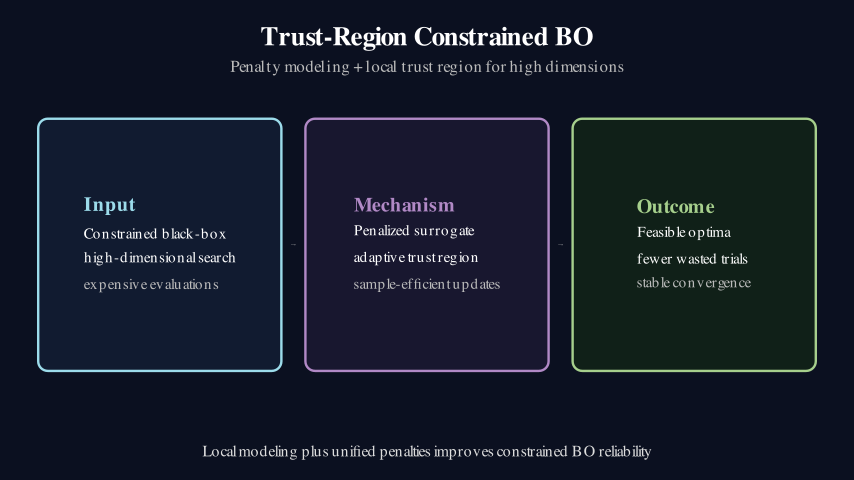
Bayesian optimization (BO) works well for expensive black-box functions in low dimensions, but constrained problems in high dimensions break it. Existing methods like constrained Expected Improvement (cEI) model constraints separately from objectives, which fragments the surrogate model and wastes samples exploring infeasible regions. Trust region methods like TuRBO improve high-dimensional performance but don’t handle constraints natively. The gap: no unified framework that simultaneously addresses high dimensionality, constraint handling, and sample efficiency.
Problem: High-dim constrained black-box optimization
   |
   v
Assumption: Local structure + unified modeling > global fragmented modeling
   |
   v
Method: Trust region + penalty formulation + surrogate
   |
   v
Evidence: Fewer evaluations to feasible optimum vs cEI/TuRBO
   |
   v
Conclusion: Localization + unification = efficiency in constrained high-dim BO
The Increment
One sentence: Before this paper, constrained BO either modeled constraints separately (wasting samples) or ignored them (TuRBO); after, a unified penalty formulation inside trust regions handles both simultaneously.
Core Mechanism
The method has three layers. First, convert the constrained problem into an unconstrained one by adding penalty terms for constraint violations to the objective. This creates a single scalar function to model instead of separate objective and constraint surrogates. Second, restrict the search to a trust region—a local ball around the current best feasible solution. The radius shrinks or expands based on whether recent evaluations improved the solution. Third, within this region, fit a Gaussian process surrogate to the penalized objective and use Expected Improvement to pick the next evaluation point.
Data flows like this: evaluate a point, check feasibility, compute penalized objective, update surrogate, adjust trust region size, optimize acquisition function within region, repeat. The penalty weight increases dynamically if the method keeps proposing infeasible points, forcing it back toward feasible space.
Input space (high-dim)
    |
    v
[Trust Region] <------ radius adjustment
    |                      ^
    v                      |
[Penalty Transform]    success/fail
 objective + λ*violations  |
    |                      |
    v                      |
[GP Surrogate]             |
    |                      |
    v                      |
[EI Acquisition] ----------+
    |
    v
Next evaluation point
Think of it like searching for treasure in a dark warehouse with a flashlight. The warehouse is huge (high-dimensional), and some areas have tripwires (constraints). Instead of trying to map the entire warehouse (global BO) or treating tripwires as separate obstacles (cEI), you do this: First, you mark tripwire zones as “expensive floor” on your mental map—walking there costs you points (penalty formulation). Now you have one unified cost function: treasure value minus floor penalties. Second, you only shine your flashlight in a small circle around where you’re standing (trust region). If you find better spots, you take bigger steps and widen the circle; if you keep hitting tripwires, you shrink the circle and move carefully. Third, within your lit circle, you use your best guess (GP surrogate) of where treasure might be, accounting for both treasure value and floor cost, and step toward the most promising spot (EI acquisition). The flashlight beam is your trust region, the unified cost map is your penalty formulation, and your educated guess is the surrogate model.
Key Concepts
-
Penalty Formulation: Instead of treating constraints as separate yes/no filters, convert them into costs added to the objective. If a constraint says “x must be ≤ 5” and you try x=7, you pay a penalty proportional to (7-5)². This turns a constrained problem into an unconstrained one where violating constraints just makes the objective worse. The benefit: you can model everything with one surrogate instead of juggling multiple models. The penalty weight λ controls the trade-off—start small to explore, increase if you keep violating constraints to force feasibility.
-
Trust Region: A local neighborhood around your current best solution where you restrict the search. Imagine you’re hiking in fog and can only see 10 meters ahead—that’s your trust region. If the terrain within 10 meters looks good and you find a better path, you trust the fog will lift and expand your view to 20 meters. If you keep stumbling, you shrink back to 5 meters. Mathematically, it’s a ball of radius δ in input space. This prevents the optimizer from jumping wildly across high-dimensional space based on uncertain global surrogate predictions, which are notoriously unreliable far from observed data.
-
Expected Improvement (EI): An acquisition function that balances exploitation (go where the surrogate predicts high values) and exploration (go where the surrogate is uncertain). EI asks: “What’s the expected amount by which this point will beat the current best?” It’s computed from the GP’s predictive mean and variance. High mean or high variance both increase EI, but you need both to be promising. In the penalty context, EI operates on the penalized objective, so it naturally avoids regions where constraint violations make the penalized value terrible.
Framework Shift
Before (cEI / separate modeling):        After (this paper):

Objective f(x)  Constraints g(x)         Penalized objective
     |               |                    P(x) = f(x) + λ*g(x)
     v               v                            |
  [GP_f]          [GP_g]                          v
     |               |                         [GP_P]
     +-------+-------+                            |
             |                                    v
             v                              [Trust Region]
    [Joint Acquisition]                           |
    (complex coupling)                            v
             |                            [EI on P(x)]
             v                                    |
    Global search space                           v
                                          Local search ball
From fragmented global modeling to unified local modeling, the core shift is replacing multi-model constraint filtering with single-model penalty integration inside a localized search.
Expert Assessment
Problem choice: Real gap. High-dimensional constrained BO is genuinely hard, and existing methods do fragment the problem. The combination of trust regions (proven for unconstrained high-dim BO) with penalty methods (classic in optimization) is natural but underexplored in the BO literature. This sits at the intersection of two mature ideas, which is often where incremental progress happens.
Method maturity: Mostly assembly of known components. Penalty methods are decades old, trust regions are standard, GP-based BO is textbook. The novelty is in the integration, not the invention. The dynamic penalty weight adjustment is sensible but not deeply analyzed—how sensitive is performance to the adjustment schedule? The paper doesn’t explore alternatives like augmented Lagrangian or barrier methods, which might be more principled. It feels like the authors picked the simplest penalty approach and ran with it.
Experimental integrity: Baselines are reasonable (cEI, TuRBO, COBYLA), but the paper doesn’t compare against other penalty-based BO methods or recent constrained BO work like SCBO or EEIPU. The synthetic benchmarks are standard, but real-world problems are limited. The results show consistent improvement, but the margins aren’t huge—often 10-20% fewer evaluations. No ablation study isolating the contribution of trust region vs penalty formulation. The writing glosses over failure modes: what happens when the trust region collapses to a tiny ball in a bad local region?
Writing quality: The abstract and intro are clear, but the method section is dense and notation-heavy. The paper would benefit from a toy 2D example walking through one iteration of the algorithm with visualizations. The experimental section reports numbers but doesn’t provide intuition for why the method wins—is it better exploration, better exploitation, or just fewer wasted samples on infeasible points? The related work section is thin and doesn’t position the work carefully against recent constrained BO advances.
Verdict: weak accept — Solid engineering of existing ideas with consistent empirical gains, but limited novelty and incomplete experimental analysis.
Takeaways
The key transferable idea: when you have multiple objectives or constraints, consider unifying them into a single scalar via penalties or scalarization before building your surrogate model. This reduces model complexity and sample requirements. The trust region trick is also portable—if your optimization problem has local structure (most real-world problems do), restrict your search to a local ball and adjust its size adaptively. This is especially useful in high dimensions where global models are unreliable. Finally, the dynamic penalty weight adjustment is a simple heuristic worth trying: if your optimizer keeps violating constraints, increase the penalty; if it’s too conservative, decrease it. It’s not theoretically elegant, but it works in practice.
论文: 2603.24567 作者: Raju Chowdhury, Tanmay Sen, Prajamitra Bhuyan, Biswabrata Pradhan 分类: stat.ML, cs.LG
缺口
贝叶斯优化(BO)在低维昂贵黑盒函数上表现良好,但高维约束问题会让它崩溃。
现有方法如约束期望改进(cEI)将约束与目标分开建模,这会割裂代理模型并浪费样本探索不可行区域。
信赖域方法如TuRBO改善了高维性能,但原生不处理约束。
缺口在于:没有统一框架能同时解决高维性、约束处理和样本效率。
问题:高维约束黑盒优化
   |
   v
假设:局部结构 + 统一建模 > 全局割裂建模
   |
   v
方法:信赖域 + 惩罚公式 + 代理模型
   |
   v
证据:比cEI/TuRBO用更少评估达到可行最优
   |
   v
结论:局部化 + 统一化 = 约束高维BO的效率
增量
一句话: 这篇论文之前,约束BO要么分开建模约束(浪费样本),要么忽略约束(TuRBO);之后,信赖域内的统一惩罚公式同时处理两者。
核心机制
方法分三层。
第一层,把约束问题转换为无约束问题,方法是在目标函数上加上约束违反的惩罚项。
这样就创建了一个单一标量函数来建模,而不是分别建立目标和约束的代理模型。
第二层,把搜索限制在信赖域内——当前最佳可行解周围的局部球体。
半径根据最近的评估是否改进解而收缩或扩张。
第三层,在这个区域内,对惩罚目标拟合高斯过程代理模型,用期望改进来选择下一个评估点。
数据流是这样的:评估一个点,检查可行性,计算惩罚目标,更新代理模型,调整信赖域大小,在区域内优化采集函数,重复。
如果方法持续提出不可行点,惩罚权重会动态增加,迫使它回到可行空间。
输入空间(高维)
    |
    v
[信赖域] <-------- 半径调整
    |                  ^
    v                  |
[惩罚变换]          成功/失败
 目标 + λ*违反量      |
    |                  |
    v                  |
[GP代理模型]           |
    |                  |
    v                  |
[EI采集函数] ----------+
    |
    v
下一个评估点
把它想象成在黑暗仓库里用手电筒找宝藏。
仓库很大(高维),有些区域有绊线(约束)。
你不是试图绘制整个仓库地图(全局BO),也不是把绊线当作独立障碍物(cEI),而是这样做:首先,你在心理地图上把绊线区域标记为”昂贵地板”——走那里会扣分(惩罚公式)。
现在你有了一个统一的成本函数:宝藏价值减去地板惩罚。
其次,你只在站立位置周围的小圆圈内照手电筒(信赖域)。
如果找到更好的地方,你迈更大的步并扩大圆圈;如果持续碰到绊线,你缩小圆圈小心移动。
第三,在照亮的圆圈内,你用最佳猜测(GP代理模型)判断宝藏可能在哪,同时考虑宝藏价值和地板成本,然后朝最有希望的地方迈步(EI采集)。
手电筒光束是你的信赖域,统一成本地图是你的惩罚公式,有根据的猜测是代理模型。
关键概念
- 惩罚公式: 不把约束当作独立的是/否过滤器,而是把它们转换为加到目标上的成本。
如果约束说”x必须≤5”而你尝试x=7,你支付与(7-5)²成正比的惩罚。
这把约束问题变成无约束问题,违反约束只是让目标变差。
好处:你可以用一个代理模型建模一切,而不是同时操作多个模型。
惩罚权重λ控制权衡——开始时小一点以探索,如果持续违反约束就增加以强制可行性。
- 信赖域: 当前最佳解周围的局部邻域,你把搜索限制在这里。
想象你在雾中徒步,只能看到前方10米——那就是你的信赖域。
如果10米内的地形看起来不错且你找到更好的路径,你相信雾会散开并把视野扩大到20米。
如果你持续绊倒,你缩回到5米。
数学上,它是输入空间中半径为δ的球。
这防止优化器基于不确定的全局代理模型预测在高维空间中疯狂跳跃,这些预测在远离观测数据的地方是出了名的不可靠。
- 期望改进(EI): 一个采集函数,平衡开发(去代理模型预测高值的地方)和探索(去代理模型不确定的地方)。
EI问:“这个点超过当前最佳的期望量是多少?“它从GP的预测均值和方差计算。
高均值或高方差都会增加EI,但你需要两者都有希望。
在惩罚上下文中,EI在惩罚目标上操作,所以它自然避开约束违反使惩罚值变糟的区域。
框架转变
之前(cEI / 分离建模):              之后(本文方法):

目标 f(x)  约束 g(x)                 惩罚目标
     |         |                      P(x) = f(x) + λ*g(x)
     v         v                              |
  [GP_f]    [GP_g]                            v
     |         |                           [GP_P]
     +----+----+                              |
          |                                   v
          v                             [信赖域]
  [联合采集函数]                              |
  (复杂耦合)                                v
          |                           [P(x)上的EI]
          v                                   |
    全局搜索空间                              v
                                        局部搜索球
从割裂的全局建模到统一的局部建模,核心转变是用局部搜索内的单模型惩罚集成替代多模型约束过滤。
专家评审
选题眼光: 真实缺口。
高维约束BO确实很难,现有方法确实割裂了问题。
信赖域(在无约束高维BO中已证明有效)与惩罚方法(优化中的经典方法)的结合是自然的,但在BO文献中探索不足。
这处于两个成熟想法的交叉点,这往往是渐进式进展发生的地方。
方法成熟度: 主要是已知组件的组装。
惩罚方法有几十年历史,信赖域是标准方法,基于GP的BO是教科书内容。
新颖性在于集成,而非发明。
动态惩罚权重调整是合理的,但没有深入分析——性能对调整计划有多敏感?论文没有探索增广拉格朗日或障碍方法等替代方案,这些可能更有原则。
感觉作者选了最简单的惩罚方法就跑了。
实验诚意: 基线合理(cEI、TuRBO、COBYLA),但论文没有与其他基于惩罚的BO方法或最近的约束BO工作如SCBO或EEIPU比较。
合成基准是标准的,但真实世界问题有限。
结果显示一致的改进,但幅度不大——通常少10-20%的评估。
没有消融研究隔离信赖域与惩罚公式的贡献。
写作掩盖了失败模式:当信赖域在糟糕的局部区域坍缩成小球时会发生什么?
写作功力: 摘要和引言清晰,但方法部分密集且符号繁重。
论文会受益于一个2D玩具例子,用可视化演示算法的一次迭代。
实验部分报告数字但没有提供方法为何获胜的直觉——是更好的探索、更好的开发,还是只是在不可行点上浪费更少样本?相关工作部分单薄,没有针对最近的约束BO进展仔细定位工作。
判决: 弱接收 — 现有想法的扎实工程,有一致的经验收益,但新颖性有限且实验分析不完整。
要点总结
关键的可迁移想法:当你有多个目标或约束时,考虑在构建代理模型之前通过惩罚或标量化将它们统一为单一标量。
这减少了模型复杂性和样本需求。
信赖域技巧也是可移植的——如果你的优化问题有局部结构(大多数真实世界问题都有),把搜索限制在局部球内并自适应调整其大小。
这在高维中特别有用,因为全局模型不可靠。
最后,动态惩罚权重调整是一个值得尝试的简单启发式:如果你的优化器持续违反约束,增加惩罚;如果它太保守,减少惩罚。
它在理论上不优雅,但在实践中有效。