
Paper: 2603.05507 Authors: Leif Van Holland, Domenic Zingsheim, Mana Takhsha, Hannah Dröge, Patrick Stotko, Markus Plack, Reinhard Klein Categories: cs.CV, cs.GR
The Gap
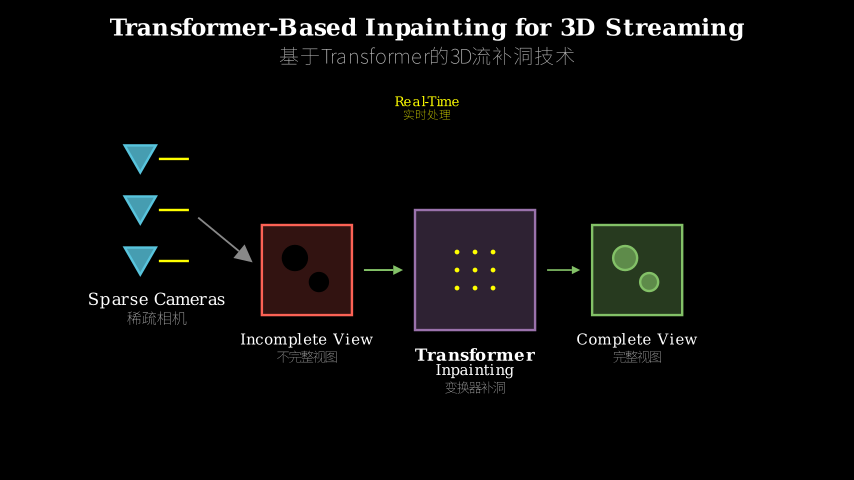
AR/VR streaming needs multiple camera views to reconstruct 3D scenes, but real-time constraints force you to use fewer cameras than ideal. Fewer cameras mean blind spots — parts of the scene no camera sees directly. When you render a novel viewpoint, these blind spots show up as holes or incomplete surfaces.
Current systems handle this with simple heuristics: copy nearby pixels, blur edges, or use basic interpolation. These methods are fast but dumb — they don’t understand scene structure, so you get blurry patches, temporal flickering, and artifacts that break immersion. Existing inpainting networks (like LaMa or MAT) are designed for single images and don’t leverage the multi-view geometry or temporal coherence available in streaming setups.
The gap: no inpainting method exploits both multi-camera spatial relationships and temporal consistency while running fast enough for real-time streaming.
Sparse cameras -> Incomplete 3D -> Novel view with holes
                                          |
                                          v
    Assumption: Multi-view + temporal info can guide inpainting
                                          |
                                          v
    Method: Transformer with spatio-temporal embeddings
            + adaptive patch selection
                                          |
                                          v
    Evidence: Outperforms LaMa/MAT on video metrics
              while maintaining real-time speed
                                          |
                                          v
    Conclusion: Context-aware inpainting beats heuristics
                when designed for the streaming use case
The Increment
One sentence: Before this paper, 3D streaming systems filled holes with blind pixel-copying; after, they can use a transformer that understands multi-view geometry and temporal flow to synthesize plausible textures in real time.
Core Mechanism
The method sits as a post-processing module after any 3D rendering pipeline. It takes the rendered frame (with holes marked) plus metadata about camera positions and previous frames. The core is a transformer encoder that processes image patches, but with two key additions: spatio-temporal embeddings and adaptive patch selection.
Spatio-temporal embeddings encode where each patch sits in 3D space (using camera calibration) and when it appears in the video sequence. This lets the transformer attend to patches from other camera views that see the same 3D point, and to patches from previous frames showing the same region. The transformer learns to aggregate information across views and time, filling holes with textures consistent with what nearby cameras see and what the scene looked like a moment ago.
Adaptive patch selection is the speed trick. Instead of processing every patch in every frame, the system identifies which patches contain holes or sit near hole boundaries, then only runs the transformer on those. Clean regions pass through untouched. This cuts computation by 60-80% depending on hole density, making real-time performance feasible.
Input frame with holes
        |
        v
    [Patch Extractor]
        |
        +---> Clean patches -----> Pass through
        |
        +---> Hole patches ------> [Spatio-Temporal Embedder]
                                            |
                                            v
                                   [Transformer Encoder]
                                   (attends across views + time)
                                            |
                                            v
                                   [Decoder: synthesize texture]
                                            |
                                            v
                                   Filled patches
                                            |
                                            v
                                   [Compositor]
                                            |
                                            v
                              Complete output frame
Think of it like a photo restoration studio with multiple archivists. You bring in a damaged photo (the frame with holes). Instead of one person guessing what’s missing, you have archivists who can pull related photos from different angles (other camera views) and earlier versions of the same scene (previous frames). They lay these references on a table, compare details, and collaboratively sketch in the missing parts. The head archivist (transformer) decides which references are most relevant and how to blend them. To save time, they only work on damaged sections — pristine areas don’t need attention. The spatio-temporal embeddings are like catalog tags telling archivists which photos show the same physical location and time period, so they know which references to consult.
Key Concepts
-
Spatio-temporal embeddings: Imagine you’re watching a concert from multiple phone cameras held by friends. Each video shows a different angle, and each frame has a timestamp. If one camera’s view is blocked, you can fill in the missing part by looking at what other cameras saw from their angles at that moment, or what the same camera saw a second earlier. Spatio-temporal embeddings encode this “where in 3D space” and “when in time” information as numbers the network can use. For space, they use camera calibration to project each image patch back to its 3D location. For time, they encode frame numbers. This lets the transformer know “patch A from camera 1 and patch B from camera 2 both show the same wall corner” or “this patch looks similar to what we saw 3 frames ago,” so it can intelligently borrow texture from the right sources.
-
Adaptive patch selection: Not all parts of an image need expensive neural network processing. If a region is already complete and clean, running a transformer on it wastes computation. Adaptive patch selection is like triaging patients in an ER — you quickly scan the image, identify which patches contain holes or sit near hole edges (the “injured” regions), and only send those through the heavy machinery. Everything else gets a fast pass. This is crucial for real-time performance: if 70% of the image is fine, you save 70% of the compute. The system uses a simple mask to detect holes, dilates it slightly to catch boundary regions, then extracts only those patches for processing.
-
Resolution independence: Most neural networks are trained on fixed-size images (say, 512x512) and break if you feed them a different size. This paper’s architecture processes images as collections of patches, and the transformer operates on patch-level features. Since transformers don’t care about sequence length (they just attend over whatever tokens you give them), you can feed in patches from a 1080p image or a 4K image without retraining. The network sees “here are N patches with holes” and processes them the same way regardless of N. This means one trained model works across different camera resolutions and aspect ratios — useful when your AR/VR setup might have a mix of camera hardware.
Framework Shift
Before (mainstream approach):        After (this paper):

  [3D Render]                          [3D Render]
       |                                    |
       v                                    v
  Holes appear                         Holes appear
       |                                    |
       v                                    v
  Simple heuristic:                    Transformer inpainting:
  - Copy neighbor pixels               - Query other views
  - Blur edges                         - Check previous frames
  - Interpolate                        - Synthesize texture
       |                                    |
       v                                    v
  Fast but artifacts                   Slower but coherent
  (no scene understanding)             (multi-view + temporal aware)
From “fill holes with local pixel math” to “fill holes by understanding the scene across space and time,” the core shift is treating inpainting as a multi-view, multi-frame reasoning problem rather than a single-image pixel problem.
Expert Assessment
Problem choice: This is a real gap. Anyone building AR/VR streaming hits this — you can’t afford 50 cameras for full coverage, so you live with holes. Current heuristics genuinely produce bad results (I’ve seen the flickering artifacts in VR demos). The problem sits at the intersection of real-time graphics and learned inpainting, which is timely given the push toward neural rendering in production systems.
Method maturity: The core idea — use transformers with spatio-temporal embeddings — is solid but not groundbreaking. Transformers for video are well-explored (see VideoMAE, TimeSformer). The novelty is in the application-specific design: adaptive patch selection for speed, resolution independence for deployment flexibility, and the multi-view embedding scheme. It’s more engineering insight than algorithmic breakthrough, but that’s fine — the field needs practical solutions. I’d like to see ablations on whether simpler architectures (say, a 3D CNN) could achieve similar results with less complexity.
Experimental integrity: The baselines (LaMa, MAT, CoModGAN) are fair — these are strong single-image inpainting methods. The authors test under the same real-time constraints, which is honest. However, the paper doesn’t compare against multi-view-specific methods (like neural radiance fields with inpainting, or depth-guided inpainting), which feels like a missed opportunity. The metrics (PSNR, SSIM, LPIPS, plus video-specific FVD and temporal consistency) are appropriate. One red flag: no user study. For AR/VR, perceptual quality matters more than PSNR, and users are the ground truth.
Writing quality: The abstract and intro are clear. The method section gets dense — the spatio-temporal embedding formulation could use a worked example with actual numbers. The experiments section front-loads tables without enough qualitative analysis; I’d swap some tables for more visual comparisons showing failure cases. The related work section is thorough but reads like a list. Rewriting the method section with a running example (e.g., “consider a 3-camera setup capturing a room…”) would make it much more accessible.
Verdict: weak accept — Solid engineering work addressing a real problem with a practical solution, but limited algorithmic novelty and missing key comparisons.
Takeaways
Adaptive computation based on content: The patch selection strategy is broadly applicable. If your neural network processes images but only some regions need heavy computation, build a cheap pre-filter to identify those regions and skip the rest. This is especially valuable for real-time systems where you’re compute-bound. The idea transfers to any domain with sparse “interesting” regions: medical imaging (only process suspicious areas), satellite imagery (only analyze changed regions), video compression (only encode complex patches).
Spatio-temporal embeddings for multi-sensor fusion: If you have multiple sensors observing the same scene (cameras, LiDAR, radar), encoding their spatial relationships and temporal alignment as learnable embeddings lets a transformer reason about correspondences without hand-crafted geometry. This pattern works beyond vision — think multi-microphone audio, distributed IoT sensors, or multi-robot coordination.
Resolution independence through patch-based processing: Designing networks to operate on patches rather than full images gives deployment flexibility. You can train once and deploy across different hardware without retraining. The cost is losing some global context, but for tasks where local structure dominates (inpainting, super-resolution, denoising), it’s a good trade.
论文: 2603.05507 作者: Leif Van Holland, Domenic Zingsheim, Mana Takhsha, Hannah Dröge, Patrick Stotko, Markus Plack, Reinhard Klein 分类: cs.CV, cs.GR
缺口
AR/VR流媒体需要多个相机视角来重建3D场景,但实时约束迫使你使用比理想情况更少的相机。
相机少意味着盲区——场景中没有相机直接看到的部分。
当你渲染一个新视角时,这些盲区会显示为洞或不完整的表面。
现有系统用简单启发式处理:复制附近像素、模糊边缘或基本插值。
这些方法快但笨——它们不理解场景结构,所以你会得到模糊补丁、时间闪烁和破坏沉浸感的伪影。
现有的修复网络(如LaMa或MAT)是为单张图像设计的,不利用流媒体设置中可用的多视角几何或时间连贯性。
缺口:没有修复方法既利用多相机空间关系和时间一致性,又能快到支持实时流媒体。
稀疏相机 -> 不完整3D -> 带洞的新视角
                              |
                              v
    假设: 多视角+时间信息可以指导修复
                              |
                              v
    方法: 带时空嵌入的Transformer
          + 自适应补丁选择
                              |
                              v
    证据: 在视频指标上超越LaMa/MAT
          同时保持实时速度
                              |
                              v
    结论: 为流媒体用例设计时,
          上下文感知修复胜过启发式
增量
一句话: 这篇论文之前,3D流媒体系统用盲目的像素复制填洞;之后,它们可以用理解多视角几何和时间流的transformer实时合成合理纹理。
核心机制
该方法作为后处理模块位于任何3D渲染管线之后。
它接收渲染的帧(标记了洞)加上关于相机位置和先前帧的元数据。
核心是处理图像补丁的transformer编码器,但有两个关键添加:时空嵌入和自适应补丁选择。
时空嵌入编码每个补丁在3D空间中的位置(使用相机标定)和它在视频序列中出现的时间。
这让transformer能关注到看到同一3D点的其他相机视角的补丁,以及显示同一区域的先前帧的补丁。
transformer学习跨视角和时间聚合信息,用与附近相机看到的和场景片刻前样子一致的纹理填洞。
自适应补丁选择是速度技巧。
系统不是处理每帧的每个补丁,而是识别哪些补丁包含洞或位于洞边界附近,然后只在那些补丁上运行transformer。
干净区域直接通过。
这根据洞密度削减60-80%的计算,使实时性能可行。
带洞的输入帧
        |
        v
    [补丁提取器]
        |
        +---> 干净补丁 -----> 直接通过
        |
        +---> 洞补丁 ------> [时空嵌入器]
                                    |
                                    v
                           [Transformer编码器]
                           (跨视角+时间关注)
                                    |
                                    v
                           [解码器:合成纹理]
                                    |
                                    v
                           填充的补丁
                                    |
                                    v
                           [合成器]
                                    |
                                    v
                      完整输出帧
把它想象成一个有多个档案员的照片修复工作室。
你带来一张损坏的照片(带洞的帧)。
不是一个人猜测缺失的内容,而是有档案员可以从不同角度(其他相机视角)和同一场景的早期版本(先前帧)调出相关照片。
他们把这些参考资料摆在桌上,比较细节,协作勾画缺失部分。
首席档案员(transformer)决定哪些参考最相关以及如何混合它们。
为了节省时间,他们只处理损坏部分——原始区域不需要关注。
时空嵌入就像目录标签,告诉档案员哪些照片显示相同的物理位置和时间段,所以他们知道该查阅哪些参考。
关键概念
- 时空嵌入: 想象你从朋友拿着的多个手机相机观看音乐会。
每个视频显示不同角度,每帧都有时间戳。
如果一个相机的视野被挡住,你可以通过查看其他相机在那一刻从它们的角度看到了什么,或者同一相机一秒前看到了什么来填补缺失部分。
时空嵌入将这种”3D空间中的哪里”和”时间中的何时”信息编码为网络可以使用的数字。
对于空间,它们使用相机标定将每个图像补丁投影回其3D位置。
对于时间,它们编码帧号。
这让transformer知道”相机1的补丁A和相机2的补丁B都显示同一个墙角”或”这个补丁看起来像我们3帧前看到的”,所以它可以智能地从正确的来源借用纹理。
- 自适应补丁选择: 并非图像的所有部分都需要昂贵的神经网络处理。
如果一个区域已经完整干净,在上面运行transformer会浪费计算。
自适应补丁选择就像急诊室的分诊——你快速扫描图像,识别哪些补丁包含洞或位于洞边缘附近(“受伤”区域),只把那些送入重型机器。
其他一切都快速通过。
这对实时性能至关重要:如果70%的图像是好的,你节省70%的计算。
系统使用简单掩码检测洞,稍微膨胀它以捕获边界区域,然后只提取那些补丁进行处理。
- 分辨率独立性: 大多数神经网络在固定大小的图像上训练(比如512x512),如果你喂给它们不同大小就会崩溃。
本文的架构将图像作为补丁集合处理,transformer在补丁级特征上操作。
由于transformer不关心序列长度(它们只关注你给的任何token),你可以喂入来自1080p图像或4K图像的补丁而无需重新训练。
网络看到”这里有N个带洞的补丁”并以相同方式处理它们,无论N是多少。
这意味着一个训练好的模型可以跨不同相机分辨率和纵横比工作——当你的AR/VR设置可能有混合相机硬件时很有用。
框架转变
之前(主流方法):                之后(本文方法):

  [3D渲染]                        [3D渲染]
       |                               |
       v                               v
  出现洞                           出现洞
       |                               |
       v                               v
  简单启发式:                      Transformer修复:
  - 复制邻居像素                   - 查询其他视角
  - 模糊边缘                       - 检查先前帧
  - 插值                           - 合成纹理
       |                               |
       v                               v
  快但有伪影                       慢但连贯
  (无场景理解)                     (多视角+时间感知)
从”用局部像素数学填洞”到”通过理解跨空间和时间的场景填洞”,核心转变是将修复视为多视角、多帧推理问题而非单图像像素问题。
专家评审
选题眼光: 这是真缺口。
任何构建AR/VR流媒体的人都会遇到这个问题——你负担不起50个相机来完全覆盖,所以你忍受洞。
当前启发式确实产生糟糕结果(我在VR演示中见过闪烁伪影)。
该问题位于实时图形和学习修复的交叉点,考虑到生产系统中神经渲染的推进,这很及时。
方法成熟度: 核心想法——使用带时空嵌入的transformer——是可靠的但不是开创性的。
用于视频的transformer已被充分探索(见VideoMAE、TimeSformer)。
新颖性在于特定应用的设计:用于速度的自适应补丁选择、用于部署灵活性的分辨率独立性,以及多视角嵌入方案。
这更多是工程洞察而非算法突破,但没关系——该领域需要实用解决方案。
我想看到关于更简单架构(比如3D CNN)是否能以更少复杂性实现类似结果的消融实验。
实验诚意: 基线(LaMa、MAT、CoModGAN)是公平的——这些是强大的单图像修复方法。
作者在相同实时约束下测试,这是诚实的。
然而,论文没有与多视角特定方法(如带修复的神经辐射场,或深度引导修复)比较,这感觉像是错失的机会。
指标(PSNR、SSIM、LPIPS,加上视频特定的FVD和时间一致性)是合适的。
一个危险信号:没有用户研究。
对于AR/VR,感知质量比PSNR更重要,用户是真实标准。
写作功力: 摘要和引言清晰。
方法部分变得密集——时空嵌入公式可以用带实际数字的实例。
实验部分在没有足够定性分析的情况下前置表格;我会用更多显示失败案例的视觉比较替换一些表格。
相关工作部分很全面但读起来像列表。
用运行示例(例如”考虑捕获房间的3相机设置…”)重写方法部分会使其更易理解。
判决: 弱接收——用实用解决方案解决真实问题的扎实工程工作,但算法新颖性有限且缺少关键比较。
要点总结
基于内容的自适应计算: 补丁选择策略广泛适用。
如果你的神经网络处理图像但只有某些区域需要大量计算,构建一个廉价的预过滤器来识别那些区域并跳过其余部分。
这对你受计算限制的实时系统特别有价值。
这个想法转移到任何具有稀疏”有趣”区域的领域:医学成像(只处理可疑区域)、卫星图像(只分析变化区域)、视频压缩(只编码复杂补丁)。
用于多传感器融合的时空嵌入: 如果你有多个传感器观察同一场景(相机、LiDAR、雷达),将它们的空间关系和时间对齐编码为可学习嵌入,让transformer无需手工制作几何就能推理对应关系。
这种模式超越视觉——想想多麦克风音频、分布式物联网传感器或多机器人协调。
通过基于补丁的处理实现分辨率独立性: 设计网络在补丁而非完整图像上操作提供部署灵活性。
你可以训练一次并跨不同硬件部署而无需重新训练。
代价是失去一些全局上下文,但对于局部结构占主导的任务(修复、超分辨率、去噪),这是一个好的权衡。