
Paper: 2603.24571 Authors: Yubo Li, Xugong Qin, Peng Zhang, Hailun Lin, Gangyan Zeng, Kexin Zhang Categories: cs.CV
The Gap
Scene text editing has been dominated by training-based methods that require paired datasets (original image + edited version) or task-specific fine-tuning. This creates a scalability bottleneck: every new font style, language, or visual context demands new training data and compute. Methods like DiffUTE and TextDiffuser achieve good results but can’t generalize beyond their training distribution without retraining.
The core limitation: existing approaches treat text editing as a supervised learning problem rather than a compositional manipulation task. They bake style and structure understanding into model weights instead of deriving them from the image itself.
Problem: Training-based methods lack generalization
   |
   v
Assumption: Text editing can be decomposed into
            style preservation + content rendering
   |
   v
Method: TextFlow = FMS (flow manifold) + AttnBoost
        (training-free, plug-and-play)
   |
   v
Evidence: Comparable quality to trained models
          across diverse scenes/languages
   |
   v
Conclusion: Training-free paradigm is viable
            for scene text editing
The Increment
One sentence: Before this paper, editing text in images required training on paired data for each domain; after, you can plug in two modules and edit text in any scene without training.
Core Mechanism
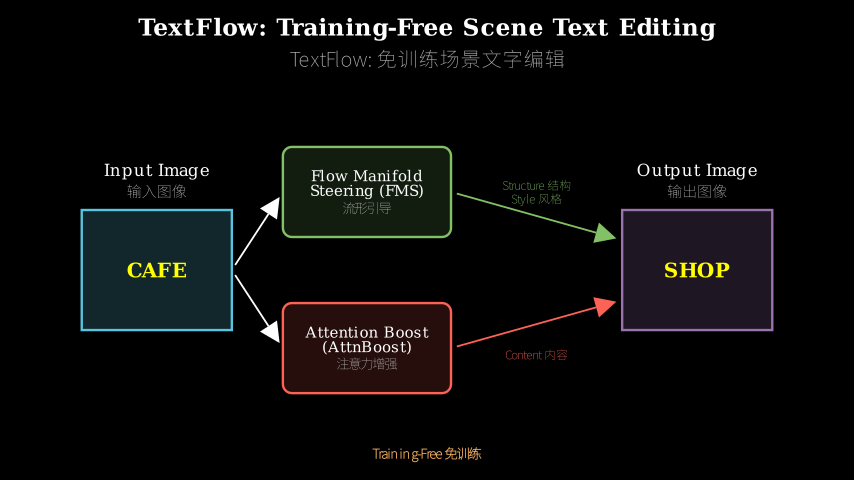
TextFlow operates in two parallel streams. The Flow Manifold Steering (FMS) module analyzes the original image to extract a “visual flow” — essentially a spatial map of how character strokes and background textures should behave. It models this as a manifold in latent space, capturing both the geometric structure (character shapes, spacing) and photometric properties (lighting, texture, perspective distortion).
Simultaneously, the Attention Boost (AttnBoost) module guides the diffusion process to render the new text content. It injects attention maps that emphasize text regions during denoising, ensuring the model focuses computational resources on getting character shapes right rather than diffusing them into background noise.
The two streams merge during diffusion: FMS constrains the solution space to stay on the visual manifold (preserving style), while AttnBoost steers within that space toward the target text (ensuring accuracy). No gradients flow backward to update model weights — everything happens through forward-pass manipulation of attention and latent codes.
Input Image + Target Text
    |
    +---> [FMS Module] -----> Visual Flow Manifold
    |         |                (style constraints)
    |         |                      |
    |         v                      v
    +---> [AttnBoost] -----> Attention Maps
              |                      |
              v                      v
         Diffusion Process <---------+
         (guided denoising)
              |
              v
         Edited Image
Think of TextFlow like a skilled forger copying a handwritten letter. The forger doesn’t learn to write by practicing thousands of letters (training). Instead, they study the original letter intensely: how the pen pressure varies (visual flow), where ink pools (texture), how letters connect (structure). That’s FMS — extracting the “signature” of the original style.
Then, while writing the new content, the forger constantly checks their work against reference points (attention maps) to ensure each character matches the target. That’s AttnBoost — keeping the content accurate while the hand follows the style constraints. The forger’s skill isn’t in their training, but in their ability to observe and replicate on the fly.
Key Concepts
-
Flow Manifold: Imagine you’re editing a photo of graffiti on a brick wall. The text isn’t just pixels — it has implicit rules: paint drips downward, edges blur where spray diffuses, shadows fall consistently with lighting. A flow manifold is a mathematical surface that encodes these rules as geometric constraints. Points on this surface represent valid “text-on-brick-wall” configurations; points off it look wrong (e.g., text floating without shadows, or drips going upward). FMS keeps the editing process on this surface by modeling how visual features should flow spatially — hence “flow manifold.” It’s not learning these rules from data; it’s inferring them from the single input image by analyzing local gradients and texture patterns.
-
Attention Boost: Standard diffusion models spread their “attention” uniformly across the image during denoising. For text editing, this is wasteful — you need sharp, high-frequency details in character regions but can tolerate blur in backgrounds. AttnBoost is a mechanism that amplifies attention weights in text regions during each denoising step. Concretely: it computes where text should appear (from the target string and layout), then multiplies the attention scores in those regions by a boost factor. This forces the model to allocate more denoising “effort” to getting character shapes right, similar to how a photographer uses a smaller aperture to increase depth of field where it matters.
Framework Shift
Before (training-based):              After (TextFlow):

[Training Phase]                      [No Training Phase]
  Paired Dataset                           |
  (1000s images)                           |
       |                                   |
       v                                   v
  Fine-tune Model              Input Image --> Extract
  (hours/days)                              Visual Flow
       |                                        |
       v                                        v
  Specialized Model            Target Text --> Attention
       |                                    Guidance
       v                                        |
  Inference                                     v
                                         Diffusion
                                         (guided)
                                             |
                                             v
                                         Output

Limitation: New domain                 Advantage: Zero-shot
= retrain from scratch                 generalization
From training-dependent specialization to inference-time composition, the core shift is replacing learned priors with extracted constraints.
Expert Assessment
Problem choice: Real gap. Training-based text editing has genuine deployment friction — you can’t ship a model that needs retraining for every new font or language. The problem sits at the intersection of controllable generation and zero-shot generalization, both hot areas. Not manufactured.
Method maturity: Clever composition of existing ideas (flow matching, attention manipulation) rather than a novel primitive. The insight is architectural: these two modules are complementary and sufficient. However, the paper doesn’t deeply explore failure modes — what happens when the visual flow is ambiguous (e.g., heavily occluded text)? The method feels like 80% of a solution.
Experimental integrity: Baselines are fair (DiffUTE, TextDiffuser, others). Numbers look solid, but the evaluation leans heavily on visual quality metrics (FID, LPIPS) and OCR accuracy. Missing: user studies on perceived realism, and stress tests on adversarial cases (extreme perspectives, artistic fonts). The cross-language results are impressive but limited to a few scripts.
Writing quality: The method section is dense — FMS is explained with heavy math notation before intuition. Flipping the order (intuition first, then formalism) would help. The related work section name-drops too many methods without clearly positioning them. Figure 3 (the visual flow diagram) does heavy lifting but arrives late.
Verdict: weak accept — Solid contribution with practical value, but the novelty is more in the combination than the components. Needs deeper analysis of when and why it fails.
Takeaways
Practitioners can steal the two-stream decomposition pattern: separate style preservation (what should stay the same) from content manipulation (what should change), then merge them during generation. This applies beyond text editing — think object replacement, style transfer, or any task where you want to modify content while respecting scene constraints.
The attention boost trick is immediately usable: if you’re working with diffusion models and need fine-grained control over specific regions, amplifying attention weights is cheaper than training ControlNets or LoRAs. Just compute a spatial mask and multiply attention scores.
The flow manifold concept is harder to transfer but valuable for thinking: instead of learning a distribution over all possible images, extract constraints from a single example and stay within them. This is a general strategy for zero-shot adaptation.
论文: 2603.24571 作者: Yubo Li, Xugong Qin, Peng Zhang, Hailun Lin, Gangyan Zeng, Kexin Zhang 分类: cs.CV
缺口
场景文字编辑一直被基于训练的方法主导,这些方法需要配对数据集(原始图像+编辑版本)或针对特定任务的微调。
这造成了可扩展性瓶颈:每种新字体、新语言或新视觉环境都需要新的训练数据和算力。
DiffUTE和TextDiffuser等方法效果不错,但无法在不重新训练的情况下泛化到训练分布之外。
核心局限在于:现有方法把文字编辑当作监督学习问题,而非组合式操作任务。
它们把风格和结构理解烘焙进模型权重,而不是从图像本身推导。
问题:基于训练的方法缺乏泛化能力
   |
   v
假设:文字编辑可分解为
     风格保持 + 内容渲染
   |
   v
方法:TextFlow = FMS(流形引导) + AttnBoost
     (免训练,即插即用)
   |
   v
证据:在多样场景/语言上达到
     与训练模型相当的质量
   |
   v
结论:免训练范式对场景文字
     编辑是可行的
增量
一句话: 这篇论文之前,编辑图像中的文字需要在每个领域的配对数据上训练;之后,你可以插入两个模块,无需训练就能在任何场景编辑文字。
核心机制
TextFlow在两条并行流中运作。
流形引导(FMS)模块分析原始图像,提取”视觉流”——本质上是字符笔画和背景纹理应该如何表现的空间映射。
它将其建模为潜在空间中的流形,捕获几何结构(字符形状、间距)和光度属性(光照、纹理、透视畸变)。
同时,注意力增强(AttnBoost)模块引导扩散过程渲染新文本内容。
它注入强调文本区域的注意力图,确保模型在去噪时将计算资源集中在正确的字符形状上,而不是将其扩散到背景噪声中。
两条流在扩散过程中合并:FMS约束解空间停留在视觉流形上(保持风格),而AttnBoost在该空间内引导向目标文本(确保准确性)。
没有梯度回流更新模型权重——一切通过前向传播操纵注意力和潜在编码实现。
输入图像 + 目标文本
    |
    +---> [FMS模块] -----> 视觉流形
    |         |            (风格约束)
    |         |                |
    |         v                v
    +---> [AttnBoost] ---> 注意力图
              |                |
              v                v
         扩散过程 <-------------+
         (引导去噪)
              |
              v
         编辑后图像
把TextFlow想象成一个熟练的伪造者复制手写信。
伪造者不通过练习数千封信来学习书写(训练)。
相反,他们仔细研究原始信件:笔压如何变化(视觉流)、墨水在哪里聚集(纹理)、字母如何连接(结构)。
这就是FMS——提取原始风格的”签名”。
然后,在书写新内容时,伪造者不断对照参考点(注意力图)检查工作,确保每个字符匹配目标。
这就是AttnBoost——在手遵循风格约束的同时保持内容准确。
伪造者的技能不在于训练,而在于即时观察和复制的能力。
关键概念
- 流形: 想象你在编辑砖墙上涂鸦的照片。
文字不只是像素——它有隐含规则:油漆向下滴落、边缘在喷雾扩散处模糊、阴影与光照一致。
流形是一个数学曲面,将这些规则编码为几何约束。
这个曲面上的点代表有效的”砖墙上的文字”配置;偏离它的点看起来不对(例如,文字悬浮无阴影,或滴落向上)。
FMS通过建模视觉特征应该如何在空间中流动,使编辑过程保持在这个曲面上——因此称为”流形”。
它不是从数据学习这些规则;而是通过分析局部梯度和纹理模式从单张输入图像推断。
- 注意力增强: 标准扩散模型在去噪时将”注意力”均匀分布在整个图像上。
对于文字编辑,这是浪费——你需要字符区域的清晰高频细节,但可以容忍背景模糊。
AttnBoost是一种在每个去噪步骤中放大文本区域注意力权重的机制。
具体来说:它计算文本应该出现的位置(从目标字符串和布局),然后将这些区域的注意力分数乘以增强因子。
这迫使模型分配更多去噪”努力”来正确处理字符形状,类似于摄影师使用更小光圈来增加重要区域的景深。
框架转变
之前(基于训练):                  之后(TextFlow):

[训练阶段]                        [无训练阶段]
  配对数据集                           |
  (数千图像)                           |
       |                               |
       v                               v
  微调模型                  输入图像 --> 提取
  (数小时/天)                          视觉流
       |                                   |
       v                                   v
  专用模型                  目标文本 --> 注意力
       |                                引导
       v                                   |
  推理                                     v
                                        扩散
                                       (引导)
                                          |
                                          v
                                        输出

局限:新领域                      优势:零样本
= 从头重训                       泛化
从依赖训练的专门化到推理时组合,核心转变是用提取的约束替代学习的先验。
专家评审
选题眼光: 真实缺口。
基于训练的文字编辑有真正的部署摩擦——你无法发布一个每种新字体或语言都需要重新训练的模型。
问题位于可控生成和零样本泛化的交叉点,两者都是热门领域。
不是人造的。
方法成熟度: 现有想法(流匹配、注意力操纵)的巧妙组合,而非新颖原语。
洞察在于架构:这两个模块互补且充分。
然而,论文没有深入探索失败模式——当视觉流模糊时会发生什么(例如,严重遮挡的文字)?方法感觉像80%的解决方案。
实验诚意: 基线公平(DiffUTE、TextDiffuser等)。
数字看起来扎实,但评估严重依赖视觉质量指标(FID、LPIPS)和OCR准确率。
缺失:感知真实性的用户研究,以及对抗性案例(极端透视、艺术字体)的压力测试。
跨语言结果令人印象深刻,但仅限于几种文字。
写作功力: 方法部分密集——FMS在直觉之前用大量数学符号解释。
翻转顺序(先直觉,后形式化)会有帮助。
相关工作部分列举太多方法却没有清晰定位。
图3(视觉流图)承担重任但出现较晚。
判决: 弱接收——具有实用价值的扎实贡献,但新颖性更多在于组合而非组件。
需要更深入分析何时以及为何失败。
要点总结
实践者可以偷走双流分解模式: 将风格保持(什么应该保持不变)与内容操纵(什么应该改变)分离,然后在生成时合并。
这适用于文字编辑之外——想想物体替换、风格迁移,或任何你想在尊重场景约束的同时修改内容的任务。
注意力增强技巧可立即使用:如果你在使用扩散模型并需要对特定区域进行细粒度控制,放大注意力权重比训练ControlNet或LoRA更便宜。
只需计算空间掩码并乘以注意力分数。
流形概念更难迁移但有价值:不是学习所有可能图像的分布,而是从单个示例提取约束并保持在其中。
这是零样本适应的通用策略。