Paper: 2603.13185 Authors: Rohith Peddi, Saurabh, Shravan Shanmugam, Likhitha Pallapothula, Yu Xiang, Parag Singla, Vibhav Gogate Categories: cs.CV
The Gap
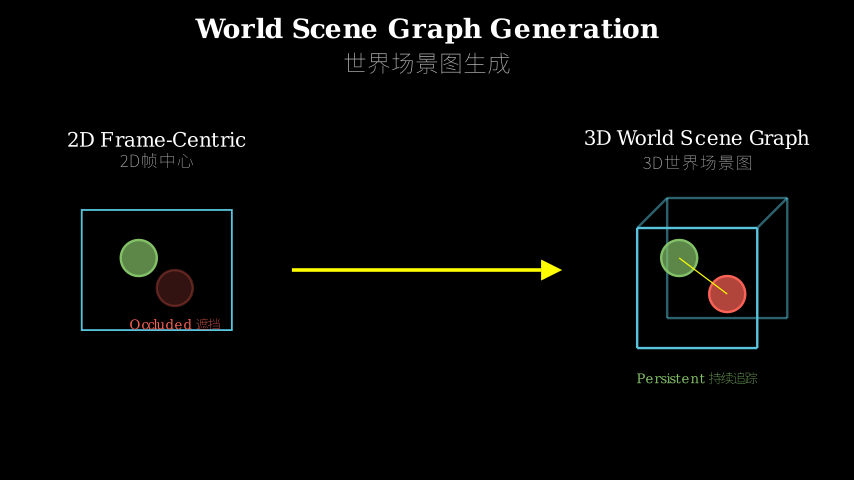
Existing scene graph generation methods treat videos as sequences of independent 2D frames. When a person walks behind a table, current systems simply delete that person from the graph. When the camera pans away from a room, all objects in that room vanish from reasoning. This frame-centric view contradicts a basic fact: objects don’t cease to exist when we stop looking at them.
Prior work (Action Genome, VidVRD, etc.) builds graphs only from visible pixels. The assumption: if it’s not in the frame, it’s not in the model. The shortcoming: this makes temporal reasoning impossible—you can’t track evolving relationships when entities flicker in and out of existence.
Problem: Frame-centric graphs lose object permanence
    |
    v
Assumption: Objects exist in world space, not just image space
    |
    v
Method: Reconstruct 3D scene + track all objects in world coordinates
    |
    v
Evidence: ActionGenome4D dataset + 3 architectures (PWG/MWAE/4DST)
    |
    v
Conclusion: World-centric graphs enable persistent relationship reasoning
The Increment
One sentence: Before this paper, scene graphs died when objects left the frame; after, they persist in 3D world space regardless of visibility.
Core Mechanism
The system has three stages. First, it lifts 2D video into 3D using off-the-shelf reconstruction (DUSt3R), creating a persistent world coordinate system. Second, it tracks every object—visible or not—by maintaining world-frame oriented bounding boxes that survive occlusion and camera motion. Third, it predicts relationships not just between visible objects, but between all objects that exist in the scene at that moment.
The authors propose three architectures exploring different strategies for reasoning about unobserved objects. PWG (Persistent World Graph) uses a simple feature buffer—when an object disappears, its last-seen features stay in memory. MWAE (Masked World Auto-Encoder) treats unobserved objects as masked tokens and uses cross-view retrieval to fill them in. 4DST (4D Scene Transformer) replaces the static buffer with temporal attention, letting each object’s representation evolve based on its motion history and camera pose changes.
Video frames --> 3D reconstruction --> World coordinate system
                                              |
                                              v
    Visible objects -----> Direct features ---+
                                              |
    Occluded objects --> [PWG: buffer]  ------+
                         [MWAE: masked] ------+---> Relationship
                         [4DST: attention] ---+     prediction
                                              |
    Off-camera objects -> Same strategies ----+
Think of it like air traffic control. Traditional scene graphs are like only tracking planes you can see out the window—when one flies behind a cloud, you forget it exists. This paper builds a radar system. The 3D reconstruction is your radar screen showing the whole airspace. PWG is like writing down each plane’s last known position on a notepad. MWAE is like having other radar stations fill in your blind spots. 4DST is like having a predictive model that estimates where each plane should be based on its flight path, even when your radar loses signal. The key insight: you need a coordinate system independent of what you can currently see.
Key Concepts
-
Object Permanence in Vision: Humans know that a cup behind a laptop still exists. Current vision systems don’t—they operate on pixels, and no pixels means no object. This paper implements object permanence by maintaining a world-space representation where objects have locations and features even when unobserved. Concretely: if a person walks behind a couch at timestamp 10, their bounding box and feature vector persist at timestamp 11, 12, 13… until they reappear. The system can then reason about relationships like “person behind couch” without seeing the person.
-
World-Centric vs. Camera-Centric: Camera-centric means coordinates are relative to the current viewpoint—turn the camera, and everything’s in a new position. World-centric means coordinates are fixed in 3D space—turn the camera, but objects stay where they are. Example: In camera-centric, a chair might be at (100, 200) pixels in frame 1 and (150, 180) in frame 2 after camera motion. In world-centric, that chair is at (2.3m, 1.5m, 0.0m) in both frames. This makes tracking trivial: same world coordinates = same object.
-
Masked Completion for Unobserved Objects: MWAE borrows from masked language modeling but applies it spatially. When an object is unobserved, its feature is masked (replaced with a learnable token). The model then predicts what that feature should be by looking at: (1) the object’s features from other viewpoints/timestamps where it was visible, and (2) the context of other objects currently in the scene. It’s like filling in a crossword puzzle—you use surrounding clues (other objects) and your memory of that word from earlier (past observations) to complete the missing entry.
Framework Shift
Before (frame-centric):              After (world-centric):

Frame t:                             World space at t:
  [person]--holds-->[cup]              [person]--holds-->[cup]
  [table]                              [table]
                                       [chair] (occluded)
Frame t+1:                               |
  [table]                              World space at t+1:
  (person occluded)                      [person] (occluded)
  (cup gone)                             [cup] (occluded)
  Graph resets!                          [table]
                                         [chair] (occluded)
                                       Relationships persist!
From image-space snapshots to world-space persistence, the core shift is treating scenes as 4D entities (3D space + time) rather than 2D image sequences.
Expert Assessment
Problem choice: This is a real gap. The field has been stuck in frame-centric thinking because it’s easier—you only model what you see. But for any application requiring temporal reasoning (robotics, video QA, action prediction), object permanence is non-negotiable. The problem sits at the intersection of 3D vision and structured scene understanding, both hot areas. Solid positioning.
Method maturity: The three architectures feel like a research exploration rather than a converged solution. PWG is almost trivially simple (just a buffer), MWAE is borrowed wholesale from NLP, and 4DST is the only one designed specifically for this problem. The reliance on off-the-shelf 3D reconstruction (DUSt3R) is pragmatic but means the method inherits all its failure modes. I’d like to see more analysis of when 3D reconstruction breaks and how that propagates to graph quality.
Experimental integrity: The ActionGenome4D dataset is the real contribution—manually annotating 3D boxes and relationships for occluded objects is serious work. The baselines are fair (they adapt existing 2D methods to 3D). However, the absolute numbers are low (recall around 20-30% for relationships), which suggests either the task is genuinely hard or the methods aren’t mature. The VLM experiments feel tacked on—using GPT-4V for graph RAG is interesting but underdeveloped. More ablations on what features matter (3D position? motion? temporal context?) would strengthen the story.
Writing quality: The paper tries to do too much. The dataset, the task formulation, three different architectures, and VLM baselines—each could be its own paper. Section 4 (methods) is dense and hard to follow; the differences between PWG/MWAE/4DST get lost in notation. The related work section is thorough but reads like a literature dump. If I were reviewing, I’d ask them to cut the VLM experiments and use that space to deeply analyze one architecture with better ablations and failure case studies.
Verdict: weak accept — Important problem and solid dataset contribution, but the methods feel exploratory rather than definitive, and the presentation tries to pack in too much.
Takeaways
The core idea—lift 2D to 3D, then reason in world space—transfers directly to any video understanding task where temporal consistency matters. If you’re building a system that needs to track objects across occlusion (surveillance, autonomous driving, AR), the world-centric coordinate system is the move. The specific technique of maintaining