
Paper: 2603.05484 Authors: Guo Chen, Lidong Lu, Yicheng Liu, Liangrui Dong, Lidong Zou, Jixin Lv, Zhenquan Li, Xinyi Mao, Baoqi Pei, Shihao Wang Categories: cs.CV
The Gap
Video understanding datasets have grown to hours of footage, but they’re stitched-together highlight reels—dense, scripted clips that don’t reflect how life actually unfolds. Real days have dead time: you cook breakfast, commute, work, sleep. Events are sparse, separated by hours or days. Current models trained on MovieQA or EgoSchema never learn to handle this sparsity.
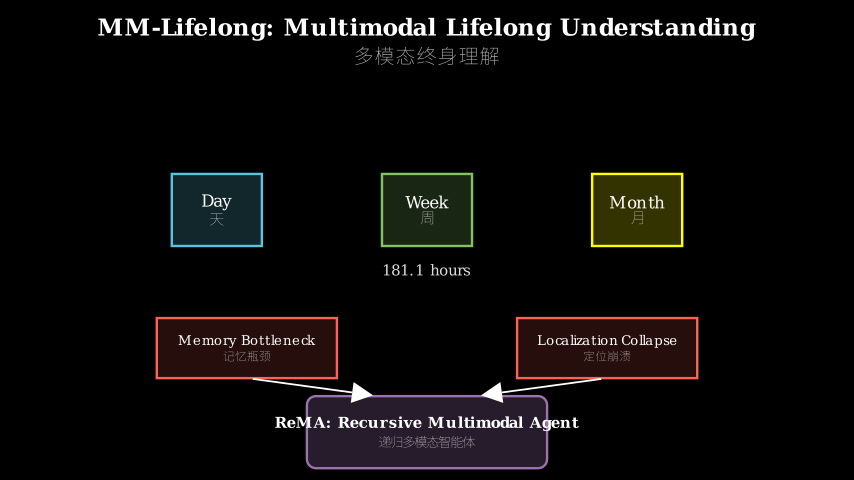
Existing approaches fail in two ways. End-to-end multimodal LLMs (like GPT-4V or Gemini) try to cram everything into context, hitting a working memory bottleneck around 10-20 minutes of video. Agentic systems (like Reflexion or Voyager) navigate by jumping through timestamps, but when events are a week apart, they lose their bearings—what the authors call “global localization collapse.” You can’t binary-search your way through a month when you don’t know where anything is.
Problem: Dense datasets != sparse life
   |
   v
Assumption: Real understanding needs multi-timescale memory
   |
   +---> Method: ReMA (recursive belief state + dynamic memory)
   |
   v
Evidence: Outperforms MLLMs and agents on Day/Week/Month tasks
   |
   v
Conclusion: Hierarchical memory > flat context or blind search
The Increment
One sentence: Before, models either drowned in context or got lost in time; now, we have a dataset that exposes both failure modes and an agent that maintains a recursive belief state to navigate sparse, month-long timelines.
Core Mechanism
ReMA operates like a detective building a case file. It doesn’t try to hold everything in working memory or blindly search through evidence. Instead, it maintains a recursive belief state—a compressed summary of what it knows so far—and updates it as new information comes in.
The system has three components: a perception module that extracts visual and audio features from video segments, a memory manager that decides what to keep and what to discard, and a reasoning engine that queries the belief state to answer questions. When you ask “What did I eat for breakfast three days ago?”, ReMA doesn’t replay three days of footage. It checks its belief state for breakfast-related entries, retrieves the relevant compressed memory, and answers.
The key innovation is dynamic memory management. As the timeline grows, ReMA doesn’t just append new observations—it recursively merges and abstracts them. Early morning routines get compressed into “typical weekday morning.” Anomalies (like a doctor’s appointment) stay detailed. This hierarchical compression prevents both context overflow and localization collapse.
Query: "What happened Tuesday morning?"
   |
   v
[Belief State] <--- recursive summary of past observations
   |            |
   v            +---> [Memory Manager]
[Reasoning]              |
   |                     v
   v              [Perception Module]
Answer                   |
                         v
                   Video segments
Think of ReMA as a journalist covering a month-long story. A bad journalist either takes verbatim notes on everything (context overflow) or skims randomly hoping to find the scoop (localization collapse). A good journalist maintains a running narrative—a belief state—that gets updated with each interview. Early background details get summarized; breaking news stays granular. When the editor asks for a specific fact, the journalist doesn’t re-read all notes; they consult their structured narrative and drill down where needed. ReMA’s belief state is that narrative, and its memory manager is the editorial judgment deciding what to compress and what to preserve.
Key Concepts
-
Working Memory Bottleneck: Imagine trying to remember a phone conversation word-for-word while having three more conversations. At some point, you can’t hold it all. MLLMs face this with long videos—they have a fixed context window (say, 128K tokens), and once video frames fill it up, they start forgetting earlier content or refusing to process more. It’s not a training problem; it’s an architectural ceiling. The model literally runs out of space to “think.”
-
Global Localization Collapse: You’re looking for a specific scene in a month of footage. You jump to day 15—too late. Jump to day 7—too early. Jump to day 11—still wrong. Without landmarks, you’re guessing. Agentic systems that navigate by timestamp jumps face this: when events are sparse (one relevant moment per day), random search becomes exponentially expensive. They collapse because they can’t build a mental map of where things are in time.
-
Recursive Belief State: Instead of storing raw observations, you store a summary that gets refined. Day 1: “Woke up, made coffee, worked.” Day 2: “Woke up, made coffee, worked.” After a week, this compresses to “Typical work routine: wake, coffee, work.” But if Day 5 had a dentist appointment, that stays detailed. The belief state is recursive because each level summarizes the level below—hours compress into days, days into weeks. It’s lossy, but intelligently so.
Framework Shift
Before (mainstream approach):        After (this paper):

[MLLM: flat context window]         [ReMA: hierarchical belief]

Video ---> [==========] ---> Answer  Video ---> [Perception]
           (context fills up)                        |
                                                     v
                                              [Memory Manager]
                                                     |
                                                     v
                                              [Belief State]
                                               /    |    \
                                            Day  Week  Month
                                                     |
                                                     v
                                              [Reasoning] ---> Answer

OR

[Agent: blind search]
Video timeline: [----*-------*---------*----]
                     ^       ^         ^
                  (jump)  (jump)    (jump)
                  (lost)  (lost)    (found?)
From treating video as a flat stream to be consumed or searched, to building a hierarchical memory structure that mirrors how humans actually remember life—compressed routines with salient details preserved.
Expert Assessment
Problem choice: This is a real gap. The field has been stuck in “movie understanding” mode—dense, scripted content—while ignoring that most video data (surveillance, lifelogs, robotics) is sparse and unstructured. The authors correctly identify that scaling context windows won’t solve this; you need architectural changes. It’s timely given the push toward embodied AI and personal assistants.
Method maturity: ReMA is more clever than brute force, but it’s not radically novel—recursive summarization has been explored in NLP (hierarchical attention, memory networks). The contribution is adapting it to multimodal, multi-timescale video. I’d like to see ablations on the memory manager’s compression strategy—how much is learned vs. hand-tuned? The paper hints at “dynamic” management but doesn’t fully open the hood.
Experimental integrity: The baselines are fair—they test both end-to-end MLLMs (GPT-4V, Gemini) and agentic systems (Reflexion-style). The failure mode analysis (working memory bottleneck, localization collapse) is well-documented with error breakdowns. One concern: 181 hours is decent but not massive. Does ReMA’s advantage hold at 1000+ hours, or does it hit its own scaling wall? The dataset splits for temporal/domain bias are a nice touch, though out-of-distribution results aren’t deeply explored.
Writing quality: The abstract and intro are crisp. The method section gets a bit hand-wavy around the memory manager—phrases like “intelligently compresses” without pseudocode or loss functions. The related work could be tighter; it lists papers without clearly positioning what’s different. If I were reviewing, I’d ask for a detailed algorithm box for ReMA and more ablation studies on compression strategies.
Verdict: weak accept — Solid dataset contribution and a reasonable baseline that exposes real failure modes, but the method feels like an incremental step rather than a breakthrough; needs deeper technical exposition.
Takeaways
If you’re building any system that processes long-duration, sparse data—think security footage analysis, personal health monitoring, or long-context document understanding—steal the hierarchical belief state idea. Don’t try to fit everything into a flat context or search blindly. Instead, maintain a compressed summary at multiple timescales and update it incrementally. The specific trick: make compression adaptive, not uniform. Keep anomalies detailed, compress routines aggressively.
Also, the dataset design is instructive: structuring data across Day/Week/Month scales forces models to handle varying temporal densities. If you’re creating benchmarks, consider multi-timescale splits—they reveal failure modes that single-scale datasets hide.
论文: 2603.05484 作者: Guo Chen, Lidong Lu, Yicheng Liu, Liangrui Dong, Lidong Zou, Jixin Lv, Zhenquan Li, Xinyi Mao, Baoqi Pei, Shihao Wang 分类: cs.CV
缺口
视频理解数据集已经扩展到数小时的时长,但它们都是拼接起来的精彩片段——密集、有脚本的剪辑,不反映生活的真实展开方式。
真实的一天有大量空白时间:你做早餐、通勤、工作、睡觉。
事件是稀疏的,相隔数小时或数天。
在MovieQA或EgoSchema上训练的当前模型从未学会处理这种稀疏性。
现有方法以两种方式失效。
端到端的多模态大语言模型(如GPT-4V或Gemini)试图将所有内容塞进上下文,在10-20分钟视频左右就会遇到工作记忆瓶颈。
智能体系统(如Reflexion或Voyager)通过跳转时间戳来导航,但当事件相隔一周时,它们会迷失方向——作者称之为”全局定位崩溃”。
当你不知道任何东西在哪里时,无法通过二分搜索来遍历一个月的内容。
问题:密集数据集 != 稀疏生活
   |
   v
假设:真正的理解需要多时间尺度记忆
   |
   +---> 方法: ReMA (递归信念状态 + 动态内存)
   |
   v
证据:在天/周/月任务上优于MLLM和智能体
   |
   v
结论:层次化记忆 > 扁平上下文或盲目搜索
增量
一句话: 之前,模型要么淹没在上下文中,要么在时间中迷失;现在,我们有了一个暴露两种失效模式的数据集,以及一个维护递归信念状态来导航稀疏的、月度时间线的智能体。
核心机制
ReMA的运作方式像一个建立案件档案的侦探。
它不试图将所有内容保存在工作记忆中,也不盲目搜索证据。
相反,它维护一个递归信念状态——对目前所知内容的压缩摘要——并随着新信息的到来更新它。
系统有三个组件:从视频片段提取视觉和音频特征的感知模块,决定保留什么和丢弃什么的内存管理器,以及查询信念状态来回答问题的推理引擎。
当你问”我三天前早餐吃了什么?”时,ReMA不会重放三天的录像。
它检查信念状态中与早餐相关的条目,检索相关的压缩记忆,然后回答。
关键创新是动态内存管理。
随着时间线的增长,ReMA不只是追加新观察——它递归地合并和抽象它们。
早晨的例行公事被压缩为”典型工作日早晨”。
异常情况(如医生预约)保持详细。
这种层次化压缩既防止了上下文溢出,也防止了定位崩溃。
查询: "周二早上发生了什么?"
   |
   v
[信念状态] <--- 过去观察的递归摘要
   |            |
   v            +---> [内存管理器]
[推理]                |
   |                  v
   v            [感知模块]
答案                  |
                      v
                 视频片段
把ReMA想象成报道一个月长故事的记者。
糟糕的记者要么逐字记录所有内容(上下文溢出),要么随机浏览希望找到独家新闻(定位崩溃)。
优秀的记者维护一个运行中的叙事——一个信念状态——随着每次采访而更新。
早期的背景细节被总结;突发新闻保持细粒度。
当编辑询问特定事实时,记者不会重读所有笔记;他们查阅结构化的叙事,并在需要的地方深入挖掘。
ReMA的信念状态就是那个叙事,它的内存管理器就是决定压缩什么和保留什么的编辑判断。
关键概念
- 工作记忆瓶颈: 想象一下,在进行另外三次对话的同时,试图逐字记住一次电话交谈。
到某个时刻,你无法全部记住。
MLLM在处理长视频时面临这个问题——它们有固定的上下文窗口(比如128K tokens),一旦视频帧填满它,它们就开始忘记早期内容或拒绝处理更多内容。
这不是训练问题;这是架构上限。
模型字面上耗尽了”思考”的空间。
- 全局定位崩溃: 你在一个月的录像中寻找特定场景。
你跳到第15天——太晚了。
跳到第7天——太早了。
跳到第11天——还是错的。
没有地标,你在猜测。
通过时间戳跳转导航的智能体系统面临这个问题:当事件稀疏时(每天一个相关时刻),随机搜索变得指数级昂贵。
它们崩溃是因为无法建立事物在时间中位置的心理地图。
- 递归信念状态: 不是存储原始观察,而是存储一个被精炼的摘要。
第1天:“醒来,煮咖啡,工作。“第2天:“醒来,煮咖啡,工作。“一周后,这压缩为”典型工作例程:醒来,咖啡,工作。“但如果第5天有牙医预约,那保持详细。
信念状态是递归的,因为每个层级总结下面的层级——小时压缩成天,天压缩成周。
它是有损的,但是智能地有损。
框架转变
之前(主流方法):                  之后(本文方法):

[MLLM: 扁平上下文窗口]           [ReMA: 层次化信念]

视频 ---> [==========] ---> 答案  视频 ---> [感知]
          (上下文填满)                        |
                                              v
                                        [内存管理器]
                                              |
                                              v
                                        [信念状态]
                                         /    |    \
                                       天    周    月
                                              |
                                              v
                                        [推理] ---> 答案

或者

[智能体: 盲目搜索]
视频时间线: [----*-------*---------*----]
                ^       ^         ^
             (跳转)  (跳转)    (跳转)
             (迷失)  (迷失)    (找到?)
从将视频视为要消费或搜索的扁平流,到构建反映人类实际记忆生活方式的层次化内存结构——压缩的例行公事,保留显著细节。
专家评审
选题眼光: 这是一个真实的缺口。
该领域一直停留在”电影理解”模式——密集、有脚本的内容——而忽略了大多数视频数据(监控、生活日志、机器人)是稀疏和非结构化的。
作者正确地识别出扩展上下文窗口无法解决这个问题;你需要架构变化。
考虑到对具身AI和个人助理的推动,这很及时。
方法成熟度: ReMA更巧妙而非蛮力,但并非根本性创新——递归总结在NLP中已被探索(层次化注意力、记忆网络)。
贡献在于将其适配到多模态、多时间尺度视频。
我想看到关于内存管理器压缩策略的消融实验——有多少是学习的vs手工调整的?论文暗示”动态”管理,但没有完全打开引擎盖。
实验诚意: 基线是公平的——他们测试了端到端MLLM(GPT-4V、Gemini)和智能体系统(Reflexion风格)。
失效模式分析(工作记忆瓶颈、定位崩溃)有详细的错误分解记录。
一个担忧:181小时还不错但不算庞大。
ReMA的优势在1000+小时时是否保持,还是会遇到自己的扩展瓶颈?用于时间/领域偏差的数据集划分是个不错的点缀,尽管分布外结果没有深入探索。
写作功力: 摘要和引言简洁。
方法部分在内存管理器周围有点含糊——像”智能压缩”这样的短语,没有伪代码或损失函数。
相关工作可以更紧凑;它列出论文但没有清楚地定位有什么不同。
如果我在审稿,我会要求为ReMA提供详细的算法框和更多关于压缩策略的消融研究。
判决: 弱接收 — 扎实的数据集贡献和一个暴露真实失效模式的合理基线,但方法感觉像是渐进步骤而非突破;需要更深入的技术阐述。
要点总结
如果你正在构建任何处理长时长、稀疏数据的系统——想想安全录像分析、个人健康监测或长上下文文档理解——偷走层次化信念状态的想法。
不要试图将所有内容塞进扁平上下文或盲目搜索。
相反,在多个时间尺度上维护一个压缩摘要,并增量更新它。
具体技巧:使压缩自适应,而非统一。
保持异常详细,积极压缩例行公事。
此外,数据集设计很有启发性:跨天/周/月尺度构建数据迫使模型处理不同的时间密度。
如果你在创建基准,考虑多时间尺度划分——它们揭示单一尺度数据集隐藏的失效模式。