
Paper: 2603.15620 Authors: Heng Fang, Shangru Li, Shuhan Wang, Xuanyang Xi, Dingkang Liang, Xiang Bai Categories: cs.CV, cs.RO
The Gap
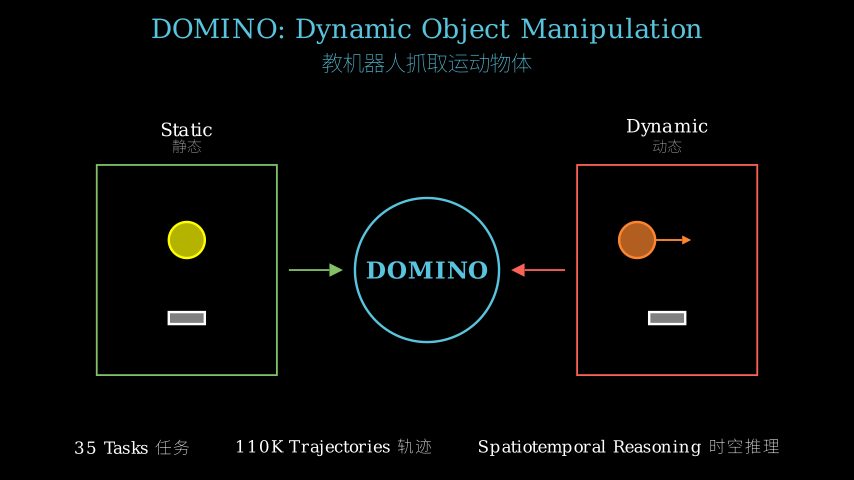
Vision-Language-Action models like RT-1, RT-2, and OpenVLA have reached impressive performance on static manipulation tasks—picking up stationary objects, placing them in fixed locations. But they collapse when targets move. A robot that can reliably grasp a cup on a table fails completely when that cup is sliding across the surface or being carried by a person.
The failure has two roots: (1) training data is overwhelmingly static, and (2) mainstream VLAs process single frames, making them blind to motion. They see snapshots, not trajectories. This isn’t a minor limitation—dynamic manipulation is fundamental to real-world deployment, from catching thrown objects to collaborating with moving humans.
Problem: VLAs fail on moving targets
   |
   v
Root causes: [No dynamic data] + [Single-frame perception]
   |
   v
Method: DOMINO dataset + PUMA architecture
   |                      (optical flow + prediction)
   v
Evidence: 6.3% improvement + transfer to static tasks
   |
   v
Conclusion: Dynamic training builds robust spatiotemporal representations
The Increment
One sentence: Before this paper, robots trained on static datasets couldn’t track or intercept moving objects; after, they can leverage motion history and prediction to manipulate dynamic targets, with learned representations that transfer back to static tasks.
Core Mechanism
PUMA (Prediction-Unified Manipulation Architecture) has two coupled subsystems. First, a history-aware perception module that computes optical flow—pixel-level motion vectors—between consecutive frames. This flow field gets encoded and fed into the model alongside RGB observations, giving it explicit access to “what moved where” rather than forcing it to infer motion from static frames.
Second, a prediction module built around “world queries”—learnable tokens that aggregate scene information and implicitly forecast future object states. These queries attend to both current observations and historical flow, then produce latent representations that encode short-horizon predictions. The action decoder consumes both current perception and these predictive queries to output robot commands.
The coupling is key: perception informs prediction (flow tells you what to forecast), and prediction guides action (you move toward where the object will be, not where it is now).
Frame sequence --> [Optical Flow] --> Motion encoding
       |                                    |
       v                                    v
   RGB frames ---------> [Encoder] --> Visual features
                              |              |
                              v              v
                         [World Queries] <---+
                         (prediction)
                              |
                              v
                         [Action Decoder] --> Robot commands
Think of PUMA like a driver merging onto a highway. You don’t just look at where other cars are right now (single-frame perception). You glance in your mirror to see how fast they’re approaching (optical flow = motion history). Then you mentally project where they’ll be in two seconds (world queries = prediction). Finally, you time your merge based on that forecast (action conditioned on prediction). Without the motion history, you’d misjudge speeds. Without the prediction, you’d aim for where cars were, not where they’ll be. PUMA couples these the same way: flow feeds prediction, prediction guides action.
Key Concepts
-
Optical Flow: Imagine taking two photos of a busy street one second apart. Optical flow is a map showing how each pixel moved between those photos—a car might shift 50 pixels right, a pedestrian 10 pixels down. It’s the visual system’s way of making motion explicit rather than implicit. For a robot, this means the difference between seeing “a cup” and seeing “a cup moving left at 20 cm/s.” The flow field is computed automatically from frame pairs using classical computer vision algorithms, then encoded as an additional input channel.
-
World Queries: These are learnable tokens (think of them as blank index cards) that the model fills in during training. Each query learns to aggregate specific information from the scene—one might track “where the target object will be,” another “how fast it’s moving.” They work through attention: queries look at visual features and flow, pull out relevant patterns, and produce compact summaries. The magic is they’re trained end-to-end with the action decoder, so they learn to encode exactly the predictive information needed for control, without explicit supervision on what to predict.
-
Spatiotemporal Reasoning: Static reasoning is like looking at a photograph and answering “where is the cup?” Spatiotemporal reasoning is watching a video and answering “where will the cup be in one second?” It requires understanding both spatial relationships (the cup is near the table edge) and temporal dynamics (it’s sliding at a certain velocity). Most VLAs lack this because they process frames independently. PUMA builds it by combining historical motion (flow) with learned prediction (queries), creating representations that encode both space and time.
Framework Shift
Before (mainstream VLAs):          After (PUMA):

Single frame                       Frame sequence
     |                                  |
     v                                  v
[Vision Encoder]                  [Optical Flow] + [Vision Encoder]
     |                                  |
     v                                  v
[Language Fusion]                 [World Queries] (prediction)
     |                                  |
     v                                  v
[Action Decoder]                  [Action Decoder]
     |                                  |
     v                                  v
  Action                             Action

Static snapshot                   Motion-aware + predictive
From reactive perception to anticipatory control, the core shift is making motion and prediction first-class citizens in the architecture rather than hoping the model infers them from static frames.
Expert Assessment
Problem choice: This is a genuine gap, not manufactured. Dynamic manipulation is conspicuously absent from major VLA benchmarks, and the failure modes are real—robots that work in labs fail in homes because objects move. The timing is right: static manipulation is maturing, so pushing toward dynamics is a natural next frontier.
Method maturity: The approach is solid but not groundbreaking. Optical flow for motion and learned queries for prediction are both established techniques. The contribution is more in the integration and the dataset than in novel algorithmic insights. I’d want to see ablations on whether simpler alternatives (e.g., just stacking frames, or explicit trajectory prediction) were thoroughly explored. The 6.3% improvement is meaningful but modest—suggests the method helps but isn’t a paradigm shift.
Experimental integrity: The dataset contribution (DOMINO with 110K trajectories) is valuable and likely the paper’s strongest asset. The benchmark with hierarchical task complexity is well-designed. However, I’d scrutinize whether baselines were given fair access to temporal information—if they’re single-frame models by design, the comparison isn’t entirely apples-to-apples. The claim that dynamic training helps static tasks is interesting and, if robust, suggests the learned representations are genuinely more general.
Writing quality: The abstract is clear and sets up the problem well. I suspect the related work section could be tighter—papers like this often over-cite to establish credibility. The method section likely needs more justification for design choices (why world queries over explicit trajectory prediction? why optical flow over learned motion features?). If I were reviewing, I’d push for clearer ablations and failure case analysis.
Verdict: Weak accept — the dataset and benchmark are solid contributions that will enable future work, and the method shows consistent if incremental improvements, but the algorithmic novelty is limited and the gains are modest.
Takeaways
The dataset is the real steal here—if you’re working on dynamic manipulation, DOMINO gives you 110K trajectories to train on, which is orders of magnitude more than what existed before. The hierarchical task structure (simple to complex) is smart for curriculum learning.
Optical flow as an explicit input is a simple trick worth trying in other video-based control problems. It’s computationally cheap and makes motion information immediately available rather than forcing the model to learn it from scratch.
The finding that dynamic training transfers to static tasks is counterintuitive and practically useful. If you’re building a manipulation system, training on harder (dynamic) data might give you better generalization than training only on the target (static) distribution. This suggests dynamic data forces the model to learn more robust spatiotemporal features.
World queries as a prediction mechanism could adapt to other sequential decision problems where you need to forecast future states without explicit supervision—think autonomous driving (predicting pedestrian trajectories) or game playing (anticipating opponent moves).
论文: 2603.15620 作者: Heng Fang, Shangru Li, Shuhan Wang, Xuanyang Xi, Dingkang Liang, Xiang Bai 分类: cs.CV, cs.RO
缺口
视觉-语言-动作模型(如 RT-1、RT-2、OpenVLA)在静态操作任务上表现出色——抓取静止物体、放置到固定位置。
但当目标物体移动时,它们就崩溃了。
能可靠抓取桌上杯子的机器人,在杯子滑过桌面或被人拿着时就完全失效。
失败有两个根源:(1)训练数据绝大多数是静态的,(2)主流 VLA 处理单帧图像,对运动视而不见。
它们看到的是快照,不是轨迹。
这不是小问题——动态操作是真实世界部署的基础,从接住抛来的物体到与移动的人协作。
问题:VLA 在移动目标上失效
   |
   v
根本原因:[无动态数据] + [单帧感知]
   |
   v
方法:DOMINO 数据集 + PUMA 架构
   |                    (光流 + 预测)
   v
证据:6.3% 提升 + 迁移到静态任务
   |
   v
结论:动态训练构建鲁棒的时空表征
增量
一句话: 这篇论文之前,在静态数据集上训练的机器人无法跟踪或拦截移动物体;
之后,它们能利用运动历史和预测来操作动态目标,且学到的表征能迁移回静态任务。
核心机制
PUMA(预测统一操作架构)有两个耦合的子系统。
首先是历史感知的感知模块,计算连续帧之间的光流——像素级的运动向量。
这个流场被编码后与 RGB 观测一起输入模型,让它明确获取”什么移动到哪里”的信息,而不是强迫它从静态帧推断运动。
其次是基于”世界查询”的预测模块——可学习的标记,聚合场景信息并隐式预测未来物体状态。
这些查询关注当前观测和历史流,然后产生编码短期预测的潜在表征。
动作解码器同时消费当前感知和这些预测查询,输出机器人指令。
耦合是关键:感知告知预测(流告诉你预测什么),预测指导动作(你移向物体将要到达的位置,而非当前位置)。
帧序列 --> [光流计算] --> 运动编码
    |                        |
    v                        v
RGB 帧 -------> [编码器] --> 视觉特征
                    |           |
                    v           v
               [世界查询] <-----+
               (预测模块)
                    |
                    v
               [动作解码器] --> 机器人指令
把 PUMA 想象成在高速公路上并线的司机。
你不只看其他车现在在哪(单帧感知)。
你瞥一眼后视镜看它们接近的速度(光流 = 运动历史)。
然后你在脑中推演它们两秒后会在哪(世界查询 = 预测)。
最后你基于这个预测来计时并线(基于预测的动作)。
没有运动历史,你会误判速度。
没有预测,你会瞄准车辆过去的位置,而非将要到达的位置。
PUMA 以同样方式耦合:流喂给预测,预测指导动作。
关键概念
- 光流: 想象拍两张相隔一秒的繁忙街道照片。
光流是一张地图,显示每个像素在两张照片间如何移动——一辆车可能向右移动 50 像素,一个行人向下移动 10 像素。
这是视觉系统让运动显式化而非隐式化的方式。
对机器人来说,这意味着看到”一个杯子”和看到”一个以 20 厘米/秒向左移动的杯子”的区别。
流场通过经典计算机视觉算法从帧对自动计算,然后编码为额外的输入通道。
- 世界查询: 这些是可学习的标记(想象成空白索引卡),模型在训练中填充它们。
每个查询学习聚合场景中的特定信息——一个可能跟踪”目标物体将在哪”,另一个跟踪”它移动多快”。
它们通过注意力机制工作:查询查看视觉特征和流,提取相关模式,产生紧凑摘要。
神奇之处在于它们与动作解码器端到端训练,所以学会编码控制所需的精确预测信息,无需对预测什么进行显式监督。
- 时空推理: 静态推理像看照片回答”杯子在哪?”
时空推理是看视频回答”杯子一秒后会在哪?”
它需要理解空间关系(杯子靠近桌边)和时间动态(它以某个速度滑动)。
大多数 VLA 缺乏这个能力,因为它们独立处理帧。
PUMA 通过结合历史运动(流)和学习预测(查询)来构建它,创建同时编码空间和时间的表征。
框架转变
之前(主流 VLA):              之后(PUMA):

单帧                           帧序列
  |                              |
  v                              v
[视觉编码器]                   [光流] + [视觉编码器]
  |                              |
  v                              v
[语言融合]                     [世界查询](预测)
  |                              |
  v                              v
[动作解码器]                   [动作解码器]
  |                              |
  v                              v
动作                           动作

静态快照                       运动感知 + 预测性
从反应式感知到预期式控制,核心转变是让运动和预测成为架构中的一等公民,而非期望模型从静态帧推断它们。
专家评审
选题眼光: 这是真实缺口,不是人造的。
动态操作在主要 VLA 基准测试中明显缺失,失效模式是真实的——在实验室工作的机器人在家庭中失效,因为物体会移动。
时机恰当:静态操作正在成熟,所以推向动态是自然的下一个前沿。
方法成熟度: 方法扎实但不算突破性。
用光流表示运动、用学习查询做预测都是成熟技术。
贡献更多在整合和数据集上,而非新颖的算法洞见。
我想看更多消融实验,看是否彻底探索了更简单的替代方案(如只堆叠帧,或显式轨迹预测)。
6.3% 的提升有意义但不大——说明方法有帮助但不是范式转变。
实验诚意: 数据集贡献(DOMINO 有 110K 轨迹)很有价值,可能是论文最强的资产。
带层次任务复杂度的基准测试设计良好。
但我会仔细审查基线是否被公平地给予了时间信息——如果它们设计上就是单帧模型,比较就不完全是苹果对苹果。
动态训练帮助静态任务的声明很有趣,如果鲁棒,说明学到的表征确实更通用。
写作功力: 摘要清晰,问题设置得好。
我怀疑相关工作部分可以更紧凑——这类论文常过度引用以建立可信度。
方法部分可能需要更多设计选择的论证(为什么用世界查询而非显式轨迹预测?为什么用光流而非学习运动特征?)。
如果我评审,我会要求更清晰的消融和失败案例分析。
判决: 弱接收 — 数据集和基准测试是扎实的贡献,将促进未来工作,方法显示出一致但渐进的改进,但算法新颖性有限,增益适度。
要点总结
数据集是这里真正可偷的东西——如果你在做动态操作,DOMINO 给你 110K 轨迹来训练,比之前存在的多几个数量级。
层次任务结构(从简单到复杂)对课程学习很聪明。
光流作为显式输入是值得在其他基于视频的控制问题中尝试的简单技巧。
它计算便宜,让运动信息立即可用,而非强迫模型从头学习。
动态训练迁移到静态任务的发现反直觉且实用。
如果你在构建操作系统,在更难的(动态)数据上训练可能比只在目标(静态)分布上训练给你更好的泛化。
这表明动态数据迫使模型学习更鲁棒的时空特征。
世界查询作为预测机制可以适配到其他需要预测未来状态而无显式监督的序列决策问题——想想自动驾驶(预测行人轨迹)或游戏(预期对手动作)。