
Paper: 2604.06155 Authors: Qimin Zhong, Hao Liao, Haiming Qin, Mingyang Zhou, Rui Mao, Wei Chen, Naipeng Chao Categories: cs.LG, cs.AI, cs.CL
The Gap
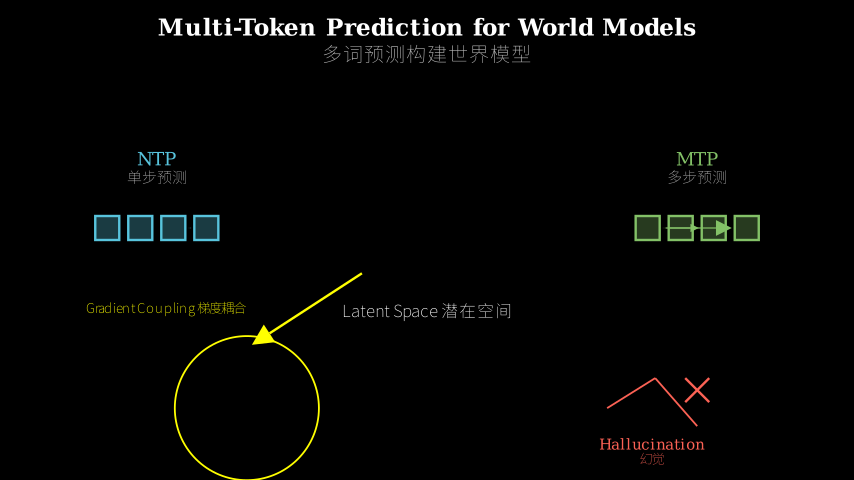
Existing research has shown that LLMs can perform impressive reasoning tasks, but whether they develop coherent internal world models—structured representations of how the world works—remains contested. Next-Token Prediction (NTP) trains models to predict one step ahead, which provides weak supervision for learning long-term dependencies and causal structures. Multi-Token Prediction (MTP) emerged as a promising alternative, predicting multiple future tokens simultaneously, but prior work lacked theoretical understanding of why MTP might learn better representations.
This paper identifies a critical flaw: standard MTP, despite its theoretical advantages, suffers from structural hallucinations where the model learns illegal shortcuts in latent space that violate environmental constraints. The gap is between MTP’s theoretical promise of learning structured representations and its practical failure to respect the underlying state dynamics.
Problem: LLMs lack coherent world models
   |
   v
Observation: NTP gives weak supervision for structure
   |
   v
Hypothesis: MTP induces representational contractivity
   |                                    |
   v                                    v
Theory: Gradient coupling        Reality: Structural hallucinations
promotes belief convergence      (discrete tokens -> illegal shortcuts)
   |                                    |
   +------------------------------------+
                    |
                    v
            Solution: LSE-MTP
    (anchor to continuous state trajectories)
                    |
                    v
            Evidence: Synthetic graphs + Manhattan Taxi
    (better alignment, fewer hallucinations, robust)
                    |
                    v
        Conclusion: Bridging discrete/continuous gap
                    enables coherent world models
The Increment
One sentence: Before this paper, MTP was known to improve representation learning but lacked theoretical grounding and suffered from structural hallucinations; after this paper, we understand MTP’s gradient inductive bias toward belief states and have a method (LSE-MTP) to prevent illegal latent shortcuts by anchoring to continuous state trajectories.
Core Mechanism
LSE-MTP operates in three stages. First, during training, the model generates hidden state representations for multiple future tokens using standard transformer layers. Second, instead of only supervising the discrete token predictions, LSE-MTP extracts the ground-truth hidden state trajectory from a reference model or oracle and computes an auxiliary loss that pulls the model’s predicted hidden states toward these ground-truth trajectories. Third, the total loss combines the standard cross-entropy loss on discrete tokens with this latent semantic alignment loss, weighted by a hyperparameter.
The key innovation is the dual supervision signal. The discrete token loss teaches the model what to predict, while the latent semantic loss teaches the model how to represent the underlying state dynamics. By anchoring predictions to continuous state trajectories rather than just discrete token sequences, LSE-MTP prevents the model from learning shortcuts that produce correct tokens through invalid intermediate representations.
Input sequence
      |
      v
  [Encoder]
      |
      v
Hidden states: h_t, h_{t+1}, h_{t+2}, ...
      |
      +------------------+------------------+
      |                  |                  |
      v                  v                  v
[Token head]      [Token head]      [Token head]
      |                  |                  |
      v                  v                  v
  token_t+1         token_t+2         token_t+3
      |                  |                  |
      v                  v                  v
  [CE Loss] <-------- Discrete supervision

      +------------------+------------------+
      |                  |                  |
      v                  v                  v
Ground-truth:     h*_{t+1}          h*_{t+2}
      |                  |                  |
      v                  v                  v
  [MSE Loss] <-------- Continuous supervision

      Both losses combined -> Total gradient
Think of LSE-MTP like teaching someone to navigate a city. Standard MTP is like showing them a sequence of street names to memorize—they might learn the route but not understand the spatial layout. They could “hallucinate” shortcuts that work on paper (correct street names) but violate physical constraints (streets don’t actually connect that way). LSE-MTP is like also showing them a map with their position marked at each step. The street names (discrete tokens) tell them where to go, while the map positions (continuous states) ensure they understand the actual spatial relationships. If they try to take an impossible shortcut, the map supervision catches it because their internal position would be wrong, even if they named the right streets.
Key Concepts
-
Representational Contractivity: Imagine you’re tracking a ball bouncing in a room. If you’re uncertain about its exact position, your uncertainty should shrink over time as you gather more observations—not explode into wildly different possibilities. Representational contractivity means the model’s internal uncertainty about the world state decreases as it processes more information. In MTP, gradient coupling across multiple prediction heads creates a pressure for the model’s representations to converge toward a single coherent belief state, rather than maintaining multiple inconsistent interpretations. This happens because errors in early predictions propagate through the gradient to affect later predictions, forcing the model to find representations that work consistently across all time steps.
-
Structural Hallucinations: These aren’t the usual “making up facts” hallucinations. Structural hallucinations occur when a model produces correct surface outputs (right tokens) through invalid internal reasoning (wrong latent states). Imagine a student who gets the right answer on a math test by accidentally canceling two mistakes. In MTP, the model might learn to predict “turn left” → “Main Street” → “arrive” by encoding an impossible spatial trajectory in its hidden states—like teleporting through buildings. The discrete token supervision only cares that the words are right, not that the implied path is physically valid. This is why standard MTP can score well on token accuracy while failing to learn coherent world models.
-
Latent Semantic Enhancement: This is the core fix. Instead of only checking if the model outputs the right words, we also check if its internal representations match the ground-truth state trajectory. Think of it as the difference between grading only the final answer versus also checking the work shown. The “latent semantic” part means we’re supervising the meaning encoded in hidden states, not just surface tokens. The “enhancement” means we’re adding this supervision on top of standard token prediction. Practically, this requires access to ground-truth state trajectories during training—either from a simulator (synthetic tasks) or a pre-trained reference model (real-world tasks).
Framework Shift
Before (Standard MTP):                After (LSE-MTP):

Token sequence                        Token sequence
  |   |   |                             |   |   |
  v   v   v                             v   v   v
[Predict] [Predict] [Predict]         [Predict] [Predict] [Predict]
  |   |   |                             |   |   |
  v   v   v                             v   v   v
Loss on tokens only                   Loss on tokens
                                        |   |   |
Hidden states float free               v   v   v
(can violate constraints)             [Align] [Align] [Align]
                                        |   |   |
                                        v   v   v
                                      Ground-truth states
                                      (enforces constraints)
From supervising only discrete outputs to supervising both discrete outputs and continuous internal states, the core shift is anchoring representations to the actual dynamics of the world being modeled.
Expert Assessment
Problem choice: This is a real gap. The question of whether LLMs develop world models is central to understanding their capabilities and limitations. The observation that MTP suffers from structural hallucinations is novel and well-motivated—it explains why MTP sometimes fails to improve reasoning despite better perplexity. The problem sits at the intersection of representation learning and world modeling, which is currently hot in the field.
Method maturity: The theoretical analysis of gradient coupling is elegant, but the solution feels somewhat brute-force. LSE-MTP requires access to ground-truth state trajectories, which limits applicability. For synthetic tasks, this is fine—you have the simulator. For real-world tasks, they use a pre-trained model as the oracle, which is circular (you need a good model to train a good model). A more mature approach would learn to infer state trajectories without external supervision, perhaps through self-consistency constraints or contrastive learning. That said, the method is a solid first step and the empirical gains are convincing.
Experimental integrity: The baselines are fair—they compare against standard NTP and MTP. The synthetic graph navigation task is well-designed to isolate the structural hallucination problem. The Manhattan Taxi dataset provides real-world validation. However, I’d like to see more analysis of failure cases. When does LSE-MTP still hallucinate? How sensitive is it to the quality of the ground-truth trajectories? The ablation studies are decent but could be deeper. The paper also doesn’t discuss computational cost—LSE-MTP requires computing and storing ground-truth trajectories, which isn’t free.
Writing quality: The paper is generally well-written, but the theoretical section (Section 3) is dense and could benefit from more intuitive explanations before diving into the math. The connection between gradient coupling and representational contractivity is crucial but gets buried in notation. If the authors rewrote Section 3 to lead with intuition and simple examples, then formalized it, the paper would be much more accessible. The experimental section is clear and well-organized.
Verdict: weak accept — The theoretical insight about MTP’s gradient inductive bias is valuable, and LSE-MTP demonstrates a practical way to reduce structural hallucinations, but the method’s reliance on ground-truth trajectories limits its generality and the experimental analysis could be more thorough.
Takeaways
Practitioners working on sequence modeling can steal the idea of dual supervision: don’t just supervise outputs, also supervise intermediate representations. This applies beyond LLMs—any model that generates sequences with underlying state dynamics (video prediction, robotics, time series forecasting) could benefit from latent semantic alignment. The specific technique: if you have access to ground-truth states (from a simulator or oracle), add an auxiliary loss that pulls your model’s hidden states toward those ground-truth trajectories. Weight it carefully—too much and you overfit to the oracle, too little and you get structural hallucinations.
The broader insight: discrete token supervision alone is insufficient for learning coherent world models because it allows illegal shortcuts in latent space. If your task has environmental constraints (spatial, physical, logical), you need to explicitly supervise the model’s internal representations to respect those constraints. This is especially relevant for reasoning tasks where getting the right answer through wrong reasoning is common.
论文: 2604.06155 作者: Qimin Zhong, Hao Liao, Haiming Qin, Mingyang Zhou, Rui Mao, Wei Chen, Naipeng Chao 分类: cs.LG, cs.AI, cs.CL
缺口
现有研究表明大语言模型能完成令人印象深刻的推理任务,但它们是否发展出连贯的内部世界模型——即对世界如何运作的结构化表征——仍存在争议。
下一词预测(NTP)训练模型预测下一步,这对学习长期依赖和因果结构提供的监督信号很弱。
多词预测(MTP)作为一个有前景的替代方案出现,同时预测多个未来词元,但先前工作缺乏对MTP为何能学到更好表征的理论理解。
本文识别出一个关键缺陷:标准MTP尽管有理论优势,却遭受结构性幻觉的困扰,模型在潜在空间中学到违反环境约束的非法捷径。
缺口在于MTP学习结构化表征的理论承诺与其实践中无法尊重底层状态动力学的失败之间。
问题: 大语言模型缺乏连贯世界模型
   |
   v
观察: NTP对结构学习的监督信号弱
   |
   v
假设: MTP诱导表征收缩性
   |                                    |
   v                                    v
理论: 梯度耦合促进              现实: 结构性幻觉
      信念状态收敛              (离散词元->非法捷径)
   |                                    |
   +------------------------------------+
                    |
                    v
            解决方案: LSE-MTP
        (锚定到连续状态轨迹)
                    |
                    v
        证据: 合成图 + 曼哈顿出租车
    (更好对齐,更少幻觉,更鲁棒)
                    |
                    v
        结论: 弥合离散/连续鸿沟
              使连贯世界模型成为可能
增量
一句话: 这篇论文之前,MTP被认为能改进表征学习但缺乏理论基础且遭受结构性幻觉困扰;这篇论文之后,我们理解了MTP朝向信念状态的梯度归纳偏置,并有了一个方法(LSE-MTP)通过锚定到连续状态轨迹来防止非法潜在捷径。
核心机制
LSE-MTP分三个阶段运作。
首先,在训练期间,模型使用标准transformer层为多个未来词元生成隐藏状态表征。
其次,LSE-MTP不仅监督离散词元预测,还从参考模型或预言机中提取真实隐藏状态轨迹,计算一个辅助损失,将模型预测的隐藏状态拉向这些真实轨迹。
第三,总损失结合离散词元上的标准交叉熵损失与这个潜在语义对齐损失,通过超参数加权。
关键创新是双重监督信号。
离散词元损失教模型预测什么,而潜在语义损失教模型如何表征底层状态动力学。
通过将预测锚定到连续状态轨迹而非仅仅离散词元序列,LSE-MTP防止模型学习通过无效中间表征产生正确词元的捷径。
输入序列
      |
      v
  [编码器]
      |
      v
隐藏状态: h_t, h_{t+1}, h_{t+2}, ...
      |
      +------------------+------------------+
      |                  |                  |
      v                  v                  v
[词元头]            [词元头]            [词元头]
      |                  |                  |
      v                  v                  v
  词元_t+1           词元_t+2           词元_t+3
      |                  |                  |
      v                  v                  v
  [交叉熵] <-------- 离散监督

      +------------------+------------------+
      |                  |                  |
      v                  v                  v
真实值:           h*_{t+1}          h*_{t+2}
      |                  |                  |
      v                  v                  v
  [均方误差] <-------- 连续监督

      两个损失结合 -> 总梯度
把LSE-MTP想象成教人在城市里导航。
标准MTP就像给他们看一串要记住的街道名——他们可能学会路线但不理解空间布局。
他们可能”幻觉”出在纸面上有效(正确街道名)但违反物理约束(街道实际上不那样连接)的捷径。
LSE-MTP就像还给他们看一张地图,每一步都标出他们的位置。
街道名(离散词元)告诉他们去哪里,而地图位置(连续状态)确保他们理解实际的空间关系。
如果他们试图走一条不可能的捷径,地图监督会抓住它,因为他们的内部位置会是错的,即使他们说对了街道名。
关键概念
- 表征收缩性: 想象你在追踪一个在房间里弹跳的球。
如果你对它的确切位置不确定,你的不确定性应该随着时间推移和收集更多观察而缩小——而不是爆炸成截然不同的可能性。
表征收缩性意味着模型对世界状态的内部不确定性随着处理更多信息而减少。
在MTP中,跨多个预测头的梯度耦合为模型的表征创造了一种压力,使其收敛到单一连贯的信念状态,而非维持多个不一致的解释。
这发生是因为早期预测中的错误通过梯度传播影响后续预测,迫使模型找到在所有时间步上一致工作的表征。
- 结构性幻觉: 这不是通常的”编造事实”幻觉。
结构性幻觉发生在模型通过无效的内部推理(错误的潜在状态)产生正确的表面输出(正确的词元)时。
想象一个学生在数学考试上通过意外抵消两个错误得到正确答案。
在MTP中,模型可能学会通过在其隐藏状态中编码一个不可能的空间轨迹来预测”左转”→“主街”→“到达”——就像穿过建筑物瞬移。
离散词元监督只关心词是否正确,不关心隐含的路径是否物理上有效。
这就是为什么标准MTP可以在词元准确率上得高分,同时无法学习连贯的世界模型。
- 潜在语义增强: 这是核心修复。
我们不仅检查模型是否输出正确的词,还检查其内部表征是否匹配真实状态轨迹。
把它想象成只给最终答案打分与同时检查演算过程的区别。
“潜在语义”部分意味着我们在监督隐藏状态中编码的意义,而非仅仅表面词元。
“增强”意味着我们在标准词元预测之上添加这个监督。
实践上,这需要在训练期间访问真实状态轨迹——要么来自模拟器(合成任务)要么来自预训练参考模型(真实世界任务)。
框架转变
之前(标准MTP):                    之后(LSE-MTP):

词元序列                          词元序列
  |   |   |                         |   |   |
  v   v   v                         v   v   v
[预测] [预测] [预测]               [预测] [预测] [预测]
  |   |   |                         |   |   |
  v   v   v                         v   v   v
仅对词元计算损失                   对词元计算损失
                                    |   |   |
隐藏状态自由漂浮                    v   v   v
(可能违反约束)                    [对齐] [对齐] [对齐]
                                    |   |   |
                                    v   v   v
                                  真实状态
                                  (强制约束)
从仅监督离散输出到同时监督离散输出和连续内部状态,核心转变是将表征锚定到被建模世界的实际动力学。
专家评审
选题眼光: 这是真缺口。
大语言模型是否发展世界模型的问题对理解它们的能力和局限至关重要。
观察到MTP遭受结构性幻觉是新颖且动机充分的——它解释了为什么MTP有时尽管困惑度更好却无法改进推理。
问题位于表征学习和世界建模的交叉点,这在该领域目前很热门。
方法成熟度: 梯度耦合的理论分析很优雅,但解决方案感觉有点蛮力。
LSE-MTP需要访问真实状态轨迹,这限制了适用性。
对于合成任务,这没问题——你有模拟器。
对于真实世界任务,他们使用预训练模型作为预言机,这是循环的(你需要一个好模型来训练一个好模型)。
更成熟的方法会学习推断状态轨迹而无需外部监督,也许通过自洽性约束或对比学习。
话虽如此,该方法是坚实的第一步,实证收益令人信服。
实验诚意: 基线公平——他们与标准NTP和MTP比较。
合成图导航任务设计良好,能隔离结构性幻觉问题。
曼哈顿出租车数据集提供真实世界验证。
然而,我想看到更多失败案例分析。
LSE-MTP什么时候仍然幻觉?它对真实轨迹质量有多敏感?消融研究还可以,但可以更深入。
论文也没讨论计算成本——LSE-MTP需要计算和存储真实轨迹,这不是免费的。
写作功力: 论文总体写得好,但理论部分(第3节)很密集,在深入数学之前可以受益于更直观的解释。
梯度耦合和表征收缩性之间的联系至关重要但被埋在符号中。
如果作者重写第3节,先用直觉和简单例子引导,然后形式化,论文会更易理解。
实验部分清晰且组织良好。
判决: 弱接收 — 关于MTP梯度归纳偏置的理论洞察有价值,LSE-MTP展示了减少结构性幻觉的实用方法,但该方法对真实轨迹的依赖限制了其通用性,实验分析可以更彻底。
要点总结
从事序列建模的实践者可以偷走双重监督的想法:不要只监督输出,也要监督中间表征。
这适用于大语言模型之外——任何生成具有底层状态动力学序列的模型(视频预测、机器人、时间序列预测)都可以从潜在语义对齐中受益。
具体技术:如果你能访问真实状态(来自模拟器或预言机),添加一个辅助损失,将你模型的隐藏状态拉向那些真实轨迹。
仔细加权——太多你会过拟合预言机,太少你会得到结构性幻觉。
更广泛的洞察:仅离散词元监督不足以学习连贯世界模型,因为它允许潜在空间中的非法捷径。
如果你的任务有环境约束(空间、物理、逻辑),你需要显式监督模型的内部表征以尊重这些约束。
这对推理任务特别相关,在那里通过错误推理得到正确答案很常见。