Paper: 2604.13018 Authors: Guoxin Chen, Jie Chen, Lei Chen, Jiale Zhao, Fanzhe Meng, Wayne Xin Zhao, Ruihua Song, Cheng Chen, Ji-Rong Wen, Kai Jia Categories: cs.CL
The Gap
Autonomous AI agents can handle short tasks well, but ML research engineering spans hours or days across task comprehension, environment setup, implementation, experimentation, and debugging. Existing agent systems rely on conversational context passing between agents, which degrades over long horizons as context windows fill up and handoffs lose fidelity. Systems like AutoGPT and MetaGPT struggle with multi-day research tasks because they treat long-horizon work as extended conversations rather than as persistent project state that needs coordination.
Problem: Long-horizon ML research (hours/days)
   |
   v
Existing approach: Conversational handoffs between agents
   |
   +---> Context window limits
   +---> Information loss at handoffs
   +---> No durable project state
   |
   v
Assumption: Need structured coordination + persistent state
   |
   v
Method: Hierarchical orchestration + File-as-Bus workspace
   |
   +---> Orchestrator: thin control layer
   +---> Specialized agents: re-ground on files
   +---> Files: durable artifacts (code, logs, plans)
   |
   v
Evidence: +10.54 PaperBench, 81.82% MLE-Bench Lite
         Ablation: -6.41/-31.82 without File-as-Bus
   |
   v
Conclusion: Long-horizon = systems problem (coordinate over state)
            not reasoning problem (extend conversations)
The Increment
One sentence: Before this paper, autonomous agents treated long-horizon research as extended conversations that degrade over time; after, they coordinate through durable file-based state that agents repeatedly re-ground on.
Core Mechanism
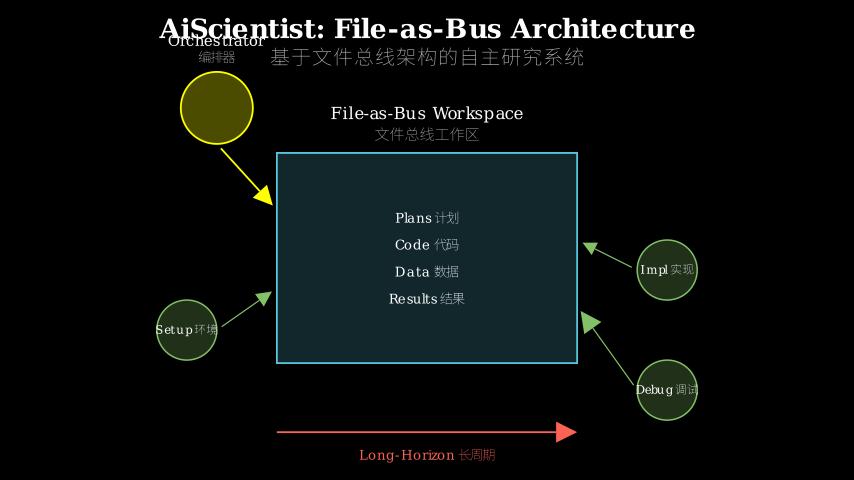
AiScientist has two layers. The top layer is an Orchestrator that maintains stage-level control (task comprehension, setup, implementation, experimentation, debugging) using concise summaries and a workspace map. It doesn’t do the work—it routes tasks to specialized agents and tracks progress through file artifacts.
The bottom layer consists of specialized agents (Planner, Coder, Experimenter, Debugger) that operate on a File-as-Bus workspace. Instead of receiving instructions through conversation and passing results back conversationally, agents read from and write to permission-scoped files: analysis documents, implementation plans, code files, experiment logs, debug traces. Each agent re-grounds on these durable artifacts when it starts work, rather than relying on what the previous agent said in chat.
Orchestrator (thin control)
   |
   +---> maintains: stage tracker, workspace map, summaries
   |
   v
   Routes tasks to:
   |
   +---> Planner ----+
   +---> Coder   ----+---> File-as-Bus Workspace
   +---> Experimenter+      (permission-scoped)
   +---> Debugger ---+      |
                            +---> analysis.md
                            +---> plan.json
                            +---> code/*.py
                            +---> logs/experiment_*.txt
                            +---> debug_trace.log

   Each agent:
   1. Reads relevant files (re-grounds)
   2. Performs specialized work
   3. Writes results to files
   4. Reports completion to Orchestrator
Think of it like a construction site. The Orchestrator is the general contractor who tracks which phase the project is in (foundation, framing, electrical, plumbing) and assigns crews. But the contractor doesn’t tell the electrician every detail of what the plumber did—instead, the electrician walks onto the site, looks at the actual pipes and walls (the durable artifacts), and figures out where to run the wiring. The building itself is the communication medium. If the electrician only had the contractor’s verbal summary of the plumbing work, they’d miss critical details. By inspecting the actual pipes, they get ground truth. Similarly, AiScientist agents inspect actual code, logs, and plans rather than relying on summarized handoffs.
Key Concepts
-
File-as-Bus: Instead of agents communicating through conversational messages (which get lost or summarized), they communicate by reading and writing files in a shared workspace. Files become the “bus” that carries information between agents. A Planner writes
plan.json, the Coder reads it and writesmodel.py, the Experimenter reads both and writesresults.log, the Debugger reads all three. Each file is a durable artifact that any agent can re-ground on. This is like using a shared Google Drive folder where everyone leaves notes and code, versus trying to remember everything said in a long Slack thread. -
Thin control over thick state: The Orchestrator maintains “thin” control—it only tracks high-level stage transitions and routes tasks. It doesn’t micromanage or hold detailed project state in memory. The “thick” state lives in files: thousands of lines of code, experiment logs, debug traces. Agents operate directly on this thick state. This inverts the typical agent architecture where a central controller holds all context and issues detailed instructions. Here, the controller is lightweight and the state is externalized.
-
Re-grounding: Each time an agent starts work, it reads the relevant files from scratch rather than relying on what was said earlier in conversation. If the Debugger needs to fix a bug, it doesn’t just read the Experimenter’s chat message saying “test failed”—it reads the actual test output file, the code file, and the plan file. This prevents information decay over long horizons. It’s like a doctor reviewing your full medical chart before each appointment rather than relying on what the nurse said in the hallway.
Framework Shift
Before (conversational agents):        After (AiScientist):

  Agent A                                Orchestrator (thin)
     |                                      |
     v (chat message)                       v (task routing)
  Agent B                                Planner --> plan.json
     |                                      |
     v (chat message)                       v
  Agent C                                Coder --> code/*.py
     |                                      |
     v (chat message)                       v
  Agent D                                Experimenter --> logs/*.txt
                                            |
  [Context degrades over time]              v
  [Information lost at handoffs]         Debugger --> debug_trace.log

                                         [State persists in files]
                                         [Agents re-ground on artifacts]
From conversational relay race to construction site coordination, the core shift is externalizing state into durable files that agents repeatedly inspect rather than passing summaries through a degrading conversation chain.
Expert Assessment
Problem choice: Real gap. Long-horizon autonomy is the frontier for AI agents, and the paper correctly identifies that existing systems fail not because of weak reasoning but because of architectural choices (conversational handoffs). This sits at the intersection of agent systems and software engineering, which is timely given the push toward AI-assisted research.
Method maturity: The File-as-Bus idea is elegant and feels obvious in hindsight—it’s how human teams actually work (shared repos, not just Slack). The hierarchical orchestration is less novel (similar to MetaGPT’s role-based structure), but the combination is well-motivated. However, the paper doesn’t deeply explore failure modes: what happens when files get corrupted, when agents write conflicting updates, or when the workspace grows too large? The permission-scoping mechanism is mentioned but not detailed.
Experimental integrity: Two benchmarks (PaperBench, MLE-Bench Lite) with solid improvements (+10.54, 81.82%). The ablation study is critical—removing File-as-Bus drops performance by 6.41 and 31.82 points, which strongly supports the core claim. Baselines include AutoGPT, MetaGPT, and OpenHands, which are reasonable comparisons. However, PaperBench is relatively new and may not be widely validated. The paper doesn’t report variance or multiple runs, which is a minor red flag. Also, 81.82% on MLE-Bench Lite is good but not dominant—there’s room for improvement.
Writing quality: The abstract and introduction are crisp. The method section could be tighter—there’s some repetition between describing the Orchestrator and the File-as-Bus protocol. The related work section is adequate but doesn’t deeply engage with software engineering literature on build systems and artifact-based coordination (e.g., Make, Bazel), which would strengthen the positioning. The results section is clear but lacks error analysis or qualitative examples of where the system succeeds or fails.
Verdict: Weak accept — solid contribution with a clean architectural insight and decent empirical validation, but lacks depth on failure modes and could benefit from more rigorous experimental reporting.
Takeaways
For agent builders: Stop passing information through conversational context. Use files or databases as the communication medium. Design agents to re-read ground truth artifacts rather than trusting summaries. This applies beyond ML research—any multi-step workflow (data pipelines, testing, deployment) benefits from durable state.
For orchestration systems: Separate control (routing, stage tracking) from state (code, logs, plans). Keep the controller thin and stateless. Let specialized workers operate directly on thick, persistent state. This is the Unix philosophy applied to agents: small tools, shared files.
For benchmarking: The ablation study here is a model—removing File-as-Bus causes massive performance drops, which proves it’s not just incremental. When designing agent systems, build in ablation points from the start so you can isolate what actually matters.
Concrete technique: Permission-scoped file access. Don’t give every agent read/write access to everything. The Planner writes plans but doesn’t touch code. The Coder reads plans but doesn’t modify experiment logs. This prevents agents from stepping on each other and makes debugging easier. Implement this with file system permissions or a simple access control layer.
论文: 2604.13018 作者: Guoxin Chen, Jie Chen, Lei Chen, Jiale Zhao, Fanzhe Meng, Wayne Xin Zhao, Ruihua Song, Cheng Chen, Ji-Rong Wen, Kai Jia 分类: cs.CL
缺口
自主AI智能体能处理短任务,但机器学习研究工程横跨数小时或数天,涵盖任务理解、环境搭建、实现、实验、调试等阶段。
现有智能体系统依赖对话式上下文在智能体间传递,这在长周期任务中会退化,因为上下文窗口填满,交接时信息失真。
AutoGPT和MetaGPT这类系统在多日研究任务上挣扎,因为它们把长周期工作当作延长的对话,而非需要协调的持久项目状态。
问题:长周期机器学习研究(数小时/数天)
   |
   v
现有方法:智能体间对话式交接
   |
   +---> 上下文窗口限制
   +---> 交接时信息丢失
   +---> 无持久项目状态
   |
   v
假设:需要结构化协调 + 持久状态
   |
   v
方法:分层编排 + 文件总线工作区
   |
   +---> 编排器:轻量控制层
   +---> 专业智能体:重新锚定文件
   +---> 文件:持久化制品(代码、日志、计划)
   |
   v
证据:PaperBench +10.54,MLE-Bench Lite 81.82%
      消融:去除文件总线后 -6.41/-31.82
   |
   v
结论:长周期 = 系统问题(在状态上协调)
      非推理问题(延长对话)
增量
一句话: 这篇论文之前,自主智能体把长周期研究当作会随时间退化的延长对话;
之后,它们通过智能体反复重新锚定的持久化文件状态来协调。
核心机制
AiScientist有两层。
顶层是编排器(Orchestrator),维护阶段级控制(任务理解、搭建、实现、实验、调试),使用简洁摘要和工作区地图。
它不做具体工作——它把任务路由给专业智能体,通过文件制品追踪进度。
底层是专业智能体(规划器、编码器、实验器、调试器),它们在文件总线工作区上操作。
智能体不是通过对话接收指令并对话式返回结果,而是读写权限范围内的文件:分析文档、实现计划、代码文件、实验日志、调试追踪。
每个智能体开始工作时重新锚定这些持久化制品,而非依赖前一个智能体在聊天中说了什么。
编排器(轻量控制)
   |
   +---> 维护:阶段追踪器、工作区地图、摘要
   |
   v
   路由任务到:
   |
   +---> 规划器 ----+
   +---> 编码器 ----+---> 文件总线工作区
   +---> 实验器 ----+      (权限范围)
   +---> 调试器 ----+      |
                           +---> analysis.md
                           +---> plan.json
                           +---> code/*.py
                           +---> logs/experiment_*.txt
                           +---> debug_trace.log

   每个智能体:
   1. 读取相关文件(重新锚定)
   2. 执行专业工作
   3. 将结果写入文件
   4. 向编排器报告完成
把它想象成建筑工地。
编排器是总承包商,追踪项目处于哪个阶段(地基、框架、电路、管道),分配施工队。
但承包商不会告诉电工水管工做了什么的每个细节——相反,电工走进工地,查看实际的管道和墙壁(持久化制品),弄清楚在哪里布线。
建筑本身就是通信媒介。
如果电工只有承包商对管道工作的口头总结,他们会错过关键细节。
通过检查实际管道,他们得到真实情况。
类似地,AiScientist智能体检查实际代码、日志和计划,而非依赖总结式交接。
关键概念
- 文件总线(File-as-Bus): 智能体不通过对话消息通信(会丢失或被总结),而是通过读写共享工作区中的文件来通信。
文件成为在智能体间传递信息的”总线”。
规划器写plan.json,编码器读它并写model.py,实验器读两者并写results.log,调试器读全部三个。
每个文件都是持久化制品,任何智能体都能重新锚定。
这就像使用共享的Google Drive文件夹,每个人留下笔记和代码,而非试图记住长Slack线程中说的一切。
- 厚状态上的薄控制: 编排器维护”薄”控制——它只追踪高层阶段转换和路由任务。
它不微观管理,也不在内存中保存详细项目状态。
“厚”状态存在于文件中:数千行代码、实验日志、调试追踪。
智能体直接在这个厚状态上操作。
这颠倒了典型的智能体架构,在那里中央控制器持有所有上下文并发出详细指令。
这里,控制器是轻量的,状态是外部化的。
- 重新锚定(Re-grounding): 每次智能体开始工作时,它从头读取相关文件,而非依赖对话中早先说的内容。
如果调试器需要修复bug,它不只是读实验器的聊天消息说”测试失败”——它读实际的测试输出文件、代码文件和计划文件。
这防止了长周期中的信息衰减。
就像医生在每次就诊前查看你的完整病历,而非依赖护士在走廊里说的话。
框架转变
之前(对话式智能体):              之后(AiScientist):

  智能体A                            编排器(薄)
     |                                  |
     v(聊天消息)                      v(任务路由)
  智能体B                            规划器 --> plan.json
     |                                  |
     v(聊天消息)                      v
  智能体C                            编码器 --> code/*.py
     |                                  |
     v(聊天消息)                      v
  智能体D                            实验器 --> logs/*.txt
                                        |
  [上下文随时间退化]                    v
  [交接时信息丢失]                   调试器 --> debug_trace.log

                                     [状态持久化在文件中]
                                     [智能体重新锚定制品]
从对话式接力赛到建筑工地协调,核心转变是将状态外部化到持久文件中,智能体反复检查这些文件,而非通过退化的对话链传递摘要。
专家评审
选题眼光: 真实缺口。
长周期自主性是AI智能体的前沿,论文正确识别出现有系统失败不是因为推理弱,而是因为架构选择(对话式交接)。
这处于智能体系统和软件工程的交叉点,考虑到AI辅助研究的推进,这很及时。
方法成熟度: 文件总线想法优雅,事后看来显而易见——这就是人类团队实际工作的方式(共享代码库,不只是Slack)。
分层编排不太新颖(类似MetaGPT的基于角色结构),但组合动机充分。
然而,论文没有深入探索失败模式:文件损坏时会怎样,智能体写冲突更新时会怎样,或工作区增长过大时会怎样?
权限范围机制被提及但未详述。
实验诚意: 两个基准(PaperBench、MLE-Bench Lite),改进稳健(+10.54、81.82%)。
消融研究至关重要——移除文件总线后性能下降6.41和31.82点,这强力支持核心主张。
基线包括AutoGPT、MetaGPT和OpenHands,是合理的比较。
然而,PaperBench相对较新,可能未被广泛验证。
论文未报告方差或多次运行,这是小红旗。
另外,MLE-Bench Lite上81.82%不错但非主导——还有改进空间。
写作功力: 摘要和引言简洁。
方法部分可以更紧凑——描述编排器和文件总线协议之间有些重复。
相关工作部分足够但未深入接触软件工程文献中关于构建系统和基于制品协调的内容(如Make、Bazel),这会加强定位。
结果部分清晰但缺乏错误分析或系统成功或失败的定性例子。
判决: 弱接收 — 扎实贡献,有清晰的架构洞见和不错的实证验证,但缺乏对失败模式的深度,可以从更严格的实验报告中受益。
要点总结
对智能体构建者: 停止通过对话上下文传递信息。
使用文件或数据库作为通信媒介。
设计智能体重新读取真实制品而非信任摘要。
这适用于机器学习研究之外——任何多步骤工作流(数据管道、测试、部署)都受益于持久状态。
对编排系统: 分离控制(路由、阶段追踪)和状态(代码、日志、计划)。
保持控制器薄且无状态。
让专业工作者直接在厚的、持久的状态上操作。
这是Unix哲学应用于智能体:小工具,共享文件。
对基准测试: 这里的消融研究是典范——移除文件总线导致性能大幅下降,证明它不只是增量改进。
设计智能体系统时,从一开始就构建消融点,这样你能隔离真正重要的东西。
具体技术: 权限范围的文件访问。
不要给每个智能体对所有东西的读写访问。
规划器写计划但不碰代码。
编码器读计划但不修改实验日志。
这防止智能体互相干扰,使调试更容易。
用文件系统权限或简单访问控制层实现。