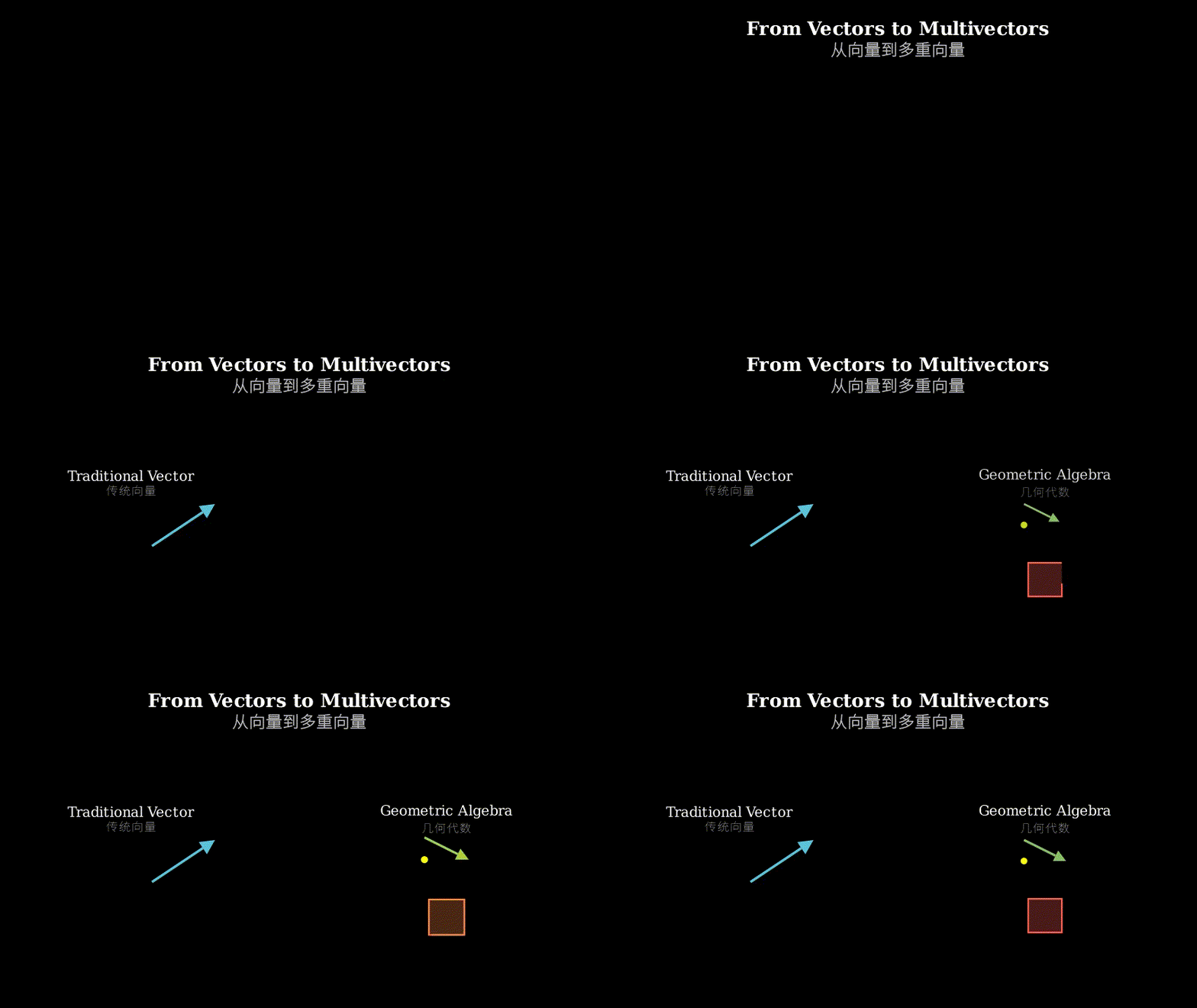
Paper: 2604.25902 Authors: James Pustejovsky Categories: cs.CL, cs.AI, cs.LG
The Gap
Distributional semantics—word2vec, BERT, GPT—represents meaning as vectors in linear spaces. You add vectors for composition, multiply matrices for transformation, compute dot products for similarity. This works remarkably well for retrieval and classification. But it breaks down when you need compositional structure: “red ball” vs “ball that is red” collapse into the same representation. Type distinctions vanish: adjectives, verbs, and nouns live in the same undifferentiated space. Interpretability suffers: what does dimension 347 mean?
The core limitation is algebraic poverty. Linear algebra gives you addition and scalar multiplication. That’s it. You can’t encode rotation, reflection, or higher-order interactions without bolting on ad-hoc mechanisms (attention, gating, nonlinear activations). The structure you need for semantics—composition rules, type constraints, logical operations—lives outside the algebra.
Problem: Semantic composition needs structure
    |
    v
Assumption: Linear algebra is the only game in town
    |
    v
Method: Geometric algebra (Clifford algebras) as foundation
    |
    v
Evidence: GA provides geometric product, grade structure, type encoding
    |
    v
Conclusion: n-dim vectors -> 2^n multivector algebra with built-in composition
The Increment
One sentence: Before this paper, semantic embeddings were vectors in linear spaces; after, they can be multivectors in geometric algebras where composition, type, and transformation are algebraically native.
Core Mechanism
Geometric algebra starts with a vector space but adds a geometric product that combines dot product (scalar) and wedge product (bivector). In 3D, you don’t just have three basis vectors e₁, e₂, e₃—you also have three bivectors e₁₂, e₂₃, e₃₁ (oriented planes), one trivector e₁₂₃ (oriented volume), and a scalar. That’s 2³ = 8 components total: a multivector.
The geometric product ab = a·b + a∧b encodes both magnitude and orientation. Composition isn’t just addition—it’s multiplication that respects geometric structure. An adjective-noun pair isn’t vector addition; it’s a geometric product that produces a bivector encoding the modification relationship. Verbs become operators (rotors, reflectors) that transform argument structures. Types emerge from grade: scalars are grade 0, vectors grade 1, bivectors grade 2.
Functional Geometric Algebra (FGA) layers typed lambda calculus on top. Each semantic type (entity, property, relation) maps to a grade structure. Composition rules become type-preserving geometric operations. You get Church’s simple type theory but with geometric operations as primitives instead of abstract functions.
Input: word embeddings (vectors)
    |
    v
[Geometric Product Layer]
    |
    +---> scalars (grade 0): magnitudes, truth values
    +---> vectors (grade 1): entities, base concepts
    +---> bivectors (grade 2): relations, modifications
    +---> trivectors (grade 3): higher-order predicates
    |
    v
[Type-Preserving Composition]
    |
    v
Output: structured multivector (2^n components)
Think of it like chemistry versus grocery shopping. Linear algebra is grocery shopping: you have a cart (vector space), you add items (vector addition), you scale quantities (scalar multiplication). That’s it. Geometric algebra is chemistry: you still have elements (basis vectors), but now they can bond (geometric product). Hydrogen and oxygen don’t just sit next to each other—they form water, a new substance with emergent properties. The bonds have orientation (wedge product) and strength (dot product). A molecule isn’t a list of atoms; it’s a structured object where relationships are first-class. Similarly, “red ball” isn’t two vectors added; it’s a bivector encoding how “red” modifies “ball,” with the modification relationship geometrically explicit.
Key Concepts
-
Geometric Product: In linear algebra, you multiply vectors by scalars or compute dot products (giving scalars). The geometric product ab of two vectors gives you both: ab = a·b + a∧b. The dot product a·b is the symmetric part (how much they align), the wedge product a∧b is the antisymmetric part (the oriented plane they span). Example: if a and b are perpendicular, a·b = 0 but a∧b is a bivector representing their plane. This single operation unifies inner and outer products, letting you encode both magnitude and orientation in one algebraic move.
-
Multivector: A vector has n components. A multivector has 2ⁿ components: scalars, vectors, bivectors, trivectors, etc. In 3D: 1 scalar + 3 vectors + 3 bivectors + 1 trivector = 8 components. Each grade has geometric meaning. For semantics: grade 0 = truth values, grade 1 = entities, grade 2 = binary relations, grade 3 = ternary relations. “John loves Mary” isn’t three separate vectors—it’s a single multivector where John and Mary are vector components and “loves” is the bivector component encoding their relationship.
-
Rotor: A rotor is a multivector that performs rotation when you sandwich a vector: RvR†. In 3D, rotors replace rotation matrices. In semantics, rotors are verb operators. “John runs” → “John ran” is a rotor transforming the tense component. “Active voice” → “passive voice” is a rotor swapping subject/object positions. Unlike matrix multiplication (which mixes all dimensions), rotors preserve geometric structure—they rotate meaning in semantic space without collapsing type distinctions.
Framework Shift
Before (linear algebra):              After (geometric algebra):

Semantic space: R^n                   Semantic space: Cl(n) ~ R^(2^n)

    [v1]                                  scalar: magnitude
    [v2]  <-- flat vector                 vector: entity
    [v3]                                  bivector: relation
    [..]                                  trivector: 3-way relation
    [vn]                                  ...
                                          n-vector: full context

Composition:                          Composition:
  v1 + v2  (addition only)              v1 * v2 = v1.v2 + v1^v2
                                        (dot + wedge = structure)

Types:                                Types:
  implicit in model architecture        explicit in grade structure
  (all vectors look the same)           (grade 0, 1, 2, ... n)
[One sentence: From flat vector addition to graded geometric multiplication, the core shift is from implicit structure in neural weights to explicit structure in algebraic operations.]
Expert Assessment
Problem choice: Real gap. Compositional semantics has been the Achilles heel of distributional methods since word2vec. The problem isn’t manufactured—it’s the reason we need increasingly complex architectures (attention, gating, residual connections) to approximate compositional structure. Pustejovsky is asking: what if the algebra itself could do the work?
Method maturity: Conceptually elegant but practically nascent. Geometric algebra is well-established in physics and computer graphics, but its application to NLP is exploratory. The paper is more manifesto than empirical validation. The worked examples (Section 4) show how GA *could represent semantic contrasts, but there’s no large-scale implementation, no comparison to transformer baselines, no evidence that GA-based models learn better or faster. The claim that transformers “already implicitly use GA operations” (Section 5) is speculative—attention isn’t literally computing geometric products.
Experimental integrity: No experiments. This is a position paper arguing for a research program, not reporting results. That’s fine for a foundational piece, but it means the empirical questions are wide open: Can you actually train GA-based models at scale? Do they generalize better? Are they more interpretable in practice, or just in theory? The paper gestures at compatibility with neural architectures but doesn’t demonstrate it.
Writing quality: Ambitious and clear in motivation, but the formalism (Section 3) is dense without sufficient pedagogical scaffolding. A reader unfamiliar with Clifford algebras will struggle. The worked example (Section 4) helps, but it arrives late. The paper would benefit from leading with a concrete semantic problem, showing how linear algebra fails, then introducing GA as the solution. As written, it front-loads abstraction and asks the reader to trust that payoff will come.
Verdict: weak accept — Important idea that deserves exploration, but needs empirical grounding before the field can assess whether GA’s theoretical advantages translate to practical gains.
Takeaways
If you’re building semantic models, steal the core insight: composition should be multiplication, not addition. Even without full GA machinery, you can experiment with multiplicative composition (Hadamard products, tensor products) instead of concatenation or addition. The paper’s type-as-grade idea is transferable: instead of treating all embeddings as undifferentiated vectors, partition your embedding space by semantic role (entities in one subspace, relations in another) and enforce composition rules that respect those boundaries. For interpretability, the notion that higher-order interactions should be explicit components (not emergent from nonlinear layers) is worth testing—can you design architectures where bivector components correspond to pairwise interactions, trivector components to three-way interactions, etc.? Finally, if you work in a domain with natural geometric structure (spatial reasoning, robotics, physics-informed NLP), GA is a direct fit—don’t force it into linear algebra.
论文: 2604.25902 作者: James Pustejovsky 分类: cs.CL, cs.AI, cs.LG
缺口
分布式语义学——word2vec、BERT、GPT——把意义表示为线性空间中的向量。
你用向量加法做组合,用矩阵乘法做变换,用点积算相似度。
这在检索和分类任务上效果惊人。
但在需要组合结构时就崩了:“红球”和”是红色的球”坍缩成同一个表示。
类型区分消失了:形容词、动词、名词都住在同一个无差别的空间里。
可解释性也受损:第 347 维是什么意思?
核心局限是代数贫瘠。
线性代数给你加法和标量乘法。
就这些。
你无法编码旋转、反射或高阶交互,除非外挂临时机制(注意力、门控、非线性激活)。
语义所需的结构——组合规则、类型约束、逻辑运算——都活在代数之外。
问题:语义组合需要结构
    |
    v
假设:线性代数是唯一选择
    |
    v
方法:几何代数(Clifford 代数)作为基础
    |
    v
证据:GA 提供几何积、等级结构、类型编码
    |
    v
结论:n 维向量 -> 2^n 多重向量代数,内置组合能力
增量
一句话: 这篇论文之前,语义嵌入是线性空间中的向量;之后,它们可以是几何代数中的多重向量,组合、类型和变换在代数层面原生支持。
核心机制
几何代数从向量空间出发,但加入了几何积,它结合了点积(标量)和楔积(双向量)。
在 3D 中,你不只有三个基向量 e₁, e₂, e₃——还有三个双向量 e₁₂, e₂₃, e₃₁(定向平面)、一个三向量 e₁₂₃(定向体积)和一个标量。
总共 2³ = 8 个分量:一个多重向量。
几何积 ab = a·b + a∧b 同时编码大小和方向。
组合不再只是加法——而是尊重几何结构的乘法。
形容词-名词对不是向量加法;而是产生双向量的几何积,编码修饰关系。
动词成为算子(旋量、反射子),变换论元结构。
类型从等级中涌现:标量是 0 级,向量 1 级,双向量 2 级。
函数几何代数(FGA)在此之上叠加类型化 lambda 演算。
每个语义类型(实体、属性、关系)映射到一个等级结构。
组合规则变成保持类型的几何运算。
你得到 Church 的简单类型论,但用几何运算作为原语,而非抽象函数。
输入:词嵌入(向量)
    |
    v
[几何积层]
    |
    +---> 标量(0 级):大小、真值
    +---> 向量(1 级):实体、基础概念
    +---> 双向量(2 级):关系、修饰
    +---> 三向量(3 级):高阶谓词
    |
    v
[保持类型的组合]
    |
    v
输出:结构化多重向量(2^n 分量)
把它想象成化学 vs 买菜。
线性代数是买菜:你有个购物车(向量空间),往里加东西(向量加法),调整数量(标量乘法)。
就这些。
几何代数是化学:你仍然有元素(基向量),但现在它们能成键(几何积)。
氢和氧不只是挨着放——它们形成水,一种有涌现性质的新物质。
键有方向(楔积)和强度(点积)。
分子不是原子列表;它’s 一个结构化对象,关系是一等公民。
类似地,“红球”不是两个向量相加;而是一个双向量,编码”红”如何修饰”球”,修饰关系在几何上显式表达。
关键概念
- 几何积: 在线性代数中,你用标量乘向量或算点积(得到标量)。
两个向量的几何积 ab 两者都给你:ab = a·b + a∧b。
点积 a·b 是对称部分(它们对齐多少),楔积 a∧b 是反对称部分(它们张成的定向平面)。
例子:如果 a 和 b 垂直,a·b = 0 但 a∧b 是表示它们平面的双向量。
这个单一运算统一了内积和外积,让你在一次代数操作中同时编码大小和方向。
- 多重向量: 向量有 n 个分量。
多重向量有 2ⁿ 个分量:标量、向量、双向量、三向量等。
在 3D 中:1 个标量 + 3 个向量 + 3 个双向量 + 1 个三向量 = 8 个分量。
每个等级有几何意义。
对语义:0 级 = 真值,1 级 = 实体,2 级 = 二元关系,3 级 = 三元关系。
“约翰爱玛丽”不是三个独立向量——而是单个多重向量,约翰和玛丽是向量分量,“爱”是编码他们关系的双向量分量。
- 旋量: 旋量是一个多重向量,当你夹住一个向量时执行旋转:RvR†。
在 3D 中,旋量取代旋转矩阵。
在语义中,旋量是动词算子。
“约翰跑” → “约翰跑了”是变换时态分量的旋量。
“主动语态” → “被动语态”是交换主宾位置的旋量。
不像矩阵乘法(混合所有维度),旋量保持几何结构——它们在语义空间中旋转意义,不坍缩类型区分。
框架转变
之前(线性代数):                之后(几何代数):

语义空间:R^n                     语义空间:Cl(n) ~ R^(2^n)

    [v1]                              标量:大小
    [v2]  <-- 扁平向量                向量:实体
    [v3]                              双向量:关系
    [..]                              三向量:三元关系
    [vn]                              ...
                                      n-向量:完整上下文

组合:                            组合:
  v1 + v2  (只有加法)              v1 * v2 = v1.v2 + v1^v2
                                    (点 + 楔 = 结构)

类型:                            类型:
  隐含在模型架构中                   显式在等级结构中
  (所有向量看起来一样)             (0 级、1 级、2 级、... n 级)
[一句话:从扁平向量加法到分级几何乘法,核心转变是从神经权重中的隐式结构到代数运算中的显式结构。
]
专家评审
选题眼光: 真缺口。
组合语义一直是分布式方法的阿喀琉斯之踵,从 word2vec 时代就是。
这问题不是人造的——正因为此我们才需要越来越复杂的架构(注意力、门控、残差连接)来近似组合结构。
Pustejovsky 在问:如果代数本身能做这工作呢?
方法成熟度: 概念上优雅但实践上初生。
几何代数在物理和计算机图形学中已成熟,但在 NLP 中的应用还在探索。
这篇论文更像宣言而非实证验证。
示例(第 4 节)展示了 GA 如何能表示语义对比,但没有大规模实现,没有与 transformer 基线的比较,没有证据表明基于 GA 的模型学得更好或更快。
声称 transformer”已经隐式使用 GA 运算”(第 5 节)是推测性的——注意力并非字面上在计算几何积。
实验诚意: 没有实验。
这是一篇立场论文,论证一个研究计划,而非报告结果。
对基础性文章来说没问题,但意味着实证问题完全开放:你真能大规模训练基于 GA 的模型吗?
它们泛化更好吗?
实践中更可解释,还是只在理论上?
论文暗示与神经架构兼容但未演示。
写作功力: 动机上雄心勃勃且清晰,但形式化部分(第 3 节)密集,缺乏足够的教学脚手架。
不熟悉 Clifford 代数的读者会挣扎。
示例(第 4 节)有帮助,但来得太晚。
论文会受益于先提出具体语义问题,展示线性代数如何失败,然后引入 GA 作为解决方案。
现在的写法是前置抽象,要求读者相信回报会来。
判决: 弱接收 — 重要想法值得探索,但需要实证基础,才能让领域评估 GA 的理论优势是否转化为实际收益。
要点总结
如果你在构建语义模型,偷走核心洞见:组合应该是乘法,不是加法。
即使没有完整的 GA 机制,你也能实验乘法组合(Hadamard 积、张量积)而非拼接或加法。
论文的类型即等级想法可迁移:不要把所有嵌入当作无差别向量,按语义角色分区你的嵌入空间(实体在一个子空间,关系在另一个),强制执行尊重这些边界的组合规则。
对可解释性,高阶交互应该是显式分量(而非从非线性层涌现)的观念值得测试——你能设计架构,让双向量分量对应成对交互,三向量分量对应三向交互等吗?
最后,如果你在有自然几何结构的领域工作(空间推理、机器人、物理知情 NLP),GA 是直接契合——别强行塞进线性代数。