Paper: 2603.02203 Authors: Ruotong Liao, Nikolai Röhrich, Xiaohan Wang, Yuhui Zhang, Yasaman Samadzadeh, Volker Tresp, Serena Yeung-Levy Categories: cs.AI, cs.CL
The Gap
Test-time reinforcement learning (TTRL) lets large reasoning models improve themselves during inference by generating multiple solutions and using majority voting as a reward signal. The problem: if the model consistently generates the same wrong answer across most rollouts, majority voting reinforces that mistake. The model enters a death spiral—confidently learning to be more wrong.
Prior work (TTRL baseline) assumes consensus equals correctness. This breaks on hard problems where the model’s initial bias is strong. The authors identify “incorrect mode collapse” as the core failure: spurious high-frequency answers become self-reinforcing pseudo-labels, and the model doubles down on errors.
Problem: Model generates wrong answer 70% of time
    |
    v
Assumption: Majority vote = ground truth (WRONG on hard problems)
    |
    v
Method: Add external tool verification before voting
    |
    v
Evidence: +8.9% on MATH-500, +15.6% on AIME 2024
    |
    v
Conclusion: Verified consensus > raw consensus for self-evolution
The Increment
One sentence: Before, models learned from whatever answer appeared most often in their own outputs; now, they only learn from answers that pass external verification (like code execution), preventing confident wrongness.
Core Mechanism
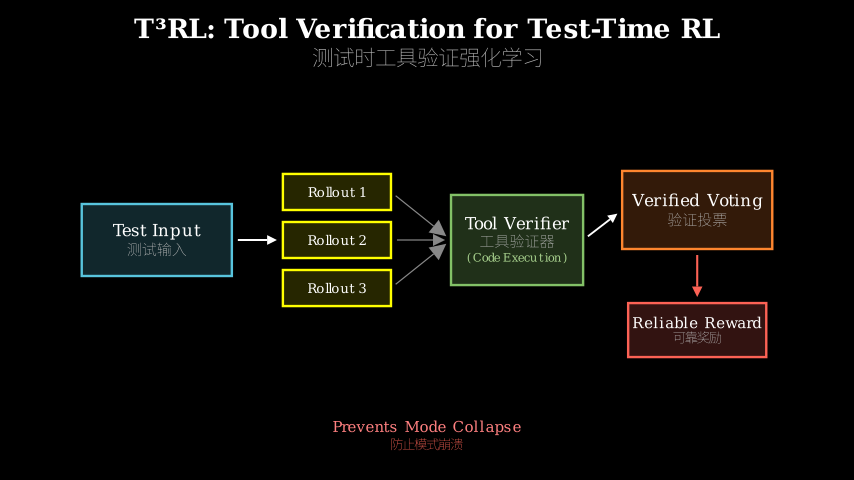
T³RL has three components working in sequence. First, the model generates multiple solution attempts (rollouts) for a test problem—say, 32 different ways to solve a math question. Second, a verifier checks each rollout using an external tool: for math problems, it extracts Python code from the solution, executes it, and sees if the computed answer matches the model’s claimed answer. Third, a verification-aware voting system counts votes, but verified rollouts get higher weight than unverified ones.
The data flow is straightforward: test input → model generates N rollouts → verifier marks each as verified/unverified → weighted voting produces pseudo-label → model trains on that pseudo-label via policy gradient. The key operation is the verification step inserting ground truth signal before the voting aggregation.
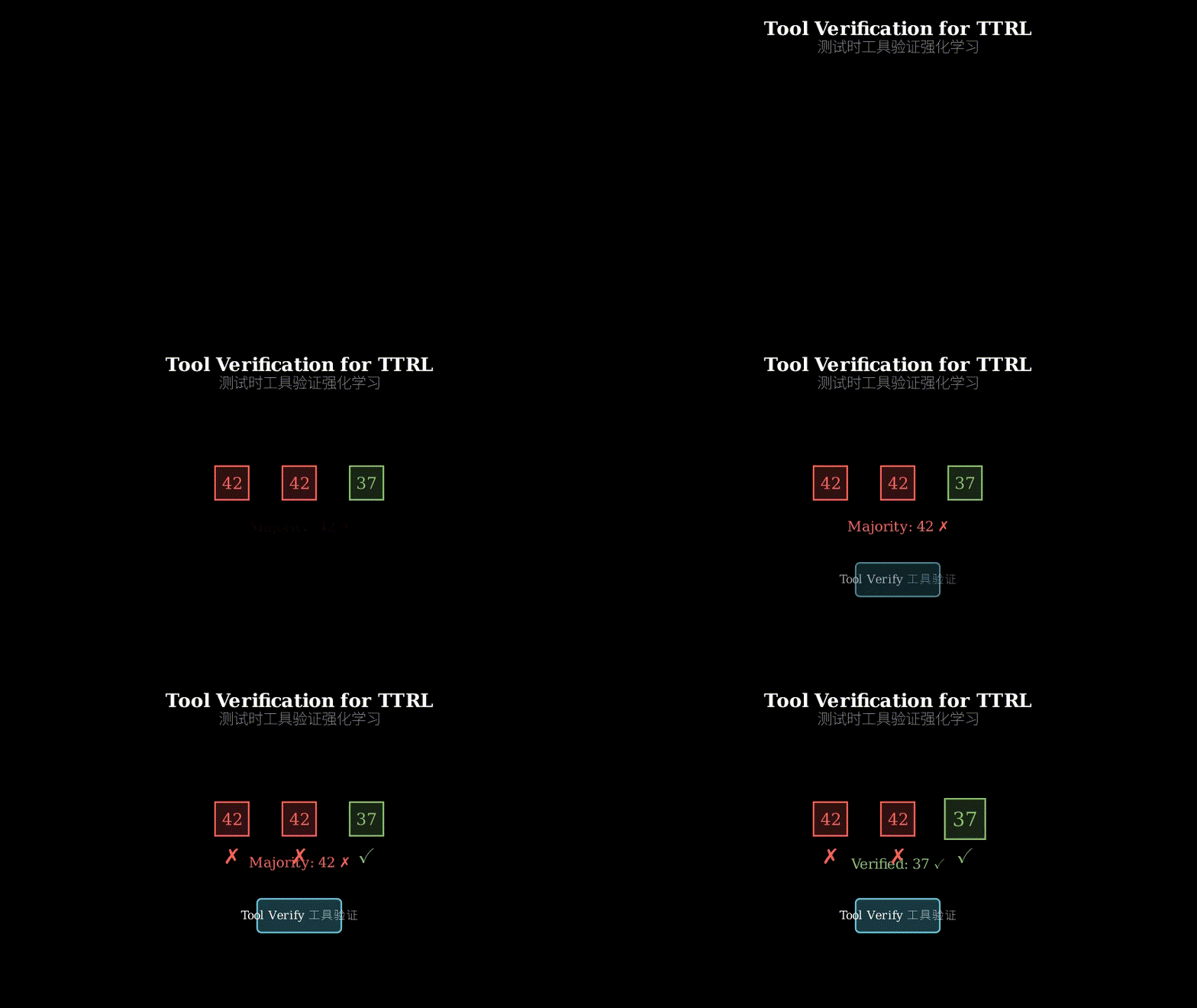
What makes this work is the upweighting function. If a rollout passes verification, its vote counts more (weight = 1 + λ, where λ is a hyperparameter). Unverified rollouts still vote but with weight = 1. This means even if 20 unverified rollouts say “42” and only 5 verified rollouts say “17”, the verified answer can still win the vote if λ is set high enough.
Test Input
    |
    v
+-------------------+
| Model generates   |
| N rollouts        |
+-------------------+
    |
    v
+-------------------+      +------------------+
| Verifier checks   | <--- | External Tool    |
| each rollout      |      | (code execution) |
+-------------------+      +------------------+
    |
    v
+-------------------+
| Weighted voting:  |
| verified = 1 + λ  |
| unverified = 1    |
+-------------------+
    |
    v
Pseudo-label for training
Think of this like a jury trial with expert witnesses. The model is a jury that keeps deliberating the same case (test problem) and voting on verdicts (answers). In standard TTRL, every juror’s vote counts equally—if 8 out of 12 jurors say “guilty” based on gut feeling, that becomes the verdict and the jury “learns” that gut feeling was right. In T³RL, some jurors bring forensic evidence (verified rollouts). Their votes count double or triple. Now even if only 4 jurors have forensic evidence saying “not guilty” and 8 have gut feelings saying “guilty”, the forensic evidence can override the majority. The jury learns to trust evidence over intuition, preventing groupthink from calcifying into doctrine.
Key Concepts
-
Test-Time Reinforcement Learning (TTRL): Imagine you’re taking a test and you’re allowed to write down 10 different attempts at each problem, then pick the most common answer as your “official” answer. Now imagine you also get to study from those official answers to get better at future problems. That’s TTRL—the model generates multiple solutions at test time, uses majority voting to pick the “best” one, and trains on that choice. The wild part: there’s no human grading. The model is both student and teacher. This works surprisingly well when the model is already decent, but fails catastrophically when the model’s initial guess is systematically biased.
-
Mode Collapse: Picture a valley with multiple paths down. Some paths lead to the correct answer at the bottom; others lead to dead ends. Mode collapse is when the model finds one dead-end path that looks appealing (maybe it’s wide and easy to walk), and every time it tries the problem, it takes that same wrong path. Because it keeps taking that path, majority voting says “this must be the right path”, so the model reinforces walking that path even more confidently. Eventually, the model forgets other paths exist. In math problems, this looks like: model generates “x = 5” in 25 out of 32 attempts, votes say “x = 5” is correct, model trains to be even more confident that “x = 5”, even though the real answer is “x = 3”.
-
Verification-Aware Voting: Standard voting is one-person-one-vote. Verification-aware voting is one-person-one-vote, but people who bring receipts get extra votes. Concretely: if a solution says “the answer is 42” and includes Python code that computes 42, the verifier runs that code. If it actually outputs 42, that solution’s vote gets multiplied by (1 + λ). If the code crashes or outputs 17, the vote stays at weight 1. This breaks the echo chamber—even if most rollouts confidently shout the wrong answer, a few rollouts with working code can outvote them.
Framework Shift
Before (TTRL):                       After (T^3RL):

Test Input                           Test Input
    |                                    |
    v                                    v
Generate N rollouts                  Generate N rollouts
    |                                    |
    v                                    v
Count votes                          Verify with tool
(all equal weight)                       |
    |                                    v
    v                                Weight votes
Pseudo-label                         (verified > unverified)
    |                                    |
    v                                    v
Train model                          Pseudo-label
                                         |
[Failure mode:                           v
 wrong answer wins                   Train model
 by popularity]
                                     [Failure mode:
                                      evidence overrides
                                      popularity]
From “trust the crowd” to “trust the crowd that shows their work”, the core shift is inserting an evidence filter before aggregation.
Expert Assessment
Problem choice: This is a real gap, not manufactured. Test-time adaptation is hot right now (see OpenAI’s o1 doing test-time compute), and the failure mode they identify—mode collapse from unverified consensus—is something practitioners actually hit. The timing is good: the field is moving from “can we do test-time learning?” to “how do we make it stable?” This paper sits right at that transition.
Method maturity: It’s a clever insight wrapped in straightforward engineering. The core idea—use external verification to reweight votes—is almost obvious in hindsight, which is the mark of a good idea. But there’s no deep theory here about why this particular weighting scheme is optimal, or how to set λ without trial and error. The method feels like a solid v1.0 that will spawn follow-ups exploring verification strategies beyond code execution.
Experimental integrity: The baselines are fair (they compare against vanilla TTRL and ablations), and the gains are consistent across multiple datasets and model sizes. The fact that gains increase with problem difficulty is a good sign—it suggests the method targets the actual failure mode rather than just adding compute. One yellow flag: all experiments are on math problems where code execution is a natural verifier. It’s unclear how this transfers to domains without clean external tools (e.g., creative writing, ambiguous reasoning).
Writing quality: The abstract and intro are crisp. The method section is clear but could use a diagram showing the verification flow more explicitly. The related work section feels obligatory rather than insightful—it lists prior work but doesn’t deeply position why those approaches fail where T³RL succeeds. If I were reviewing, I’d ask them to rewrite the “why verification helps” section with more mechanistic analysis: what properties of the verification signal make it effective? Is it binary feedback, or the fact that it’s external, or something else?
Verdict: weak accept — Solid incremental contribution with clear practical value, but lacks theoretical depth and domain generality to be a strong accept.
Takeaways
If you’re building any system where a model learns from its own outputs (self-play, self-training, iterative refinement), steal this pattern: insert an external verification step before you aggregate self-generated labels. The verification doesn’t have to be perfect—even noisy external signal (like code execution that sometimes crashes) is better than pure self-consensus.
Concretely, the upweighting formula is dead simple to implement: weight = 1 + λ * is_verified. You can plug this into any voting or ensemble system. Start with λ = 1 (verified votes count double) and tune from there.
The broader lesson: self-evolution needs grounding. Models are bad at knowing when they’re wrong, so you need external anchors—tools, human feedback, formal verifiers, anything that doesn’t come from the model’s own distribution. This paper shows that even partial grounding (verifying some rollouts, not all) is enough to stabilize learning.
论文: 2603.02203 作者: Ruotong Liao, Nikolai Röhrich, Xiaohan Wang, Yuhui Zhang, Yasaman Samadzadeh, Volker Tresp, Serena Yeung-Levy 分类: cs.AI, cs.CL
缺口
测试时强化学习(TTRL)让大型推理模型在推理过程中自我改进:生成多个解,用多数投票作为奖励信号。
问题在于:如果模型在大多数尝试中都生成同一个错误答案,多数投票就会强化这个错误。
模型进入死亡螺旋——自信地学会更错。
先前工作(TTRL基线)假设共识等于正确性。
这在困难问题上失效,因为模型的初始偏差很强。
作者识别出”错误模式坍缩”作为核心失败:虚假的高频答案变成自我强化的伪标签,模型在错误上加倍下注。
问题: 模型70%时间生成错误答案
    |
    v
假设: 多数投票 = 真实答案 (在难题上错误)
    |
    v
方法: 投票前加入外部工具验证
    |
    v
证据: MATH-500上+8.9%, AIME 2024上+15.6%
    |
    v
结论: 验证过的共识 > 原始共识,用于自我进化
增量
一句话: 之前模型从自己输出中出现最多的答案学习;现在只从通过外部验证(如代码执行)的答案学习,防止自信的错误。
核心机制
T³RL有三个顺序工作的组件。
首先,模型为测试问题生成多个解答尝试(rollouts)——比如用32种不同方法解一道数学题。
其次,验证器用外部工具检查每个rollout:对数学问题,它从解答中提取Python代码,执行代码,看计算出的答案是否匹配模型声称的答案。
第三,验证感知投票系统计票,但验证过的rollouts比未验证的权重更高。
数据流很直接:测试输入 → 模型生成N个rollouts → 验证器标记每个为已验证/未验证 → 加权投票产生伪标签 → 模型通过策略梯度在该伪标签上训练。
关键操作是验证步骤在投票聚合前插入真实信号。
让这个方法有效的是加权函数。
如果rollout通过验证,它的投票计数更多(权重 = 1 + λ,其中λ是超参数)。
未验证的rollouts仍然投票但权重 = 1。
这意味着即使20个未验证rollouts说”42”,只有5个验证过的rollouts说”17”,如果λ设置足够高,验证过的答案仍能赢得投票。
测试输入
    |
    v
+-------------------+
| 模型生成          |
| N个rollouts       |
+-------------------+
    |
    v
+-------------------+      +------------------+
| 验证器检查        | <--- | 外部工具         |
| 每个rollout       |      | (代码执行)       |
+-------------------+      +------------------+
    |
    v
+-------------------+
| 加权投票:         |
| 已验证 = 1 + λ    |
| 未验证 = 1        |
+-------------------+
    |
    v
训练用的伪标签
把这想象成有专家证人的陪审团审判。
模型是一个陪审团,不断审议同一个案子(测试问题)并对判决(答案)投票。
在标准TTRL中,每个陪审员的票数相等——如果12个陪审员中8个基于直觉说”有罪”,那就成为判决,陪审团”学到”直觉是对的。
在T³RL中,一些陪审员带来法医证据(验证过的rollouts)。
他们的票数算两倍或三倍。
现在即使只有4个陪审员有法医证据说”无罪”,8个有直觉说”有罪”,法医证据也能推翻多数。
陪审团学会信任证据而非直觉,防止群体思维钙化成教条。
关键概念
- 测试时强化学习(TTRL): 想象你在考试,允许你对每道题写下10个不同的尝试,然后选最常见的答案作为”正式”答案。
现在想象你还能从这些正式答案中学习,在未来问题上变得更好。
这就是TTRL——模型在测试时生成多个解,用多数投票选”最佳”的,并在该选择上训练。
疯狂的部分:没有人类评分。
模型既是学生又是老师。
当模型已经不错时这出奇地有效,但当模型的初始猜测系统性偏差时灾难性失败。
- 模式坍缩: 想象一个有多条下山路径的山谷。
一些路径通向谷底的正确答案;其他通向死胡同。
模式坍缩是当模型找到一条看起来吸引人的死胡同路径(也许它又宽又好走),每次尝试问题时都走那条错误路径。
因为它不断走那条路,多数投票说”这一定是正确路径”,所以模型更自信地强化走那条路。
最终,模型忘记其他路径存在。
在数学问题中,这看起来像:模型在32次尝试中25次生成”x = 5”,投票说”x = 5”正确,模型训练得更自信”x = 5”,即使真实答案是”x = 3”。
- 验证感知投票: 标准投票是一人一票。
验证感知投票是一人一票,但带收据的人获得额外票数。
具体地:如果一个解说”答案是42”并包含计算42的Python代码,验证器运行该代码。
如果它确实输出42,该解的票数乘以(1 + λ)。
如果代码崩溃或输出17,票数保持权重1。
这打破了回音室——即使大多数rollouts自信地喊出错误答案,少数有工作代码的rollouts也能投票胜过它们。
框架转变
之前(TTRL):                      之后(T^3RL):

测试输入                         测试输入
    |                                |
    v                                v
生成N个rollouts                  生成N个rollouts
    |                                |
    v                                v
计票                             用工具验证
(所有权重相等)                       |
    |                                v
    v                            加权投票
伪标签                           (已验证 > 未验证)
    |                                |
    v                                v
训练模型                         伪标签
                                     |
[失败模式:                           v
 错误答案靠                      训练模型
 流行度获胜]
                                 [失败模式:
                                  证据推翻
                                  流行度]
从”信任群众”到”信任展示工作的群众”,核心转变是在聚合前插入证据过滤器。
专家评审
选题眼光: 这是真缺口,不是人造的。
测试时适应现在很热(看OpenAI的o1做测试时计算),他们识别的失败模式——未验证共识导致的模式坍缩——是实践者真正遇到的。
时机很好:该领域正从”我们能做测试时学习吗?”转向”如何让它稳定?”这篇论文正好在那个转折点。
方法成熟度: 这是包裹在直接工程中的巧妙洞见。
核心想法——用外部验证重新加权投票——事后看几乎显而易见,这是好想法的标志。
但这里没有关于为什么这个特定加权方案最优,或如何不经试错设置λ的深层理论。
方法感觉像一个扎实的v1.0,会催生探索代码执行之外验证策略的后续工作。
实验诚意: 基线公平(他们与原版TTRL和消融实验比较),收益在多个数据集和模型大小上一致。
收益随问题难度增加这一事实是好迹象——表明方法针对实际失败模式而不只是增加计算。
一个黄旗:所有实验都在数学问题上,代码执行是自然验证器。
不清楚这如何迁移到没有干净外部工具的领域(如创意写作、模糊推理)。
写作功力: 摘要和引言简洁。
方法部分清晰但可以用图更明确地展示验证流程。
相关工作部分感觉是义务性的而非有洞见——它列出先前工作但没有深入定位为什么那些方法在T³RL成功的地方失败。
如果我在审稿,我会要求他们用更多机制分析重写”为什么验证有帮助”部分:验证信号的什么属性使其有效?是二元反馈,还是它是外部的这一事实,还是别的?
判决: 弱接收 — 扎实的增量贡献,有清晰的实用价值,但缺乏理论深度和领域通用性,不足以强接收。
要点总结
如果你在构建任何模型从自己输出学习的系统(自我对弈、自我训练、迭代精炼),偷这个模式:在聚合自生成标签前插入外部验证步骤。
验证不必完美——即使有噪声的外部信号(如有时崩溃的代码执行)也比纯自我共识好。
具体地,加权公式实现起来极其简单:权重 = 1 + λ * 是否验证。
你可以把这插入任何投票或集成系统。
从λ = 1开始(验证过的票数算两倍)然后调优。
更广泛的教训:自我进化需要接地。
模型不擅长知道自己何时错了,所以你需要外部锚点——工具、人类反馈、形式验证器,任何不来自模型自身分布的东西。
这篇论文表明即使部分接地(验证一些rollouts,不是全部)也足以稳定学习。