
Paper: 2603.10990 Authors: Zhengyao Fang, Zexi Jia, Yijia Zhong, Pengcheng Luo, Jinchao Zhang, Guangming Lu, Jun Yu, Wenjie Pei Categories: cs.CV
The Gap
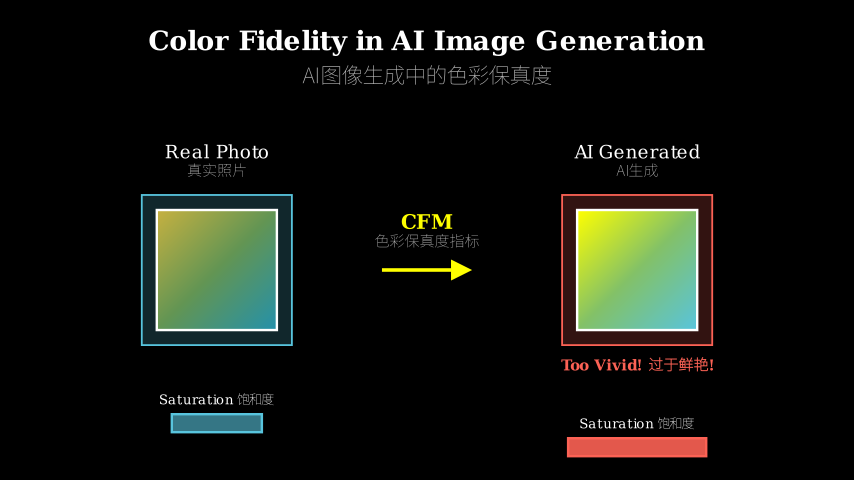
Text-to-image models like DALL-E and Midjourney can generate stunning visuals, but there’s a subtle problem: when you ask for “realistic” images, they often produce photos that look too perfect, too saturated, too contrasty. Think Instagram filter vs raw camera output. Current evaluation methods (human ratings, preference metrics) actually reward this artificial vividness because humans prefer punchy colors in isolation. But when you need truly photorealistic output—for film, product visualization, or scientific applications—this bias becomes a real limitation.
Problem: Realistic prompts → Overly vivid outputs
    |
    v
Assumption: Current metrics favor visual appeal over authenticity
    |
    v
Method: CFD dataset + CFM metric + CFR refinement
    |
    v
Evidence: 1.3M images with color realism rankings
    |
    v
Conclusion: Framework improves photographic authenticity
The Increment
One sentence: Before this paper, “realistic” image generation was evaluated by visual appeal; after, we can measure and optimize for actual photographic color fidelity.
Core Mechanism
The method has three interlocking components. First, the Color Fidelity Dataset (CFD) contains 1.3M images with ordered levels of color realism—think of it as a spectrum from “obviously synthetic” to “could fool a photographer.” Second, the Color Fidelity Metric (CFM) uses a multimodal encoder trained on this dataset to score how photographically authentic an image’s colors appear. Third, Color Fidelity Refinement (CFR) is a training-free technique that modulates the guidance scale during generation to pull colors toward more realistic ranges.
Input Text → T2I Model → Initial Image
                ↓
            CFM Evaluation
                ↓
         CFR Refinement ← Attention Maps
                ↓
           Final Image
Think of this like a photo editor with a “realism dial.” The CFD is like having a master photographer sort millions of images from “fake-looking” to “camera-authentic.” The CFM learns to see what the photographer sees—subtle color relationships that signal real vs synthetic. The CFR is the actual dial that can turn down the artificial saturation boost that T2I models naturally apply. When CFM detects areas that look too processed, CFR’s attention mechanism knows exactly where to apply more conservative color guidance.
Key Concepts
-
Color Fidelity: Not about color accuracy (matching a reference) but about color authenticity—whether the color relationships and saturation levels match what cameras actually capture. A sunset can be orange, but there’s a difference between camera-orange and Instagram-orange.
-
Spatial-Temporal Guidance Modulation: During diffusion generation, the guidance scale controls how strongly the model follows the text prompt. CFR adaptively adjusts this scale across different image regions and generation timesteps, reducing guidance where colors are becoming unnaturally vivid.
Framework Shift
Before (mainstream approach):        After (this paper):
Text → Model → Image                Text → Model → Image
  ↓                                   ↓        ↓
Human Rating                        CFM Score  CFR Adjust
  ↓                                   ↓        ↓
"Looks good!"                      Realism    Refined
                                   Check      Output
From optimizing for visual impact to optimizing for photographic authenticity, the core shift is measurement-driven refinement.
Expert Assessment
Problem choice: This addresses a real gap that matters for practical applications. The Instagram-ification of AI-generated “realistic” images is a genuine limitation that affects commercial use cases. The problem sits at the intersection of perceptual psychology and generative modeling—fertile ground.
Method maturity: The approach is methodologically sound but not groundbreaking. CFD is valuable dataset work, CFM is standard multimodal learning, and CFR is a clever but incremental guidance technique. The real contribution is recognizing and formalizing the color fidelity problem rather than inventing new architectures.
Experimental integrity: The 1.3M image dataset with ordered realism levels is substantial. Baselines seem fair, though I’d want to see more analysis of edge cases where “realistic” color might legitimately be vivid (neon signs, tropical scenes). The human evaluation methodology could be stronger—color perception varies significantly across individuals.
Writing quality: The paper clearly articulates the problem and solution. The related work section could better position this against other realism metrics. The technical details of CFR’s attention mechanism deserve more explanation—it’s the most novel component but gets the least space.
Verdict: weak accept — Addresses a real problem with a solid if incremental solution, plus contributes a valuable dataset.
Takeaways
The core insight—that evaluation metrics shape generation quality in subtle ways—transfers broadly. Any domain where “good” and “realistic” diverge (synthetic speech, virtual environments, data augmentation) could benefit from similar authenticity-focused metrics. The spatial-temporal guidance modulation technique could work for other attributes beyond color. Most practically, the CFD dataset provides a template for building ordered realism datasets in other domains.
论文: 2603.10990 作者: Zhengyao Fang, Zexi Jia, Yijia Zhong, Pengcheng Luo, Jinchao Zhang, Guangming Lu, Jun Yu, Wenjie Pei 分类: cs.CV
缺口
DALL-E、Midjourney这些文本生图模型能生成惊艳的视觉效果,但有个微妙问题:当你要求”真实”图像时,它们往往产出过于完美、过度饱和、对比度过强的照片。 想想Instagram滤镜vs相机原片的区别。 现有评估方法(人类评分、偏好指标)实际上奖励这种人工鲜艳度,因为人类在孤立情况下偏爱浓郁色彩。 但当你需要真正的照片级真实输出——用于电影、产品可视化或科学应用时,这种偏见就成了真正的局限。
问题:真实提示 → 过度鲜艳输出
    |
    v
假设:现有指标偏爱视觉冲击而非真实性
    |
    v
方法:CFD数据集 + CFM指标 + CFR精炼
    |
    v
证据:130万张带色彩真实度排序的图像
    |
    v
结论:框架改善摄影真实性
增量
一句话: 这篇论文之前,“真实”图像生成靠视觉吸引力评估;之后,我们能测量和优化真正的摄影色彩保真度。
核心机制
方法有三个互锁组件。 首先,色彩保真度数据集(CFD)包含130万张带有色彩真实度排序的图像——想象成从”明显合成”到”能骗过摄影师”的光谱。 其次,色彩保真度指标(CFM)使用在此数据集上训练的多模态编码器,为图像色彩的摄影真实性打分。 第三,色彩保真度精炼(CFR)是一种免训练技术,在生成过程中调节引导尺度,将色彩拉向更真实的范围。
输入文本 → T2I模型 → 初始图像
                ↓
            CFM评估
                ↓
         CFR精炼 ← 注意力图
                ↓
           最终图像
把这想象成带”真实度旋钮”的照片编辑器。 CFD就像让大师摄影师把数百万张图像从”假模假样”分类到”相机级真实”。 CFM学会看摄影师所看到的——那些标志真实vs合成的微妙色彩关系。 CFR是实际的旋钮,能调低T2I模型天然施加的人工饱和度提升。 当CFM检测到看起来过度处理的区域时,CFR的注意力机制知道在哪里精确施加更保守的色彩引导。
关键概念
-
色彩保真度: 不是色彩准确性(匹配参考),而是色彩真实性——色彩关系和饱和度水平是否匹配相机实际捕获的效果。 日落可以是橙色,但相机橙和Instagram橙是有区别的。
-
空间-时间引导调制: 在扩散生成过程中,引导尺度控制模型多强烈地遵循文本提示。 CFR在不同图像区域和生成时间步自适应调整这个尺度,在色彩变得不自然鲜艳的地方减少引导。
框架转变
之前(主流方法):                之后(本文方法):
文本 → 模型 → 图像                文本 → 模型 → 图像
  ↓                                ↓        ↓
人类评分                          CFM评分   CFR调整
  ↓                                ↓        ↓
"看起来不错!"                    真实度    精炼
                                 检查      输出
从优化视觉冲击到优化摄影真实性,核心转变是测量驱动的精炼。
专家评审
选题眼光: 这解决了对实际应用重要的真实缺口。 AI生成”真实”图像的Instagram化是影响商业用例的真正局限。 问题处于感知心理学和生成建模的交叉点——肥沃土壤。
方法成熟度: 方法在方法论上可靠但不突破性。 CFD是有价值的数据集工作,CFM是标准多模态学习,CFR是巧妙但渐进的引导技术。 真正贡献是识别和形式化色彩保真度问题,而非发明新架构。
实验诚意: 130万张带真实度排序的图像数据集很充实。 基线看起来公平,但我想看更多边缘情况分析,即”真实”色彩可能合理鲜艳的情况(霓虹灯、热带场景)。 人类评估方法可以更强——色彩感知在个体间差异显著。
写作功力: 论文清楚阐述了问题和解决方案。 相关工作部分可以更好地将此工作定位于其他真实性指标。 CFR注意力机制的技术细节值得更多解释——它是最新颖的组件但得到最少篇幅。
判决: 弱接收 — 用扎实但渐进的解决方案解决真实问题,加上贡献有价值数据集。
要点总结
核心洞见——评估指标以微妙方式塑造生成质量——广泛迁移。 任何”好”和”真实”分歧的领域(合成语音、虚拟环境、数据增强)都能从类似的真实性聚焦指标中受益。 空间-时间引导调制技术可以用于色彩之外的其他属性。 最实用的是,CFD数据集为在其他领域构建有序真实性数据集提供了模板。