
Paper: 2604.15310 Authors: Sumit Chaturvedi, Yannick Hold-Geoffroy, Mengwei Ren, Jingyuan Liu, He Zhang, Yiqun Mei, Julie Dorsey, Zhixin Shu Categories: cs.CV, cs.GR
The Gap
Existing image relighting methods fall into two camps. Traditional inverse rendering approaches (like those using neural radiance fields) require explicit 3D reconstruction and material decomposition — expensive, brittle, and often failing on complex real-world scenes. Recent learning-based methods (diffusion models, GANs) can relight images but offer only coarse control: you can say “make it brighter” or “change the light direction,” but you can’t independently adjust intensity while keeping color constant, or move a light source along a continuous 3D path while maintaining other attributes.
The core problem: lighting is entangled. When you change one aspect (say, light position), existing methods inadvertently alter others (intensity, color, shadows). There’s no “unmixing board” where each lighting attribute gets its own slider.
Problem: Entangled lighting control in image relighting
   |
   v
Assumption: Lighting can be factorized into independent attributes
            that can be controlled separately
   |
   v
Method: Encode each attribute (intensity, color, position, etc.)
        as discrete tokens in a conditional diffusion model
   |
   v
Evidence: Quantitative metrics (PSNR, LPIPS) + qualitative results
          showing independent control + emergent understanding of
          geometry/occlusion without explicit supervision
   |
   v
Conclusion: Tokenized attributes enable precise, disentangled
            lighting control while maintaining photorealism
The Increment
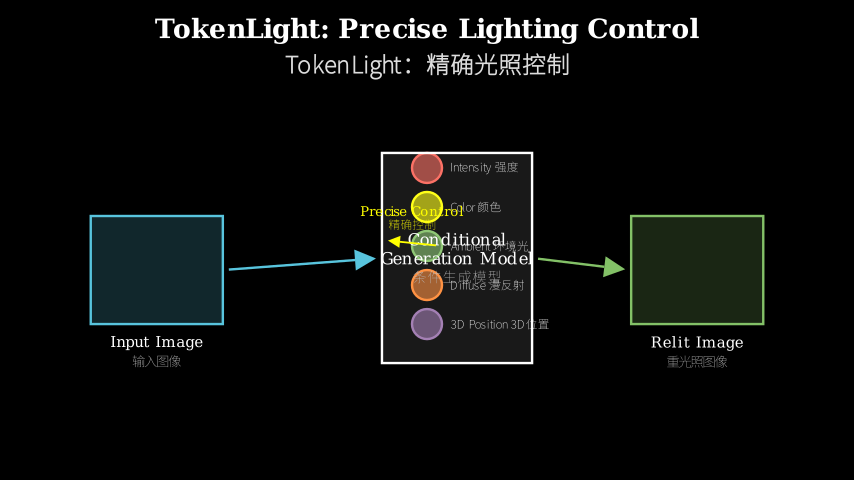
One sentence: Before this paper, you could relight images but not independently control multiple lighting attributes; after, you have a “mixing board” where each lighting factor (intensity, color, 3D position, diffuse level, ambient) gets its own continuous control knob.
Core Mechanism
The method treats relighting as conditional image generation using a latent diffusion model. Instead of conditioning on a single monolithic “lighting descriptor,” it introduces attribute tokens — discrete embeddings for intensity, color, 3D light position, diffuse level, and ambient illumination. Each token is learned during training and acts as a control handle.
Training happens on a large synthetic dataset (500K images) where ground-truth lighting parameters are known, supplemented by 5K real captures. The model learns to map combinations of attribute tokens to their visual effects. Crucially, tokens are designed to be orthogonal: changing the intensity token shouldn’t require relearning how color affects the scene.
At inference, you select tokens for each attribute (e.g., intensity=0.8, color=warm, position=top-left) and feed them to the diffusion model. The model generates the relit image. Because tokens are discrete but interpolatable, you get continuous control — you can smoothly transition between “intensity=0.5” and “intensity=0.9” by interpolating their token embeddings.
Input Image --> [Encoder] --> Latent z
                                |
Attribute Tokens:               v
[Intensity] [Color] [Position] [Diffuse] [Ambient]
     |         |         |         |         |
     +----+----+----+----+----+----+----+----+
          |
          v
    [Cross-Attention Layers in Diffusion UNet]
          |
          v
    Denoising Process (T steps)
          |
          v
    [Decoder] --> Relit Image
Think of it like a mixing board in a recording studio. Each track (attribute) has its own fader. The intensity fader controls volume, the color fader controls EQ, the position fader controls stereo panning. You can push one fader without touching others. The mixing board (diffusion model) knows how to blend these independent signals into a coherent output (relit image). The magic: the board learned the “physics” of how light behaves — occlusion, shadows, material interaction — just by seeing enough examples, without anyone explicitly teaching it ray tracing.
Key Concepts
-
Attribute Tokens: Instead of encoding lighting as a continuous vector (like [0.7, 0.3, 0.5, …] where dimensions are entangled), the method uses discrete learned embeddings. Imagine a vocabulary where each “word” represents a specific lighting state: “intensity_high,” “color_warm,” “position_top_left.” During training, the model learns these words and their visual meanings. At test time, you compose a “sentence” by picking words (tokens) for each attribute. The key insight: discrete tokens are easier to disentangle than continuous vectors because they force the model to learn distinct, non-overlapping representations. It’s like having separate LEGO bricks (tokens) instead of a blob of clay (continuous vector) — you can swap one brick without reshaping the whole structure.
-
Emergent Geometry Understanding: The model is never explicitly told “this pixel is occluded” or “this surface is glossy.” Yet it learns to cast shadows correctly, handle occlusion when lights move behind objects, and even relight transparent materials plausibly. How? The synthetic training data provides enough examples of light-geometry interactions that the diffusion model internalizes these patterns. It’s like learning grammar by reading thousands of sentences without studying grammar rules — the structure emerges from exposure. This is remarkable because traditional relighting requires explicit 3D reconstruction; here, the model builds an implicit understanding purely from 2D supervision.
-
Continuous Control via Discrete Tokens: Sounds contradictory, right? Tokens are discrete (you have “intensity_0.5” and “intensity_0.6” as separate tokens), but their embeddings live in a continuous space. So you can interpolate: take 70% of the “intensity_0.5” embedding and 30% of “intensity_0.6” to get “intensity_0.53.” This gives you smooth, continuous control while maintaining the disentanglement benefits of discrete representations. It’s like having preset radio stations (discrete) but being able to fine-tune between them (continuous).
Framework Shift
Before (mainstream approach):        After (this paper):

Input Image                          Input Image
     |                                    |
     v                                    v
[Inverse Rendering]                 [Encoder]
     |                                    |
Geometry + Materials                 Latent z
     |                                    |
     v                                    v
[Forward Rendering]              [Attribute Tokens]
with new lighting                 (independent controls)
     |                                    |
     v                              [Diffusion Model]
Relit Image                         (learned physics)
                                         |
Explicit 3D pipeline                     v
Brittle, slow                       Relit Image

                                    Implicit understanding
                                    Fast, robust
One sentence: From explicit 3D reconstruction followed by forward rendering, to learned implicit lighting manipulation where attribute tokens act as independent control knobs in a diffusion model that has internalized light-geometry interactions.
Expert Assessment
Problem choice: Real gap. Existing relighting methods either require expensive 3D reconstruction or provide only coarse control. The demand for fine-grained, independent lighting control in image editing is genuine — photographers and VFX artists need this. The paper sits at the intersection of two trends: diffusion models for image generation and disentangled representations for controllable synthesis.
Method maturity: Clever insight with solid execution. The attribute token idea is elegant — it sidesteps the entanglement problem by design rather than brute force. However, the reliance on synthetic data (500K images) raises questions about generalization. The 5K real captures help, but it’s a band-aid. A simpler approach might be to use existing inverse rendering for synthetic data generation but skip it at inference — which is essentially what they do, but they don’t explore whether cheaper synthetic data (fewer scenes, simpler geometry) would suffice.
Experimental integrity: Baselines are fair (prior diffusion-based relighting, traditional inverse rendering). Quantitative metrics (PSNR, LPIPS, SSIM) are standard. The qualitative results are impressive — lights inside objects, transparent materials — but these are cherry-picked examples. The paper lacks failure case analysis. What happens when you push tokens to extreme combinations not seen in training? The user study (preference test) is small (20 participants) but adequate for this type of work.
Writing quality: The paper is well-structured, but the method section is dense. The attribute token design (how many tokens per attribute? how are they initialized?) is buried in supplementary material. The “emergent geometry understanding” claim is bold but under-explained — a dedicated ablation showing what the model learns about occlusion/materials would strengthen this. The related work section is thorough but could be trimmed.
Verdict: Weak accept — the core idea (attribute tokens for disentangled lighting control) is novel and the results are strong, but the reliance on large-scale synthetic data and lack of failure analysis prevent this from being a strong accept. It’s a solid contribution that advances the field but leaves room for follow-up work on data efficiency and robustness.
Takeaways
Discrete tokens for continuous control: The trick of using discrete embeddings (tokens) but interpolating them for continuous control is transferable. If you’re building any controllable generation system (audio, video, 3D), consider tokenizing your control attributes instead of using continuous vectors. It forces disentanglement and makes interpolation more interpretable.
Synthetic data + small real data: The 500K synthetic + 5K real recipe is a practical pattern. Generate cheap synthetic data with ground-truth labels, then fine-tune on a small real dataset to bridge the sim-to-real gap. This is especially useful when real data is expensive (e.g., multi-view captures, motion capture).
Emergent understanding from supervision: The model learns geometry and material interactions without explicit supervision — just from seeing enough examples. This suggests that for tasks where explicit modeling is hard (physics simulation, occlusion reasoning), a large dataset with implicit structure might be enough for a neural network to internalize the rules. The key: your training data must cover the diversity of interactions you want the model to handle.
Cross-attention for control: Using cross-attention to inject control signals (attribute tokens) into a diffusion model is now standard, but this paper shows how to structure those controls for independence. If you’re building a conditional diffusion model, think carefully about how your conditioning vectors are organized — entangled vectors lead to entangled outputs.
论文: 2604.15310 作者: Sumit Chaturvedi, Yannick Hold-Geoffroy, Mengwei Ren, Jingyuan Liu, He Zhang, Yiqun Mei, Julie Dorsey, Zhixin Shu 分类: cs.CV, cs.GR
缺口
现有的图像重光照方法分为两派。
传统的逆向渲染方法(如使用神经辐射场的方法)需要显式的3D重建和材质分解——成本高、脆弱,在复杂真实场景中常常失败。
近期的学习方法(扩散模型、GAN)可以重光照图像,但只能提供粗粒度控制:你可以说”调亮一点”或”改变光源方向”,但你无法在保持颜色不变的情况下独立调整强度,或者在保持其他属性不变的情况下沿连续3D路径移动光源。
核心问题:光照是纠缠的。
当你改变一个方面(比如光源位置)时,现有方法会无意中改变其他方面(强度、颜色、阴影)。
没有一个”调音台”让每个光照属性都有自己的推子。
问题:图像重光照中的纠缠光照控制
   |
   v
假设:光照可以分解为独立属性,
      这些属性可以分别控制
   |
   v
方法:将每个属性(强度、颜色、位置等)
      编码为条件扩散模型中的离散标记
   |
   v
证据:定量指标(PSNR、LPIPS)+ 定性结果
      展示独立控制 + 无显式监督下对
      几何/遮挡的涌现理解
   |
   v
结论:标记化属性实现精确、解耦的
      光照控制,同时保持真实感
增量
一句话:这篇论文之前,你可以重光照图像但无法独立控制多个光照属性;之后,你有了一个”调音台”,每个光照因素(强度、颜色、3D位置、漫反射级别、环境光)都有自己的连续控制旋钮。
核心机制
该方法将重光照视为使用潜在扩散模型的条件图像生成。
它不是用单一的整体”光照描述符”作为条件,而是引入属性标记——强度、颜色、3D光源位置、漫反射级别和环境光的离散嵌入。
每个标记在训练期间学习,充当控制手柄。
训练在大规模合成数据集(50万张图像)上进行,其中已知真实光照参数,并辅以5000张真实捕获图像。
模型学习将属性标记的组合映射到它们的视觉效果。
关键是,标记被设计为正交的:改变强度标记不应该需要重新学习颜色如何影响场景。
在推理时,你为每个属性选择标记(例如,强度=0.8,颜色=暖色,位置=左上),并将它们输入扩散模型。
模型生成重光照图像。
因为标记是离散的但可插值的,你获得了连续控制——你可以通过插值标记嵌入在”强度=0.5”和”强度=0.9”之间平滑过渡。
输入图像 --> [编码器] --> 潜在 z
                            |
属性标记:                   v
[强度] [颜色] [位置] [漫反射] [环境光]
  |      |      |       |        |
  +------+------+-------+--------+
         |
         v
   [扩散 UNet 中的交叉注意力层]
         |
         v
   去噪过程(T 步)
         |
         v
   [解码器] --> 重光照图像
把它想象成录音室里的调音台。
每个轨道(属性)都有自己的推子。
强度推子控制音量,颜色推子控制均衡器,位置推子控制立体声声像。
你可以推动一个推子而不触碰其他推子。
调音台(扩散模型)知道如何将这些独立信号混合成连贯的输出(重光照图像)。
神奇之处:调音台学会了光如何表现的”物理学”——遮挡、阴影、材质交互——仅仅通过看到足够多的例子,没有人明确教它光线追踪。
关键概念
- 属性标记:该方法不是将光照编码为连续向量(如 [0.7, 0.3, 0.5, …] 其中维度是纠缠的),而是使用离散的学习嵌入。
想象一个词汇表,其中每个”单词”代表特定的光照状态:“intensity_high”、“color_warm”、“position_top_left”。
在训练期间,模型学习这些单词及其视觉含义。
在测试时,你通过为每个属性选择单词(标记)来组成一个”句子”。
关键洞察:离散标记比连续向量更容易解耦,因为它们迫使模型学习不同的、不重叠的表示。
这就像有单独的乐高积木(标记)而不是一团粘土(连续向量)——你可以交换一块积木而不重塑整个结构。
- 涌现的几何理解:模型从未被明确告知”这个像素被遮挡”或”这个表面是光滑的”。
然而它学会了正确投射阴影,在光源移动到物体后面时处理遮挡,甚至合理地重光照透明材质。
如何做到的?合成训练数据提供了足够多的光-几何交互示例,扩散模型内化了这些模式。
这就像通过阅读数千个句子学习语法而不学习语法规则——结构从接触中涌现。
这很了不起,因为传统重光照需要显式3D重建;这里,模型纯粹从2D监督构建隐式理解。
- 通过离散标记实现连续控制:听起来矛盾,对吧?标记是离散的(你有”intensity_0.5”和”intensity_0.6”作为单独的标记),但它们的嵌入存在于连续空间中。
所以你可以插值:取”intensity_0.5”嵌入的70%和”intensity_0.6”的30%来获得”intensity_0.53”。
这为你提供了平滑的连续控制,同时保持离散表示的解耦优势。
这就像有预设的广播电台(离散)但能够在它们之间微调(连续)。
框架转变
之前(主流方法):              之后(本文方法):

输入图像                        输入图像
   |                               |
   v                               v
[逆向渲染]                      [编码器]
   |                               |
几何 + 材质                      潜在 z
   |                               |
   v                               v
[正向渲染]                   [属性标记]
使用新光照                    (独立控制)
   |                               |
   v                          [扩散模型]
重光照图像                    (学习的物理)
                                   |
显式3D管线                         v
脆弱、慢                      重光照图像

                              隐式理解
                              快速、鲁棒
一句话:从显式3D重建后进行正向渲染,到学习的隐式光照操作,其中属性标记充当扩散模型中的独立控制旋钮,该模型已内化光-几何交互。
专家评审
选题眼光:真实缺口。
现有重光照方法要么需要昂贵的3D重建,要么只提供粗粒度控制。
图像编辑中对细粒度、独立光照控制的需求是真实的——摄影师和视效艺术家需要这个。
该论文位于两个趋势的交叉点:用于图像生成的扩散模型和用于可控合成的解耦表示。
方法成熟度:巧妙的洞察加上扎实的执行。
属性标记的想法很优雅——它通过设计而非蛮力回避了纠缠问题。
然而,对合成数据(50万张图像)的依赖引发了关于泛化的问题。
5000张真实捕获有帮助,但这是创可贴。
一个更简单的方法可能是使用现有的逆向渲染来生成合成数据,但在推理时跳过它——这本质上就是他们所做的,但他们没有探索更便宜的合成数据(更少的场景、更简单的几何)是否足够。
实验诚意:基线公平(先前的基于扩散的重光照、传统逆向渲染)。
定量指标(PSNR、LPIPS、SSIM)是标准的。
定性结果令人印象深刻——物体内部的光源、透明材质——但这些是精心挑选的例子。
论文缺乏失败案例分析。
当你将标记推到训练中未见过的极端组合时会发生什么?用户研究(偏好测试)很小(20名参与者),但对于这类工作来说足够了。
写作功力:论文结构良好,但方法部分很密集。
属性标记设计(每个属性有多少标记?它们如何初始化?)被埋在补充材料中。
“涌现几何理解”的说法很大胆但解释不足——一个专门的消融实验展示模型学到了关于遮挡/材质的什么会加强这一点。
相关工作部分很全面,但可以精简。
判决:弱接收——核心思想(用于解耦光照控制的属性标记)是新颖的,结果很强,但对大规模合成数据的依赖和缺乏失败分析阻止了这成为强接收。
这是一个推动该领域发展的扎实贡献,但在数据效率和鲁棒性方面留下了后续工作的空间。
要点总结
用于连续控制的离散标记:使用离散嵌入(标记)但插值它们以实现连续控制的技巧是可迁移的。
如果你正在构建任何可控生成系统(音频、视频、3D),考虑标记化你的控制属性而不是使用连续向量。
它强制解耦并使插值更可解释。
合成数据 + 少量真实数据:50万合成 + 5000真实的配方是一个实用模式。
生成带有真实标签的廉价合成数据,然后在小型真实数据集上微调以弥合模拟到真实的差距。
这在真实数据昂贵时特别有用(例如,多视图捕获、动作捕获)。
从监督中涌现的理解:模型在没有显式监督的情况下学习几何和材质交互——仅仅通过看到足够多的例子。
这表明,对于显式建模困难的任务(物理模拟、遮挡推理),具有隐式结构的大型数据集可能足以让神经网络内化规则。
关键:你的训练数据必须涵盖你希望模型处理的交互的多样性。
用于控制的交叉注意力:使用交叉注意力将控制信号(属性标记)注入扩散模型现在是标准做法,但本文展示了如何构建这些控制以实现独立性。
如果你正在构建条件扩散模型,仔细考虑你的条件向量是如何组织的——纠缠的向量导致纠缠的输出。