Paper: 2611.34848 — Put the World Back: Timestamps Matter in Time Series Reasoning
Authors: Tingrui Huang, Yuanyuan Deng, Qingren Yao, Joaquin Vanschoren, Mykola Pechenizkiy, Songgaojun Deng
Categories: cs.LG
Reading scope: Original arXiv v1 HTML, completely extracted to 72,319 characters. Main sections 1–4 and Appendices A, B, D and E were read, together with Appendix C’s overview, method definitions, label-agreement checks, diagnostic audit and representative traces. The long labeller prompt templates in C.2 and C.4 were not reviewed in full. Selected original table cells were checked; Figures 1 and 4 were visually inspected. Code, raw datasets and external references were not independently audited; experiments were not reproduced.
The Problem
A basketball question asks which event belongs in a gap in the game record. At the marked row, Team A’s score goes from 2 to 5, while Team B stays at 4. Of the four options, only D describes a three-point basket by Team A. The paper’s illustrated question gives D as the correct answer (Figure 4).
The table has already marked where the event belongs. Removing the game clock leaves that marker and the two score rows available. The question can still be answered through the point change.
That is reasonable problem solving. But if it earns a high score on a time-series reasoning benchmark, what has the score established about the model’s use of time?
The authors study this ambiguity by changing timestamp fields in two existing tasks and inspecting answers and emitted reasoning. Their contribution combines a view of timestamps as a shared index between events and observations, a diagnostic checklist, and an empirical analysis of which temporal requirements the questions actually exercise (§§1–3).
The Explanation
A score and an event are partial records of the same world
A basketball game contains players, possessions, shots and rebounds. A scoreboard preserves one small part: the points at each moment. A play-by-play description preserves another part. Matching them requires knowing which event and which numerical observation refer to the same moment.
The paper calls this a world-to-series projection. Numerical observations and textual records each leave information out; timestamps provide a common index for connecting them (§2.1; Figure 1).
The authors distinguish three roles for that index. Timing concerns order, spacing and simultaneous events: knowing which happened first does not tell a one-hour gap from a one-week gap. Time semantics concerns the meaning of a game clock or calendar date, including relevant world knowledge. Alignment concerns which event belongs with which observation.
These are conditions for coherent temporal reasoning. They do not identify a causal mechanism by themselves. The study explicitly makes no claim of causal identification (Appendix E).
Change the fields while keeping the question fixed
The study uses 310 questions from two TSRBench tasks: 150 NBA questions and 160 GDELT questions. These questions are evaluated across models and conditions; 310 is the question count, not the total number of model outputs (§3; Appendix B.1).
NBA asks for a missing event from four candidates. It supplies ordered surrounding plays and a table of team scores and win probabilities, with the missing row marked. GDELT asks for the correct order of six to eight news summaries from four options. It supplies a numerical series and candidate event times, but withholds the matching between stories and times.
For each question, the events, numerical values, question, options and gold answer stay fixed. Four input conditions vary the timestamp information (Appendix B.2):
- Full supplies the original game clock or calendar timestamps.
- Relative expresses NBA times as exact seconds from the target and GDELT times as hours from the first series record. It retains order, spacing and correspondence, while removing the original game-clock or calendar identity.
- No-TS removes the timestamp fields. NBA still has event order, the past/future split and the target marker. GDELT keeps the news text and replaces series timestamps with row positions, while removing the event-time list.
- Shuffled disrupts event–series correspondence. NBA gives each event another event’s time and re-sorts the event list; its numerical table stays unchanged. GDELT supplies mismatched real timestamps from the series while keeping the series unchanged.
Relative still contains temporal information. No-TS also leaves contextual cues available. These interventions test different information dependencies.
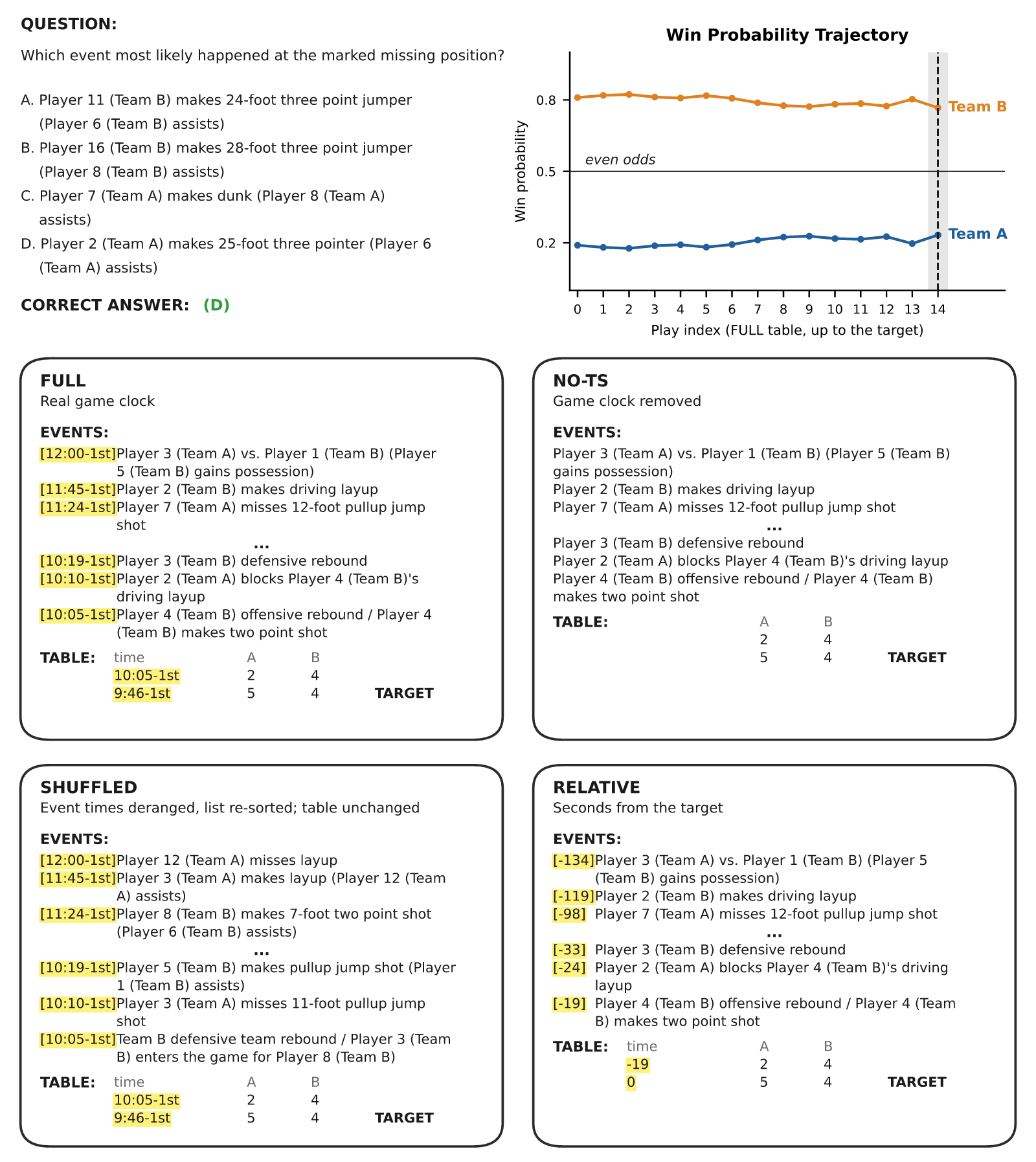
Original Figure 4, rasterized from its supplied SVG on white. This is the paper’s input illustration, with correct option D shown. It illustrates retained markers, relative offsets and reassigned event clocks; it is not a report of a model’s answer to this individual question.
The same model faces two different requirements
For GLM-5.3-Flash, the reported accuracies are:
| Timestamp condition | NBA: 150 questions | GDELT: 160 questions |
|---|---|---|
| Full | 97.3% | 51.9% |
| Relative | 98.7% | 40.0% |
| No-TS | 94.7% | 12.5% |
| Shuffled | 86.7% | 31.9% |
These are percentages converted from Tables 1 and 9. Each condition uses the same questions within its task. The two columns describe different problems, so their levels should not be read as an overall ability ranking.
On NBA, the marked row can replace clock-based alignment. In the illustrated question, the score change still points to Team A’s three-point basket after the clock is deleted. High aggregate accuracy therefore need not show that the model recovered the event’s time.
The authors’ labeller assigns 61–66% of GLM’s NBA runs to reading the score or win-probability change at the marked row, and 21–25% to basketball knowledge that rules out options. These are labels for the decisive method in emitted reasoning, not direct measurements of internal computation (§3.1; Appendix C.3).
The pattern extends to the three models with higher NBA baseline accuracy, but not uniformly to every model. Qwen3.5-9B falls from 68.0% to 51.3% under No-TS, compared with 59.3% under Shuffled. Its larger cost from deleting the clock is an important exception (Table 1).
The small numerical gain for GLM under Relative is within Full’s reported bootstrap interval. It does not establish that replacing clocks with offsets improves general temporal reasoning.
Dates become more useful when event order is withheld
GDELT’s numerical values use a GoldStein scale: each record receives a conflict–cooperation value from −10 to +10. To choose an event order, the model needs to connect the supplied stories with the time-indexed records (§3.2; Appendix B.1).
Here a marked gap does not supply the correspondence. GLM’s drop from 51.9% to 12.5% when timestamp fields are removed shows that this model depends much more on them in this task.
Replacing dates with offsets preserves the numerical shape and spacing, yet reduces accuracy to 40.0%. Appendix D reports a paired cost of 11.9 percentage points, with a 95% bootstrap interval of 2.5–21.2 points. The authors interpret this pattern as evidence that calendar cues matter beyond relative spacing in this setting.
The labelled traces suggest what that something can be. A method called Date → slot recalls when a story happened and places it on an offered time. Its reported share falls from 46% to 16% under Relative. Value tone, which matches a story’s cooperative or conflictual tone to the numerical values, rises from 29% to 57% (§3.2; Appendix C.5). These shares concern analyzed GLM reasoning records, not answer accuracy.
This is a different use of time from the basketball case. Dates can act as cues to remembered world events, while the score marker had already located the relevant basketball observation.
Using dates and checking their correspondence are separate
Under Shuffled, GLM’s GDELT accuracy is 31.9%, a reported paired loss of 20.0 points from Full, with a 95% interval of 11.3–28.7 points (Appendix D).
In a separate condition-blind annotation pass, 36% of its Shuffled traces flag that the times do not fit, compared with 11% under Full. Many records continue applying date-based or tone-based methods to mismatched inputs (§3.2; Appendices C.1 and C.7).
The result does not show that the model never uses dates. It shows that date use and checking event–series consistency can come apart.
The models also differ. Sonnet-5 retains 43.1% GDELT accuracy under No-TS, compared with 65.6% under Full. The authors suggest remembered event chronology may help, but their trajectory analysis covers GLM only. No-TS leaves news wording unchanged, so date phrases inside a summary can remain too. A timestamp-free field format is not the removal of every possible temporal cue (Table 9; Appendices C.5 and E).
An additional Qwen model is near chance on GDELT, and the authors do not interpret its timestamp contrasts as evidence of a particular strategy (Appendix D).
Ask whether the benchmark made a time check necessary
The authors organize these questions into the Temporal Causal Diagnostic Protocol, or TCDP. It groups binary checks by timing, time semantics and alignment. For each rule it asks whether the task requires the rule, and, when it does, whether the observable reasoning follows it (§2.2).
It is a checklist of necessary conditions, not a combined score for temporal intelligence. The audit finds that these two tasks exercise only three of ten checks; other checks are unneeded or unmeasured. Neither task requires lag reasoning, so the study cannot establish how well models reason about elapsed time (Appendix C.7; Table 6).
For the basketball example, the marked row has already supplied the place to look. The diagnostic records that help from the benchmark instead of treating a correct answer as evidence that every temporal requirement was met.
Core Concepts
A timestamp is a shared index between partial records. The score and the account of a shot describe different parts of a game. A common time can connect them, while leaving the causal explanation to establish separately.
Pre-alignment is work the dataset has already done. A marked row or a supplied chronological sequence can solve part of the correspondence problem. Using it may be entirely reasonable for the question, but it changes what a high score demonstrates.
A correct answer tests only the requirements the question exercised. Relative offsets preserve timing information; omitted fields can leave ordering cues; familiar news can invite memory-based answers. A diagnostic has to track those remaining routes and distinguish an untested rule from a failed rule.
These distinctions explain why timestamp dependence varies across the two tasks.
The Insight
Credit an accurate answer for the problem it actually solved. In the NBA example, the dataset points at the score change, so correct gap filling offers limited evidence of clock-based alignment.
GDELT provides the complementary finding: calendar timestamps can improve answers when chronology is withheld, while models still miss inconsistent associations. A useful evaluation checks both whether a time cue was necessary and whether its connection to the observations was validated.
A Critical Reading
The input interventions give the strongest evidence here. They keep question content and gold answers fixed, but the NBA Shuffled condition also reorders the event list after clocks are reassigned. Its effect concerns supplied correspondence and ordering together. It does not isolate attention to a clock token with every other cue held fixed (Appendix B.2).
Reported accuracy includes response availability. A valid option matching the gold answer is required; missing answers and token-limit failures count as wrong. Table 9 also retains eight original GDELT API failures, two under Full and six under No-TS, even though they were later rerun after labelling. The low No-TS score therefore includes nonanswers and service failures, as well as incorrect choices (Appendices B.3 and C.1).
The reported accuracy uses one original attempt per question, condition and model. The bootstrap intervals quantify uncertainty over these questions, not repeated-generation variation or every possible task design. The experiment measures information dependence under changed inputs; removing essential information can also make a question harder to determine, rather than expose a failure on a fully specified task.
Trace labels provide supporting evidence with limits. Two LLM labellers agree on 30 of 40 sampled NBA final-method labels, with Cohen’s kappa 0.61, and on 30 of 36 sampled GDELT timestamp-conflict labels, with kappa 0.47. The main GDELT method labeller sees the condition; the conflict check is labelled again without it. These are model annotations of emitted reasoning, and the authors explicitly caution that such text may not reflect internal processes. Some labels cannot be exactly regenerated because an original labeller model became unavailable (Appendices C.1, C.6 and E).
Scope remains narrow: two tasks, limited model families, and no causal-identification validation. Familiar news dates may also behave differently for events after a model’s training cutoff. The results support diagnosing which timestamp roles a benchmark tests; they do not establish general forecasting, causal reasoning or real-world synchronization ability (Appendix E).
What You Can Use
Return to the marked basketball row. If the intended task is gap filling with that context supplied, the marker is useful information. Assessing whether a model can recover alignment is a separate problem and needs questions where the correspondence is not already handed over.
For that goal, provide recoverable but independently obtained event and observation records, test whether contradictory times are noticed, and require time intervals when the answer depends on them. Track which work the input has done before the model begins. A benchmark score then has a clearer interpretation about the temporal capability it actually exercised.
论文: 2611.34848 — Put the World Back: Timestamps Matter in Time Series Reasoning
作者: Tingrui Huang, Yuanyuan Deng, Qingren Yao, Joaquin Vanschoren, Mykola Pechenizkiy, Songgaojun Deng
分类: cs.LG
阅读范围: 原始arXiv v1 HTML完整提取72,319字符。
阅读正文第1–4节、附录A、B、D、E,以及附录C中的概述、方法定义、标签一致性、诊断审计和代表性推理记录;C.2、C.4的长标注提示模板未完整审阅。
核对选定原始表格单元格,目视检查图1、图4。
未独立审计代码、原始数据集和外部参考资料,未复现实验。
问题
一道篮球题让模型补上缺失的比赛事件。 标记行里,A队从2分变成5分,B队仍是4分。 四个选项中,只有D描述A队拿到3分的进球;论文图4也给出正确答案D。
表格已经标好了事件应该落在哪一行。 删掉比赛钟,那枚标记和前后的比分还在,依然可以靠分数变化解题。
这是一种合理的解题办法。 可是,这样的正确答案在“时间序列推理”基准里拿到高分,究竟测出了模型怎样使用时间?
作者通过改动两项既有任务的时间戳字段,检查答案与模型输出的推理。 贡献包括:把时间戳看作事件与数值观测共享的索引,提出诊断清单,再实测题目究竟要求了哪些时间能力(第1–3节)。
翻译
比分和事件,各自只留下世界的一部分
一场比赛里有球员、球权、投篮和篮板。 记分牌只保留其中一个切面:每个时刻的分数;逐条比赛记录保留另一些信息。 要把两边接起来,就得知道哪条事件与哪次数值观测属于同一时刻。
论文把这种关系称为“世界到序列的投影”。 数字与文字记录都会丢掉一部分信息,时间戳则提供共同索引,把它们连回发生的时刻(第2.1节;图1)。
作者区分了三种用途。 时间关系,涉及先后、间隔和同时发生:只知道谁先谁后,还分不清一小时与一星期的间隔。 时间语义,涉及比赛钟或日历日期所指的场景,以及有关那个时刻的知识。 事件与序列对齐,涉及哪条事件应该对应哪次数值观测。
这些是时间推理保持一致所需的条件。 它们本身没有识别出因果机制,论文也明确不声称完成了因果识别(附录E)。
问题留下,只改变时间字段
研究使用TSRBench里的310道题:NBA篮球任务150题,GDELT新闻任务160题。 每道题在不同模型与条件下重复测试,310数的是题目,不是模型输出总数(第3节;附录B.1)。
NBA提供按比赛顺序排列的前后事件,以及两队比分、胜率随时间变化的表格,标出缺失行,让模型从四个候选事件里选择。 GDELT让模型从四个选项里选出六至八条新闻的正确顺序,提供数值序列和候选事件时间,但不直接给出故事与时间的配对。
每题的事件内容、数值、问题、选项与正确答案保持不变。 四种条件改变时间戳提供的信息(附录B.2):
- Full完整条件:保留原始比赛钟或日历时间。
- Relative相对时间:NBA用距离目标的精确秒差,GDELT用距离序列第一条记录的小时差;保留顺序、间隔和对应关系,去掉原来的比赛钟或日历身份。
- No-TS无时间戳字段:NBA仍保留事件顺序、过去与未来的划分及目标标记;GDELT保留新闻文字,把序列时间改成行位置,并删掉事件时间列表。
- Shuffled错配条件:NBA把其他事件的时间分给当前事件,再按新时间重排事件列表,数值表不动;GDELT提供来自序列的错配时间,序列本身不动。
相对时间仍然包含时间信息,无字段条件也还留下了上下文线索。 它们检验的是不同的信息依赖。
原论文图4,由提供的SVG转成白底图片。这是输入示例,图中给出正确选项D;它展示保留的标记、相对偏移与重分配的事件时间,并非报告某个模型对这道具体题的作答。
同一个模型,面对两种不同要求
GLM-5.3-Flash的报告正确率如下:
| 时间戳条件 | NBA:150题 | GDELT:160题 |
|---|---|---|
| Full完整 | 97.3% | 51.9% |
| Relative相对 | 98.7% | 40.0% |
| No-TS无字段 | 94.7% | 12.5% |
| Shuffled错配 | 86.7% | 31.9% |
这些百分比由表1、表9里的小数准确率换算而来,各任务的条件间使用同一批题。 两列是不同问题,不能把分数高低读成模型能力的总排名。
NBA的标记行,可以替代根据比赛钟来定位。 回到图中的题,时钟删掉后,分数变化仍指向A队的3分进球。 整体高正确率,还不能说明模型自己恢复了事件发生的时间。
作者的标注模型,把GLM篮球任务中**61–66%**的运行归为读取标记行的比分或胜率变化,**21–25%**归为用篮球知识排除选项。 这是对输出推理中决定答案的方法所作的标签,没有直接测量模型内部计算(第3.1节;附录C.3)。
NBA基线表现较高的三个模型有相近模式,但并非每个模型都一样。 Qwen3.5-9B在无字段条件下从68.0%降到51.3%,错配条件为59.3%。 对它,删时钟的代价更大,这是重要例外(表1)。
GLM在相对时间条件下的小幅数值提升,仍落在Full报告的自助抽样区间内,还不能证明把比赛钟改成偏移量会提高一般时间推理能力。
不给事件顺序,日期就更有用
GDELT的数字使用GoldStein尺度,每条记录被编码成**−10到+10**之间的冲突—合作值。 选出事件顺序,需要把提供的新闻与按时间索引的记录对应起来(第3.2节;附录B.1)。
这里没有一枚缺失行标记替模型完成配对。 去掉时间字段,GLM从51.9%降到12.5%,说明这个模型在此任务中更依赖这些字段。
把日期改成偏移,数字形状与时间间隔还在,准确率却降到40.0%。 附录D报告相对Full损失11.9个百分点,配对95%自助抽样区间为2.5–21.2个百分点。 作者把这项变化读作:这套输入中,日历线索的作用不只在于相对间隔。
标注记录提示了其中一种来源。 Date → slot日期配时点,是回忆故事发生日期,再放到给出的某个时间上;其报告占比从Full的46%降到16%。 Value tone语气配数值,是按故事偏合作还是冲突来匹配数值,占比从29%升到57%(第3.2节;附录C.5)。 这些比例属于被分析的GLM推理记录,不是答案正确率。
这与篮球题里的时间用途不同。 新闻日期可以唤起有关世界事件的记忆,篮球标记行则已经定位了相关观测。
使用日期,与检查日期对应关系,是两件事
错配条件下,GLM的GDELT正确率为31.9%。 附录D报告相对Full损失20.0个百分点,配对95%区间为11.3–28.7个百分点。
另一次不告知条件的标注里,36%的错配推理记录指出时间不合,而Full条件为11%。 许多记录继续把日期或语气匹配办法用在错配输入上(第3.2节;附录C.1、C.7)。
这说明模型会使用日期,但使用和验证事件—序列一致性可以分开。
模型之间也有差别。 Sonnet-5在无字段条件下仍有43.1%的GDELT准确率,Full为65.6%。 作者认为记住的事件顺序可能有帮助,但推理轨迹分析只覆盖GLM。 无字段条件还保留新闻原文,摘要里的日期短语也可能留下;删时间戳字段,并非删掉所有可能的时间线索(表9;附录C.5、E)。
附录中的另一个Qwen模型在GDELT上接近随机猜测,作者没有把它的时间戳对照读成某种具体策略的证据(附录D)。
先问,题目有没有迫使模型检查时间
作者把这些检查组织成时间因果诊断协议TCDP。 它按时间关系、时间语义和对齐分组,逐条问:题目需要这条规则吗?需要时,输出的推理有没有遵守?(第2.2节)
它是必要条件清单,不是一个合成的“时间智能分数”。 审计发现,两项任务只实际检验了十条检查中的三条,其他检查不需要或没有测量。 两项任务都不要求推理时间间隔,因此研究还不能确立模型处理时长的能力(附录C.7;表6)。
回到篮球题,标记行已经告诉模型往哪儿看。 诊断要把基准给予的这份帮助记下来,不能因为答案正确,就当作所有时间要求都已经满足。
核心概念
时间戳,是部分记录之间的共同索引。 比分和一次投篮的文字记录,描述比赛的不同部分。 共同时间可以把它们接起来,因果解释还需要另行建立。
预先对齐,是数据集已经做过的工作。 一枚标记或一串给好的顺序,可以解决部分对应问题。 用它解题完全可能合理,但高分能证明什么,也随之改变。
正确答案,只检验题目实际要求过的条件。 相对偏移保留时间信息,删字段可能留下顺序线索,熟悉的新闻还可能唤起记忆。 诊断需要追踪剩下的解题路线,区分没有测过一条规则,与违反一条规则。
这些区别解释了,两个任务对时间戳的依赖为什么不同。
洞见
把正确答案的功劳,记在它实际解决的问题上。 NBA示例里,数据集已经指向分数变化;补空题答对,对比赛钟对齐能力提供的证据有限。
GDELT提供了另一面:事件顺序不直接给出时,日历时间可以改善答案,模型却仍会漏掉不一致的对应关系。 有用的评测,要同时检查时间线索是否必要,以及它与观测的联系有没有被验证。
博导审稿
最有力的证据来自输入对照。 问题内容与正确答案固定,但NBA的错配条件还会在重分配比赛钟后重排事件列表。 变化涉及对应关系和列表顺序,没有单独隔离对某个时钟词的注意力(附录B.2)。
正确率也包含能不能给出答案。 只有有效选项符合标准答案才算正确,未作答和达到词元上限都算错。 表9还保留了八次原始GDELT接口失败:Full两次,无字段六次,尽管标注之后又重跑过。 因此,无字段条件的低分还包含未作答与服务失败,并非全是选错顺序(附录B.3、C.1)。
报告正确率使用每题、每个模型、每个条件的一次原始尝试。 自助抽样区间描述这批题的不确定性,没有涵盖重复生成波动与所有任务设计。 实验测的是改动输入后的信息依赖;移除必要信息,也可能让问题更难确定,还不能把所有下降都读成模型在信息完整的题目上失灵。
轨迹标签提供辅助证据,也有边界。 两个语言模型标注者,在抽样的NBA最终方法标签上同意40条中的30条,Cohen’s kappa为0.61;GDELT时间冲突标签同意36条中的30条,kappa为0.47。 主要GDELT方法标注者看得到条件,冲突检查则另做不告知条件的标注。 这些是对输出推理的模型标注,作者也明确提醒,文字未必反映内部过程。 某些标签还因原标注模型不可用,不能精确重新生成(附录C.1、C.6、E)。
范围仍然有限:只有两个任务、有限模型家族,没有验证因果识别。 熟悉新闻的日期线索,在模型训练截止之后的事件上也可能改变作用。 结果支持诊断基准测了哪些时间戳用途,还不能确立一般预测、因果推理或真实世界同步能力(附录E)。
启发
回到那一行篮球比分。 如果任务本来就是带着标记补空,标记是有用的信息。 要评价模型自己恢复对齐的能力,是另一个问题,就需要对应关系还没直接交到它手里的题。
为此,可以提供能够恢复联系、但独立获得的事件与观测记录,检查矛盾时间有没有被发现;答案依赖间隔时,就让题目真的要求计算间隔。 先记清输入替模型做过哪些工作,一个基准分数对它实际测过的时间能力,才有更清楚的含义。