Paper: 2603.08182 Authors: Toms Bergmanis, Martins Kronis, Ingus Jānis Pretkalniņš, Dāvis Nicmanis, Jeļizaveta Jeļinska, Roberts Rozis, Rinalds Vīksna, Mārcis Pinnis Categories: cs.CL, cs.AI
The Gap
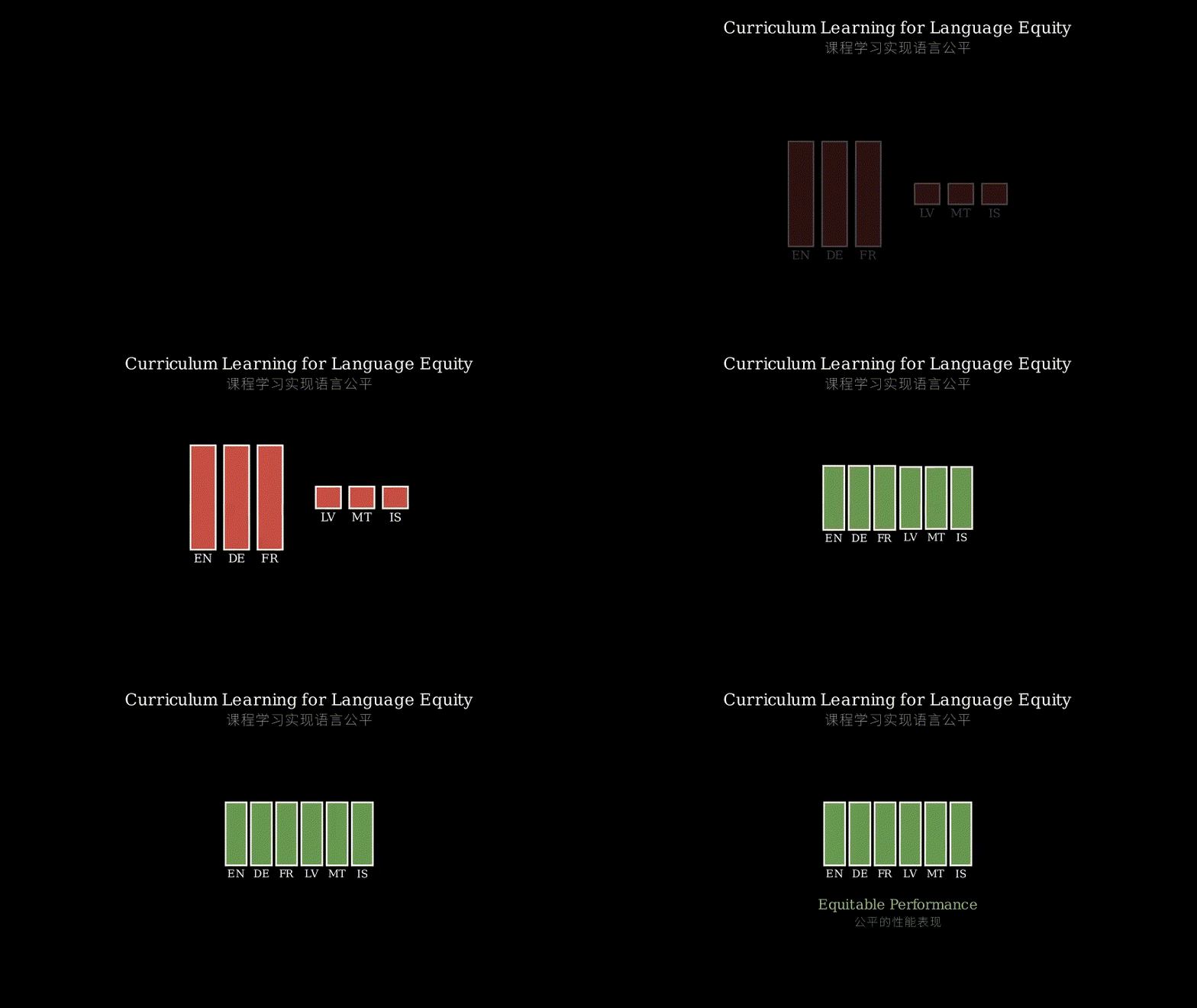
Existing multilingual LLMs like mGPT, BLOOM, and Llama follow the natural distribution of web data during training. This sounds reasonable until you realize that “natural” means English gets 90% of the attention while Estonian gets crumbs. Models like BLOOM tried upsampling low-resource languages, but they still trained on the upsampled distribution continuously — imagine force-feeding someone Estonian text for months straight. The result? Baltic and Finno-Ugric languages remain second-class citizens with error rates 10x higher than English.
The core assumption here is that data imbalance isn’t just about quantity — it’s about when and how you expose the model to different languages during training. Prior work treated this as a static mixing problem. This paper asks: what if we alternate between giving the model equal exposure to all languages and letting it see the natural web distribution?
Problem: English dominates → Low-resource languages suffer
    |
    v
Assumption: Training schedule matters as much as data volume
    |
    v
Method: Curriculum learning (alternate uniform + natural distribution)
    |
    v
Evidence: 10x error reduction in Baltic/Finno-Ugric languages
    |
    v
Conclusion: Smart scheduling beats naive upsampling
The Increment
One sentence: Before this paper, multilingual LLMs either followed natural data distributions (leaving small languages behind) or upsampled uniformly (wasting compute on redundant exposure); after, we have a training recipe that alternates between equal and natural exposure, achieving better low-resource performance without extra compute.
Core Mechanism
The method has three components working in sequence. First, dataset upsampling creates two parallel data streams: one where all 34 languages get equal representation (uniform distribution), and one that mirrors the natural web (English-heavy). Second, a curriculum scheduler alternates between these streams during training — think of it as switching between two different textbooks every few chapters. Third, the model trains on 30B parameters using standard transformer architecture, but the magic is in what it sees and when.
Here’s the data flow: raw multilingual corpora → upsample low-resource languages → split into uniform stream and natural stream → curriculum scheduler decides which stream to sample from at each training step → model updates weights → repeat for the full training run. The operations are straightforward: no architectural changes, no fancy loss functions, just controlled exposure timing.
Raw Data (34 languages, imbalanced)
    |
    v
+-------------------+
| Upsampling Engine |
+-------------------+
    |
    +---> Uniform Stream (all languages equal)
    |
    +---> Natural Stream (web distribution)
    |
    v
+-------------------+
| Curriculum        |  <-- Alternates between streams
| Scheduler         |
+-------------------+
    |
    v
+-------------------+
| 30B Transformer   |
| (standard arch)   |
+-------------------+
Think of this like training a chef who needs to master both everyday cooking and exotic cuisines. Most culinary schools (standard training) just throw you into a kitchen where 90% of orders are burgers — you get really good at burgers but panic when someone orders Georgian khachapuri. TildeOpen’s approach is like a rotation system: Week 1, you cook equal amounts of every cuisine (uniform stream) so you don’t forget the rare dishes. Week 2, you work the real kitchen with its burger-heavy orders (natural stream) so you learn what actually matters in production. Alternate these rotations, and you end up fluent in both common and rare dishes without spending extra time in school.
The uniform stream is your “don’t forget the rare stuff” rotation. The natural stream is your “learn what matters in the real world” rotation. The curriculum scheduler is the head chef deciding when to switch your station. The model’s weights are your muscle memory that improves with each rotation.
Key Concepts
-
Curriculum Learning in Language Training: Imagine teaching a kid to read. You don’t hand them Tolstoy on day one — you start with picture books, then chapter books, then novels. Curriculum learning applies this to model training: control the order and mixture of what the model sees. In this paper, it’s not about difficulty progression but *distribution progression. The model alternates between seeing all languages equally (so it doesn’t forget Estonian exists) and seeing languages as they naturally occur on the web (so it learns that English matters more in practice). The curriculum isn’t “easy to hard” — it’s “balanced to realistic” and back again, repeatedly. Concrete example: In phase 1, the model might see 100 Estonian sentences and 100 English sentences. In phase 2, it sees 10 Estonian and 1000 English. Phase 3 goes back to 100-100. This prevents catastrophic forgetting of rare languages while still teaching real-world distributions.
-
Upsampling vs. Curriculum Scheduling: Upsampling means copying rare data to match common data — if you have 1000 English sentences and 10 Estonian ones, you repeat those 10 Estonian sentences 100 times. Simple, but wasteful: the model sees the same Estonian sentences over and over. Curriculum scheduling is smarter: you create two separate data streams (one upsampled to uniform, one natural), then alternate between them during training. It’s the difference between eating the same meal 100 times versus eating it once per week for 100 weeks while varying your other meals. The model gets repeated exposure without the redundancy problem, because the *context around each exposure changes as the model evolves.
Framework Shift
Before (mainstream approach):        After (this paper):

Training Data (fixed mixture)        Training Data (two streams)
    |                                     |
    v                                     +---> Uniform
[EN EN EN EN EN ET]                      |     [EN ET LV ...]
[EN EN EN EN EN ET]                      |
[EN EN EN EN EN ET]                      +---> Natural
    |                                           [EN EN EN ET]
    v                                     |
Model sees same                           v
distribution forever                  Scheduler alternates
                                          |
                                          v
                                      Model sees both
                                      distributions cyclically
From static mixing to dynamic alternation, the core shift is treating training distribution as a time-varying curriculum rather than a fixed recipe.
Expert Assessment
Problem choice: This is a real gap, not manufactured. The linguistic equity issue in LLMs is well-documented, and existing solutions (naive upsampling, larger models) are either ineffective or expensive. The problem sits at a sweet spot: important enough to matter for millions of speakers, tractable enough to solve without inventing new architectures. It’s incremental but addresses a genuine pain point.
Method maturity: This is clever reuse of known techniques (curriculum learning, upsampling) rather than a novel algorithm. The insight is in the *combination — alternating between distributions instead of blending them once. That said, the paper doesn’t deeply explore why this works beyond “it prevents forgetting.” A more mature treatment would include ablations on alternation frequency, phase duration, and transition strategies. The approach feels like it landed on a good heuristic without fully understanding the mechanism.
Experimental integrity: Baselines are fair — they compare against BLOOM, mGPT, and other open multilingual models. The 10x error reduction claim is backed by human evaluation, which is expensive and credible. However, the paper is light on failure cases. What happens to high-resource languages? Do they suffer from the uniform phases? The benchmarks are standard (multilingual comprehension, generation), but I’d want to see more stress tests: code-switching, low-frequency words, domain transfer. The compute efficiency claim (fewer resources than competitors) is mentioned but not quantified precisely — how much fewer?
Writing quality: The abstract and intro are strong, but the method section is too high-level. The curriculum schedule details are vague — how long is each phase? What triggers the switch? The results section dumps numbers without enough analysis of *why certain languages improved more than others. If they rewrote Section 4 (Method) with concrete hyperparameters and decision rationale, the paper would jump from “interesting idea” to “reproducible recipe.”
Verdict: weak accept — Solid contribution to an important problem with credible results, but the method lacks depth and the writing could be tighter.
Takeaways
The transferable idea here is distribution alternation as a regularization technique. If you’re training on imbalanced data (which is most real-world scenarios), don’t just upsample and blend — create multiple views of your data with different balance properties, then alternate between them during training. This applies beyond languages: imagine training a medical diagnosis model where rare diseases get “uniform phases” to prevent forgetting, alternating with “natural phases” that reflect actual hospital admission rates. Or a recommendation system that alternates between showing equal exposure to niche content and popular content.
The specific technique to steal: maintain two data loaders (balanced and natural), switch between them every N steps, and track performance on rare classes separately. The curriculum doesn’t need to be sophisticated — even a simple alternation schedule can prevent the model from collapsing into “just predict the majority class.”
One warning: this only works if your rare classes have some data. If you have 5 examples of Estonian, no amount of curriculum magic will help — you’re still just memorizing those 5 examples. The method shines when you have hundreds or thousands of examples per rare class, enough to learn patterns but not enough to compete with the majority class in a naive mixture.
论文: 2603.08182 作者: Toms Bergmanis, Martins Kronis, Ingus Jānis Pretkalniņš, Dāvis Nicmanis, Jeļizaveta Jeļinska, Roberts Rozis, Rinalds Vīksna, Mārcis Pinnis 分类: cs.CL, cs.AI
缺口
现有的多语言大模型如mGPT、BLOOM、Llama在训练时遵循网络数据的自然分布。 这听起来合理,直到你意识到”自然”意味着英语占据90%的注意力而爱沙尼亚语只能捡剩饭。 BLOOM等模型尝试过上采样低资源语言,但它们仍然在上采样后的分布上持续训练——想象一下连续几个月强行灌输爱沙尼亚语文本。 结果呢?波罗的海语系和芬兰-乌戈尔语系仍然是二等公民,错误率比英语高10倍。
这里的核心假设是数据不平衡不仅关乎数量,更关乎训练期间何时以及如何让模型接触不同语言。 先前工作把这当作静态混合问题。 本文提问:如果我们在给模型平等接触所有语言和让它看到自然网络分布之间交替,会怎样?
问题: 英语主导 → 低资源语言受损
    |
    v
假设: 训练时间表和数据量同样重要
    |
    v
方法: 课程学习(交替均匀分布+自然分布)
    |
    v
证据: 波罗的海/芬兰-乌戈尔语系错误率降低10倍
    |
    v
结论: 智能调度胜过朴素上采样
增量
一句话: 这篇论文之前,多语言大模型要么遵循自然数据分布(抛弃小语种),要么均匀上采样(在冗余曝光上浪费算力);之后,我们有了在平等曝光和自然曝光之间交替的训练配方,无需额外算力就能获得更好的低资源语言性能。
核心机制
该方法有三个按顺序工作的组件。 首先,数据集上采样创建两条并行数据流:一条让所有34种语言获得平等代表性(均匀分布),一条镜像自然网络(英语为主)。 其次,课程调度器在训练期间在这些流之间交替——想象成每隔几章就切换不同教科书。 第三,模型使用标准transformer架构在300亿参数上训练,但魔法在于它看到什么以及何时看到。
数据流如下:原始多语言语料→上采样低资源语言→分割为均匀流和自然流→课程调度器决定每个训练步骤从哪个流采样→模型更新权重→重复整个训练过程。 操作很直接:没有架构改变,没有花哨的损失函数,只是控制曝光时机。
原始数据(34种语言,不平衡)
    |
    v
+-------------------+
| 上采样引擎         |
+-------------------+
    |
    +---> 均匀流(所有语言平等)
    |
    +---> 自然流(网络分布)
    |
    v
+-------------------+
| 课程调度器         |  <-- 在流之间交替
+-------------------+
    |
    v
+-------------------+
| 300亿Transformer  |
| (标准架构)         |
+-------------------+
把这想象成培训一个既要掌握日常烹饪又要精通异国料理的厨师。 大多数烹饪学校(标准训练)就是把你扔进厨房,90%的订单是汉堡——你汉堡做得很好,但有人点格鲁吉亚奶酪面包时你就慌了。 TildeOpen的方法像轮岗系统:第1周,你平等烹饪每种菜系(均匀流),这样你不会忘记稀有菜品。 第2周,你在真实厨房工作,处理汉堡为主的订单(自然流),这样你学会实际生产中什么重要。 交替这些轮岗,你最终既精通常见菜又精通稀有菜,而不用在学校多花时间。
均匀流是你的”别忘稀有菜”轮岗。 自然流是你的”学习现实世界重点”轮岗。 课程调度器是决定何时切换岗位的主厨。 模型权重是随每次轮岗改进的肌肉记忆。
关键概念
-
语言训练中的课程学习: 想象教小孩阅读。 你不会第一天就给他们托尔斯泰——你从绘本开始,然后章节书,然后小说。 课程学习把这应用到模型训练:控制模型看到内容的顺序和混合。 在本文中,这不是难度递进而是分布递进。 模型在平等看到所有语言(这样它不会忘记爱沙尼亚语存在)和看到语言在网络上的自然出现(这样它学会英语在实践中更重要)之间交替。 课程不是”从易到难”——而是”从平衡到现实”再回来,反复进行。 具体例子:第1阶段,模型可能看到100个爱沙尼亚语句子和100个英语句子。 第2阶段,它看到10个爱沙尼亚语和1000个英语。 第3阶段回到100-100。 这防止了稀有语言的灾难性遗忘,同时仍然教授真实世界分布。
-
上采样vs课程调度: 上采样意味着复制稀有数据以匹配常见数据——如果你有1000个英语句子和10个爱沙尼亚语句子,你把那10个爱沙尼亚语句子重复100次。 简单,但浪费:模型一遍又一遍看到相同的爱沙尼亚语句子。 课程调度更聪明:你创建两个独立数据流(一个上采样到均匀,一个自然),然后在训练期间在它们之间交替。 这是吃同一顿饭100次和在100周内每周吃一次同时变换其他餐食的区别。 模型获得重复曝光而没有冗余问题,因为每次曝光周围的上下文随着模型演化而变化。
框架转变
之前(主流方法):                  之后(本文方法):

训练数据(固定混合)                训练数据(两条流)
    |                                 |
    v                                 +---> 均匀流
[EN EN EN EN EN ET]                  |     [EN ET LV ...]
[EN EN EN EN EN ET]                  |
[EN EN EN EN EN ET]                  +---> 自然流
    |                                       [EN EN EN ET]
    v                                 |
模型永远看到                           v
相同分布                           调度器交替
                                      |
                                      v
                                  模型循环看到
                                  两种分布
从静态混合到动态交替,核心转变是把训练分布当作时变课程而非固定配方。
专家评审
选题眼光: 这是真缺口,不是人造的。 大模型中的语言公平问题有充分记录,现有解决方案(朴素上采样、更大模型)要么无效要么昂贵。 问题处于甜蜜点:对数百万使用者足够重要,又足够可行无需发明新架构。 这是渐进式的但解决了真实痛点。
方法成熟度: 这是已知技术(课程学习、上采样)的巧妙重用而非新算法。 洞见在于组合——在分布之间交替而非一次性混合。 话虽如此,论文没有深入探索为什么这有效,只说”防止遗忘”。 更成熟的处理会包括交替频率、阶段持续时间、过渡策略的消融实验。 这方法感觉像是找到了好启发式但没完全理解机制。
实验诚意: 基线公平——他们与BLOOM、mGPT等开放多语言模型比较。 10倍错误率降低的声明有人工评估支持,这既昂贵又可信。 然而,论文对失败案例着墨不多。 高资源语言会怎样?它们会因均匀阶段受损吗?基准是标准的(多语言理解、生成),但我想看更多压力测试:代码切换、低频词、领域迁移。 算力效率声明(比竞争对手更少资源)被提及但没有精确量化——少多少?
写作功力: 摘要和引言很强,但方法部分太高层。 课程时间表细节模糊——每个阶段多长?什么触发切换?结果部分倾倒数字而没有足够分析为什么某些语言改进更多。 如果他们用具体超参数和决策理由重写第4节(方法),论文会从”有趣想法”跃升到”可复现配方”。
判决: 弱接收——对重要问题的扎实贡献,结果可信,但方法缺乏深度,写作可以更紧凑。
要点总结
这里可迁移的想法是分布交替作为正则化技术。 如果你在不平衡数据上训练(这是大多数真实场景),不要只是上采样和混合——创建具有不同平衡属性的数据多视图,然后在训练期间在它们之间交替。 这超越语言:想象训练医疗诊断模型,稀有疾病获得”均匀阶段”以防遗忘,与反映实际住院率的”自然阶段”交替。 或推荐系统在展示小众内容平等曝光和流行内容之间交替。
可偷的具体技术:维护两个数据加载器(平衡的和自然的),每N步在它们之间切换,并单独跟踪稀有类的性能。 课程不需要复杂——即使简单的交替时间表也能防止模型坍缩为”只预测多数类”。
一个警告:这只在你的稀有类有一些数据时有效。 如果你只有5个爱沙尼亚语例子,再多课程魔法也没用——你仍然只是记住那5个例子。 该方法在每个稀有类有数百或数千例子时发光,足以学习模式但不足以在朴素混合中与多数类竞争。