
Paper: 2603.22281 Authors: Haichao Zhang, Yijiang Li, Shwai He, Tushar Nagarajan, Mingfei Chen, Jianglin Lu, Ang Li, Yun Fu Categories: cs.CV, cs.AI, cs.CL, cs.LG, cs.RO
The Gap
Latent world models like V-JEPA2 predict future states by processing dense video frames, but their short observation windows trap them in local pattern matching—they see the hand moving but miss the goal of “opening the jar.” Vision-language models (VLMs) understand high-level semantics by reasoning over sparse frames, but can’t serve as dense predictors: they sample too sparsely (compute constraints), compress spatial details into text (language bottleneck), and struggle with small action-conditioned datasets (data regime mismatch). Neither approach alone captures both fine-grained dynamics and long-horizon intent.
Problem: Dense prediction vs semantic understanding trade-off
   |
   v
Assumption: Both signals are complementary, not competing
   |
   v
Method: Dual-pathway architecture (dense JEPA + sparse VLM thinker)
   |
   v
Evidence: Outperforms VLM-only and JEPA-only on hand manipulation
   |
   v
Conclusion: Hierarchical fusion enables robust long-horizon rollout
The Increment
One sentence: Before—choose between dense dynamics or semantic grounding; after—get both through parallel pathways with hierarchical fusion.
Core Mechanism
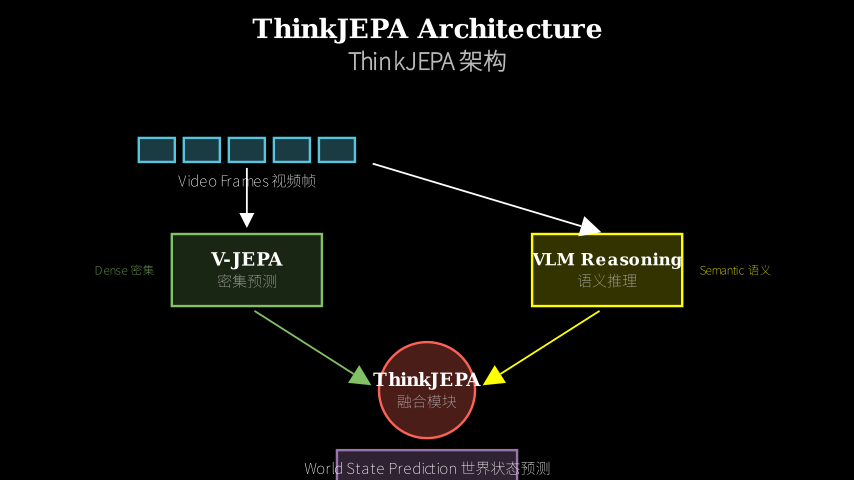
The architecture splits temporal processing into two streams. The dense JEPA branch processes consecutive frames at high frequency, learning local motion patterns and interaction cues through self-supervised prediction. Simultaneously, the VLM thinker branch samples frames with larger temporal strides, applying its pre-trained reasoning to extract semantic guidance about goals and object relationships.
The challenge is making these incompatible representations talk to each other. VLMs output high-dimensional features tuned for language tasks, while JEPA operates in a compact latent space optimized for pixel-level prediction. The hierarchical pyramid extraction module solves this by pulling features from multiple VLM layers, aggregating them into guidance signals that match JEPA’s latent dimensionality and semantic granularity.
During training, the JEPA predictor receives both its own historical latent states and the VLM’s guidance features. The VLM pathway remains frozen (preserving pre-trained knowledge), while the JEPA branch and fusion module learn to weight and integrate semantic cues into trajectory prediction. At inference, this dual-pathway design enables long-horizon rollouts that maintain both physical plausibility (from dense dynamics) and goal-directedness (from semantic reasoning).
Input Video Frames
   |
   +---> Dense Sampling -----> JEPA Encoder -----> Latent States
   |                                |                    |
   |                                v                    v
   +---> Sparse Sampling ----> VLM Thinker -----> Pyramid Extract
                                (frozen)              |
                                                      v
                                              Guidance Features
                                                      |
                                                      v
                                    JEPA Predictor <--+
                                         |
                                         v
                                  Future Latents
Think of it like a rally car team: the driver (JEPA) handles moment-to-moment steering, feeling every bump and curve through dense sensory feedback. The co-driver (VLM) reads the pace notes, calling out upcoming turns and hazards from a strategic view. The driver can’t see far ahead, and the co-driver isn’t touching the wheel—but through a shared language (hierarchical fusion), the co-driver’s high-level route knowledge guides the driver’s split-second decisions. Neither could navigate the course alone: the driver would crash on blind corners, the co-driver would miss the micro-adjustments that keep the car on the road.
Key Concepts
-
JEPA-style prediction: Instead of reconstructing pixels, JEPA predicts abstract representations of future frames in a learned latent space. Imagine compressing a video into a sequence of “essence vectors” that capture motion and structure without pixel noise. The predictor learns to extrapolate these vectors forward in time, like forecasting the trajectory of a ball by understanding its momentum rather than memorizing every pixel of its surface. This makes learning more efficient because the model focuses on what changes (dynamics) rather than what stays the same (static textures).
-
Hierarchical pyramid extraction: VLMs process images through many transformer layers, each capturing different abstraction levels—early layers see edges and textures, middle layers recognize objects, deep layers understand relationships and goals. Instead of using only the final output (which is optimized for language generation), this module extracts features from multiple layers and combines them into a multi-scale representation. It’s like making a smoothie from whole fruit: you get fiber from the skin (low-level features), sweetness from the flesh (mid-level), and aroma from the oils (high-level)—blending them creates something more nutritious than juice alone.
-
Dual-temporal pathway: The system processes the same video at two different frame rates simultaneously. The dense path sees every frame (high temporal resolution, short context), while the sparse path skips frames (low temporal resolution, long context). This is like reading a book two ways at once: one eye scans every word for grammar and flow, the other skims paragraphs for plot and themes. The dense path catches micro-interactions (finger contact, object slip), the sparse path tracks macro-goals (reaching, grasping, placing). Fusing both gives you local precision with global coherence.
Framework Shift
Before (mainstream approach):        After (this paper):

Video Frames                         Video Frames
     |                                    |
     v                                    +---> Dense ---> JEPA
Single-path processing                    |                 |
(choose one):                             |                 v
                                          +---> Sparse --> VLM
  Dense JEPA:                                               |
  [====] high-res, short context                            v
                                                    Hierarchical Fusion
  OR                                                        |
                                                            v
  Sparse VLM:                                      Guided Prediction
  [=   =   =] low-res, long context

Trade-off: dynamics XOR semantics    Synthesis: dynamics AND semantics
From exclusive choice to parallel integration, the core shift is treating temporal resolution as a spectrum to sample from, not a single operating point.
Expert Assessment
Problem choice: Real gap. The tension between dense prediction and semantic understanding is fundamental in video modeling—V-JEPA’s success on reconstruction doesn’t automatically transfer to goal-directed tasks, and VLMs’ reasoning power is bottlenecked by their output modality. The hand manipulation domain is well-chosen: complex enough to need both signals, constrained enough to validate cleanly.
Method maturity: Clever architectural insight with some engineering pragmatism. Freezing the VLM is smart (avoids catastrophic forgetting on small datasets), but the hierarchical pyramid extraction feels like a necessary adapter rather than a principled design. The paper doesn’t deeply explore why certain VLM layers work better, or whether simpler fusion schemes (e.g., attention-based) could suffice. It’s a working solution, not an elegant theory.
Experimental integrity: Baselines are fair—VLM-only and JEPA-only comparisons isolate the contribution. Hand manipulation results are convincing, but the evaluation is narrow: one domain, one dataset scale. The “long-horizon rollout” claim needs stress-testing on diverse tasks. Ablations on fusion strategies and VLM layer selection would strengthen confidence. No obvious red flags, but the evidence is more “proof of concept” than “definitive validation.”
Writing quality: The abstract oversells (“empowering,” “knowledge-rich”) where precision would serve better. The method section is dense but clear. The related work could better position this against multi-modal fusion literature beyond world models. The results section would benefit from failure case analysis—when does VLM guidance hurt rather than help? Rewriting the introduction to lead with the rally car metaphor (or similar) would make the motivation land faster.
Verdict: weak accept — Solid contribution addressing a real problem with reasonable evidence, but needs broader evaluation and deeper analysis to move from “interesting idea” to “established technique.”
Takeaways
The hierarchical pyramid extraction is the transferable trick here. If you’re fusing a frozen pre-trained model (VLM, LLM, diffusion model) with a task-specific learner, don’t just grab the final layer output—mine intermediate representations and aggregate them. Different layers encode different abstractions, and your downstream task might need a blend. This applies beyond video: think multi-modal retrieval (CLIP features at multiple depths), code generation (LLM hidden states for syntax vs semantics), or robotics (vision-language grounding at multiple granularities).
The dual-temporal pathway idea generalizes to any domain with multi-scale dynamics: financial forecasting (tick-level + daily trends), climate modeling (hourly weather + seasonal patterns), or network traffic analysis (packet-level + flow-level). The key is identifying which signals need high resolution and which need long context, then designing fusion that doesn’t force a single sampling rate.
One warning: freezing the VLM preserves its knowledge but also its biases and failure modes. If your VLM hallucinates or misinterprets sparse frames, that error propagates through the guidance pathway. The paper doesn’t address this—consider adding a confidence-weighted fusion mechanism that downweights VLM guidance when uncertainty is high.
论文: 2603.22281 作者: Haichao Zhang, Yijiang Li, Shwai He, Tushar Nagarajan, Mingfei Chen, Jianglin Lu, Ang Li, Yun Fu 分类: cs.CV, cs.AI, cs.CL, cs.LG, cs.RO
缺口
像V-JEPA2这样的潜在世界模型通过处理密集视频帧来预测未来状态,但短观察窗口把它们困在局部模式匹配中——它们看到手在动,却看不到”打开罐子”这个目标。
视觉-语言模型(VLM)通过对稀疏帧推理来理解高层语义,但无法充当密集预测器:采样太稀疏(计算约束),将空间细节压缩成文本(语言瓶颈),在小规模动作条件数据集上表现挣扎(数据范式不匹配)。
两种方法单独使用都无法同时捕获细粒度动力学和长时意图。
问题:密集预测与语义理解的权衡
   |
   v
假设:两种信号互补而非竞争
   |
   v
方法:双路径架构(密集JEPA + 稀疏VLM思考器)
   |
   v
证据:在手部操作任务上超越纯VLM和纯JEPA
   |
   v
结论:层次融合实现鲁棒的长时展开
增量
一句话: 之前——在密集动力学和语义基础之间二选一;之后——通过并行路径和层次融合两者兼得。
核心机制
架构将时间处理分成两个流。
密集JEPA分支以高频率处理连续帧,通过自监督预测学习局部运动模式和交互线索。
同时,VLM思考器分支以更大的时间步长采样帧,应用其预训练的推理能力提取关于目标和物体关系的语义引导。
挑战在于让这些不兼容的表示相互对话。
VLM输出为语言任务调优的高维特征,而JEPA在为像素级预测优化的紧凑潜在空间中运作。
层次金字塔提取模块通过从多个VLM层拉取特征来解决这个问题,将它们聚合成与JEPA潜在维度和语义粒度匹配的引导信号。
训练期间,JEPA预测器同时接收自己的历史潜在状态和VLM的引导特征。
VLM路径保持冻结(保留预训练知识),而JEPA分支和融合模块学习对语义线索进行加权并整合到轨迹预测中。
推理时,这种双路径设计使长时展开既保持物理合理性(来自密集动力学)又具有目标导向性(来自语义推理)。
输入视频帧
   |
   +---> 密集采样 -----> JEPA编码器 -----> 潜在状态
   |                                |              |
   |                                v              v
   +---> 稀疏采样 ----> VLM思考器 -----> 金字塔提取
                        (冻结)              |
                                            v
                                      引导特征
                                            |
                                            v
                          JEPA预测器 <------+
                               |
                               v
                          未来潜在表示
把它想象成拉力赛车队:驾驶员(JEPA)处理每时每刻的转向,通过密集的感官反馈感受每个颠簸和弯道。
副驾驶(VLM)阅读路书,从战略视角提前报告即将到来的转弯和危险。
驾驶员看不到远处,副驾驶不碰方向盘——但通过共享语言(层次融合),副驾驶的高层路线知识引导驾驶员的瞬间决策。
两者都无法单独完成赛道:驾驶员会在盲弯撞车,副驾驶会错过保持车辆在路上的微调整。
关键概念
- JEPA式预测: JEPA不重建像素,而是在学习的潜在空间中预测未来帧的抽象表示。
想象把视频压缩成一系列”本质向量”,捕获运动和结构而不包含像素噪声。
预测器学习在时间上外推这些向量,就像通过理解球的动量来预测其轨迹,而不是记忆其表面的每个像素。
这使学习更高效,因为模型专注于变化的内容(动力学)而非保持不变的内容(静态纹理)。
- 层次金字塔提取: VLM通过许多transformer层处理图像,每层捕获不同的抽象级别——早期层看到边缘和纹理,中间层识别物体,深层理解关系和目标。
这个模块不只使用最终输出(为语言生成优化),而是从多层提取特征并组合成多尺度表示。
就像用整个水果做奶昔:从果皮获得纤维(低层特征),从果肉获得甜味(中层),从油脂获得香气(高层)——混合它们创造出比单纯果汁更营养的东西。
- 双时间路径: 系统同时以两种不同帧率处理同一视频。
密集路径看到每一帧(高时间分辨率,短上下文),稀疏路径跳过帧(低时间分辨率,长上下文)。
这就像同时用两种方式读书:一只眼睛扫描每个词的语法和流畅性,另一只眼睛略读段落的情节和主题。
密集路径捕获微交互(手指接触、物体滑动),稀疏路径跟踪宏观目标(伸手、抓取、放置)。
融合两者给你局部精度和全局连贯性。
框架转变
之前(主流方法):                  之后(本文方法):

视频帧                           视频帧
  |                                |
  v                                +---> 密集 ---> JEPA
单路径处理                          |               |
(二选一):                           |               v
                                   +---> 稀疏 --> VLM
  密集JEPA:                                         |
  [====] 高分辨率,短上下文                            v
                                            层次融合
  或                                              |
                                                  v
  稀疏VLM:                                  引导预测
  [=   =   =] 低分辨率,长上下文

权衡:动力学异或语义              综合:动力学且语义
从排他选择到并行整合,核心转变是将时间分辨率视为可采样的频谱,而非单一操作点。
专家评审
选题眼光: 真实缺口。
密集预测与语义理解之间的张力是视频建模的根本问题——V-JEPA在重建上的成功不会自动迁移到目标导向任务,VLM的推理能力受其输出模态瓶颈限制。
手部操作领域选择得当:足够复杂需要两种信号,足够受限可以干净验证。
方法成熟度: 巧妙的架构洞察加上一些工程实用主义。
冻结VLM很聪明(避免在小数据集上灾难性遗忘),但层次金字塔提取感觉像必要的适配器而非原则性设计。
论文没有深入探索为什么某些VLM层效果更好,或更简单的融合方案(如基于注意力)是否足够。
这是可行方案,不是优雅理论。
实验诚意: 基线公平——纯VLM和纯JEPA对比隔离了贡献。
手部操作结果令人信服,但评估范围狭窄:一个领域,一个数据集规模。
“长时展开”声明需要在多样任务上压力测试。
关于融合策略和VLM层选择的消融实验会增强信心。
没有明显危险信号,但证据更像”概念验证”而非”决定性验证”。
写作功力: 摘要过度推销(“赋能”、“知识丰富”),精确表达会更好。
方法部分密集但清晰。
相关工作可以更好地将本文定位在世界模型之外的多模态融合文献中。
结果部分会受益于失败案例分析——VLM引导何时有害而非有益?重写引言以拉力赛车比喻(或类似)开头会让动机更快落地。
判决: 弱接收 — 用合理证据解决真实问题的扎实贡献,但需要更广泛评估和更深入分析才能从”有趣想法”升级为”成熟技术”。
要点总结
层次金字塔提取是这里可迁移的技巧。
如果你在融合冻结的预训练模型(VLM、LLM、扩散模型)与任务特定学习器,不要只抓取最终层输出——挖掘中间表示并聚合它们。
不同层编码不同抽象,你的下游任务可能需要混合。
这超越视频适用:想想多模态检索(多深度CLIP特征)、代码生成(语法vs语义的LLM隐藏状态)或机器人(多粒度视觉-语言基础)。
双时间路径思想推广到任何具有多尺度动力学的领域:金融预测(逐笔+日趋势)、气候建模(小时天气+季节模式)或网络流量分析(数据包级+流级)。
关键是识别哪些信号需要高分辨率、哪些需要长上下文,然后设计不强制单一采样率的融合。
一个警告:冻结VLM保留其知识但也保留其偏见和失败模式。
如果你的VLM对稀疏帧产生幻觉或误解,该错误会通过引导路径传播。
论文没有解决这个问题——考虑添加置信度加权融合机制,在不确定性高时降低VLM引导的权重。