
Paper: 2606.02580 Authors: Guangzhao He, Rundong Luo, Wei-Chiu Ma, Hadar Averbuch-Elor Categories: cs.CV
The Gap
Inverse graphics aims to reconstruct images as editable 3D scenes. Current approaches rely on specialized 2D/3D foundation models (like NeRF, Gaussian Splatting), differentiable renderers, or multi-view images. These methods produce reconstructions that are hard to edit—you get a 3D representation, but modifying the material of a single object or adjusting lighting requires expertise and often manual intervention. The constraint: existing methods optimize in implicit or continuous spaces that don’t map cleanly to the discrete, symbolic operations artists use in 3D software.
This paper asks: can a general-purpose vision-language model reconstruct a scene directly as executable Blender code from a single image, without domain-specific 3D priors?
Problem: Single image -> editable 3D scene
   |
   v
Existing constraint: Specialized models + implicit representations
   |                  (hard to edit, not symbolic)
   v
Assumption: VLMs understand both visual structure AND code syntax
   |
   v
Method: Staged refinement in Blender code space
   |      (geometry -> materials -> composition -> lighting)
   v
Evidence: Quantitative metrics + downstream editing tasks
   |
   v
Conclusion: Task decomposition enables executable inverse graphics
The Increment
One sentence: Before this paper, inverse graphics produced hard-to-edit implicit 3D representations; after, a single image becomes an editable Blender script you can modify like any code.
Core Mechanism
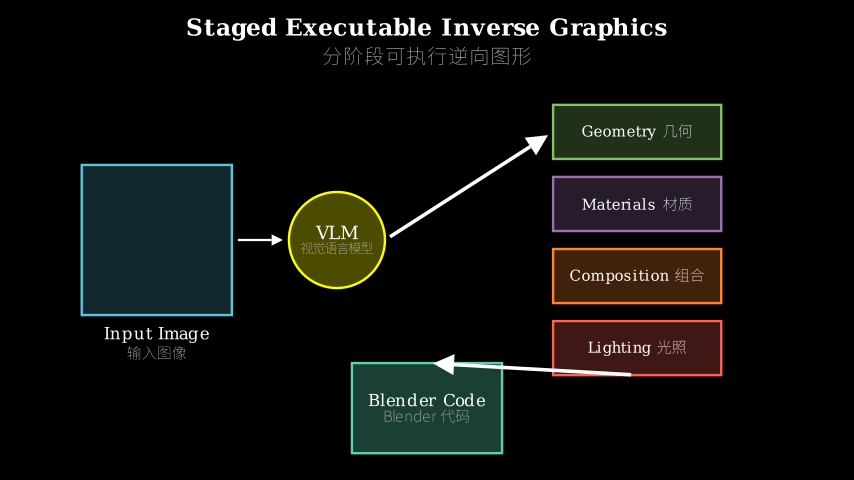
The method treats inverse graphics as staged code generation. Given an input image, a vision-language model generates Blender Python code in four sequential stages: (1) geometry construction (primitives, meshes), (2) material assignment (colors, textures, reflectance), (3) spatial composition (object placement, camera view), and (4) lighting setup (light sources, environment maps). Each stage refines the previous stage’s output by comparing rendered results against the input image.
Data flows like this: the VLM receives the input image plus the current Blender code state, proposes code modifications, executes them in Blender, renders the scene, compares the rendering to the target, and iterates. The VLM operates as both programmer and critic—it writes code, evaluates visual discrepancies, and debugs. Refinement loops within each stage until convergence or iteration limit, then the next stage begins with the accumulated code.
The staged structure mirrors how artists build 3D scenes: rough shapes first, then materials, then layout, then lighting. Each stage constrains the search space—you don’t simultaneously optimize all factors. The VLM uses visual feedback (rendered vs. target) to guide code edits, but unlike gradient-based methods, edits are discrete symbolic operations (add_cube, set_metallic, move_light) that remain human-readable and editable.
Structural metaphor: Think of it as reverse-engineering a recipe by tasting the dish. You start with a photo of a meal. Stage 1: identify the main ingredients (is that chicken or tofu?). Stage 2: figure out seasonings and cooking methods (fried or baked? salty or sweet?). Stage 3: arrange the plating (what’s in front, what’s garnish?). Stage 4: adjust lighting for the food photo (harsh or soft light?). At each stage, you cook a test version, compare it to the photo, adjust the recipe, and lock in that part before moving to the next. The final output isn’t just a similar-looking dish—it’s a recipe anyone can follow, modify, and reuse.
Key Concepts
-
Executable inverse graphics: Traditional inverse graphics produces 3D representations (voxels, meshes, radiance fields) optimized to match an image. Executable inverse graphics produces a program—code that, when run, generates the 3D scene. The difference: a program is symbolic, editable, and compositional. You can change line 47 to swap a sphere for a cube, or adjust a parameter to make something shinier. It’s the difference between getting a JPEG of a chart versus the Excel file that made it. The program is the representation, not just a path to one.
-
Staged refinement: Instead of optimizing all scene factors simultaneously (geometry, materials, lighting), the method decomposes the problem into sequential stages with clear dependencies. Geometry comes first because you can’t assign materials to objects that don’t exist. Materials come before lighting because reflectance properties determine how light interacts. This isn’t just a convenience—it’s a regularization strategy. By forcing the model to commit to geometry before tweaking materials, you prevent it from “cheating” by compensating for wrong shapes with wrong colors. Each stage reduces the hypothesis space for the next.
-
VLM as agentic reconstructor: The vision-language model acts as an agent that observes (compares renderings), plans (proposes code changes), acts (modifies Blender script), and iterates. It’s not generating code in one shot—it’s debugging in a loop. The VLM’s dual capability (visual understanding + code generation) bridges the pixel-symbolic gap. It sees that an object is too dark, understands that darkness comes from material properties or lighting, and translates that understanding into a specific code edit. The agent has no specialized 3D inductive bias—it reasons from scratch using visual-linguistic priors.
Framework Shift
Before (NeRF/3DGS pipeline):        After (SEIG):

Input image                         Input image
    |                                   |
    v                                   v
Multi-view or pose                  VLM + Blender runtime
    |                                   |
    v                                   v
Differentiable render           Stage 1: Code -> Geometry
    |                                   |
    v                                   v
Gradient descent                Stage 2: Code -> Materials
    |                                   |
    v                                   v
Implicit 3D (NeRF/Gaussian)     Stage 3: Code -> Composition
    |                                   |
    v                                   v
Hard to edit manually           Stage 4: Code -> Lighting
                                        |
                                        v
                                    Blender script
                                        |
                                        v
                                    Editable 3D scene
One sentence: From continuous optimization in implicit space to discrete symbolic refinement in code space, the core shift is making the reconstruction itself a human-readable program.
Expert Assessment
Problem choice: Real gap. Inverse graphics has produced impressive neural reconstructions, but the editing bottleneck is underexplored. Artists want scene graphs and parameters, not million-dimensional latent vectors. The timing is right—VLMs are capable enough to attempt this, but the problem isn’t artificially constructed to showcase them.
Method maturity: Clever insight with practical limitations. The staged decomposition is well-motivated and the choice to work in code space is bold. However, relying purely on VLM reasoning without any 3D inductive bias is both a strength (generality) and a weakness (efficiency). The method likely struggles with complex geometry or subtle lighting that requires precise spatial reasoning. The paper would benefit from ablating the staging—does the order matter? What if stages overlap?
Experimental integrity: Baselines are reasonable (NeRF, 3DGS, text-to-3D methods) but not perfectly matched—those methods use multi-view or 3D priors, which is somewhat unfair. However, the point is to show VLMs alone can do this, so it’s defensible. The metrics (pixel-level, perceptual, semantic) cover different fidelity dimensions, which is good. Missing: failure case analysis. When does this completely fall apart? Transparent objects? Mirrors? Fine text? The downstream applications (relighting, editing) are shown qualitatively but not measured rigorously.
Writing quality: The paper is clear in motivation but light on technical depth. The staging strategy is described at a high level, but implementation details are sparse—what prompt templates guide each stage? How many iterations per stage? How does the VLM know when to stop refining? The related work section conflates several research threads (inverse graphics, program synthesis, VLM agents) without clearly positioning this work. The results section would be stronger with explicit discussion of where the method fails and why.
Verdict: weak accept — promising direction that demonstrates VLMs can perform executable inverse graphics, but needs deeper analysis of failure modes, ablations on staging strategy, and more rigorous evaluation of downstream editability to be truly convincing.
Takeaways
Practitioners can steal the staged refinement pattern for any problem where you’re generating complex structured outputs from vision. If you’re building a vision-to-X system (vision-to-CAD, vision-to-recipe, vision-to-floorplan), consider decomposing into stages with clear dependencies rather than generating everything at once. Each stage locks in one aspect and constrains the search space for the next.
The idea of using code as the representation space is transferable beyond 3D. If your domain has a programmatic API (design software, robotics, data pipelines), you can frame generation as code synthesis and leverage VLMs’ dual vision-code capability. The rendered output becomes your evaluation signal—execute the code, compare the result to the goal, refine.
Concrete technique: When using VLMs for iterative generation, give the model access to execution feedback (run the code, show the output) rather than asking it to plan everything upfront. The observe-propose-execute-iterate loop is more robust than one-shot generation, especially for complex structured tasks where correctness is verifiable.
论文: 2606.02580 作者: Guangzhao He, Rundong Luo, Wei-Chiu Ma, Hadar Averbuch-Elor 分类: cs.CV
缺口
逆向图形学的目标是把图像重建为可编辑的 3D 场景。
现有方法依赖专用的 2D/3D 基础模型(如 NeRF、高斯散射)、可微渲染器,或多视角图像。
这些方法生成的重建难以编辑——你得到了一个 3D 表示,但要修改单个物体的材质或调整光照,需要专业知识,往往还要手工干预。
约束在于:现有方法在隐式或连续空间中优化,无法干净地映射到艺术家在 3D 软件中使用的离散符号操作。
本文提出问题:通用视觉-语言模型能否从单张图像直接重建场景为可执行的 Blender 代码,而不需要领域特定的 3D 先验?
问题:单张图像 -> 可编辑 3D 场景
   |
   v
现有约束:专用模型 + 隐式表示
   |        (难以编辑,非符号化)
   v
假设:VLM 同时理解视觉结构和代码语法
   |
   v
方法:在 Blender 代码空间中分阶段精炼
   |    (几何 -> 材质 -> 组合 -> 光照)
   v
证据:定量指标 + 下游编辑任务
   |
   v
结论:任务分解使可执行逆向图形学成为可能
增量
一句话: 在本文之前,逆向图形学产出难以编辑的隐式 3D 表示;
在本文之后,单张图像变成可编辑的 Blender 脚本,你可以像修改普通代码一样修改它。
核心机制
该方法把逆向图形学视为分阶段的代码生成。
给定输入图像,视觉-语言模型分四个顺序阶段生成 Blender Python 代码:(1) 几何构建(基元、网格),(2) 材质分配(颜色、纹理、反射率),(3) 空间组合(物体摆放、相机视角),(4) 光照设置(光源、环境贴图)。
每个阶段通过对比渲染结果与输入图像来精炼前一阶段的输出。
数据流动如下:VLM 接收输入图像加上当前 Blender 代码状态,提出代码修改,在 Blender 中执行,渲染场景,将渲染结果与目标对比,然后迭代。
VLM 既是程序员又是评论家——它写代码、评估视觉差异、调试。
每个阶段内的精炼循环持续到收敛或达到迭代上限,然后下一阶段从累积的代码开始。
分阶段结构模仿艺术家构建 3D 场景的方式:先粗略形状,再材质,再布局,最后光照。
每个阶段约束搜索空间——你不会同时优化所有因素。
VLM 使用视觉反馈(渲染 vs 目标)来指导代码编辑,但与基于梯度的方法不同,编辑是离散符号操作(add_cube、set_metallic、move_light),保持人类可读和可编辑。
核喻:把它想象成通过品尝菜肴来逆向工程菜谱。
你从一张菜肴照片开始。
阶段 1:识别主要食材(那是鸡肉还是豆腐?
)。
阶段 2:找出调味料和烹饪方法(油炸还是烘烤?
咸还是甜?
)。
阶段 3:安排摆盘(什么在前面,什么是装饰?
)。
阶段 4:调整美食照片的光照(强光还是柔光?
)。
每个阶段,你做一个测试版本,与照片对比,调整菜谱,锁定这部分,然后进入下一阶段。
最终输出不只是外观相似的菜——而是一份任何人都能遵循、修改和重用的菜谱。
关键概念
- 可执行逆向图形学:传统逆向图形学产生 3D 表示(体素、网格、辐射场),经过优化以匹配图像。
可执行逆向图形学产生程序——运行时生成 3D 场景的代码。
区别在于:程序是符号化的、可编辑的、可组合的。
你可以修改第 47 行把球体换成立方体,或调整参数让某物更亮。
这就像得到图表的 JPEG 和生成该图表的 Excel 文件之间的区别。
程序本身是表示,而不只是通向表示的路径。
- 分阶段精炼:该方法不是同时优化所有场景因素(几何、材质、光照),而是将问题分解为具有明确依赖关系的顺序阶段。
几何优先,因为你不能给不存在的物体分配材质。
材质在光照之前,因为反射特性决定光的交互方式。
这不只是方便——它是一种正则化策略。
通过强制模型在调整材质之前先确定几何,你防止它用错误的颜色补偿错误的形状来”作弊”。
每个阶段为下一阶段减少假设空间。
- VLM 作为代理重建器:视觉-语言模型充当观察(对比渲染)、计划(提出代码更改)、行动(修改 Blender 脚本)和迭代的代理。
它不是一次性生成代码——而是在循环中调试。
VLM 的双重能力(视觉理解 + 代码生成)桥接了像素-符号鸿沟。
它看到物体太暗,理解暗度来自材质属性或光照,并将这种理解转化为特定的代码编辑。
代理没有专门的 3D 归纳偏置——它使用视觉-语言先验从零推理。
框架转变
之前(NeRF/3DGS 流水线):      之后(SEIG):

输入图像                         输入图像
    |                                   |
    v                                   v
多视角或姿态                     VLM + Blender 运行时
    |                                   |
    v                                   v
可微渲染                        阶段 1:代码 -> 几何
    |                                   |
    v                                   v
梯度下降                        阶段 2:代码 -> 材质
    |                                   |
    v                                   v
隐式 3D(NeRF/高斯)            阶段 3:代码 -> 组合
    |                                   |
    v                                   v
难以手动编辑                    阶段 4:代码 -> 光照
                                        |
                                        v
                                    Blender 脚本
                                        |
                                        v
                                    可编辑 3D 场景
一句话:从隐式空间的连续优化到代码空间的离散符号精炼,核心转变是让重建本身成为人类可读的程序。
专家评审
选题眼光:真实缺口。
逆向图形学产生了令人印象深刻的神经重建,但编辑瓶颈探索不足。
艺术家想要场景图和参数,而不是百万维潜在向量。
时机成熟——VLM 有能力尝试这个,但问题不是人为构造来展示它们的。
方法成熟度:巧妙洞察但有实际局限。
分阶段分解有充分动机,选择在代码空间工作很大胆。
但是,纯粹依赖 VLM 推理而没有任何 3D 归纳偏置既是优势(通用性)也是劣势(效率)。
该方法可能在复杂几何或需要精确空间推理的微妙光照上挣扎。
论文应该消融分阶段——顺序重要吗?
阶段重叠会怎样?
实验诚意:基线合理(NeRF、3DGS、文本到 3D 方法),但不完全匹配——那些方法使用多视角或 3D 先验,这有点不公平。
但是,重点是展示仅 VLM 可以做到,所以可以辩护。
指标(像素级、感知、语义)涵盖不同保真度维度,这很好。
缺失:失败案例分析。
什么时候完全崩溃?
透明物体?
镜子?
精细文字?
下游应用(重新光照、编辑)定性展示但没有严格测量。
写作功力:动机清晰但技术深度不足。
分阶段策略在高层次描述,但实现细节稀疏——什么提示模板指导每个阶段?
每个阶段多少次迭代?
VLM 如何知道何时停止精炼?
相关工作部分混淆了几个研究线索(逆向图形学、程序综合、VLM 代理),没有清楚定位这项工作。
结果部分如果明确讨论方法失败的地方和原因会更强。
判决:弱接收 — 有前景的方向,证明 VLM 可以执行可执行逆向图形学,但需要更深入的失败模式分析、分阶段策略的消融,以及对下游可编辑性更严格的评估,才能真正令人信服。
要点总结
实践者可以为任何从视觉生成复杂结构化输出的问题”偷”走分阶段精炼模式。
如果你在构建视觉到 X 系统(视觉到 CAD、视觉到菜谱、视觉到平面图),考虑分解为具有明确依赖关系的阶段,而不是一次生成所有内容。
每个阶段锁定一个方面,为下一阶段约束搜索空间。
把代码作为表示空间的想法可以迁移到 3D 之外。
如果你的领域有程序化 API(设计软件、机器人、数据管道),你可以将生成框定为代码合成,并利用 VLM 的双重视觉-代码能力。
渲染输出成为你的评估信号——执行代码,将结果与目标对比,精炼。
具体技术:使用 VLM 进行迭代生成时,给模型提供执行反馈(运行代码,显示输出),而不是要求它预先规划一切。
观察-提议-执行-迭代循环比一次性生成更鲁棒,特别是对于正确性可验证的复杂结构化任务。