Paper: 2604.15301 Authors: Yiyang Jiang, Li Zhang, Xiao-Yong Wei, Li Qing Categories: cs.CV
The Gap
Existing sign language translation (SLT) systems treat the task as a direct video-to-text mapping problem. Many rely on gloss annotations (word-level labels for signs) as an intermediate representation, which is expensive to obtain and assumes a one-to-one correspondence between signs and words. Even gloss-free methods still operate under the assumption that brief signing chunks map cleanly to spoken words. This breaks down because sign languages are spatial-temporal languages where meaning emerges from context, spatial arrangement, and movement patterns—not discrete word units.
The core issue: current methods lack an explicit reasoning layer to handle the compositional and context-dependent nature of signing. They jump straight from visual features to text, missing the intermediate semantic organization that human interpreters naturally perform.
Problem: Sign language has no word boundaries
    |
    v
Assumption: Video frames -> Text tokens (direct mapping)
    |
    v
Limitation: Fails on context-dependent, compositional meanings
    |
    v
Method: Insert latent thought sequence as reasoning layer
    |
    v
Evidence: Gains on benchmarks with complex context
    |
    v
Conclusion: SLT is reasoning, not just sequence transduction
The Increment
One sentence: Before this paper, SLT systems translated video frames directly to text; after, there’s an explicit intermediate reasoning layer that organizes meaning before generating words.
Core Mechanism
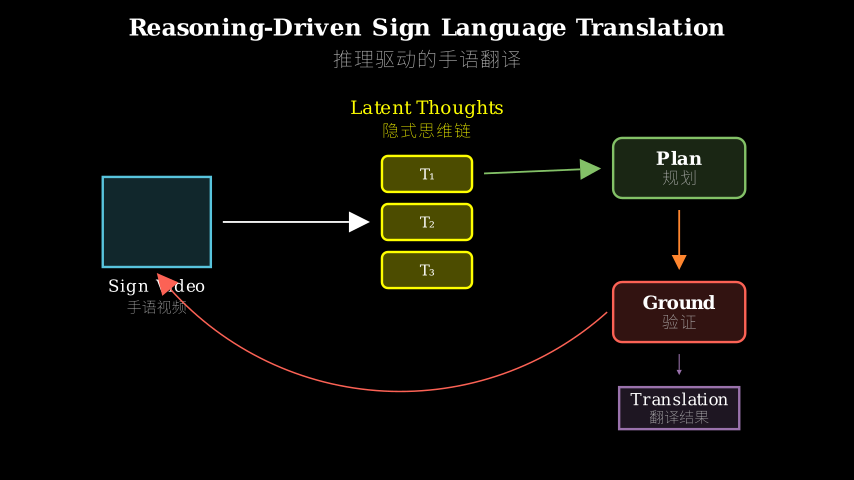
The method introduces three components: (1) a latent thought encoder that produces an ordered sequence of abstract semantic units from the video, (2) a plan-then-ground decoder that first decides what to say (planning) and then looks back at the video to find supporting evidence (grounding), and (3) a training regime that supervises both the thought sequence and the final text output.
The video encoder extracts frame-level features. These feed into the thought encoder, which outputs a sequence of latent thought vectors—think of them as semantic waypoints. Each thought vector captures a chunk of meaning without committing to specific words yet. The decoder operates in two stages: it first generates a draft plan based on the thought sequence, then refines this plan by attending back to the original video features to ground abstract concepts in visual evidence.
Video frames
    |
    v
[Frame Encoder] -> visual features
    |
    v
[Thought Encoder] -> [T1] [T2] [T3] ... [Tn]  (latent thoughts)
    |
    v
[Plan Decoder] -> draft semantic plan
    |
    v
[Ground Decoder] -> attends to video + thoughts -> final text
Think of this like a courtroom argument. The thought encoder is the lawyer organizing evidence into key points (latent thoughts). The plan decoder is the opening statement—laying out what you’ll argue without citing specific evidence yet. The ground decoder is the detailed argument—going back to the evidence (video) to support each claim. You don’t just read the evidence aloud (direct video-to-text); you first decide what story to tell, then find the clips that prove it.
Key Concepts
-
Latent Thoughts: These are learned semantic units that sit between raw video and text. Unlike gloss annotations (which are predefined word labels), latent thoughts are continuous vectors learned end-to-end. They’re “latent” because they don’t correspond to any human-readable symbols—they’re the model’s internal way of chunking meaning. Imagine reading a paragraph and mentally noting “this part is about the problem, this part is the solution”—you’re not writing those notes down, but they guide your understanding. Latent thoughts do the same for the model.
-
Plan-then-Ground Decoding: Traditional decoders generate text autoregressively, attending to video features at each step. This method splits decoding into two phases. Planning: generate a rough semantic outline using only the thought sequence. Grounding: refine each part of the outline by looking back at the video. This separation prevents the model from getting lost in low-level visual details before it knows what it’s trying to say. It’s like writing an essay: first outline your argument, then fill in quotes and evidence.
Framework Shift
Before (mainstream approach):        After (this paper):

Video -> [Encoder] -> Features       Video -> [Encoder] -> Features
              |                                    |
              v                                    v
        [Decoder] -----> Text              [Thought Encoder]
         (direct)                                  |
                                                   v
                                            [T1][T2][T3]...
                                                   |
                                                   v
                                            [Plan Decoder]
                                                   |
                                                   v
                                          [Ground Decoder] -> Text
                                                   ^
                                                   |
                                            (attends back to video)
From direct transduction to staged reasoning, the core shift is inserting an explicit semantic organization layer that separates “what to say” from “how to say it.”
Expert Assessment
Problem choice: This is a real gap. The assumption that signing maps to words is linguistically naive—sign languages are not encoded spoken languages. The authors correctly identify that context-dependence and compositionality are underserved by current architectures. The problem sits at the intersection of low-resource translation and multimodal reasoning, both active areas.
Method maturity: The latent thought mechanism is conceptually clean but not entirely novel—it’s reminiscent of latent variable models in NMT and chain-of-thought prompting in LLMs. The plan-then-ground decoding is clever and well-motivated. However, the paper doesn’t deeply explore what the latent thoughts actually learn (no probing, no visualization of thought semantics). It feels like the method works but we don’t fully understand why.
Experimental integrity: The baselines are fair—they compare against recent gloss-free methods. The new dataset is a valuable contribution, though details on annotation quality are sparse. The gains are consistent but not dramatic (a few BLEU points). One red flag: no ablation on the number of latent thoughts or their dimensionality, which seems like a critical hyperparameter.
Writing quality: The abstract and introduction are strong. The method section is dense—Figure 2 (presumably the architecture diagram) is doing too much work. The related work section conflates gloss-based and gloss-free methods without clearly delineating the boundary. The results section would benefit from error analysis: where does the method still fail?
Verdict: weak accept — Solid problem framing and a principled method, but the execution feels incomplete. The latent thoughts are a black box, and the experimental analysis doesn’t dig deep enough to reveal when and why the approach works.
Takeaways
The plan-then-ground decoding strategy is transferable. Any task where you need to generate structured output from noisy input (video captioning, document summarization, code generation from specs) could benefit from separating high-level planning from low-level grounding. The key insight: don’t force your model to juggle abstraction and detail simultaneously—let it think in stages.
The latent thought framework is a template for adding interpretability to sequence-to-sequence models. If you’re working on a translation or generation task where intermediate reasoning would help, consider inserting a learned latent sequence and supervising it with auxiliary losses (even weak supervision like length or diversity constraints).
The dataset contribution matters more than the method. Large-scale gloss-free SLT data with realistic context is rare. If you’re in sign language research, this dataset is the real artifact to pay attention to.
论文: 2604.15301 作者: Yiyang Jiang, Li Zhang, Xiao-Yong Wei, Li Qing 分类: cs.CV
缺口
现有的手语翻译(SLT)系统将任务视为直接的视频到文本映射问题。
许多系统依赖词汇标注(gloss annotations,即手语动作的词级标签)作为中间表示,这种标注成本高昂,且假设手语动作与单词之间存在一对一对应关系。
即使是无词汇标注的方法,仍然假设简短的手语片段能干净地映射到口语单词。
这个假设站不住脚,因为手语是时空语言,意义从上下文、空间布局和动作模式中涌现——而非离散的词汇单元。
核心问题:当前方法缺乏显式的推理层来处理手语的组合性和上下文依赖性。
它们直接从视觉特征跳到文本,跳过了人类翻译者自然执行的中间语义组织过程。
问题:手语没有词边界
    |
    v
假设:视频帧 -> 文本词元(直接映射)
    |
    v
局限:在上下文依赖、组合性意义上失效
    |
    v
方法:插入隐式思维序列作为推理层
    |
    v
证据:在复杂上下文基准上取得提升
    |
    v
结论:SLT 是推理任务,而非单纯序列转换
增量
一句话:这篇论文之前,SLT 系统直接将视频帧翻译为文本;之后,有了一个显式的中间推理层,在生成词汇之前先组织意义。
核心机制
该方法引入三个组件:(1)隐式思维编码器,从视频中生成有序的抽象语义单元序列;(2)先规划后定位的解码器,先决定要说什么(规划),然后回看视频寻找支撑证据(定位);(3)训练机制,同时监督思维序列和最终文本输出。
视频编码器提取帧级特征。
这些特征输入思维编码器,输出一系列隐式思维向量——可以把它们想象成语义路标。
每个思维向量捕获一块意义,但还没有落实到具体词汇。
解码器分两阶段运行:先基于思维序列生成草稿规划,然后通过回看原始视频特征来细化规划,将抽象概念定位到视觉证据上。
视频帧
    |
    v
[帧编码器] -> 视觉特征
    |
    v
[思维编码器] -> [T1] [T2] [T3] ... [Tn]  (隐式思维)
    |
    v
[规划解码器] -> 草稿语义规划
    |
    v
[定位解码器] -> 注意力回看视频+思维 -> 最终文本
把这个过程想象成法庭辩论。
思维编码器是律师整理证据为关键论点(隐式思维)。
规划解码器是开场陈述——阐明你要论证什么,但还不引用具体证据。
定位解码器是详细论证——回到证据(视频)来支撑每个主张。
你不是简单地朗读证据(直接视频到文本);你先决定讲什么故事,然后找到证明它的片段。
关键概念
- 隐式思维:这些是介于原始视频和文本之间的学习到的语义单元。
与词汇标注(预定义的词标签)不同,隐式思维是端到端学习的连续向量。
它们是”隐式”的,因为不对应任何人类可读的符号——它们是模型内部分块意义的方式。
想象你读一段文字,心里默默标注”这部分讲问题,这部分讲解决方案”——你没有写下这些笔记,但它们指导你的理解。
隐式思维对模型做同样的事。
- 先规划后定位解码:传统解码器自回归生成文本,每步都注意视频特征。
这个方法将解码分为两个阶段。
规划:仅使用思维序列生成粗略的语义大纲。
定位:通过回看视频来细化大纲的每个部分。
这种分离防止模型在知道要说什么之前就迷失在低级视觉细节中。
就像写论文:先列提纲,再填充引文和证据。
框架转变
之前(主流方法):              之后(本文方法):

视频 -> [编码器] -> 特征         视频 -> [编码器] -> 特征
              |                                    |
              v                                    v
        [解码器] -----> 文本              [思维编码器]
         (直接)                                   |
                                                  v
                                           [T1][T2][T3]...
                                                  |
                                                  v
                                           [规划解码器]
                                                  |
                                                  v
                                         [定位解码器] -> 文本
                                                  ^
                                                  |
                                           (注意力回看视频)
从直接转换到分阶段推理,核心转变是插入一个显式的语义组织层,将”说什么”与”怎么说”分离。
专家评审
选题眼光:这是真实的缺口。
手语映射到单词的假设在语言学上是幼稚的——手语不是编码的口语。
作者正确识别出上下文依赖性和组合性在当前架构中服务不足。
这个问题位于低资源翻译和多模态推理的交叉点,两者都是活跃领域。
方法成熟度:隐式思维机制概念清晰,但不完全新颖——让人想起神经机器翻译中的隐变量模型和大语言模型中的思维链提示。
先规划后定位的解码巧妙且动机充分。
然而,论文没有深入探索隐式思维实际学到了什么(没有探测实验,没有思维语义的可视化)。
感觉方法有效,但我们不完全理解为什么。
实验诚意:基线公平——与近期的无词汇标注方法比较。
新数据集是有价值的贡献,尽管标注质量的细节稀少。
提升是一致的但不显著(几个 BLEU 点)。
一个警示信号:没有关于隐式思维数量或维度的消融实验,这似乎是关键超参数。
写作功力:摘要和引言很强。
方法部分密集——图2(推测是架构图)承担了太多工作。
相关工作部分混淆了基于词汇标注和无词汇标注的方法,没有清晰划定边界。
结果部分会受益于错误分析:方法在哪里仍然失败?
判决:弱接收 — 扎实的问题框架和有原则的方法,但执行感觉不完整。
隐式思维是黑箱,实验分析没有深入挖掘以揭示方法何时以及为何有效。
要点总结
先规划后定位的解码策略可迁移。
任何需要从嘈杂输入生成结构化输出的任务(视频字幕、文档摘要、从规格生成代码)都能受益于将高层规划与低层定位分离。
关键洞见:不要强迫模型同时处理抽象和细节——让它分阶段思考。
隐式思维框架是为序列到序列模型添加可解释性的模板。
如果你在做翻译或生成任务,中间推理会有帮助,考虑插入一个学习到的隐式序列,并用辅助损失监督它(即使是弱监督,如长度或多样性约束)。
数据集贡献比方法更重要。
带有真实上下文的大规模无词汇标注 SLT 数据很稀缺。
如果你在手语研究领域,这个数据集是真正值得关注的产出。