Paper: 2603.17998 Authors: Yigit Ekin, Yossi Gandelsman Categories: cs.CV
The Gap
Controllable image editing has two dominant camps. The first requires fine-tuning or training auxiliary networks (ControlNet, InstructPix2Pix, DreamBooth-style adapters) — effective but expensive and model-specific. The second uses prompt engineering or attention manipulation at inference time — cheap but coarse, and the edits tend to be binary: either the change happens or it doesn’t. There’s no dial.
The specific pain point: if you want to gradually increase the “photorealism” of a generated face, or smoothly shift an expression from neutral to smiling, existing training-free methods give you a cliff, not a slope. You can’t interpolate meaningfully between “original” and “edited” without the output collapsing or jumping discontinuously.
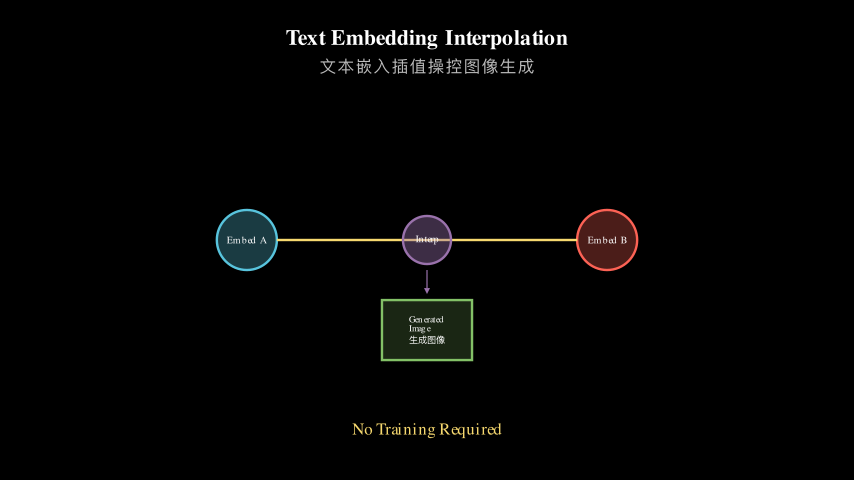
This paper asks: can we find a direction in text-embedding space that, when you walk along it in small steps, produces semantically uniform, smooth changes in the output image?
Problem: Editing is binary or requires training
    |
    v
Assumption: Semantic axes exist in text-encoder space
    |
    v
Method: LM -> contrastive prompts -> steering vector
         + elastic range search for valid magnitude interval
    |
    v
Evidence: Continuity metric + visual comparisons vs baselines
    |
    v
Conclusion: Simple vector arithmetic in embedding space
            is sufficient for smooth, continuous control
The Increment
One sentence: Before this paper, training-free continuous image editing didn’t really exist — after it, you can steer any text-conditioned generator along a semantic axis with a single vector and no extra training.
Core Mechanism
The method has three stages. First, given a target concept like “make this more photorealistic,” an LLM generates a small set of contrastive prompt pairs — positive prompts that embody the concept and negative prompts that represent its absence, with explicit debiasing to avoid confounds (e.g., making sure the positive prompts don’t accidentally all describe outdoor scenes). These pairs are embedded through the generator’s text encoder.
Second, a steering vector is computed by taking the mean difference between positive and negative embedings. This is the direction in embedding space that points “toward” the concept. The vector is then added (scaled by a magnitude alpha) directly to the embedding of whatever prompt the user actually wants to generate with.
Third — and this is the clever part — an elastic range search finds the valid interval of alpha values. Too small and nothing changes (under-steering). Too large and the image breaks or drifts into unrelated territory (over-steering). The search probes the space and identifies the plateau where edits are meaningful but controlled. Within this interval, you can sample uniformly to get a smooth, continuous edit sequence.
User prompt
    |
    v
[Text Encoder] --> prompt embedding (e_p)
                \
LM generates                + alpha * v --> modified embedding
contrastive pairs                      /
    |                 /
    v                                /
[Text Encoder] --> pos embedings --+
                --> neg embeddings --+
                        |
                        v
                  v = mean(pos) - mean(neg)   <-- steering vector
                        |
                        v
              Elastic Range Search
              finds alpha in [alpha_min, alpha_max]
                |
                        v
              Sample alpha uniformly in range
                |
                        v
              [Generator] --> smooth edit sequence
Think of it like a graphic equalizer for image semantics. Your original prompt is the base audio signal. The steering vector is a frequency band — say, “photorealism.” The elastic range search figures out the safe gain range for that band: below a certain gain, you can’t hear the difference; above another, the audio clips and distorts. Within the safe range, you can turn the knob smoothly and the music changes in a controlled, predictable way. The LM’s job is to build a clean, uncolored version of that frequency band — the contrastive pairs are like reference tones used to isolate exactly the frequency you care about, without bleed from adjacent bands.
Key Concepts
-
Steering vector: Imagine you have a high-dimensional space where every possible text description lives as a point. Concepts aren’t random — “photorealistic portrait” and “photorealistic landscape” are closer to each other than either is to “cartoon sketch.” A steering vector is just the average direction you’d walk in this space to move from “not the concept” to “the concept.” It’s computed by embedding many examples of both sides and taking their mean difference. The key insight is that this direction is often surprisingly consistent and transferable — adding it to an unrelated prompt nudges the generator toward the concept without rewriting the whole prompt.
-
Elastic range search: The steering vector has a magnitude knob (alpha). The problem is that the “useful” range of alpha is different for every concept and every base prompt — there’s no universal safe value. The elastic search starts from zero and expands outward, measuring at each step whether the output is actually changing (using a perceptual similarity metric). It stops when changes become too large or semantically incoherent. The result is a concept-specific, prompt-specific interval that you can then sample uniformly to get smooth edits.
-
Debiased contrastive prompts: If you ask an LLM for “photorealistic” prompts and “non-photorealistic” prompts, the photorealistic ones might accidentally all describe outdoor scenes while the non-photorealistic ones describe indoor scenes. Your steering vector would then encode “outdoors” as much as “photorealism.” Debiasing means explicitly instructing the LLM to hold all other attributes constant — same subject, same lighting, same composition — and vary only the target concept. This makes the vector cleaner and more semantically precise.
Framework Shift
Before (mainstream approach):        After (this paper):

User prompt                User prompt
    |                                    |
    v                                    v
[Fine-tune model]                    [Text Encoder]
    |                                    |
    v                                    v
[Edited model]                       e_p + alpha * v
    |                                |
    v                                    v
Generate edited image                [Generator]
                         |
                                         v
                     Smooth edit sequence
                     (no training, any model)

Cost: high, model-specific           Cost: near-zero, model-agnostic
Control: coarse (on/off)             Control: continuous dial
From training-dependent, model-specific editing to training-free, model-agnostic steering, the core shift is treating the text-encoder’s embedding space as a semantic coordinate system you can navigate directly.
Expert Assessment
Problem choice: This is a real gap. Continuous, training-free editing is genuinely underexplored, and the framing around “continuity” as a first-class property (rather than just edit quality) is a useful contribution. The field has been so focused on fidelity that smoothness got neglected. That said, the problem is somewhat niche — most practitioners either don’t need continuous control or are willing to pay the training cost for it.
Method maturity: The core idea — mean difference of embeddings as a steering vector — is not new. It’s been used in NLP (concept vectors, linear probes) and in vision (GANSpace, SeFa). What’s new here is the elastic range search and the application to text-conditioned diffusion models with LM-assisted prompt construction. The combination is clean and the engineering is solid, but calling it “unreasonably effective” is a bit of marketing. It’s reasonably effective, which is still good.
Experimental integrity: The new continuity metric is a reasonable idea but self-serving — the paper introduces the metric and then wins on it. The comparison against training-based methods is fair in spirit but the baselines are not always aples-to-apples (different models, different training data). The qualitative results look convincing, but I’d want to see a user study before fully trusting the “comparable to training-based” claim.
Writing quality: The elastic range search section is underexplained — the paper describes what it does but not why the specific stopping criteria were chosen or how sensitive results are to those choices. That section, if rewritten with ablations and sensitivity analysis, would significantly strengthen the paper’s credibility.
Verdict: weak accept — solid engineering contribution with a clean idea, but the novelty claims are slightly overclaimed and the evaluation has some self-referential circularity.
Takeaways
A few things worth stealing:
The “LM as debiased prompt generator” pattern is broadly useful. Any time you need contrastive examples for a concept, asking an LLM to generate matched pairs (vary only X, hold everything else constant) is a cleaner approach than curating datasets manually. This transfers directly to classification, retrieval, and probing tasks.
The elastic range search idea — automatically finding the valid operating interval for a parameter rather than hand-tuning it — is a general technique. If you’re doing any kind of activation steering, latent space manipulation, or prompt perturbation, this kind of adaptive range detection is worth implementing.
The continuity metric itself is worth borrowing. If you’re building any system that produces a sequence of outputs along a semantic axis (style transfer, morphing, progressive editing), measuring whether the semantic change is uniform across steps is a more honest evaluation than just measuring endpoint quality.
论文: 2603.17998 作者: Yigit Ekin, Yossi Gandelsman 分类: cs.CV
缺口
可控图像编辑领域目前有两个主流阵营。
第一个阵营依赖微调或训练辅助网络,比如 ControlNet、InstructPix2Pix、DreamBooth 风格的适配器——效果不错,但代价高昂,且与特定模型绑定。
第二个阵营在推理时使用提示词工程或注意力操控——成本低,但控制粒度粗糙,编辑往是二元的:要么变了,要么没变,没有”旋钮”可调。
具体的痛点在于:如果你想让生成的人脸逐渐变得更写实,或者让表情从中性平滑过渡到微笑,现有的无训练方法给你的是一个悬崖,而不是一个斜坡。 你无法在”原始”和”编辑后”之间做有意义的插值,输出要么崩塌,要么跳变。
这篇论文的核心问题是:能否在文本嵌入空间中找到一个方向,沿着这个方向小步前进时,输出图像会产生语义均匀、平滑的变化?
问题:编辑是二元的,或者需要训练
    |
    v
假设:文本编码器空间中存在语义轴
    |
    v
方法:LM -> 对比提示对 -> 引导向量
         + 弹性范围搜索确定有效幅度区间
    |
    v
证据:连续性指标 + 与基线的视觉对比
    |
    v
结论:嵌入空间中的简单向量运算
      足以实现平滑、连续的控制
增量
一句话:这篇论文之前,无训练的连续图像编辑基本不存在;之后,你可以用一个向量、零额外训练,沿语义轴引导任意文本条件生成器。
核心机制
方法分三个阶段。
第一阶段,给定目标概念(比如”让图像更写实”),LLM 生成一组对比提示对——正向提示体现该概念,负向提示代表其缺失,并显式去偏以避免混淆(例如确保正向提示不会全部描述户外场景)。 这些提示对通过生成器的文本编码器嵌入到向量空间中。
第二阶段,通过计算正负嵌入的均值差,得到引导向量。 这个向量就是嵌入空间中指向目标概念的方向。 将该向量(乘以幅度系数 alpha)直接加到用户实际使用的提示词嵌入上,即可完成引导。
第三阶段——也是最巧妙的部分——弹性范围搜索找到 alpha 的有效区间。 太小则什么都不变(引导不足);太大则图像崩溃或漂移到无关领域(引导过度)。 搜索过程探测这个空间,找到编辑有意义且可控的平台区。 在这个区间内均匀采样,就能得到平滑连续的编辑序列。
用户提示词
    |
    v
[文本编码器] --> 提示嵌入 (e_p)
                                    \
LLM 生成                + alpha * v --> 修改后的嵌入
对比提示对                           /
    |                               /
    v                              /
[文本编码器] --> 正向嵌入 ----------+
             --> 负向嵌入 ----------+
                    |
                    v
              v = mean(正) - mean(负)   <--引导向量
                    |
                    v
            弹性范围搜索
            找到 alpha 在 [alpha_min, alpha_max] 内的区间
                |
                    v
            在区间内均匀采样 alpha
                    |
                    v
            [生成器] --> 平滑编辑序列
把这个方法想象成图像语义的均衡器。
你的原始提示词是基础音频信号。 引导向量是一个频段——比如”写实感”。 弹性范围搜索负责找出这个频段的安全增益范围:增益太低,听不出差别;增益太高,音频削波失真。 在安全范围内,你可以平滑地转动旋钮,音乐以可预测的方式变化。
LM 的工作是构建这个频段的干净、无染色版本——对比提示对就像参考音调,用来精确隔离你关心的频率,避免相邻频段的串扰。
关键概念
-
引导向量:想象一个高维空间,每一种可能的文字描述都是其中的一个点。概念不是随机分布的——“写实人像”和”写实风景彼此更近,而两者都远离”卡通素描”。引导向量就是你在这个空间中从”不具备该概念”走向”具备该概念”的平均方向,通过嵌入两侧的大量示例并取均值差来计算。关键洞察在于:这个方向往出奇地一致且可迁移——把它加到一个无关提示词上,就能在不重写整个提示词的情况下,把生成器推向目标概念。
-
弹性范围搜索:引导向量有一个幅度旋钮(alpha)。问题在于,“有效”的 alpha 范围因概念和基础提示词而异,没有通用的安全值。弹性搜索从零开始向外扩展,在每一步用感知相似度指标衡量输出是否真的在变化,直到变化过大或语义不连贯时停止。结果是一个针对特定概念和特定提示词的区间,在其中均匀采样即可得到平滑编辑。
-
去偏对比提示:如果你让 LLM 生成”写实”和”非写实”的提示词,实的那些可能碰巧全是户外场景,非写实的全是室内场景。这样你的引导向量就会把”户外”和”写实感”混在一起。去偏的意思是明确指示 LLM 保持所有其他属性不变——相同主体、相同光线、相同构图——只改变目标概念。这让向量更干净,语义更精准。
框架转变
之前(主流方法):                之后(本文方法):

用户提示词                            用户提示词
    |                                     |
    v                                     v
[微调模型]                            [文本编码器]
    |                                     |
    v                                     v
[编辑后的模型]                        e_p + alpha * v
    |                                     |
    v                                     v
生成编辑图像                          [生成器]
                                          |
                                          v
                      平滑编辑序列
                      (无需训练,适用任意模型)

代价:高,与模型绑定                代价:近乎为零,模型无关
控制:粗粒度(开/关)                 控制:连续旋钮
从依赖训练、与模型绑定的编辑,到无需训练、模型无关的引导,核心转变是:把文本编码器的嵌入空间当作一个可以直接导航的语义坐标系。
专家评审
选题眼光:这是真实的缺口。 连续、无训练的编辑确实被严重忽视,把”连续性”作为一等公民属性(而非仅仅关注编辑质量)是有价值的贡献。 该领域长期过于关注保真度,平滑性被冷落了。 不过这个问题相对小众——大多数实践者要么不需要连续控制,要么愿意为此付出训练代价。
方法成熟度:核心思路——嵌入均值差作为引导向量——并不新鲜。 它在 NLP(概念向量、线性探针)和视觉领域(GANSpace、SeFa)都有先例。 新颖之处在于弹性范围搜索,以及将 LM 辅助提示构建应用于文本条件扩散模型的组合。 整体设计干净,工程扎实,但”出奇有效”这个说法有点营销味道——它是”合理地有效”,这已经不错了。
实验诚意:新提出的连续性指标是个合理的想法,但有自我服务之嫌——论文自己定义指标,然后在上面赢了。 与训练方法的对比在精神上是公平的,但基线并非总是苹果对苹果(不同模型、不同训练数据)。 定性结果看起来令人信服,但在看到用户研究之前,我不会完全相信”与训练方法相当”这个说法。
写作功力:弹性范围搜索那一节解释不足——论文描述了它做什么,但没有说明为什么选择这些具体的停止准则,也没有分析结果对这些选择的敏感性。 如果重写这一节,加入消融实验和敏感性分析,整篇论文的可信度会显著提升。
判决:弱接收——工程贡献扎实,思路干净,但新颖性主张略有夸大,评估体系存在一定的自我循环。
要点总结
有几个值得”偷走”的东西。
“LM 作为去偏提示生成器”这个模式有广泛用途。 任何时候你需要为某个概念构建对比样本,让 LLM 生成匹配的提示对(只改变 X,其他全部保持不变)比手工整理数据集更干净。 这个思路可以直接迁移到分类、检索和探针任务中。
弹性范围搜索的思路——自动找到参数的有效操作区间,而不是手动调参——是一种通用技术。 如果你在做任何形式的激活引导、潜空间操控或提示扰动,这种自适应范围检测值得实现。
连续性指标本身也值得借鉴。 如果你在构建任何沿语义轴产生输出序列的系统(风格迁移、形态变换、渐进式编辑),衡量语义变化在各步骤间是否均匀,比只测量端点质量更诚实。