
Paper: 2603.24559 Authors: Martin Jaraiz Categories: cs.NE, cs.AI, cs.MA
The Gap
Existing metaheuristics (Genetic Algorithms, PSO, Simulated Annealing) all share a fundamental constraint: you must specify a fitness function upfront. This works when you know what “good” looks like, but breaks down in open-ended domains where the objective itself should emerge from the system. In prebiotic chemistry, we don’t know which molecules “should” form. In economic forecasting, hand-crafted models require extensive parameter estimation and fail to generalize across countries.
The deeper issue: these algorithms treat optimization as search through a fixed space toward a known target. But many real systems—biological evolution, economic markets, chemical networks—don’t have prescribed goals. They self-organize through local interactions.
Problem: Closed optimization paradigm
   |
   v
Assumption: Fitness can emerge from local supply-demand dynamics
   |
   v
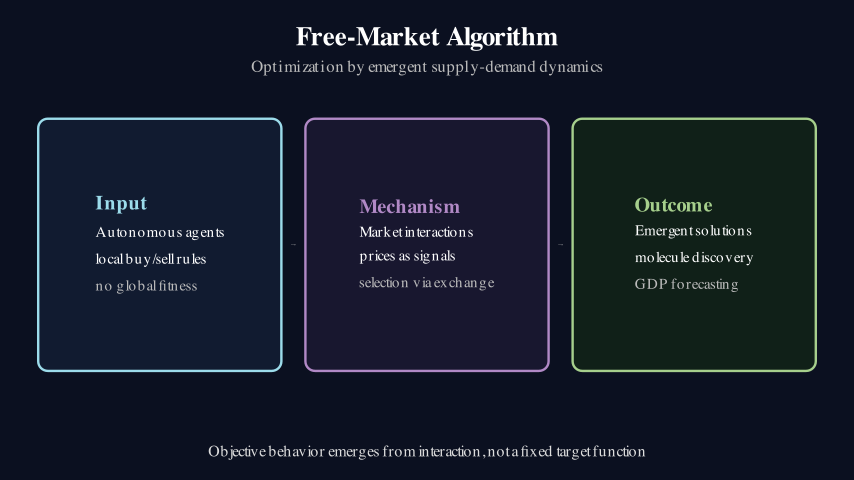
Method: Market mechanism with autonomous agents (no global fitness)
   |
   v
Evidence: Discovers amino acids + nucleobases (chemistry)
          Forecasts GDP across 33 countries (economics)
   |
   v
Conclusion: Darwinian market dynamics as general optimization principle
The Increment
One sentence: Before this paper, metaheuristics required you to define success; after, the algorithm discovers what matters through emergent market dynamics.
Core Mechanism
FMA has three layers. The bottom layer is a universal market mechanism: agents produce goods, goods have supply and demand, competition determines prices, selection eliminates unprofitable firms. This layer is identical across all applications.
The middle layer contains domain-specific behavioral rules. In chemistry, rules are reaction pathways (e.g., “C + O → CO”). In economics, rules are production functions (e.g., “steel + labor → cars”). Agents discover which rules to apply by trying combinations and seeing what sells.
The top layer is domain-specific observation: what counts as a “good” and how demand is measured. In chemistry, goods are molecules and demand comes from thermodynamic stability. In economics, goods are commodities and demand comes from input-output tables.
Domain Observation Layer
   |  (what are goods? what drives demand?)
   v
+------------------------------------------+
|  Agent discovers rule: A + B -> C       |
|  Opens firm, produces C                 |
|  Market evaluates: does C have demand?  |
|  If yes: profit, firm survives          |
|  If no: loss, firm closes               |
+------------------------------------------+
   ^
   |
Universal Market Mechanism
(supply, demand, competition, selection)
Think of it like a city’s restaurant ecosystem. No central planner decides which cuisines should exist. Instead, entrepreneurs (agents) try opening restaurants (firms) with different recipes (rules). Customers (demand) vote with their wallets. Successful restaurants expand, unsuccessful ones close. Over time, the city’s culinary landscape (solution space) self-organizes to match what people actually want—without anyone defining “good food” upfront.
The key insight: fitness isn’t a function you write; it’s a signal that emerges when supply meets demand. Agents don’t optimize toward a target; they compete for customers. The “solution” is the entire network of surviving firms and their production pathways.
Key Concepts
-
Emergent Fitness: Traditional algorithms require you to write a function that scores solutions (e.g., “minimize distance” or “maximize accuracy”). FMA replaces this with market dynamics. An agent’s fitness is its profit—revenue from selling goods minus cost of inputs. Profit emerges from whether other agents need what you produce. No one programs “amino acids are good”; amino acids become valuable because they’re inputs to more complex molecules that have demand. It’s fitness by consensus, not by decree.
-
Open-Ended Search Space: Most algorithms search a fixed space defined upfront (e.g., “all possible neural network weights”). FMA’s search space grows during execution. Agents can discover new rules by combining existing ones, creating goods that didn’t exist at initialization. In the chemistry experiment, the algorithm starts with 900 bare atoms and discovers 240 independent synthesis routes for amino acids—pathways that weren’t in the initial rule set. The space isn’t explored; it’s constructed.
-
Hierarchical Pathway Networks: Solutions aren’t single points or parameter vectors; they’re networks of production pathways. Each node is a good, each edge is a transformation rule, and the network shows how raw materials flow into final products. In chemistry, this reveals not just “glycine exists” but “here are 47 ways to synthesize glycine from C, H, O, N.” The solution is the entire supply chain, not the endpoint.
Framework Shift
Before (mainstream approach):        After (this paper):

  Define fitness function              No fitness function
         |                                    |
         v                                    v
  Generate candidates         Agents discover rules
         |                                    |
         v                                    v
  Evaluate via f(x)           Market evaluates via supply/demand
         |                                    |
         v                                    v
  Select best                 Profitable firms survive
         |                                    |
         v                                    v
  Fixed search space          Open-ended pathway networks
From centralized evaluation to distributed market dynamics, the core shift is replacing “what should exist” with “what can sustain itself.”
Expert Assessment
Problem choice: This is a real gap. The limitation of prescribed fitness functions is well-known in artificial life and open-ended evolution research, but most work stays theoretical. Applying it to concrete problems (prebiotic chemistry, GDP forecasting) is bold and positions the paper at the intersection of optimization, economics, and origin-of-life studies.
Method maturity: The market mechanism is elegant but not deeply novel—it’s essentially multi-agent reinforcement learning with economic framing. The chemistry validation is impressive (discovering all amino acids and nucleobases is non-trivial), but the economic forecasting feels weaker. Achieving 0.42 percentage point MAE “comparable to professional forecasters” needs more context—what’s the baseline variance? How does it handle structural breaks? The claim of “zero estimated parameters” is misleading; the input-output table itself encodes economic structure.
Experimental integrity: The chemistry experiment is well-designed with clear success criteria. The economic validation across 33 countries is promising but thin—one paragraph, no ablations, no failure analysis. The Assembly Theory connection feels tacked on, more philosophical than empirical. The paper would be stronger focusing on the two concrete validations rather than reaching for grand unification with physics.
Writing quality: The introduction oversells (“Darwinian market dynamics may reflect a deeper organizational principle that lead to the unfolding of Nature itself”). The method section is clear but could use pseudocode. The results section buries key details (e.g., how exactly is demand computed in chemistry?). Rewriting the economic forecasting section with rigorous comparison to ARIMA, VAR, and professional forecasts would elevate the paper significantly.
Verdict: weak accept — The core idea is sound and the chemistry validation is strong, but the economic claims need tightening and the philosophical framing distracts from the technical contribution.
Takeaways
If you’re working on problems where the objective is unclear or should emerge from the system, steal the three-layer architecture: universal mechanism (competition/selection), domain rules (what transformations are possible), domain observation (what drives demand). This separation makes the approach portable.
For chemical network discovery or metabolic pathway inference, the idea of letting supply-demand dynamics reveal important molecules is directly applicable. Instead of hand-picking target compounds, let the market tell you what’s central.
The hierarchical pathway network representation is useful beyond this paper. If your problem involves multi-step transformations (synthesis planning, recipe generation, proof search), representing solutions as networks rather than sequences captures more structure.
One subtle technique: agents “open firms” by discovering rules, then “close firms” when unprofitable. This is a clean way to handle dynamic rule discovery without exponential branching—only rules that prove useful stick around. Applicable to any system where you’re learning a grammar or rule set online.
论文: 2603.24559 作者: Martin Jaraiz 分类: cs.NE, cs.AI, cs.MA
缺口
现有的元启发式算法(遗传算法、粒子群优化、模拟退火)都有一个根本性约束:你必须预先指定适应度函数。
当你知道”好”是什么样子时,这没问题,但在开放式领域中就失效了——在这些领域里,目标本身应该从系统中涌现出来。
在前生物化学中,我们不知道哪些分子”应该”形成。
在经济预测中,手工制作的模型需要大量参数估计,且无法跨国泛化。
更深层的问题是:这些算法把优化当作在固定空间中朝已知目标搜索。
但许多真实系统——生物进化、经济市场、化学网络——并没有预设目标。
它们通过局部交互自组织。
问题:封闭的优化范式
   |
   v
假设:适应度可以从局部供需动力学中涌现
   |
   v
方法:带自主智能体的市场机制(无全局适应度)
   |
   v
证据:发现氨基酸+核碱基(化学)
     预测33个国家的GDP(经济学)
   |
   v
结论:达尔文式市场动力学作为通用优化原理
增量
一句话: 这篇论文之前,元启发式算法要求你定义成功;之后,算法通过涌现的市场动力学自己发现什么重要。
核心机制
FMA有三层。
底层是通用市场机制:智能体生产商品,商品有供给和需求,竞争决定价格,选择淘汰不盈利的企业。
这一层在所有应用中都相同。
中间层包含特定领域的行为规则。
在化学中,规则是反应路径(如”C + O → CO”)。
在经济学中,规则是生产函数(如”钢铁 + 劳动力 → 汽车”)。
智能体通过尝试组合并观察什么能卖出去来发现应用哪些规则。
顶层是特定领域的观察:什么算作”商品”,如何衡量需求。
在化学中,商品是分子,需求来自热力学稳定性。
在经济学中,商品是大宗商品,需求来自投入产出表。
领域观察层
   |  (什么是商品?什么驱动需求?)
   v
+------------------------------------------+
|  智能体发现规则: A + B -> C              |
|  开设企业,生产C                          |
|  市场评估: C有需求吗?                    |
|  如果有:盈利,企业存活                    |
|  如果没有:亏损,企业关闭                  |
+------------------------------------------+
   ^
   |
通用市场机制
(供给、需求、竞争、选择)
把它想象成一个城市的餐饮生态系统。
没有中央规划者决定应该存在哪些菜系。
相反,创业者(智能体)尝试用不同的菜谱(规则)开餐馆(企业)。
顾客(需求)用钱包投票。
成功的餐馆扩张,不成功的关门。
随着时间推移,城市的美食景观(解空间)自组织以匹配人们真正想要的——无需任何人预先定义”好食物”。
关键洞察:适应度不是你写的函数;它是供给遇到需求时涌现的信号。
智能体不朝目标优化;它们为客户竞争。
“解”是整个存活企业及其生产路径的网络。
关键概念
- 涌现适应度: 传统算法要求你写一个给解打分的函数(如”最小化距离”或”最大化准确率”)。
FMA用市场动力学取代了这一点。
智能体的适应度是它的利润——销售商品的收入减去投入成本。
利润从其他智能体是否需要你生产的东西中涌现。
没人编程”氨基酸是好的”;氨基酸变得有价值是因为它们是有需求的更复杂分子的输入。
这是共识决定的适应度,而非法令决定的。
- 开放式搜索空间: 大多数算法搜索预先定义的固定空间(如”所有可能的神经网络权重”)。
FMA的搜索空间在执行过程中增长。
智能体可以通过组合现有规则发现新规则,创造初始化时不存在的商品。
在化学实验中,算法从900个裸原子开始,发现了240条氨基酸的独立合成路线——这些路径不在初始规则集中。
空间不是被探索的;它是被构建的。
- 层次化路径网络: 解不是单个点或参数向量;它们是生产路径的网络。
每个节点是一个商品,每条边是一个转换规则,网络显示原材料如何流入最终产品。
在化学中,这不仅揭示”甘氨酸存在”,还揭示”这里有47种从C、H、O、N合成甘氨酸的方法”。
解是整个供应链,而非终点。
框架转变
之前(主流方法):                之后(本文方法):

  定义适应度函数                 无适应度函数
         |                              |
         v                              v
  生成候选解                    智能体发现规则
         |                              |
         v                              v
  通过f(x)评估                  市场通过供需评估
         |                              |
         v                              v
  选择最佳                      盈利企业存活
         |                              |
         v                              v
  固定搜索空间                  开放式路径网络
从中心化评估到分布式市场动力学,核心转变是用”什么能自我维持”取代”什么应该存在”。
专家评审
选题眼光: 这是真缺口。
预设适应度函数的局限在人工生命和开放式进化研究中众所周知,但大多数工作停留在理论层面。
将其应用于具体问题(前生物化学、GDP预测)是大胆的,将论文定位在优化、经济学和生命起源研究的交叉点。
方法成熟度: 市场机制优雅但不算深度创新——本质上是带经济学框架的多智能体强化学习。
化学验证令人印象深刻(发现所有氨基酸和核碱基并非易事),但经济预测感觉较弱。
实现0.42个百分点的MAE”与专业预测者相当”需要更多背景——基线方差是多少?如何处理结构性断裂?”零估计参数”的说法有误导性;投入产出表本身就编码了经济结构。
实验诚意: 化学实验设计良好,有明确的成功标准。
跨33个国家的经济验证有前景但单薄——一段话,无消融实验,无失败分析。
与组装理论的联系感觉是硬凑的,更哲学而非实证。
论文如果专注于两个具体验证而非追求与物理学的宏大统一会更强。
写作功力: 引言过度推销(“达尔文式市场动力学可能反映了导致自然本身展开的更深层组织原理”)。
方法部分清晰但可以加伪代码。
结果部分埋藏了关键细节(如化学中需求到底如何计算?)。
用与ARIMA、VAR和专业预测的严格比较重写经济预测部分会显著提升论文质量。
判决: 弱接收 — 核心思想扎实,化学验证强劲,但经济主张需要收紧,哲学框架分散了对技术贡献的注意力。
要点总结
如果你在做目标不清晰或应该从系统中涌现的问题,偷走这个三层架构:通用机制(竞争/选择)、领域规则(什么转换是可能的)、领域观察(什么驱动需求)。
这种分离使方法可移植。
对于化学网络发现或代谢路径推断,让供需动力学揭示重要分子的想法可以直接应用。
不要手工挑选目标化合物,让市场告诉你什么是核心。
层次化路径网络表示在本文之外也有用。
如果你的问题涉及多步转换(合成规划、配方生成、证明搜索),将解表示为网络而非序列能捕获更多结构。
一个微妙的技巧:智能体通过发现规则”开设企业”,然后在不盈利时”关闭企业”。
这是处理动态规则发现而不产生指数分支的简洁方法——只有证明有用的规则才会留下。
适用于任何在线学习语法或规则集的系统。