
Paper: 2603.24584 Authors: Jiaying Zhou, Zhihao Zhan, Ruifeng Zhai, Qinhan Lyu, Hao Liu, Keze Wang, Liang Lin, Guangrun Wang Categories: cs.CV, cs.RO
The Gap
Vision-Language-Action (VLA) policies can map “pick up the red mug” to robot arm trajectories. They work in clean scenes. But add clutter — three red mugs, two blue cups, a phone — and the robot grabs the wrong thing. Not wildly wrong: it executes a plausible grasp, just 5cm off-target or on the blue cup instead.
Prior work assumed this was a motion planning failure. Train harder, add more data, tune the action head. But the authors’ failure analysis reveals the real culprit: instance-level grounding collapse. The policy sees “red mug,” generates a reasonable trajectory, but the visual attention diffuses across similar objects. The language instruction gets diluted by visual noise.
Existing fixes require architectural changes (attention masks, object-centric modules) or expensive retraining. The gap: no inference-time mechanism to sharpen object focus without touching the trained weights.
Problem: VLA policies blur attention across similar objects
   |
   v
Assumption: Contrasting [full scene] vs [scene minus target]
            reveals target's causal influence
   |
   v
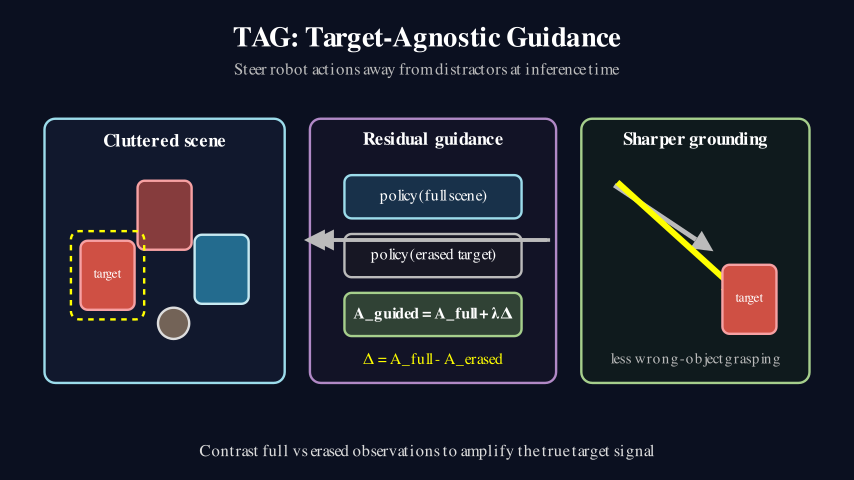
Method: TAG guidance = policy(full) - policy(erased)
        Steer action by this residual signal
   |
   v
Evidence: +8-15% success on LIBERO/VLABench clutter tasks
          Fewer wrong-object and near-miss failures
   |
   v
Conclusion: Inference-time guidance fixes grounding without retraining
The Increment
One sentence: Before TAG, fixing VLA grounding failures required retraining the model; after TAG, you can patch it at inference time by contrasting predictions with and without the target object visible.
Core Mechanism
TAG runs the VLA policy twice per action step. First pass: normal observation. Second pass: same observation but with the target object erased (inpainted out). The policy produces two action distributions. TAG computes their difference — this residual captures how much the target object influenced the decision. Scale up this residual and add it back to the original prediction. The result: actions that lean harder on target evidence and away from distractors.
The object erasure uses an off-the-shelf inpainting model (SAM + LaMa). No custom training. The guidance scale λ is a single hyperparameter (they use λ=1.5). The whole thing plugs into existing VLA policies — OpenVLA, Octo — without modifying their architecture.
Input: RGB observation + language instruction
   |
   +---> VLA policy ---> action_full
   |
   +---> [Erase target] ---> VLA policy ---> action_erased
   |
   v
residual = action_full - action_erased
   |
   v
guided_action = action_full + lambda * residual
Think of TAG like noise-canceling headphones for robot vision. Headphones work by recording ambient noise, inverting it, and mixing it back into the audio signal. TAG records the policy’s behavior when the target is missing (the “noise” of distractor influence), inverts that signal (the residual), and mixes it back to amplify the target’s voice. The policy hears the instruction more clearly because the background chatter is actively suppressed.
Key Concepts
-
Classifier-Free Guidance (CFG): In diffusion models, CFG improves sample quality by contrasting conditional and unconditional predictions. Train a model on both “text prompt → image” and “no prompt → image.” At inference, compute
output = unconditional + scale ** (conditional - unconditional). The residual(conditional - unconditional)isolates the prompt’s influence. Amplifying it makes outputs follow prompts more faithfully. TAG borrows this idea but applies it to action policies: the “unconditional” case is the erased observation, and the residual isolates the target object’s causal effect on actions. -
Instance-Level Grounding Failure: The policy knows what a “red mug” looks like but can’t pin down *which red mug in a cluttered scene. It’s not a recognition failure (the model sees red mugs) or a motion failure (the trajectory is geometrically sound). It’s a binding failure: the language token “red mug” doesn’t lock onto a single spatial location. The attention map spreads across multiple candidates. TAG fixes this by explicitly removing one candidate and measuring how much the policy’s confidence drops — that drop reveals the true target.
Framework Shift
Before (mainstream VLA):              After (TAG):

Observation + Instruction             Observation + Instruction
        |                                     |
        v                                     +---> Policy ---> A_full
    VLA Policy                                |
        |                                     +---> Erase target
        v                                     |
    Action                                    v
  (blurred across                         Policy ---> A_erased
   similar objects)                           |
                                              v
                                         Residual = A_full - A_erased
                                              |
                                              v
                                         A_guided = A_full + λ * Residual
                                         (sharpened on target)
From implicit grounding (hope the policy learned it) to explicit contrast (measure what the target contributes and amplify it).
Expert Assessment
Problem choice: Real and underreported. Most VLA papers show success rates in clean scenes; clutter performance is buried in appendices. The “near-miss” failure mode (grasp lands 2cm off) is particularly insidious because it looks like a motion error but stems from grounding. Solid problem.
Method maturity: Clever adaptation of CFG, but the object erasure step is a bit hacky. They use SAM for segmentation and LaMa for inpainting — two separate models, neither trained for this task. Inpainting quality varies; sometimes the erased region leaves artifacts that confuse the policy. A tighter integration (e.g., training the VLA to handle masked inputs) would be cleaner, but that defeats the “no retraining” selling point. The method works despite this roughness, which is impressive.
Experimental integrity: Baselines are fair (vanilla OpenVLA, Octo, RT-1). Ablations are thorough (varying λ, comparing to attention masking). But the benchmarks (LIBERO, VLABench) are simulated. Real-world clutter is messier — lighting changes, partial occlusions, non-rigid objects. The +8-15% gains might shrink on a physical robot. Also, they don’t report inference time overhead. Running the policy twice per step could be prohibitive for real-time control.
Writing quality: The intro and method sections are crisp. The related work section is a laundry list — cut half of it and expand the failure analysis instead. Figure 3 (the qualitative comparisons) does heavy lifting; the text should reference it more. The appendix has useful ablations that belong in the main paper.
Verdict: Weak accept — the core idea is sound and the results are convincing in simulation, but the method’s real-world viability is unproven and the reliance on external inpainting models feels brittle.
Takeaways
- Inference-time guidance as a debugging tool: Even if you don’t deploy TAG in production, running the contrast (policy with vs without object) reveals which objects the policy is actually using. If erasing a distractor barely changes the action, your policy is ignoring the instruction.
- CFG beyond generative models: The “conditional - unconditional” trick applies anywhere you can ablate an input. For LLMs: contrast “answer with context” vs “answer without context” to measure retrieval quality. For recommender systems: contrast “user history” vs “no history” to detect filter bubble effects.
- Residual steering scales better than retraining: When a model fails in a specific way (e.g., distractor bias), computing a corrective residual at inference time is cheaper than collecting new data and retraining. The residual is a patch, not a fix, but patches ship faster.
论文: 2603.24584 作者: Jiaying Zhou, Zhihao Zhan, Ruifeng Zhai, Qinhan Lyu, Hao Liu, Keze Wang, Liang Lin, Guangrun Wang 分类: cs.CV, cs.RO
缺口
视觉-语言-动作(VLA)策略能把「拿起红色杯子」映射成机械臂轨迹。
在干净场景里没问题。
但加点杂乱——三个红杯子、两个蓝杯子、一部手机——机器人就抓错了。
不是离谱地错:它执行了一个看起来合理的抓取,只是偏了5厘米,或者抓了蓝杯子。
之前的工作以为这是运动规划失败。
更努力地训练,加更多数据,调动作输出头。
但作者的失败分析揭示了真正的罪魁:实例级定位崩溃。
策略看到「红杯子」,生成了合理的轨迹,但视觉注意力在相似物体间扩散了。
语言指令被视觉噪声稀释了。
现有的修复方法需要改架构(注意力掩码、以物体为中心的模块)或昂贵的重训练。
缺口在于:没有推理时机制能在不动训练权重的情况下锐化物体焦点。
问题: VLA策略的注意力在相似物体间模糊
   |
   v
假设: 对比[完整场景]和[场景减去目标]
      能揭示目标的因果影响
   |
   v
方法: TAG引导 = 策略(完整) - 策略(擦除)
      用这个残差信号引导动作
   |
   v
证据: LIBERO/VLABench杂乱任务成功率+8-15%
      更少的抓错物体和差一点失败
   |
   v
结论: 推理时引导无需重训练就能修复定位
增量
一句话: TAG之前,修复VLA定位失败需要重训练模型;TAG之后,你可以在推理时通过对比有无目标物体的预测来打补丁。
核心机制
TAG在每个动作步骤运行VLA策略两次。
第一遍:正常观察。
第二遍:同样的观察但目标物体被擦除了(修复掉)。
策略产生两个动作分布。
TAG计算它们的差——这个残差捕捉了目标物体对决策的影响有多大。
放大这个残差并加回原始预测。
结果:动作更依赖目标证据,更远离干扰物。
物体擦除用现成的修复模型(SAM + LaMa)。
不需要定制训练。
引导尺度λ是单个超参数(他们用λ=1.5)。
整个东西插入现有VLA策略——OpenVLA、Octo——不用改它们的架构。
输入: RGB观察 + 语言指令
   |
   +---> VLA策略 ---> 动作_完整
   |
   +---> [擦除目标] ---> VLA策略 ---> 动作_擦除
   |
   v
残差 = 动作_完整 - 动作_擦除
   |
   v
引导动作 = 动作_完整 + lambda * 残差
把TAG想象成机器人视觉的降噪耳机。
耳机的工作原理是记录环境噪音,反转它,然后混回音频信号。
TAG记录目标缺失时策略的行为(干扰物影响的「噪音」),反转那个信号(残差),然后混回去放大目标的声音。
策略听指令更清楚了,因为背景杂音被主动压制了。
关键概念
- 无分类器引导(CFG): 在扩散模型里,CFG通过对比有条件和无条件预测来提升样本质量。
在「文本提示→图像」和「无提示→图像」上训练模型。
推理时,计算输出 = 无条件 + 尺度 * (有条件 - 无条件)。
残差(有条件 - 无条件)隔离了提示的影响。
放大它让输出更忠实地遵循提示。
TAG借用了这个想法但应用到动作策略:「无条件」情况是擦除的观察,残差隔离了目标物体对动作的因果效应。
- 实例级定位失败: 策略知道「红杯子」长什么样,但在杂乱场景里定不住**哪个*红杯子。
这不是识别失败(模型看到了红杯子)或运动失败(轨迹在几何上是合理的)。
这是绑定失败:语言标记「红杯子」没有锁定单个空间位置。
注意力图在多个候选物上扩散。
TAG通过显式移除一个候选物并测量策略的置信度下降多少来修复这个问题——那个下降揭示了真正的目标。
框架转变
之前(主流VLA):                    之后(TAG):

观察 + 指令                          观察 + 指令
    |                                     |
    v                                     +---> 策略 ---> A_完整
VLA策略                                   |
    |                                     +---> 擦除目标
    v                                     |
  动作                                    v
(在相似物体间模糊)                    策略 ---> A_擦除
                                          |
                                          v
                                     残差 = A_完整 - A_擦除
                                          |
                                          v
                                     A_引导 = A_完整 + λ * 残差
                                     (在目标上锐化)
从隐式定位(希望策略学到了)到显式对比(测量目标贡献了什么并放大它)。
专家评审
选题眼光: 真实且报道不足。
大多数VLA论文展示干净场景的成功率;杂乱性能被埋在附录里。
「差一点」失败模式(抓取落点偏2厘米)特别阴险,因为它看起来像运动错误但源于定位。
扎实的问题。
方法成熟度: CFG的巧妙改编,但物体擦除步骤有点粗糙。
他们用SAM做分割,LaMa做修复——两个独立模型,都没为这个任务训练过。
修复质量不稳定;有时擦除区域留下的伪影会迷惑策略。
更紧密的集成(比如训练VLA处理掩码输入)会更干净,但那就违背了「无需重训练」的卖点。
方法尽管粗糙但有效,这很厉害。
实验诚意: 基线公平(原版OpenVLA、Octo、RT-1)。
消融彻底(变化λ,对比注意力掩码)。
但基准测试(LIBERO、VLABench)是仿真的。
真实世界的杂乱更乱——光照变化、部分遮挡、非刚性物体。
+8-15%的增益在物理机器人上可能缩水。
而且,他们没报告推理时间开销。
每步运行策略两次对实时控制可能太慢。
写作功力: 引言和方法部分简洁。
相关工作部分是流水账——砍掉一半,扩展失败分析。
图3(定性对比)承担了重任;正文应该更多引用它。
附录有有用的消融应该放进正文。
判决: 弱接收——核心想法扎实,仿真结果有说服力,但方法的真实世界可行性未经证明,对外部修复模型的依赖感觉脆弱。
要点总结
- 推理时引导作为调试工具: 即使你不在生产中部署TAG,运行对比(有无物体的策略)也能揭示策略实际在用哪些物体。
如果擦除干扰物几乎不改变动作,你的策略在忽略指令。
- CFG超越生成模型: 「有条件 - 无条件」技巧适用于任何你能消融输入的地方。
对LLM:对比「有上下文回答」和「无上下文回答」来测量检索质量。
对推荐系统:对比「用户历史」和「无历史」来检测过滤气泡效应。
- 残差引导比重训练扩展性更好: 当模型以特定方式失败(比如干扰物偏差)时,在推理时计算修正残差比收集新数据和重训练更便宜。
残差是补丁,不是修复,但补丁发布更快。