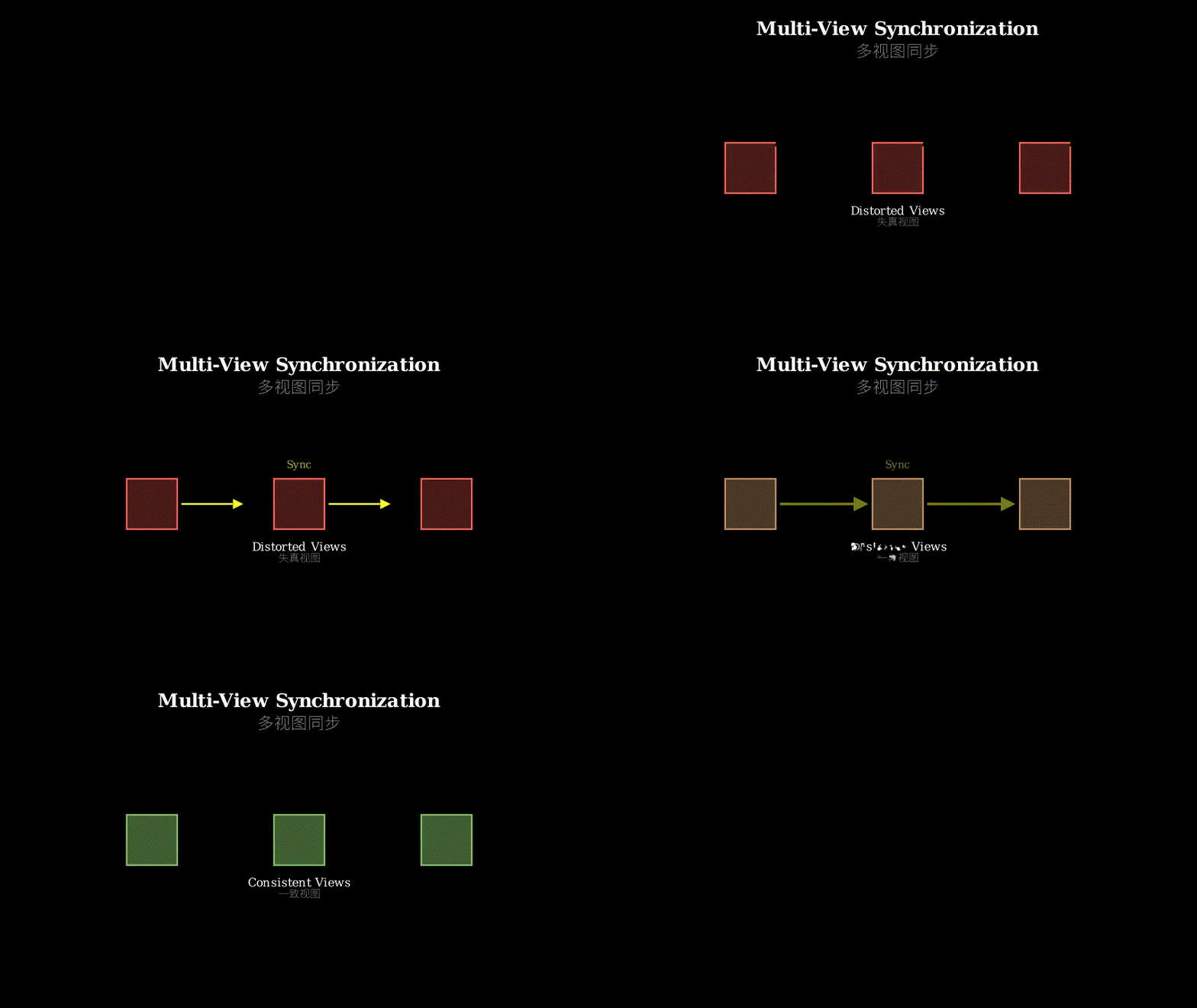
Paper: 2604.11797 Authors: Deming Li, Abhay Yadav, Cheng Peng, Rama Chellappa, Anand Bhattad Categories: cs.CV
The Gap
3D reconstruction from images has reached a point where we can generate plausible geometry, but the results are riddled with semantic and geometric inconsistencies across views. Existing refinement methods treat each view independently — they denoise or enhance individual images without coordinating what’s happening in other views. This creates a fundamental problem: you fix artifacts in one view but introduce contradictions when you look from another angle. Methods like DreamFusion and Score Distillation Sampling improve single views but don’t enforce that a chair leg visible from the left must match the same chair leg from the right.
The core issue: refinement happens in isolation, but 3D consistency requires coordination.
Problem: Independent view refinement
   |
   v
Assumption: Multi-view consistency can be learned
            as joint conditional distribution
   |
   v
Method: Latent bridge matching across views
        with synchronized denoising trajectory
   |
   v
Evidence: Quality improves with more views,
          outperforms baselines without references
   |
   v
Conclusion: Joint conditioning enables consistent
            3D refinement from distorted inputs
The Increment
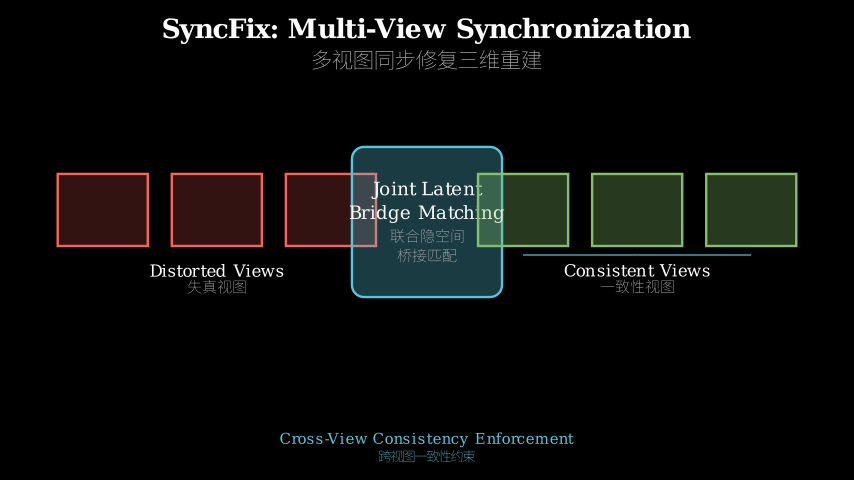
One sentence: Before SyncFix, you refined 3D reconstructions by fixing each view separately and hoping they’d align; after SyncFix, you refine all views jointly so consistency is enforced throughout the denoising process.
Core Mechanism
SyncFix operates in the latent space of a diffusion model. It takes multiple distorted views of a reconstructed scene and learns to map them jointly to clean, consistent representations. The key is formulating this as a bridge matching problem — you’re not just denoising each view independently, you’re learning a trajectory that connects distorted multi-view inputs to clean multi-view outputs while maintaining geometric and semantic alignment across views.
The framework has three main components: a latent encoder that compresses views into a shared representation space, a bridge network that learns the joint conditional distribution over multiple views, and a decoder that reconstructs the refined images. During training, it only sees pairs of images (distorted and clean), but the joint conditioning structure means it naturally generalizes to arbitrary numbers of views at inference time.
The synchronization happens through the bridge matching objective. Instead of learning N independent denoising paths (one per view), you learn a single joint path that must satisfy consistency constraints. If view A shows a wall at a certain depth, view B must show the same wall at a geometrically consistent location. This coupling is baked into the loss function — the model can’t minimize error on one view without considering how that affects the others.
Input: Multiple distorted views
   |
   v
[Latent Encoder] ---> Shared latent space
   |                       |
   |                       v
   |              [Bridge Network]
   |               (joint conditional
   |                over all views)
   |                       |
   v                       v
Consistency <------- Synchronized
constraints          denoising path
   |                       |
   v                       v
[Latent Decoder] <--- Refined latents
   |
   v
Output: Consistent clean views
Think of it like a team of sculptors working on different sides of the same statue. The old way: each sculptor works independently, occasionally walking around to check if their side matches the others, making adjustments after the fact. SyncFix’s way: all sculptors are connected by a shared nervous system — when one makes a chisel stroke, the others feel it and adjust their hands in real-time to maintain the statue’s coherence. The statue (3D scene) never exists in an inconsistent state because all modifications are coordinated through a shared signal (the joint latent bridge). Training on pairs is like practicing with just two sculptors, but the nervous system architecture naturally extends to any number of sculptors at performance time.
Key Concepts
-
Latent Bridge Matching: Imagine you have two islands (distorted views and clean views) separated by water. A bridge connects them, but it’s foggy and you can’t see the path clearly. Bridge matching is about learning the optimal path across this bridge by observing many successful crossings. In diffusion models, you’re in a high-dimensional latent space, and the “bridge” is the trajectory from noisy/distorted data to clean data. Traditional diffusion learns this path for single images. SyncFix learns a joint path for multiple views simultaneously — it’s like building a multi-lane bridge where all lanes must stay parallel and coordinated. The “matching” part means you’re matching the joint distribution of distorted multi-view inputs to the joint distribution of clean multi-view outputs, not just matching marginals independently.
-
Cross-View Consistency: In 3D reconstruction, the same physical point appears in multiple camera views. Consistency means these appearances must agree — if a red cube is 2 meters away in view A, it must appear at the geometrically correct location and color in view B. The challenge: diffusion models naturally introduce stochasticity, which can make each view look good individually but break 3D coherence. SyncFix enforces consistency by making the denoising process aware of all views simultaneously. It’s not post-hoc alignment (generate then fix), it’s intrinsic — the model literally cannot generate view A without considering view B because they’re coupled in the latent space.
Framework Shift
Before (mainstream approach):        After (this paper):

View 1 ---> [Refine] ---> Clean 1    Views 1,2,...,N
View 2 ---> [Refine] ---> Clean 2         |
View 3 ---> [Refine] ---> Clean 3         v
     |           |            |       [Joint Latent
     v           v            v        Encoder]
[Post-process alignment]               |
     |                                 v
     v                            Shared latent
Inconsistent 3D                   representation
                                       |
                                       v
                                  [Bridge Network]
                                   (synchronized
                                    denoising)
                                       |
                                       v
                                  [Joint Latent
                                   Decoder]
                                       |
                                       v
                                  Clean 1,2,...,N
                                       |
                                       v
                                  Consistent 3D
From sequential independent refinement to joint synchronized refinement, the core shift is treating multi-view consistency as a constraint during generation rather than a correction after generation.
Expert Assessment
Problem choice: This is a real gap. Anyone who’s worked with NeRF or 3D Gaussian Splatting reconstructions knows the pain of view-dependent artifacts. The problem sits at the intersection of diffusion models and 3D vision — a hot area with practical applications in VR/AR and content creation. It’s not manufactured; it’s a natural next step after single-view diffusion refinement methods proved successful but insufficient.
Method maturity: The bridge matching formulation is elegant, but I’m skeptical about one claim: training on pairs and generalizing to N views. The paper doesn’t deeply explain why this works beyond “the joint conditioning structure allows it.” That’s hand-wavy. The diminishing returns with more views (mentioned in the abstract) suggests there might be a capacity bottleneck or that the pairwise training doesn’t fully capture higher-order interactions. A simpler approach might be explicit geometric constraints (depth consistency, epipolar geometry) rather than learning them implicitly through latent coupling. The paper doesn’t compare against such hybrid methods.
Experimental integrity: The baselines seem fair — they compare against recent diffusion-based refinement methods. However, I’d want to see ablations on: (1) what happens if you just train on triplets or quadruplets instead of pairs, (2) how much of the gain is from the bridge matching vs just having a bigger model that sees multiple views, (3) failure cases where geometric ambiguity breaks the method. The “even without clean references” claim is strong but needs more scrutiny — what’s the quality floor when inputs are severely degraded?
Writing quality: The abstract and introduction are crisp, but the method section could use a clearer walk-through of the training procedure. Specifically: how do you sample view pairs during training? Are they random pairs from the same scene, or do you prioritize certain baselines/overlaps? The loss function formulation is buried and deserves more prominence. The related work section is thorough but could better position this against test-time optimization methods like DreamFusion variants.
Verdict: weak accept — The core idea of joint latent bridge matching for multi-view consistency is novel and the results look convincing, but the paper needs stronger theoretical justification for why pairwise training generalizes to N views and more rigorous ablations to isolate the contribution of each component.
Takeaways
The big transferable idea: when you have multiple correlated observations of the same underlying structure, don’t refine them independently — learn a joint conditional that enforces consistency throughout the refinement process. This applies beyond 3D reconstruction: multi-modal generation (text + image + audio for the same content), temporal consistency in video generation, or even ensemble methods where you want diverse but coherent predictions. The specific technique — latent bridge matching with synchronized denoising — gives you a concrete way to implement this without expensive post-hoc alignment.
For practitioners: if you’re using diffusion models for any task with multiple related outputs, consider whether you can reformulate it as a joint generation problem rather than independent generation + alignment. The training efficiency gain (train on pairs, infer on N) is particularly attractive for data-scarce domains.
论文: 2604.11797 作者: Deming Li, Abhay Yadav, Cheng Peng, Rama Chellappa, Anand Bhattad 分类: cs.CV
缺口
从图像进行三维重建已经能生成看似合理的几何结构,但结果在不同视角间充满语义和几何不一致。
现有的精修方法独立处理每个视角——它们对单张图像去噪或增强,而不协调其他视角正在发生什么。
这造成了根本问题:你修复了一个视角的瑕疵,但从另一个角度看时又引入了矛盾。
像 DreamFusion 和 Score Distillation Sampling 这样的方法能改善单个视角,但不强制要求从左边看到的椅子腿必须与从右边看到的同一条椅子腿匹配。
核心问题:精修在孤立中进行,但三维一致性需要协调。
问题:独立的视角精修
   |
   v
假设:多视图一致性可以作为
      联合条件分布来学习
   |
   v
方法:跨视图的隐空间桥接匹配
      与同步去噪轨迹
   |
   v
证据:质量随视图增加而提升,
      无参考情况下超越基线
   |
   v
结论:联合条件化使得从扭曲输入
      进行一致的三维精修成为可能
增量
一句话: SyncFix 之前,你通过分别修复每个视角并希望它们能对齐来精修三维重建;SyncFix 之后,你联合精修所有视角,使一致性在整个去噪过程中得到强制执行。
核心机制
SyncFix 在扩散模型的隐空间中运作。
它接收重建场景的多个扭曲视角,学习将它们联合映射到干净、一致的表示。
关键在于将其表述为桥接匹配问题——你不只是独立地对每个视角去噪,而是学习一条连接扭曲多视图输入到干净多视图输出的轨迹,同时在视角间保持几何和语义对齐。
该框架有三个主要组件:将视角压缩到共享表示空间的隐编码器,学习多视图联合条件分布的桥接网络,以及重建精修图像的解码器。
训练期间它只看到图像对(扭曲的和干净的),但联合条件化结构意味着它在推理时自然泛化到任意数量的视角。
同步通过桥接匹配目标实现。
不是学习 N 条独立的去噪路径(每个视角一条),而是学习一条必须满足一致性约束的单一联合路径。
如果视角 A 显示某个深度的墙,视角 B 必须在几何一致的位置显示同一面墙。
这种耦合被烘焙进损失函数——模型无法在一个视角上最小化误差而不考虑这如何影响其他视角。
输入:多个扭曲视角
   |
   v
[隐编码器] ---> 共享隐空间
   |                |
   |                v
   |          [桥接网络]
   |          (所有视角的
   |           联合条件)
   |                |
   v                v
一致性 <------- 同步的
约束            去噪路径
   |                |
   v                v
[隐解码器] <--- 精修后的隐表示
   |
   v
输出:一致的干净视角
把它想象成一队雕塑家在同一座雕像的不同侧面工作。
旧方法:每个雕塑家独立工作,偶尔走一圈检查自己这一面是否与其他面匹配,事后进行调整。
SyncFix 的方法:所有雕塑家通过共享的神经系统连接——当一个人凿下一刀,其他人感受到并实时调整手的动作以保持雕像的连贯性。
雕像(三维场景)从不存在于不一致的状态,因为所有修改都通过共享信号(联合隐桥接)协调。
在成对数据上训练就像只用两个雕塑家练习,但神经系统架构在表演时自然扩展到任意数量的雕塑家。
关键概念
- 隐空间桥接匹配: 想象你有两座岛(扭曲视角和干净视角)被水分隔。
一座桥连接它们,但有雾,你看不清路径。
桥接匹配是通过观察许多成功的穿越来学习跨越这座桥的最优路径。
在扩散模型中,你处于高维隐空间,“桥”是从噪声/扭曲数据到干净数据的轨迹。
传统扩散为单张图像学习这条路径。
SyncFix 同时为多个视角学习联合路径——就像建造一座多车道桥梁,所有车道必须保持平行和协调。
“匹配”部分意味着你在匹配扭曲多视图输入的联合分布与干净多视图输出的联合分布,而不只是独立匹配边缘分布。
- 跨视图一致性: 在三维重建中,同一物理点出现在多个相机视角中。
一致性意味着这些外观必须一致——如果红色立方体在视角 A 中距离 2 米,它必须在视角 B 中出现在几何正确的位置和颜色。
挑战在于:扩散模型自然引入随机性,这可能使每个视角单独看起来不错但破坏三维连贯性。
SyncFix 通过使去噪过程同时感知所有视角来强制一致性。
这不是事后对齐(生成然后修复),而是内在的——模型字面上无法在不考虑视角 B 的情况下生成视角 A,因为它们在隐空间中耦合。
框架转变
之前(主流方法):              之后(本文方法):

视角1 ---> [精修] ---> 干净1    视角 1,2,...,N
视角2 ---> [精修] ---> 干净2         |
视角3 ---> [精修] ---> 干净3         v
     |           |            |    [联合隐
     v           v            v     编码器]
[事后对齐处理]                       |
     |                               v
     v                          共享隐表示
不一致的三维                          |
                                     v
                                [桥接网络]
                                 (同步
                                  去噪)
                                     |
                                     v
                                [联合隐
                                 解码器]
                                     |
                                     v
                              干净 1,2,...,N
                                     |
                                     v
                                一致的三维
从顺序独立精修到联合同步精修,核心转变是将多视图一致性视为生成期间的约束而非生成后的修正。
专家评审
选题眼光: 这是真实的缺口。
任何使用过 NeRF 或三维高斯溅射重建的人都知道视角相关伪影的痛苦。
该问题位于扩散模型和三维视觉的交叉点——一个在 VR/AR 和内容创作中有实际应用的热门领域。
这不是人造的;它是单视角扩散精修方法被证明成功但不足之后的自然下一步。
方法成熟度: 桥接匹配的表述很优雅,但我对一个声明持怀疑态度:在成对数据上训练并泛化到 N 个视角。
论文没有深入解释为什么这有效,只说”联合条件化结构允许它”。
这很含糊。
随着更多视角而递减的收益(摘要中提到)表明可能存在容量瓶颈,或者成对训练没有完全捕获高阶交互。
更简单的方法可能是显式几何约束(深度一致性、极线几何)而非通过隐耦合隐式学习它们。
论文没有与这类混合方法比较。
实验诚意: 基线看起来公平——他们与最近的基于扩散的精修方法比较。
然而,我想看到关于以下方面的消融:(1) 如果你只在三元组或四元组上训练会发生什么,(2) 有多少增益来自桥接匹配 vs 只是有一个看到多个视角的更大模型,(3) 几何歧义破坏方法的失败案例。
“即使没有干净参考”的声明很强,但需要更多审查——当输入严重退化时质量底线是什么?
写作功力: 摘要和引言简洁,但方法部分可以更清晰地演示训练过程。
具体来说:训练期间如何采样视角对?它们是来自同一场景的随机对,还是优先考虑某些基线/重叠?损失函数的表述被埋没了,值得更突出。
相关工作部分很全面,但可以更好地将其与 DreamFusion 变体等测试时优化方法对比。
判决: 弱接收——多视图一致性的联合隐桥接匹配核心思想新颖,结果看起来令人信服,但论文需要更强的理论论证来说明为什么成对训练泛化到 N 个视角,以及更严格的消融来隔离每个组件的贡献。
要点总结
可迁移的大想法:当你有同一底层结构的多个相关观测时,不要独立精修它们——学习一个在整个精修过程中强制一致性的联合条件。
这超越了三维重建的应用:多模态生成(同一内容的文本+图像+音频)、视频生成中的时间一致性,甚至是你想要多样但连贯预测的集成方法。
具体技术——带同步去噪的隐桥接匹配——为你提供了一种具体方式来实现这一点,而无需昂贵的事后对齐。
对实践者:如果你在任何具有多个相关输出的任务中使用扩散模型,考虑是否可以将其重新表述为联合生成问题而非独立生成+对齐。
训练效率增益(在成对数据上训练,在 N 个上推理)对数据稀缺领域特别有吸引力。