Paper: 2605.04012 Authors: Joseph Breda, Fadi Yousif, Beszel Hawkins, Marinela Cotoi, Miao Liu, Ray Luo, Po-Hsuan Cameron Chen, Mike Schaekermann, Samuel Schmidgall, Xin Liu Categories: cs.AI
The Gap
Language models perform well on curated medical vignettes—complex cases with rich context written for teaching. But real patients don’t arrive with a paragraph of symptoms. They say “my throat hurts” or “I’ve been tired lately.” Existing benchmarks (PubMedQA, MedQA, USMLE-style cases) test diagnostic reasoning on complete information. They don’t test the interview itself: what questions to ask, when to probe deeper, how to build a complete symptom picture from fragments.
The gap: we don’t know if LLMs can conduct the messy, iterative process of symptom gathering that precedes diagnosis in everyday healthcare. Prior work evaluates the destination (correct diagnosis given full context) but ignores the journey (getting that context through conversation).
Prior work:                    This paper:

Rich vignette --> LLM --> Dx   Patient: "throat hurts"
                                    |
[Tests reasoning only]              v
                              LLM interview (iterative)
                                    |
                                    v
                              Complete symptom set --> Dx

                              [Tests interview + reasoning]
The Increment
One sentence: Before this paper, we knew LLMs could diagnose given complete information; now we know they can gather that information through structured interviews better than humans do in the same setting.
Core Mechanism
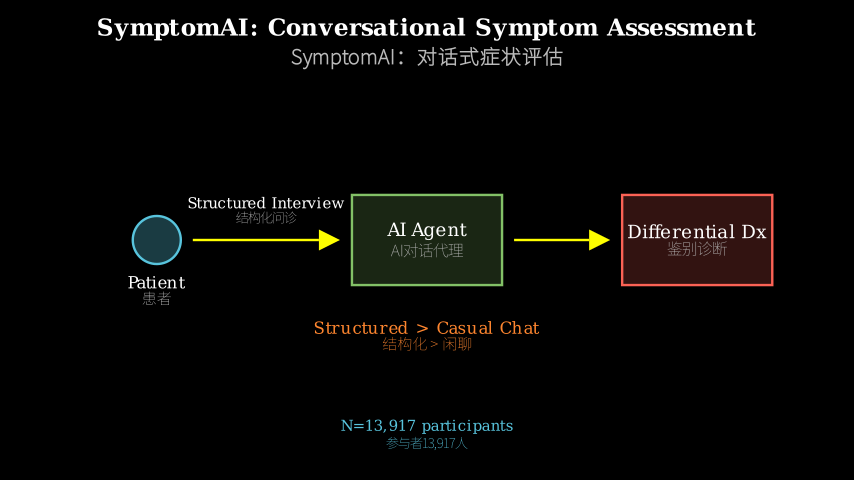
SymptomAI deploys five conversational agents that differ in how they structure the interview. The baseline agent lets users guide the conversation—ask whatever, in whatever order. The agentic variants impose structure: they conduct a dedicated symptom interview before offering a diagnosis. This means asking about symptom onset, duration, severity, associated symptoms, and relevant medical history in a systematic way, regardless of what the user initially volunteers.
Each agent uses the same underlying language model but with different prompting strategies. After the interview, all agents produce a ranked list of differential diagnoses. The study randomized 13,917 Fitbit users to interact with these agents when reporting symptoms. A subset of 1,228 later provided clinician-confirmed diagnoses, creating ground truth. Independent clinicians also reviewed 517 conversations in a blinded comparison—they saw the dialogue transcript and made their own diagnosis without knowing what the AI suggested.
User reports symptom
        |
        v
    [Agent type]
        |
    +---+---+
    |       |
Baseline  Agentic
    |       |
    |   [Structured interview]
    |       |
    |   - Onset/duration?
    |   - Severity scale?
    |   - Associated symptoms?
    |   - Medical history?
    |       |
    +---+---+
        |
        v
   [LLM reasoning]
        |
        v
  Ranked DDx list
Think of it like the difference between a customer walking into a store and browsing versus a salesperson conducting a needs assessment. The baseline agent is the browser: the user picks what to mention, the AI responds to what’s offered. The agentic agent is the salesperson: it has a checklist of information it needs and systematically works through it. The user still provides all the information, but the agent controls the sequence and ensures nothing critical is skipped.
The key insight: medical interviews have known structure (review of systems, OPQRST for pain, etc.). Letting users guide the conversation means they might forget to mention the rash that started yesterday or the family history of autoimmune disease. A structured interview ensures completeness. The LLM’s job isn’t just to reason about symptoms—it’s to actively elicit them.
Key Concepts
-
Differential Diagnosis (DDx): A ranked list of possible conditions that could explain a patient’s symptoms. Not a single answer but a probability distribution over diseases. For “fever + cough,” the DDx might be: (1) viral URI, (2) influenza, (3) COVID-19, (4) bacterial pneumonia. The goal is to rank the true condition highly, not necessarily first. In this study, accuracy means the true diagnosis appears in the top-k predictions, where k varies by analysis (top-1, top-3, top-5).
-
Agentic Strategy: The AI takes initiative in structuring the conversation rather than passively responding. In a baseline chat, if the user says “I have a headache,” the AI might ask “how long?” and wait for the next user input. In an agentic strategy, the AI says “I’m going to ask you a series of questions to understand your headache better” and then systematically covers onset, location, quality, radiation, severity, timing, and exacerbating factors—even if the user didn’t think to mention them. The agent has a goal (complete symptom profile) and a plan (interview protocol) rather than reacting turn-by-turn.
-
Blinded Randomized Comparison: Clinicians reviewed conversation transcripts without knowing which diagnosis came from the AI and which came from another clinician. They also provided their own independent diagnosis. This setup isolates diagnostic accuracy from other factors (bedside manner, trust in AI). If the AI’s diagnosis is more accurate than the human clinician’s diagnosis when both are working from the same transcript, it suggests the AI’s reasoning is stronger, not that it has better rapport or more time.
Framework Shift
Before (mainstream approach):        After (this paper):

User: "I feel sick"                  User: "I feel sick"
  |                                    |
  v                                    v
AI: "Tell me more"                   AI: [Interview protocol]
  |                                    |
User: [volunteers info]              AI: "When did it start?"
  |                                  User: "Two days ago"
  v                                    |
AI: [responds to info]               AI: "Rate severity 1-10?"
  |                                  User: "7"
  v                                    |
[Iterates until user                 AI: "Any fever?"
 stops volunteering]                 User: "Yes, 101F"
  |                                    |
  v                                    v
Diagnosis on incomplete data         [Continues until complete]
                                       |
                                       v
                                     Diagnosis on structured data
One sentence: From reactive chat that depends on user knowledge of what’s medically relevant, to proactive interview that systematically ensures completeness.
Expert Assessment
Problem choice: Real and underexplored. The medical AI literature is heavy on benchmark performance (USMLE, MedQA) and light on actual patient interaction. Deploying to 14,000 real users via Fitbit is a significant step toward ecological validity. The problem isn’t manufactured—clinicians do spend significant time on symptom gathering, and patients do underreport relevant information.
Method maturity: The core idea (structured prompting for interviews) is straightforward, almost obvious in hindsight. The contribution is empirical: showing it works at scale with real users and real diagnoses. The agentic strategies aren’t novel algorithms—they’re prompt engineering plus conversation management. That’s fine; sometimes the insight is “do the obvious thing systematically” rather than “invent a new technique.” The comparison to clinicians is valuable but limited by the blinded transcript setup, which removes clinical examination and follow-up.
Experimental integrity: The randomization is solid. The ground truth (self-reported clinician diagnosis) is weak but acknowledged. The blinded clinician comparison is well-designed. One concern: the 1,228 participants who provided diagnoses are a self-selected subset of the 13,917 who used the app. Were they sicker? More engaged? The auxiliary validation on a general US panel (1,509 conversations) helps but doesn’t fully address this. The wearable data analysis (500,000 days across 400 conditions) is exploratory and hypothesis-generating, not confirmatory—the authors are appropriately cautious here.
Writing quality: The abstract and introduction are clear. The methods section is dense and would benefit from a figure showing the study flow (recruitment → randomization → interaction → ground truth collection → clinician review). The results section jumps between the main study and auxiliary analyses without clear signposting. The discussion oversells the wearable findings—those are correlational and underpowered for rare conditions. The core message (agentic interviews improve accuracy) gets diluted by the breadth of analyses.
Verdict: weak accept — Solid empirical work on an underexplored problem, but the method is incremental (prompt engineering) and the ground truth is noisy. The scale and ecological validity elevate it above a typical benchmark paper.
Takeaways
For practitioners building medical AI: Don’t default to open-ended chat. If there’s a known structure to the information you need (and in medicine, there usually is), encode it in the conversation flow. Use the LLM to execute the protocol, not to invent one on the fly.
For conversational AI more broadly: User-guided conversations feel natural but often leave gaps. If your task has a completeness requirement (gathering all relevant info before making a decision), consider agentic strategies that take initiative. The tradeoff is user experience—some people will find structured interviews robotic—but for high-stakes decisions, completeness beats naturalness.
For evaluation: Benchmarks that provide complete context test reasoning but not information gathering. If your system will face incomplete or user-provided information in deployment, test it in that setting. The gap between “diagnose this vignette” and “interview this patient” is larger than it looks.
Specific technique: The paper doesn’t detail the prompts, but the pattern is clear: (1) explicit interview phase with a checklist, (2) transition signal (“Now that I have this information…”), (3) reasoning phase. This two-phase structure (gather, then decide) is transferable to other domains where decisions depend on systematically collecting information—insurance claims, technical support, legal intake.
论文: 2605.04012 作者: Joseph Breda, Fadi Yousif, Beszel Hawkins, Marinela Cotoi, Miao Liu, Ray Luo, Po-Hsuan Cameron Chen, Mike Schaekermann, Samuel Schmidgall, Xin Liu 分类: cs.AI
缺口
语言模型在精心编写的医学案例上表现出色——那些为教学准备的、包含丰富上下文的复杂病例。
但真实患者不会带着一段完整的症状描述来就诊。
他们会说”我嗓子疼”或”最近总觉得累”。
现有基准测试(PubMedQA、MedQA、USMLE风格的案例)测试的是在信息完整时的诊断推理能力。
它们不测试问诊本身:该问什么问题、何时深入追问、如何从碎片化信息中构建完整的症状图景。
缺口在于:我们不知道LLM能否完成日常医疗中诊断之前那个混乱的、迭代的症状收集过程。
先前工作评估的是终点(在完整上下文下做出正确诊断),却忽略了旅程(通过对话获取那些上下文)。
先前工作:                    本文:

完整病例 --> LLM --> 诊断      患者:"嗓子疼"
                                    |
[只测试推理]                        v
                              LLM问诊(迭代式)
                                    |
                                    v
                              完整症状集 --> 诊断

                              [测试问诊+推理]
增量
一句话:这篇论文之前,我们知道LLM在信息完整时能做诊断;现在我们知道它们能通过结构化问诊收集信息,且在同等条件下比人类做得更好。
核心机制
SymptomAI部署了五个对话代理,它们在问诊结构上有所不同。
基线代理让用户主导对话——想问什么就问什么,想按什么顺序就按什么顺序。
代理式变体则施加结构:它们在给出诊断前进行专门的症状问诊。
这意味着系统性地询问症状起始时间、持续时间、严重程度、伴随症状和相关病史,无论用户最初主动提供了什么。
每个代理使用相同的底层语言模型,但采用不同的提示策略。
问诊结束后,所有代理都生成一个排序的鉴别诊断列表。
研究将13,917名Fitbit用户随机分配给这些代理,让他们在报告症状时与代理交互。
其中1,228人后来提供了临床医生确认的诊断,形成真实标签。
独立临床医生还在盲审对比中评估了517段对话——他们看到对话记录并做出自己的诊断,但不知道AI建议了什么。
用户报告症状
        |
        v
    [代理类型]
        |
    +---+---+
    |       |
基线型  代理式
    |       |
    |   [结构化问诊]
    |       |
    |   - 起始/持续时间?
    |   - 严重程度评分?
    |   - 伴随症状?
    |   - 病史?
    |       |
    +---+---+
        |
        v
   [LLM推理]
        |
        v
  排序的鉴别诊断
可以这样理解:就像顾客走进商店自己浏览,和销售人员进行需求评估的区别。
基线代理是浏览模式:用户选择提什么,AI回应提供的内容。
代理式代理是销售模式:它有一份需要收集的信息清单,系统性地逐项完成。
用户仍然提供所有信息,但代理控制顺序并确保不遗漏关键内容。
核心洞察:医学问诊有已知的结构(系统回顾、疼痛的OPQRST等)。
让用户主导对话意味着他们可能忘记提及昨天开始的皮疹或自身免疫病家族史。
结构化问诊确保完整性。
LLM的工作不只是推理症状——而是主动引出症状。
关键概念
- 鉴别诊断(DDx):一个可能解释患者症状的疾病排序列表。
不是单一答案,而是疾病的概率分布。
对于”发热+咳嗽”,鉴别诊断可能是:(1)病毒性上呼吸道感染,(2)流感,(3)COVID-19,(4)细菌性肺炎。
目标是让真实病症排名靠前,不一定非得第一。
在本研究中,准确性指真实诊断出现在前k个预测中,k根据分析而变(前1、前3、前5)。
- 代理式策略:AI主动构建对话结构,而非被动响应。
在基线聊天中,如果用户说”我头疼”,AI可能问”多久了?“然后等待下一轮用户输入。
在代理式策略中,AI会说”我要问你一系列问题来更好地了解你的头疼”,然后系统性地覆盖起始、位置、性质、放射、严重程度、时间规律和加重因素——即使用户没想到要提这些。
代理有目标(完整症状档案)和计划(问诊协议),而非逐轮反应。
- 盲法随机对比:临床医生审阅对话记录时不知道哪个诊断来自AI,哪个来自另一位临床医生。
他们还提供自己的独立诊断。
这种设置将诊断准确性与其他因素(床旁态度、对AI的信任)隔离开。
如果AI的诊断比人类临床医生基于同一份记录做出的诊断更准确,说明AI的推理更强,而非它有更好的亲和力或更多时间。
框架转变
之前(主流方法):                之后(本文方法):

用户:"我不舒服"                  用户:"我不舒服"
  |                                    |
  v                                    v
AI:"说详细点"                       AI:[问诊协议]
  |                                    |
用户:[主动提供信息]                 AI:"什么时候开始的?"
  |                                  用户:"两天前"
  v                                    |
AI:[回应信息]                       AI:"严重程度1-10打分?"
  |                                  用户:"7分"
  v                                    |
[迭代直到用户                        AI:"有发热吗?"
 不再主动提供]                       用户:"有,101华氏度"
  |                                    |
  v                                    v
基于不完整数据诊断                   [继续直到完整]
                                       |
                                       v
                                     基于结构化数据诊断
一句话:从依赖用户知道什么医学相关的被动聊天,到系统性确保完整性的主动问诊。
专家评审
选题眼光:真实且探索不足。
医学AI文献在基准测试表现(USMLE、MedQA)上很丰富,但在实际患者交互上很薄弱。
通过Fitbit向14,000真实用户部署是向生态效度迈出的重要一步。
问题不是人造的——临床医生确实在症状收集上花费大量时间,患者确实会漏报相关信息。
方法成熟度:核心想法(问诊的结构化提示)很直接,事后看几乎显而易见。
贡献在于实证:展示它在真实用户和真实诊断的规模上有效。
代理式策略不是新算法——它们是提示工程加对话管理。
这没问题;有时洞察是”系统性地做显而易见的事”而非”发明新技术”。
与临床医生的对比有价值,但受限于盲法记录设置,这移除了临床检查和随访。
实验诚意:随机化很扎实。
真实标签(自报的临床医生诊断)较弱但已承认。
盲法临床医生对比设计良好。
一个担忧:提供诊断的1,228名参与者是13,917名使用应用者中自我选择的子集。
他们病得更重吗?
更投入吗?
在一般美国人群样本上的辅助验证(1,509段对话)有帮助但未完全解决这个问题。
可穿戴数据分析(400种病症的500,000天数据)是探索性和假设生成的,非验证性——作者在这里适当谨慎。
写作功力:摘要和引言清晰。
方法部分密集,需要一张展示研究流程的图(招募→随机化→交互→真实标签收集→临床医生审阅)。
结果部分在主研究和辅助分析间跳跃,缺乏清晰路标。
讨论部分过度推销可穿戴发现——那些是相关性的且对罕见病症统计效力不足。
核心信息(代理式问诊提高准确性)被分析的广度稀释了。
判决:弱接收 — 在探索不足的问题上做了扎实的实证工作,但方法是增量式的(提示工程),真实标签有噪声。
规模和生态效度使其高于典型基准测试论文。
要点总结
对于构建医学AI的实践者:不要默认使用开放式聊天。
如果你需要的信息有已知结构(在医学中通常如此),把它编码进对话流程。
用LLM执行协议,而非让它即兴发明。
对于更广泛的对话AI:用户主导的对话感觉自然但常留下空白。
如果你的任务有完整性要求(在做决策前收集所有相关信息),考虑采取主动的代理式策略。
权衡是用户体验——有些人会觉得结构化问诊机械——但对于高风险决策,完整性胜过自然性。
对于评估:提供完整上下文的基准测试测试推理但不测试信息收集。
如果你的系统在部署时会面对不完整或用户提供的信息,在那种设置下测试它。
“诊断这个病例”和”问诊这个患者”之间的差距比看起来大。
具体技术:论文没详述提示词,但模式清晰:(1)带清单的显式问诊阶段,(2)转换信号(“现在我有了这些信息…”),(3)推理阶段。
这种两阶段结构(收集,然后决策)可迁移到其他依赖系统性收集信息做决策的领域——保险理赔、技术支持、法律接待。