Paper: 2603.06570 Authors: Alejandra Perez, Anita Rau, Lee White, Busisiwe Mlambo, Chinedu Nwoye, Muhammad Abdullah Jamal, Omid Mohareri Categories: cs.CV, cs.AI
The Gap
Surgical AI has gotten good at the “what”—recognizing instruments, tracking phases, segmenting anatomy. Models like CholecT50 and EndoVis can label surgical scenes with decent accuracy. But ask them “why is the surgeon using monopolar scissors here instead of bipolar?” or “what complication risk does this tissue manipulation pose?” and they go silent. The problem isn’t model architecture—it’s training data. Existing surgical datasets (CholecT45, PSI-AVA, Surgical-VQLA) provide labels for actions and objects, but not the reasoning behind them. Annotating surgical rationale at scale requires expert surgeons to watch thousands of hours of video and articulate their thought process for each decision—economically infeasible.
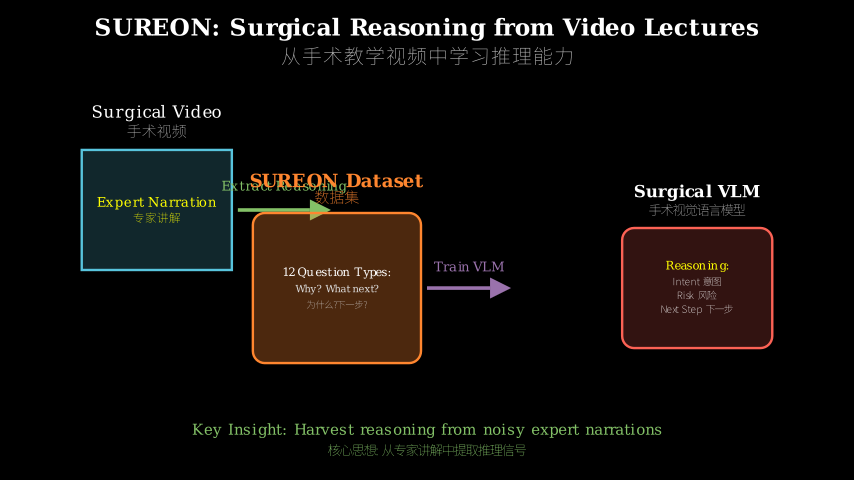
Yet the reasoning already exists, narrated aloud in surgical teaching videos. When an expert records a lecture, they explain “I’m choosing this approach because…” and “watch for bleeding here due to…” This supervision is noisy (mixed with tangential commentary) and unstructured (free-form speech), but it encodes exactly what’s missing: intent, risk assessment, and anticipation.
Problem: Surgical AI lacks reasoning ability
   |
   v
Observation: Teaching videos contain expert reasoning (noisy, unstructured)
   |
   v
Method: Multi-agent pipeline extracts QA pairs from lecture narrations
   |
   v
Evidence: 206.8K QA pairs across 12 reasoning categories, models reach 84% accuracy
   |
   v
Conclusion: Harvesting teaching signal enables surgical reasoning without manual annotation
The Increment
One sentence: Before SUREON, surgical AI could recognize what’s happening in an OR; after SUREON, it can explain why it’s happening and what might happen next.
Core Mechanism
SUREON’s pipeline has three stages. First, it ingests surgical teaching videos (YouTube lectures, recorded procedures with expert commentary) and uses speech recognition to extract narration transcripts. Second, a multi-agent LLM system processes these transcripts: one agent identifies reasoning-rich segments (explanations of technique choice, risk warnings, outcome predictions), another generates question-answer pairs following 12 predefined categories (safety assessment, decision rationale, forecasting, etc.), and a third validates coherence and grounds answers in visual content. Third, the system pairs each QA with its corresponding video clip, creating training triplets of (video, question, answer).
[Video Lecture] --speech-to-text--> [Transcript]
                                         |
                                         v
                              +----------+----------+
                              |  Multi-Agent LLM   |
                              +----------+----------+
                                         |
                    +--------------------+--------------------+
                    |                    |                    |
                    v                    v                    v
              [Identifier]          [Generator]         [Validator]
              (finds reasoning)   (creates QA pairs)   (checks quality)
                    |                    |                    |
                    +--------------------+--------------------+
                                         |
                                         v
                              [QA Pair + Video Clip]
                                         |
                                         v
                              [Training Dataset: 206.8K pairs]
Think of this like a medical school study group that records itself. The recording captures not just the procedure demonstration, but the running commentary: “I’m using this suture because…”, “if you see this sign, worry about…”. SUREON is the diligent student who rewatches all recordings, extracts every teaching moment, and organizes them into flashcards. The “identifier agent” is the student marking timestamps where the instructor explains something important. The “generator agent” turns those explanations into quiz questions. The “validator agent” is the study partner who checks if the flashcard makes sense and actually relates to what’s shown on screen. The result: a massive deck of surgical reasoning flashcards, automatically generated from existing teaching materials.
Key Concepts
-
Reasoning vs. Perception in Surgical AI: Perception means labeling what you see—“that’s a grasper, that’s the gallbladder”. Reasoning means understanding the clinical logic—“the surgeon chose a grasper instead of scissors because blunt dissection reduces bleeding risk in this inflamed tissue”. Current surgical datasets provide perception labels (bounding boxes, phase annotations). SUREON provides reasoning supervision (why this tool, what could go wrong, what happens next). It’s the difference between a medical student who can name anatomy and one who can explain a treatment plan.
-
Multi-Agent Extraction Pipeline: Instead of one LLM doing everything, SUREON uses specialized agents in sequence. Why? Because extracting reasoning from noisy lecture transcripts requires different skills: finding relevant segments (filtering), generating coherent questions (creativity), and validating visual grounding (quality control). One agent might hallucinate, but three agents checking each other’s work reduces errors. It’s like having a writer, an editor, and a fact-checker instead of one person doing all three jobs poorly.
-
Group Relative Policy Optimization (GRPO): Standard supervised fine-tuning teaches a model to mimic training examples. GRPO goes further—it trains the model to generate reasoning chains (like chain-of-thought), then rewards outputs that lead to correct answers. The model learns not just to answer, but to show its work. Imagine teaching a student by grading not just their final answer, but the quality of their reasoning steps. GRPO does this by comparing multiple reasoning attempts and reinforcing the better ones.
Framework Shift
Before (mainstream approach):        After (this paper):

[Surgical Video]                     [Surgical Video + Lecture Audio]
       |                                      |
       v                                      v
[Manual Annotation]                  [Multi-Agent Extraction]
 (experts label actions)              (LLMs mine reasoning)
       |                                      |
       v                                      v
[Perception Dataset]                 [Reasoning Dataset]
 (what is happening)                  (why + what if)
       |                                      |
       v                                      v
[Recognition Model]                  [Reasoning Model]
 "This is a grasper"                  "Grasper chosen for blunt
                                       dissection to reduce
                                       bleeding risk"
From manually annotating what’s visible to automatically harvesting why it matters, the core shift is treating teaching narration as free supervision instead of noise to be discarded.
Expert Assessment
Problem choice: This is a real gap. Surgical AI has plateaued at perception tasks—adding more labeled instruments won’t make models clinically useful. The leap to reasoning is necessary for deployment, and the observation that teaching videos already contain this signal is sharp. It sits at the frontier where computer vision meets clinical decision support.
Method maturity: The multi-agent pipeline is clever but not novel—it’s competent engineering of existing LLM techniques. The real contribution is problem framing: recognizing that lecture narrations are harvestable supervision. GRPO for surgical reasoning is a reasonable choice, though the paper doesn’t deeply explore why it outperforms alternatives. A simpler approach might be direct prompting of large VLMs, but the authors don’t test this baseline rigorously.
Experimental integrity: The benchmark (354 expert-validated examples) is small but carefully curated. Baselines include GPT-4V and Gemini, which is fair. The 84% accuracy sounds impressive until you realize the benchmark might be easier than real clinical scenarios—questions are derived from the same lecture corpus used for training, risking distribution overlap. The paper acknowledges this but doesn’t quantify the risk. Ablations are present but shallow—no analysis of which question categories benefit most from reasoning vs. supervised fine-tuning.
Writing quality: The abstract and introduction are strong. The method section buries important details (how are the 12 question categories defined? what prompts guide the agents?) in supplementary material. The results section focuses on aggregate accuracy without enough error analysis—which reasoning types still fail? The qualitative examples are cherry-picked; showing failure cases would build trust.
Verdict: Weak accept—the dataset contribution is valuable and the problem framing is important, but the modeling work feels incremental and the evaluation could be more rigorous.
Takeaways
The transferable idea: when expert reasoning is too expensive to annotate but already exists in unstructured teaching materials (lectures, tutorials, documentation), use multi-agent LLM pipelines to extract and structure it at scale. This applies beyond surgery—think code review comments for programming education, design critiques for architecture training, or strategy explanations in game replays. The key is identifying domains where experts naturally narrate their reasoning for teaching purposes, then systematically harvesting that signal.
Specific technique: the three-agent pattern (identifier → generator → validator) is a practical recipe for quality control when mining noisy text. Don’t trust one LLM to do extraction, generation, and validation—specialize and sequence them.
Warning: the paper doesn’t address a critical deployment question—how do you prevent the model from confidently hallucinating reasoning that sounds plausible but is clinically wrong? Surgical errors kill people. The 84% accuracy means 16% failure rate, which is unacceptable in real ORs. The paper treats this as a research benchmark problem, not a clinical deployment problem, which is honest but limits immediate applicability.
论文: 2603.06570 作者: Alejandra Perez, Anita Rau, Lee White, Busisiwe Mlambo, Chinedu Nwoye, Muhammad Abdullah Jamal, Omid Mohareri 分类: cs.CV, cs.AI
缺口
手术AI已经很擅长回答”是什么”——识别器械、追踪阶段、分割解剖结构。 像CholecT50和EndoVis这样的模型能以不错的准确率标注手术场景。 但如果你问”为什么外科医生在这里用单极剪刀而不是双极?”或”这种组织操作有什么并发症风险?”它们就哑口无言了。 问题不在模型架构,而在训练数据。 现有手术数据集(CholecT45、PSI-AVA、Surgical-VQLA)提供动作和物体的标签,但不提供背后的推理。 大规模标注手术推理需要专家外科医生观看数千小时视频,并为每个决策阐述思考过程——经济上不可行。
然而推理已经存在,就在手术教学视频的旁白中。 当专家录制讲座时,他们会解释”我选择这种方法是因为…”和”注意这里可能出血,原因是…”。 这种监督信号有噪声(混杂着无关评论)且无结构(自由形式的语音),但它恰好编码了缺失的东西:意图、风险评估和预判。
问题: 手术AI缺乏推理能力
   |
   v
观察: 教学视频包含专家推理(有噪声、无结构)
   |
   v
方法: 多智能体管道从讲座旁白中提取问答对
   |
   v
证据: 12个推理类别的206.8K问答对,模型达到84%准确率
   |
   v
结论: 收割教学信号使手术推理成为可能,无需人工标注
增量
一句话: SUREON之前,手术AI能识别手术室里正在发生什么; SUREON之后,它能解释为什么发生以及接下来可能发生什么。
核心机制
SUREON的管道分三个阶段。 首先,它摄入手术教学视频(YouTube讲座、带专家评论的录制手术),用语音识别提取旁白文本。 其次,多智能体LLM系统处理这些文本:一个智能体识别富含推理的片段(技术选择的解释、风险警告、结果预测),另一个按12个预定义类别(安全评估、决策理由、预测等)生成问答对,第三个验证连贯性并将答案锚定在视觉内容上。 第三,系统将每个问答与对应的视频片段配对,创建(视频、问题、答案)的训练三元组。
[教学视频] --语音转文字--> [文本]
                              |
                              v
                   +----------+----------+
                   |  多智能体LLM系统   |
                   +----------+----------+
                              |
         +--------------------+--------------------+
         |                    |                    |
         v                    v                    v
    [识别器]              [生成器]            [验证器]
  (找推理片段)          (创建问答对)        (检查质量)
         |                    |                    |
         +--------------------+--------------------+
                              |
                              v
                   [问答对 + 视频片段]
                              |
                              v
                   [训练数据集: 206.8K对]
把这想象成一个医学院学习小组录制自己的讨论。 录音不仅捕捉手术演示,还捕捉实时评论:“我用这种缝合线是因为…”、“如果你看到这个征象,要担心…”。 SUREON是那个勤奋的学生,重看所有录音,提取每个教学时刻,并把它们整理成抽认卡。 “识别器智能体”是标记讲师解释重要内容的时间戳的学生。 “生成器智能体”把那些解释变成测验问题。 “验证器智能体”是检查抽认卡是否合理、是否真的与屏幕上显示的内容相关的学习伙伴。 结果:一副海量的手术推理抽认卡,从现有教学材料中自动生成。
关键概念
-
手术AI中的推理vs感知: 感知意味着标注你看到的——“那是抓钳,那是胆囊”。 推理意味着理解临床逻辑——“外科医生选择抓钳而不是剪刀,因为钝性分离在这种炎症组织中能降低出血风险”。 现有手术数据集提供感知标签(边界框、阶段标注)。 SUREON提供推理监督(为什么用这个工具、可能出什么问题、接下来会怎样)。 这是能说出解剖名称的医学生和能解释治疗方案的医学生之间的区别。
-
多智能体提取管道: 不是让一个LLM做所有事,SUREON用专门的智能体按顺序工作。 为什么?因为从有噪声的讲座文本中提取推理需要不同技能:找相关片段(过滤)、生成连贯问题(创造力)、验证视觉锚定(质量控制)。 一个智能体可能产生幻觉,但三个智能体互相检查能减少错误。 这就像有作家、编辑和事实核查员,而不是一个人把三份工作都做得很糟。
-
群体相对策略优化(GRPO): 标准监督微调教模型模仿训练样例。 GRPO更进一步——它训练模型生成推理链(类似思维链),然后奖励导致正确答案的输出。 模型学习的不仅是回答,还有展示推理过程。 想象教学生时不仅给最终答案打分,还给推理步骤的质量打分。 GRPO通过比较多次推理尝试并强化更好的那些来做到这一点。
框架转变
之前(主流方法):                  之后(本文方法):

[手术视频]                       [手术视频 + 讲座音频]
     |                                  |
     v                                  v
[人工标注]                       [多智能体提取]
(专家标注动作)                   (LLM挖掘推理)
     |                                  |
     v                                  v
[感知数据集]                     [推理数据集]
(正在发生什么)                   (为什么 + 如果)
     |                                  |
     v                                  v
[识别模型]                       [推理模型]
"这是抓钳"                       "选择抓钳是为了钝性
                                  分离以降低出血风险"
从人工标注可见内容到自动收割其重要性,核心转变是把教学旁白当作免费监督而非要丢弃的噪声。
专家评审
选题眼光: 这是真缺口。 手术AI在感知任务上已经停滞——标注更多器械不会让模型在临床上有用。 向推理的跃迁对部署是必要的,而观察到教学视频已经包含这种信号是敏锐的。 它处在计算机视觉与临床决策支持交汇的前沿。
方法成熟度: 多智能体管道巧妙但不新颖——是对现有LLM技术的称职工程。 真正的贡献是问题框架:认识到讲座旁白是可收割的监督。 GRPO用于手术推理是合理选择,但论文没有深入探讨为什么它优于替代方案。 更简单的方法可能是直接提示大型VLM,但作者没有严格测试这个基线。
实验诚意: 基准测试(354个专家验证样例)规模小但精心策划。 基线包括GPT-4V和Gemini,这是公平的。 84%的准确率听起来令人印象深刻,直到你意识到基准可能比真实临床场景更容易——问题源自用于训练的同一讲座语料库,存在分布重叠风险。 论文承认这点但没有量化风险。 消融实验存在但浅显——没有分析哪些问题类别从推理vs监督微调中受益最多。
写作功力: 摘要和引言很强。 方法部分把重要细节(12个问题类别如何定义?什么提示引导智能体?)埋在补充材料里。 结果部分关注总体准确率,错误分析不足——哪些推理类型仍然失败?定性例子是精心挑选的; 展示失败案例会建立信任。
判决: 弱接收——数据集贡献有价值,问题框架重要,但建模工作感觉渐进,评估可以更严格。
要点总结
可迁移的想法:当专家推理标注成本太高但已存在于非结构化教学材料(讲座、教程、文档)中时,用多智能体LLM管道大规模提取并结构化它。 这适用于手术之外——想想编程教育的代码审查评论、建筑培训的设计批评、或游戏回放中的策略解释。 关键是识别专家为教学目的自然叙述推理的领域,然后系统地收割那个信号。
具体技术:三智能体模式(识别器→生成器→验证器)是挖掘有噪声文本时质量控制的实用配方。 不要信任一个LLM做提取、生成和验证——专门化并按顺序执行它们。
警告:论文没有解决一个关键的部署问题——如何防止模型自信地幻觉出听起来合理但临床上错误的推理?手术错误会致命。 84%准确率意味着16%失败率,这在真实手术室中是不可接受的。 论文把这当作研究基准问题而非临床部署问题,这是诚实的但限制了即时适用性。