
Paper: 2605.06642 Authors: Xiangyuan Xue, Yifan Zhou, Zidong Wang, Shengji Tang, Philip Torr, Wanli Ouyang, Lei Bai, Zhenfei Yin Categories: cs.CL, cs.AI
The Gap
Current LLM agents trained with RL are purely reactive—they see a state, pick an action, repeat. This works for short tasks but breaks down over long horizons because: (1) exploration becomes aimless wandering without a guiding plan, and (2) credit assignment gets diluted across dozens of steps, making it hard to learn what early decisions mattered. Prior work like ReAct and Reflexion add reasoning traces, but these are still step-by-step reactions, not strategic commitments. The field has trajectory-level rewards but no trajectory-level intent.
Problem: Long-horizon RL for LLM agents
    |
    v
Observation: Reactive policies struggle with exploration + credit assignment
    |
    v
Assumption: Explicit strategy can guide action sequences
    |
    v
Method: Two-level hierarchy (strategy -> actions) + joint training
    |
    v
Evidence: 93.1% ALFWorld, 84.2% WebShop, 63.5% SciWorld
    |
    v
Conclusion: Strategic abstraction improves sample efficiency + final performance
The Increment
One sentence: Before StraTA, LLM agents reacted step-by-step to observations; after StraTA, they commit to a compact strategy upfront and execute actions conditioned on that plan.
Core Mechanism
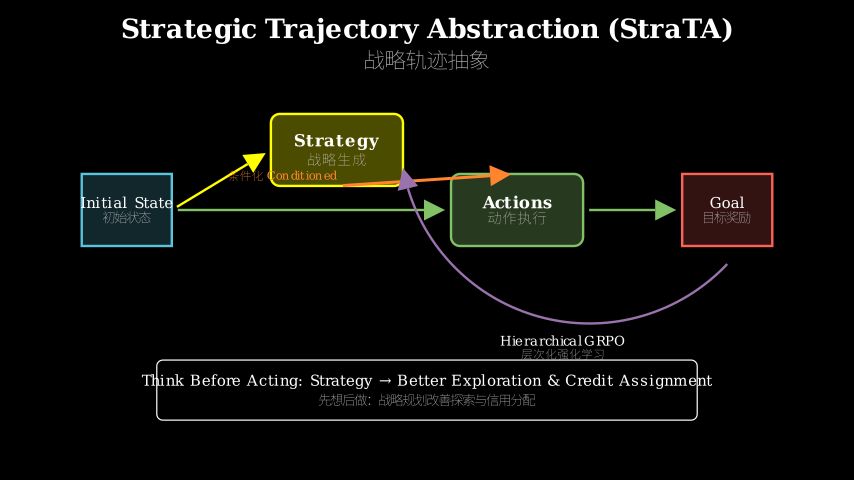
StraTA introduces a two-level hierarchy. At the start of an episode, a strategy generator samples a compact natural language plan (e.g., “search for the target object in likely rooms, then manipulate it”). This strategy is a short paragraph, not a step-by-step script. The action executor then generates individual actions conditioned on both the current observation and the fixed strategy.
Training happens jointly via hierarchical GRPO (Group Relative Policy Optimization). For each task, StraTA samples multiple strategies, rolls out action trajectories for each, and computes trajectory-level rewards. The strategy generator learns to produce plans that lead to high-reward rollouts. The action executor learns to follow those plans effectively. Two enhancements boost performance: diverse strategy rollout (sample varied plans to explore different solution paths) and critical self-judgment (the model critiques its own strategy before execution, filtering out obviously bad plans).
Episode Start
    |
    v
[Strategy Generator] --samples--> "Search kitchen, then bedroom..."
    |                                        |
    |                                        v
    |                              (compact natural language)
    |                                        |
    +----------------------------------------+
    |
    v
[Action Executor] --conditioned on strategy + obs--> action_1, action_2, ...
    |
    v
Trajectory Rollout --> Reward
    |
    v
[Hierarchical GRPO] updates both generator + executor
Think of StraTA like a chess player deciding on an opening strategy before moving pieces. A reactive player evaluates each move in isolation—“this square looks good right now.” A strategic player commits to an opening (e.g., “I’ll play the Sicilian Defense”) and then executes moves that fit that plan. The strategy doesn’t dictate every move, but it constrains the search space and gives coherence to the sequence. If the opening fails, the player learns to pick better openings next time, not just better individual moves. StraTA’s strategy generator is the opening choice, the action executor is the move-by-move play, and hierarchical GRPO is the post-game analysis that updates both levels.
Key Concepts
-
Trajectory-level strategy: A compact natural language plan generated once at the start of an episode, not a step-by-step script. It’s abstract enough to allow flexibility (the executor still decides specific actions) but concrete enough to guide exploration (e.g., “focus on the kitchen first” rules out wandering into the garage). The key insight: by committing to a strategy upfront, the agent turns a long-horizon problem into a shorter one—now it’s just executing a plan, not searching the entire action space at every step. Example: In ALFWorld, instead of randomly opening drawers, the strategy might be “locate the target object type, then find a container to place it in,” which immediately narrows the search.
-
Hierarchical GRPO: Standard GRPO compares action probabilities within a group of rollouts to compute advantages. StraTA extends this to two levels: strategy-level GRPO compares different strategies’ trajectory rewards, and action-level GRPO compares actions within each strategy’s rollout. The hierarchy matters because it separates “was this a good plan?” from “did I execute the plan well?” Without this separation, a bad strategy with lucky actions could get reinforced, or a good strategy with clumsy execution could get penalized. The joint training ensures both levels improve together.
-
Critical self-judgment: Before executing a strategy, the model generates a critique of its own plan (e.g., “This strategy assumes the object is in the kitchen, but the task description mentions the bedroom—this might fail”). If the critique identifies fatal flaws, the strategy is rejected and a new one is sampled. This is a lightweight filter that prevents obviously doomed plans from wasting rollout budget. It’s not a separate model—it’s the same LLM doing self-reflection, which works because LLMs are decent at spotting logical inconsistencies in text, even their own.
Framework Shift
Before (reactive RL):                After (StraTA):

  obs_1 --> action_1                   task --> [Strategy Gen]
    |                                            |
  obs_2 --> action_2                             v
    |                                        "search A, then B"
  obs_3 --> action_3                             |
    |                                            v
   ...                                   obs_1 + strategy --> action_1
    |                                            |
  reward                                 obs_2 + strategy --> action_2
                                                 |
(each action independent)                       ...
                                                 |
                                             reward
                                                 |
                                                 v
                                         update strategy + actions
From step-by-step reaction to plan-then-execute, the core shift is introducing an explicit commitment layer that guides the entire trajectory.
Expert Assessment
Problem choice: This is a real gap. Long-horizon RL for LLM agents is a known pain point, and the reactive nature of current methods is a legitimate bottleneck. The problem sits squarely in the “LLMs as agents” trajectory, which is hot but still early-stage. The framing is clean—strategy as a first-class object, not just a side effect of reasoning traces.
Method maturity: The core idea (hierarchical planning) is old, but the execution is thoughtful. Using natural language as the strategy representation is clever—it leverages the LLM’s existing strengths rather than forcing it to learn a new symbolic language. The hierarchical GRPO design is straightforward, not a Rube Goldberg machine. Critical self-judgment feels a bit like prompt engineering dressed up as a method, but it’s cheap and it works. No obvious simpler approach is being overlooked—you could try end-to-end RL without the hierarchy, but that’s exactly what fails in the baselines.
Experimental integrity: Baselines are fair (ReAct, Reflexion, standard GRPO). The benchmarks (ALFWorld, WebShop, SciWorld) are standard in the field. The numbers are strong—93.1% on ALFWorld is near-saturation, 84.2% on WebShop beats prior SOTA by a healthy margin, and 63.5% on SciWorld outperforms GPT-4. One red flag: no ablation on critical self-judgment’s contribution in isolation, only combined with diverse rollout. The writing glosses over failure modes—what happens when the strategy is coherent but wrong? How often does self-judgment reject good strategies?
Writing quality: The method section is clear, but the related work is a laundry list. The results section front-loads the wins without enough error analysis. If the authors rewrote Section 4.3 to include failure case studies (e.g., “here’s a strategy that looked good but led to a dead end, and here’s why the model generated it”), the paper would feel more honest and the insights would be more actionable.
Verdict: weak accept — The method is sound, the results are strong, and the problem is real, but the paper doesn’t dig deep enough into when and why the approach fails.
Takeaways
Hierarchical conditioning is underused: Most LLM agent work treats every decision as equally important. StraTA shows that separating high-level intent from low-level execution improves both. This transfers directly to other domains—imagine a coding agent that first decides “refactor the auth module” (strategy) then generates specific diffs (actions), rather than making isolated edits.
Self-critique as a filter: Critical self-judgment is a cheap way to prune bad plans before wasting compute on rollouts. The key: use the same model, not a separate verifier. This works for any generative task where the model can spot its own mistakes in text form (e.g., “this SQL query will fail because the table doesn’t exist”).
Natural language as a latent space: Instead of learning abstract strategy embeddings, StraTA uses natural language plans. This makes the strategy interpretable and lets you inject domain knowledge via prompting. If you’re building hierarchical agents, consider whether your “high-level plan” can be human-readable text rather than a learned vector.
论文: 2605.06642 作者: Xiangyuan Xue, Yifan Zhou, Zidong Wang, Shengji Tang, Philip Torr, Wanli Ouyang, Lei Bai, Zhenfei Yin 分类: cs.CL, cs.AI
缺口
当前用强化学习训练的大语言模型智能体是纯反应式的——看到状态,选择动作,重复。
这对短任务有效,但在长期任务中会崩溃,原因有二:(1)探索变成漫无目的的游荡,缺乏指导性计划;(2)信用分配在几十个步骤中被稀释,难以学习早期决策的重要性。
ReAct 和 Reflexion 等先前工作添加了推理轨迹,但这些仍然是逐步反应,而非战略承诺。
该领域有轨迹级奖励,但没有轨迹级意图。
问题:大语言模型智能体的长期强化学习
    |
    v
观察:反应式策略在探索和信用分配上挣扎
    |
    v
假设:显式战略可以引导动作序列
    |
    v
方法:两层层级(战略 -> 动作)+ 联合训练
    |
    v
证据:ALFWorld 93.1%,WebShop 84.2%,SciWorld 63.5%
    |
    v
结论:战略抽象提升样本效率和最终性能
增量
一句话:StraTA 之前,大语言模型智能体逐步对观察做出反应;StraTA 之后,它们预先承诺一个紧凑战略,然后基于该计划执行动作。
核心机制
StraTA 引入两层层级。
在回合开始时,战略生成器采样一个紧凑的自然语言计划(例如”在可能的房间中搜索目标物体,然后操作它”)。
这个战略是一个短段落,不是逐步脚本。
然后动作执行器基于当前观察和固定战略生成单个动作。
训练通过分层 GRPO(组相对策略优化)联合进行。
对于每个任务,StraTA 采样多个战略,为每个战略展开动作轨迹,并计算轨迹级奖励。
战略生成器学习产生导致高奖励展开的计划。
动作执行器学习有效遵循这些计划。
两个增强提升性能:多样化战略展开(采样不同计划以探索不同解决路径)和批判性自我判断(模型在执行前批判自己的战略,过滤掉明显糟糕的计划)。
回合开始
    |
    v
[战略生成器] --采样--> "搜索厨房,然后卧室..."
    |                              |
    |                              v
    |                    (紧凑自然语言)
    |                              |
    +------------------------------+
    |
    v
[动作执行器] --基于战略+观察--> 动作1, 动作2, ...
    |
    v
轨迹展开 --> 奖励
    |
    v
[分层GRPO] 更新生成器和执行器
把 StraTA 想象成下棋选手在移动棋子前决定开局战略。
反应式选手孤立评估每步棋——“这个位置现在看起来不错”。
战略型选手承诺一个开局(例如”我要走西西里防御”),然后执行符合该计划的走法。
战略不规定每一步,但它约束搜索空间并赋予序列连贯性。
如果开局失败,选手学习下次选择更好的开局,而不仅仅是更好的单步走法。
StraTA 的战略生成器是开局选择,动作执行器是逐步走棋,分层 GRPO 是赛后分析,更新两个层级。
关键概念
- 轨迹级战略:在回合开始时生成一次的紧凑自然语言计划,不是逐步脚本。
它足够抽象以允许灵活性(执行器仍然决定具体动作),但足够具体以引导探索(例如”先关注厨房”排除了游荡到车库)。
关键洞察:通过预先承诺战略,智能体将长期问题转化为短期问题——现在它只是执行计划,而不是在每一步搜索整个动作空间。
例子:在 ALFWorld 中,战略可能是”定位目标物体类型,然后找一个容器放置它”,而不是随机打开抽屉,这立即缩小了搜索范围。
- 分层 GRPO:标准 GRPO 比较一组展开中的动作概率以计算优势。
StraTA 将其扩展到两个层级:战略级 GRPO 比较不同战略的轨迹奖励,动作级 GRPO 比较每个战略展开中的动作。
层级很重要,因为它分离了”这是个好计划吗?“和”我执行计划好吗?”。
没有这种分离,一个糟糕战略加上幸运动作可能被强化,或者一个好战略加上笨拙执行可能被惩罚。
联合训练确保两个层级一起改进。
- 批判性自我判断:在执行战略之前,模型生成对自己计划的批判(例如”这个战略假设物体在厨房,但任务描述提到卧室——这可能失败”)。
如果批判识别出致命缺陷,战略被拒绝并采样新的。
这是一个轻量级过滤器,防止明显注定失败的计划浪费展开预算。
它不是单独的模型——是同一个大语言模型在做自我反思,这有效是因为大语言模型擅长发现文本中的逻辑不一致,即使是自己的。
框架转变
之前(反应式强化学习):          之后(StraTA):

  观察1 --> 动作1                   任务 --> [战略生成]
    |                                        |
  观察2 --> 动作2                            v
    |                                   "搜索A,然后B"
  观察3 --> 动作3                            |
    |                                        v
   ...                              观察1 + 战略 --> 动作1
    |                                        |
  奖励                               观察2 + 战略 --> 动作2
                                             |
(每个动作独立)                            ...
                                             |
                                          奖励
                                             |
                                             v
                                      更新战略和动作
从逐步反应到先计划后执行,核心转变是引入一个显式承诺层来引导整个轨迹。
专家评审
选题眼光:这是真实缺口。
大语言模型智能体的长期强化学习是已知痛点,当前方法的反应性是合理瓶颈。
问题正好处于”大语言模型作为智能体”的轨迹中,这个方向很热但仍处于早期阶段。
框架清晰——战略作为一等对象,而不仅仅是推理轨迹的副作用。
方法成熟度:核心思想(分层规划)是旧的,但执行是深思熟虑的。
使用自然语言作为战略表示很聪明——它利用大语言模型的现有优势,而不是强迫它学习新的符号语言。
分层 GRPO 设计简单直接,不是鲁布·戈德堡机器。
批判性自我判断感觉有点像伪装成方法的提示工程,但它便宜且有效。
没有明显被忽略的更简单方法——你可以尝试没有层级的端到端强化学习,但那正是基线中失败的。
实验诚意:基线公平(ReAct、Reflexion、标准 GRPO)。
基准测试(ALFWorld、WebShop、SciWorld)是该领域的标准。
数字强劲——ALFWorld 上 93.1% 接近饱和,WebShop 上 84.2% 以健康幅度击败先前最佳,SciWorld 上 63.5% 超越 GPT-4。
一个警示:没有单独对批判性自我判断贡献的消融实验,只有与多样化展开结合的。
写作掩盖了失败模式——当战略连贯但错误时会发生什么?自我判断多久拒绝一次好战略?
写作功力:方法部分清晰,但相关工作是清单式的。
结果部分优先展示胜利,没有足够的错误分析。
如果作者重写 4.3 节以包含失败案例研究(例如”这是一个看起来不错但导致死胡同的战略,这是模型生成它的原因”),论文会感觉更诚实,洞察会更可操作。
判决:弱接收——方法合理,结果强劲,问题真实,但论文没有深入挖掘方法何时以及为何失败。
要点总结
分层条件化被低估:大多数大语言模型智能体工作将每个决策视为同等重要。
StraTA 表明分离高层意图和低层执行可以改进两者。
这直接迁移到其他领域——想象一个编码智能体首先决定”重构认证模块”(战略),然后生成具体差异(动作),而不是进行孤立编辑。
自我批判作为过滤器:批判性自我判断是在浪费计算展开之前修剪糟糕计划的廉价方法。
关键:使用同一个模型,而不是单独的验证器。
这适用于任何模型可以以文本形式发现自己错误的生成任务(例如”这个 SQL 查询会失败,因为表不存在”)。
自然语言作为潜在空间:StraTA 使用自然语言计划,而不是学习抽象战略嵌入。
这使战略可解释,并允许你通过提示注入领域知识。
如果你正在构建分层智能体,考虑你的”高层计划”是否可以是人类可读的文本,而不是学习的向量。