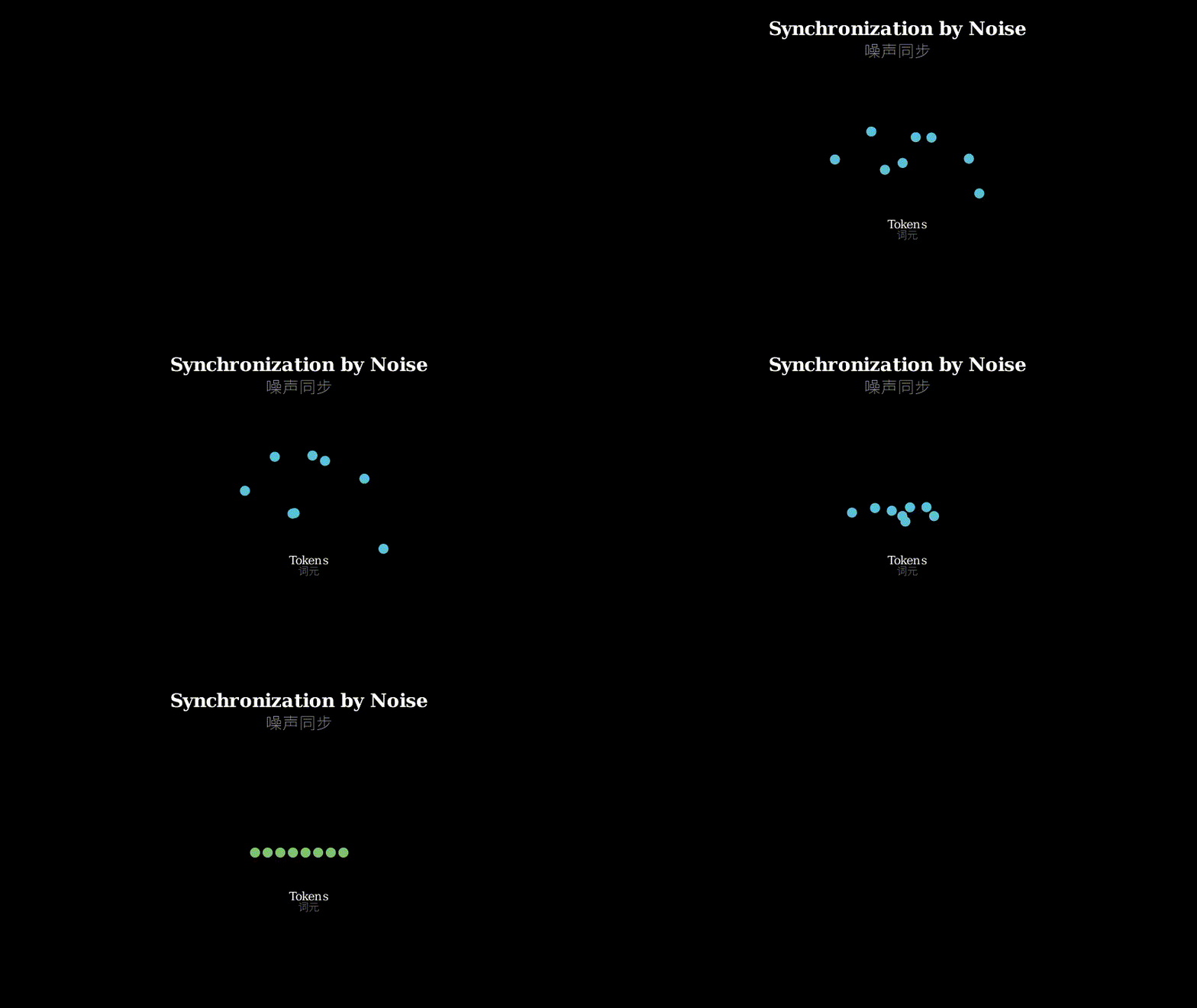
Paper: 2604.26898 Authors: Andrea Agazzi, Giuseppe Bruno, Eloy Mosig García, Samuele Saviozzi, Marco Romito Categories: math.PR, cs.LG, stat.ML
The Gap
We know transformers work empirically, but we lack rigorous mathematical foundations for why they work. Prior work either analyzes infinite-width limits (losing finite-width behavior) or studies deterministic dynamics (ignoring stochastic training). The gap: no pathwise convergence proof for finite-depth, finite-width transformers with stochastic noise that explains emergent synchronization behavior.
Empirical Success          Mathematical Gap              This Paper
    (transformers)    -->  (no rigorous limit)      -->  (pathwise proof)
         |                        |                           |
         v                        v                           v
    [observed                [missing                   [stochastic PDE
     sync behavior]           theory]                    + chaos proof]
         |                        |                           |
         +------------------------+---------------------------+
                                  |
                                  v
                         Why does noise help?
The Increment
One sentence: Before this paper, we had no rigorous proof that finite transformers converge to continuous stochastic systems with quantifiable synchronization; after, we have pathwise convergence bounds and a PDE describing token evolution.
Core Mechanism
The paper treats each token as a particle moving through transformer layers. As depth and width grow (but stay finite), these particles’ trajectories converge to a continuous-time stochastic process. The key components: (1) self-attention creates deterministic drift pulling tokens toward each other, (2) MLP blocks inject common noise across all tokens, (3) the interplay between drift and noise determines whether tokens synchronize or diverge.
The proof establishes quantitative bounds on convergence rates using Wasserstein distance. Crucially, the limits commute—you can take depth→∞ then width→∞ or vice versa and get the same result. When token count is large, propagation of chaos holds: each token’s evolution becomes independent in the limit, governed by a mean-field SPDE.
Layer k:   [token_1]  [token_2]  ...  [token_N]
              |  \      /  |              |
              |   \    /   |              |
           [self-attention drift] -----> pulls together
              |      |      |              |
              v      v      v              v
           [MLP noise injection] -------> common randomness
              |      |      |              |
              v      v      v              v
Layer k+1: [token_1'] [token_2'] ... [token_N']
              |                              |
              +------------------------------+
                          |
                    (iterate depth)
                          |
                          v
              Continuous limit (depth -> ∞)
                          |
                          v
              Stochastic PDE for distribution
Think of it like a flock of birds. Self-attention is the social force—each bird adjusts velocity based on neighbors’ positions (deterministic drift). MLP noise is turbulent wind affecting all birds simultaneously (common noise). In calm air, birds might drift apart. But strong turbulent wind forces them to move together—they synchronize not despite the noise, but because of it. The paper proves this “synchronization by noise” rigorously: when common noise is sufficiently coercive (strong enough relative to drift), the interaction energy between tokens decays exponentially. The flock coheres.
Key Concepts
-
Propagation of Chaos: Imagine a crowded room where everyone influences everyone else. As the room grows infinitely large, paradoxically, each person’s behavior becomes *independent—they only feel the average crowd effect, not individual interactions. Mathematically: N interacting particles converge to N independent copies of a mean-field process. Concrete example: in a transformer with 1000 tokens, each token’s evolution is approximately governed by the average token distribution, not by specific pairwise interactions.
-
Synchronization by Noise: Counterintuitive phenomenon where randomness creates order. Two oscillators with slightly different natural frequencies will drift apart deterministically. Add common noise (same random kicks to both), and they lock into phase. Here: tokens with different initial embeddings would diverge under pure self-attention, but MLP noise (shared across tokens) forces alignment. The paper proves this happens when noise covariance dominates the Hessian of self-attention drift.
-
Commuting Limits: Taking depth→∞ then width→∞ gives the same result as width→∞ then depth→∞. This is non-trivial—many neural network scaling limits don’t commute (order matters). Here it does, meaning the continuous-time stochastic model is robust: it doesn’t depend on which asymptotic you take first. Think of it like reaching a mountain peak: whether you climb the north face then traverse east, or go east then climb, you end up at the same summit.
Framework Shift
Before (mainstream approach):        After (this paper):

Transformer as                       Transformer as
discrete computation:                continuous stochastic flow:

  Layer 1                              t=0: initial distribution
     |                                   |
  Layer 2              vs.               | (SPDE evolution)
     |                                   |
  Layer 3                              t=T: final distribution
     |
  Output                              + Quantitative bounds
                                      + Synchronization proof
                                      + Chaos propagation

(empirical analysis)                 (rigorous limit theory)
From discrete layer-by-layer computation to continuous stochastic flow, the core shift is treating depth as time and proving pathwise convergence with quantifiable rates.
Expert Assessment
Problem choice: Real gap. The disconnect between empirical transformer success and theoretical understanding is a major open problem. This paper doesn’t just manufacture a toy model—it tackles finite-depth, finite-width transformers with realistic components (self-attention + MLP). The synchronization angle is fresh; most theory work ignores emergent collective behavior.
Method maturity: Sophisticated machinery from stochastic analysis (Wasserstein distance, propagation of chaos, SPDE theory). Not brute force—the commuting limits result is elegant and non-obvious. However, the assumptions are strong: requires specific scaling of parameters, smooth activation functions, and sufficiently coercive noise. Real transformers use ReLU (non-smooth) and may not satisfy coercivity conditions. The gap between theory and practice remains.
Experimental integrity: This is a pure theory paper—no experiments. The proofs appear rigorous (published authors with strong track records in stochastic analysis). The quantitative bounds are explicit, which is rare and valuable. Red flag: no numerical validation that the bounds are tight or that the limiting SPDE actually approximates finite transformers well in practice.
Writing quality: Dense. The abstract packs too much jargon for accessibility. Section 2 (setup) could benefit from a concrete example before diving into notation. The synchronization result (Theorem 4.1) is buried—should be highlighted earlier. If the authors rewrote the introduction to lead with “we prove transformers synchronize via noise” and deferred technical conditions, the paper would reach a broader audience.
Verdict: weak accept — Solid theoretical contribution with rigorous proofs, but limited immediate practical impact due to restrictive assumptions and lack of empirical validation.
Takeaways
For theorists: The commuting limits technique is transferable. If you’re proving scaling limits for any multi-scale system (depth + width, time + space), check whether limits commute—it often simplifies analysis and strengthens results.
For practitioners: The synchronization-by-noise insight suggests a design principle: if you want token representations to align, inject *common noise (same dropout mask across tokens) rather than independent noise. This is opposite to standard dropout practice. Worth experimenting with.
For ML researchers: The paper identifies which activation functions enable synchronization (those with coercive Hessians). This gives a principled way to choose activations beyond empirical trial-and-error. Specifically: activations with strong second derivatives relative to first derivatives promote synchronization.
Honest assessment: Most practitioners won’t directly use these results—the assumptions are too restrictive. But the conceptual framing (transformers as particle systems, noise as synchronizer) is valuable for building intuition about why deep networks generalize.
论文: 2604.26898 作者: Andrea Agazzi, Giuseppe Bruno, Eloy Mosig García, Samuele Saviozzi, Marco Romito 分类: math.PR, cs.LG, stat.ML
缺口
我们知道 Transformer 在实践中有效,但缺乏严格的数学基础来解释为什么有效。
此前的工作要么分析无限宽度极限(丢失有限宽度行为),要么研究确定性动力学(忽略随机训练)。
缺口在于:没有针对有限深度、有限宽度 Transformer 的路径收敛证明,无法解释随机噪声下的涌现同步行为。
实践成功              数学缺口                本文
(transformers)   -->  (无严格极限)       -->  (路径证明)
     |                     |                      |
     v                     v                      v
 [观察到的              [缺失的                [随机偏微分方程
  同步行为]              理论]                  + 混沌传播证明]
     |                     |                      |
     +---------------------+----------------------+
                           |
                           v
                   噪声为何有助?
增量
一句话: 本文之前,我们没有严格证明有限 Transformer 收敛到具有可量化同步性的连续随机系统;
本文之后,我们有了路径收敛界和描述 token 演化的偏微分方程。
核心机制
论文将每个 token 视为穿越 Transformer 层的粒子。
当深度和宽度增长(但保持有限)时,这些粒子的轨迹收敛到连续时间随机过程。
关键组件:(1)自注意力产生确定性漂移,将 token 拉向彼此;
(2)MLP 块向所有 token 注入共同噪声;
(3)漂移与噪声的相互作用决定 token 是同步还是发散。
证明使用 Wasserstein 距离建立了收敛速率的定量界。
关键是极限可交换——你可以先取深度→∞再取宽度→∞,或反过来,得到相同结果。
当 token 数量很大时,混沌传播成立:每个 token 的演化在极限下变得独立,由平均场随机偏微分方程支配。
第 k 层:   [token_1]  [token_2]  ...  [token_N]
              |  \      /  |              |
              |   \    /   |              |
           [自注意力漂移] -----> 拉到一起
              |      |      |              |
              v      v      v              v
           [MLP 噪声注入] -------> 共同随机性
              |      |      |              |
              v      v      v              v
第 k+1 层: [token_1'] [token_2'] ... [token_N']
              |                              |
              +------------------------------+
                          |
                    (迭代深度)
                          |
                          v
              连续极限 (深度 -> ∞)
                          |
                          v
              分布演化的随机偏微分方程
把它想象成一群鸟。
自注意力是社会力——每只鸟根据邻居的位置调整速度(确定性漂移)。
MLP 噪声是同时影响所有鸟的湍流风(共同噪声)。
在平静空气中,鸟可能分散。
但强湍流风迫使它们一起移动——它们同步不是尽管有噪声,而是因为噪声。
论文严格证明了这种”噪声同步”:当共同噪声足够强制(相对于漂移足够强)时,token 之间的相互作用能量呈指数衰减。
鸟群凝聚。
关键概念
- 混沌传播: 想象一个拥挤的房间,每个人都影响其他人。
当房间无限大时,矛盾的是,每个人的行为变得独立——他们只感受到平均人群效应,而非个体互动。
数学上:N 个相互作用的粒子收敛到平均场过程的 N 个独立副本。
具体例子:在有 1000 个 token 的 Transformer 中,每个 token 的演化近似由平均 token 分布支配,而非特定的成对互动。
- 噪声同步: 反直觉现象,随机性创造秩序。
两个自然频率略有不同的振荡器在确定性下会分离。
添加共同噪声(对两者相同的随机踢动),它们锁定相位。
这里:具有不同初始嵌入的 token 在纯自注意力下会发散,但 MLP 噪声(跨 token 共享)强制对齐。
论文证明当噪声协方差主导自注意力漂移的 Hessian 时会发生这种情况。
- 可交换极限: 先取深度→∞再取宽度→∞与先取宽度→∞再取深度→∞给出相同结果。
这并非平凡——许多神经网络缩放极限不可交换(顺序重要)。
这里可以,意味着连续时间随机模型是稳健的:不依赖于你先取哪个渐近。
想象爬山:无论你先爬北坡再向东横穿,还是先向东再爬,都到达同一山峰。
框架转变
之前(主流方法):                之后(本文方法):

Transformer 作为                  Transformer 作为
离散计算:                        连续随机流:

  第 1 层                            t=0: 初始分布
     |                                  |
  第 2 层              vs.              | (随机偏微分方程演化)
     |                                  |
  第 3 层                             t=T: 最终分布
     |
  输出                               + 定量界
                                     + 同步证明
                                     + 混沌传播

(经验分析)                          (严格极限理论)
从逐层离散计算到连续随机流,核心转变是将深度视为时间并证明具有可量化速率的路径收敛。
专家评审
选题眼光: 真实缺口。
Transformer 实践成功与理论理解之间的脱节是重大开放问题。
本文不是制造玩具模型——它处理具有现实组件(自注意力 + MLP)的有限深度、有限宽度 Transformer。
同步角度新颖;
大多数理论工作忽略涌现的集体行为。
方法成熟度: 来自随机分析的复杂机制(Wasserstein 距离、混沌传播、随机偏微分方程理论)。
不是蛮力——可交换极限结果优雅且非显然。
然而,假设很强:需要参数的特定缩放、光滑激活函数和足够强制的噪声。
真实 Transformer 使用 ReLU(非光滑)且可能不满足强制性条件。
理论与实践之间的差距仍然存在。
实验诚意: 这是纯理论论文——没有实验。
证明看起来严格(作者在随机分析领域有强大记录)。
定量界是显式的,这很罕见且有价值。
警示:没有数值验证界是紧的或极限随机偏微分方程在实践中很好地近似有限 Transformer。
写作功力: 密集。
摘要为了可及性塞了太多术语。
第 2 节(设置)在深入符号之前可以受益于具体例子。
同步结果(定理 4.1)被埋没——应该更早突出。
如果作者重写引言,以”我们证明 Transformer 通过噪声同步”开头并推迟技术条件,论文将触及更广泛的受众。
判决: 弱接收 — 具有严格证明的扎实理论贡献,但由于限制性假设和缺乏经验验证,直接实践影响有限。
要点总结
对理论家: 可交换极限技术可迁移。
如果你正在证明任何多尺度系统(深度 + 宽度、时间 + 空间)的缩放极限,检查极限是否可交换——它通常简化分析并加强结果。
对实践者: 噪声同步洞见提示设计原则:如果你想让 token 表示对齐,注入**共同*噪声(跨 token 相同的 dropout 掩码)而非独立噪声。
这与标准 dropout 实践相反。
值得实验。
对机器学习研究者: 论文识别哪些激活函数启用同步(具有强制 Hessian 的那些)。
这提供了超越经验试错选择激活的原则方法。
具体:相对于一阶导数具有强二阶导数的激活促进同步。
诚实评估: 大多数实践者不会直接使用这些结果——假设太限制。
但概念框架(Transformer 作为粒子系统、噪声作为同步器)对建立深度网络为何泛化的直觉很有价值。