Paper: 2603.13131 Authors: Zhengwei Xie, Zhisheng Chen, Ziyan Weng, Tingyu Wu, Chenglong Li, Vireo Zhang, Kun Wang Categories: cs.AI
The Gap
Existing open-world embodied agents (like those in Minecraft) struggle with long-horizon tasks not because they can’t plan individual steps, but because they can’t learn from their mistakes systematically. Current approaches either use static retrieval from fixed experience databases or fine-tune model parameters, which is expensive and brittle. The core problem: when an agent fails at “build a house,” it gets a binary signal (success/fail) but no structured understanding of why it failed at step 37 of 200, making it impossible to extract reusable lessons.
Prior work like Voyager uses code-based skills but lacks failure analysis. ReAct-style methods do online replanning but don’t accumulate knowledge across episodes. DEPS and similar systems store experiences but without fine-grained diagnosis, leading to shallow pattern matching.
Problem: Long-horizon tasks fail, no learning mechanism
    |
    v
Assumption: Rich diagnosis + structured storage = evolution
    |
    v
Method: 3-phase cycle (Anchor -> Distill -> Control)
    |
    v
Evidence: MCU benchmark shows consistent gains over baselines
    |
    v
Conclusion: Non-parametric evolution works for embodied agents
The Increment
One sentence: Before this paper, agents either didn’t learn from failures or required expensive retraining; after, they evolve through structured experience accumulation without touching model weights.
Core Mechanism
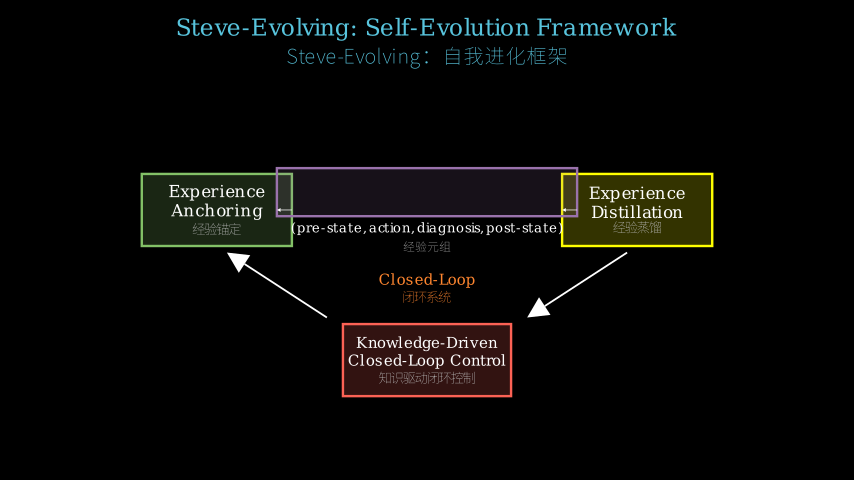
The system operates in three phases that form a closed loop. First, Experience Anchoring captures every subgoal attempt as a structured tuple: what the world looked like before (pre-state), what action was taken, a detailed diagnosis of what happened (not just pass/fail, but state differences, failure causes, stagnation detection), and the resulting world state (post-state). These tuples get indexed in a three-tier space using condition signatures, spatial hashing, and semantic tags, with rolling summarization to keep the database manageable.
Second, Experience Distillation processes these anchored experiences in two parallel tracks. Successful trajectories get generalized into reusable skills with explicit preconditions (“you can craft a pickaxe if you have sticks and cobblestone”) and verification criteria (“check inventory for pickaxe item”). Failed trajectories get distilled into guardrails—executable constraints that capture root causes and forbid risky operations (“don’t try to mine diamond with a wooden pickaxe” or “avoid this subgoal sequence that causes inventory overflow”).
Third, Knowledge-Driven Closed-Loop Control injects retrieved skills and guardrails into the LLM planner’s context. When diagnosis signals trigger during execution (like detecting a loop or stagnation), the system does local replanning and updates active constraints on the fly. This creates a continual evolution process where the agent gets smarter over time without any gradient descent.
Experience Flow:

  Execute -> Diagnose -> Anchor
     ^          |          |
     |          v          v
  Replan <- [3-Tier Storage]
     ^              |
     |              v
  Control <- Distill (Skills + Guardrails)
     |              ^
     +------<-------+
   (Closed Loop)
Think of this like a chef learning to cook. Experience Anchoring is like keeping a detailed journal: not just “dinner failed” but “the sauce broke at minute 12 because I added cold butter to hot roux too fast, temperature was 180°C, consistency was grainy.” Experience Distillation is the chef extracting two types of lessons: positive recipes (“when making béchamel, add butter gradually at 70-80°C”) and negative rules (“never add cold dairy to boiling liquid”). Knowledge-Driven Control is the chef consulting both the recipe book and the “don’t do this” list while cooking, adjusting in real-time when they notice the sauce starting to separate. The chef gets better without changing their fundamental cooking skills—they just accumulate structured knowledge about what works and what doesn’t.
Key Concepts
-
Fine-Grained Diagnosis: Instead of binary success/failure, the system generates compositional signals: state-difference summaries (what changed in the world), enumerated failure causes (why it failed), continuous indicators (progress metrics), and pattern detection (is the agent stuck in a loop?). This is like the difference between a doctor saying “you’re sick” versus “your white blood cell count is elevated, temperature is 38.5°C, throat culture shows streptococcus.” The richness of diagnosis determines what you can learn. If you only know “building failed,” you can’t distinguish between “ran out of materials” and “placed blocks in wrong order.” With fine-grained diagnosis, each failure becomes a data point you can reason about.
-
Dual-Track Knowledge Distillation: The system maintains two separate knowledge bases that evolve in parallel. The skills track captures what works—generalized procedures with preconditions and verification. The guardrails track captures what doesn’t work—constraints that prevent repeating mistakes. This is crucial because learning isn’t just about accumulating positive examples. If you only store “successful pickaxe crafting,” you might try it without the right materials. Guardrails say “don’t attempt pickaxe crafting unless you have 3 cobblestone and 2 sticks in inventory.” The dual tracks create a complete knowledge space: do this when conditions are met, avoid that when warning signs appear.
-
Non-Parametric Evolution: The agent improves without updating neural network weights. All learning happens through structured data accumulation and retrieval. This is like the difference between learning to play chess by rewiring your brain versus keeping a notebook of positions and strategies. Non-parametric means faster iteration (no training time), better interpretability (you can inspect what was learned), and easier debugging (bad knowledge can be removed without catastrophic forgetting). The tradeoff is that retrieval quality becomes critical—if you can’t find the right experience when you need it, the system doesn’t benefit from past learning.
Framework Shift
Before (mainstream approach):        After (this paper):

LLM Planner                          LLM Planner
     |                                    |
     v                                    v
Execute Action                       Execute Action
     |                                    |
     v                                    v
Success/Fail                         Fine-Grained
     |                                Diagnosis
     v                                    |
[Static Skill Library]               +---+---+
  (no evolution)                     |       |
                                     v       v
                                  Skills  Guardrails
                                     |       |
                                     +---+---+
                                         |
                                         v
                                   [3-Tier Storage]
                                         |
                                         v
                                   Retrieve & Inject
                                         |
                                         v
                                   Update Constraints
                                    (closed loop)
From static retrieval to closed-loop evolution, the core shift is treating execution diagnosis as a first-class signal that drives knowledge accumulation and online constraint updates.
Expert Assessment
Problem choice: This is a real gap. Long-horizon embodied tasks are genuinely bottlenecked by learning mechanisms, not single-step planning quality. The authors correctly identify that binary feedback is insufficient and that parameter updates are impractical for continual learning in open worlds. The problem sits at the intersection of embodied AI and lifelong learning, which is a hot area but still lacks principled solutions.
Method maturity: The three-phase structure is well-motivated, but the implementation feels like careful engineering rather than a fundamental insight. The fine-grained diagnosis is the strongest contribution—compositional signals are clearly better than binary outcomes. However, the dual-track distillation (skills vs guardrails) is somewhat obvious once you commit to learning from both successes and failures. The three-tier indexing scheme (condition signatures, spatial hashing, semantic tags) seems ad-hoc; it’s unclear why these specific dimensions were chosen or whether simpler indexing would suffice.
Experimental integrity: The MCU benchmark is appropriate for long-horizon tasks, and the baselines (Voyager, ReAct, DEPS) are reasonable comparisons. However, the paper doesn’t deeply analyze failure modes or show where the method breaks down. The ablation studies would benefit from isolating the contribution of each component (diagnosis granularity, dual-track distillation, indexing scheme). The improvements are consistent but not dramatic, suggesting the method is solid but not transformative.
Writing quality: The abstract and introduction oversell the novelty (“tightly couples,” “closed loop” sound more sophisticated than they are). The method section is dense with terminology that could be simplified. The diagnosis taxonomy (state-difference summaries, enumerated causes, continuous indicators, stagnation detection) is introduced but not rigorously defined—what exactly counts as a “state-difference summary”? The paper would benefit from a concrete walkthrough of one complete cycle with actual Minecraft examples showing the diagnosis output, distilled knowledge, and how it affects subsequent planning.
Verdict: weak accept — Solid engineering contribution with clear practical value, but lacks the conceptual depth or empirical rigor for a strong accept. The fine-grained diagnosis is genuinely useful, and the non-parametric evolution angle is appealing for practitioners.
Takeaways
The fine-grained diagnosis taxonomy is immediately applicable beyond Minecraft. If you’re building any agent that executes multi-step plans, replace binary success/failure with compositional signals: what changed (state diff), why it failed (enumerated causes), how much progress was made (continuous indicators), and whether it’s stuck (pattern detection). This costs almost nothing to implement but dramatically improves what you can learn from failures.
The dual-track knowledge structure (skills + guardrails) is a simple but effective framing. Most systems only store positive examples. Explicitly maintaining a “don’t do this” database with root causes prevents repeated mistakes and makes the system more robust. The key is making guardrails executable—not just “this failed before” but “don’t attempt X when condition Y holds.”
The three-tier indexing (condition signatures, spatial hashing, semantic tags) is overkill for most applications, but the underlying principle is sound: multi-dimensional indexing improves retrieval quality when your experience space is large and heterogeneous. Start with semantic tags and add spatial/temporal indices only if retrieval becomes a bottleneck.
论文: 2603.13131 作者: Zhengwei Xie, Zhisheng Chen, Ziyan Weng, Tingyu Wu, Chenglong Li, Vireo Zhang, Kun Wang 分类: cs.AI
缺口
现有的开放世界具身智能体(比如 Minecraft 中的智能体)在长时程任务上挣扎,不是因为它们不会规划单个步骤,而是因为它们无法系统性地从错误中学习。
当前方法要么使用固定经验数据库的静态检索,要么微调模型参数,成本高且脆弱。
核心问题:当智能体在”建造房屋”任务中失败时,它只得到二元信号(成功/失败),但对为什么在第 37 步(共 200 步)失败没有结构化理解,导致无法提取可复用的经验教训。
先前工作如 Voyager 使用基于代码的技能但缺乏失败分析。
ReAct 风格的方法做在线重规划但不跨回合积累知识。
DEPS 等系统存储经验但没有细粒度诊断,导致浅层模式匹配。
问题:长时程任务失败,无学习机制
    |
    v
假设:丰富诊断 + 结构化存储 = 进化
    |
    v
方法:三阶段循环(锚定 -> 蒸馏 -> 控制)
    |
    v
证据:MCU 基准测试显示相比基线持续提升
    |
    v
结论:非参数化进化对具身智能体有效
增量
一句话: 这篇论文之前,智能体要么不从失败中学习,要么需要昂贵的重训练;之后,它们通过结构化经验积累实现进化,无需触碰模型权重。
核心机制
系统在三个阶段中运作,形成闭环。
首先,经验锚定将每次子目标尝试捕获为结构化元组:世界之前的样子(前状态)、采取的动作、发生了什么的详细诊断(不只是通过/失败,还有状态差异、失败原因、停滞检测)、以及结果世界状态(后状态)。
这些元组在三层空间中被索引,使用条件签名、空间哈希和语义标签,加上滚动摘要来保持数据库可管理。
其次,经验蒸馏在两条并行轨道上处理这些锚定的经验。
成功轨迹被泛化为可复用技能,带有明确的前置条件(“如果你有木棍和圆石就能制作镐”)和验证标准(“检查库存中是否有镐物品”)。
失败轨迹被蒸馏为护栏——可执行的约束,捕获根本原因并禁止风险操作(“不要用木镐挖钻石”或”避免这个导致库存溢出的子目标序列”)。
第三,知识驱动闭环控制将检索到的技能和护栏注入 LLM 规划器的上下文。
当执行期间诊断信号触发时(比如检测到循环或停滞),系统进行局部重规划并实时更新活动约束。
这创建了一个持续进化过程,智能体随时间变得更聪明,无需任何梯度下降。
经验流:

  执行 -> 诊断 -> 锚定
     ^          |          |
     |          v          v
  重规划 <- [三层存储]
     ^              |
     |              v
  控制 <- 蒸馏(技能 + 护栏)
     |              ^
     +------<-------+
   (闭环)
把这想象成厨师学做菜。
经验锚定就像记详细日志:不只是”晚餐失败了”,而是”酱汁在第 12 分钟破裂,因为我把冷黄油加到热面糊里太快,温度是 180°C,质地是颗粒状的”。
经验蒸馏是厨师提取两类经验教训:正面配方(“做白酱时,在 70-80°C 逐渐加黄油”)和负面规则(“永远不要把冷乳制品加到沸腾液体里”)。
知识驱动控制是厨师在做菜时同时查阅配方书和”别这么做”清单,当注意到酱汁开始分离时实时调整。
厨师变得更好,但没有改变他们的基本烹饪技能——他们只是积累了关于什么有效、什么无效的结构化知识。
关键概念
- 细粒度诊断: 系统不是生成二元的成功/失败,而是生成组合信号:状态差异摘要(世界中什么变了)、枚举的失败原因(为什么失败)、连续指标(进度度量)、以及模式检测(智能体是否卡在循环里?)。
这就像医生说”你生病了”和”你的白细胞计数升高,体温 38.5°C,咽喉培养显示链球菌”之间的区别。
诊断的丰富性决定了你能学到什么。
如果你只知道”建造失败”,你无法区分”材料用完了”和”方块放置顺序错误”。
有了细粒度诊断,每次失败都成为你可以推理的数据点。
- 双轨知识蒸馏: 系统维护两个并行进化的独立知识库。
技能轨道捕获什么有效——带有前置条件和验证的泛化过程。
护栏轨道捕获什么无效——防止重复错误的约束。
这很关键,因为学习不只是积累正面例子。
如果你只存储”成功的镐制作”,你可能在没有合适材料时尝试它。
护栏说”除非库存中有 3 个圆石和 2 根木棍,否则不要尝试制作镐”。
双轨创建了完整的知识空间:条件满足时做这个,出现警告信号时避免那个。
- 非参数化进化: 智能体在不更新神经网络权重的情况下改进。
所有学习通过结构化数据积累和检索发生。
这就像通过重新连接大脑来学习下棋,和保留一本位置和策略笔记本之间的区别。
非参数化意味着更快的迭代(无训练时间)、更好的可解释性(你可以检查学到了什么)、以及更容易的调试(坏知识可以被移除而不会灾难性遗忘)。
权衡是检索质量变得关键——如果你在需要时找不到正确的经验,系统就无法从过去的学习中受益。
框架转变
之前(主流方法):                之后(本文方法):

LLM 规划器                        LLM 规划器
     |                                    |
     v                                    v
执行动作                             执行动作
     |                                    |
     v                                    v
成功/失败                            细粒度
     |                                诊断
     v                                    |
[静态技能库]                         +---+---+
  (无进化)                           |       |
                                     v       v
                                  技能    护栏
                                     |       |
                                     +---+---+
                                         |
                                         v
                                   [三层存储]
                                         |
                                         v
                                   检索并注入
                                         |
                                         v
                                   更新约束
                                    (闭环)
从静态检索到闭环进化,核心转变是将执行诊断视为驱动知识积累和在线约束更新的一等信号。
专家评审
选题眼光: 这是真实的缺口。
长时程具身任务确实受学习机制瓶颈制约,而非单步规划质量。
作者正确识别出二元反馈不足,且参数更新对开放世界中的持续学习不切实际。
问题位于具身 AI 和终身学习的交叉点,这是热门领域但仍缺乏原则性解决方案。
方法成熟度: 三阶段结构动机充分,但实现感觉像精心工程而非根本洞见。
细粒度诊断是最强贡献——组合信号明显优于二元结果。
然而,双轨蒸馏(技能 vs 护栏)在你承诺从成功和失败中学习后就有些显而易见了。
三层索引方案(条件签名、空间哈希、语义标签)看起来有些临时拼凑;不清楚为什么选择这些特定维度,或者更简单的索引是否足够。
实验诚意: MCU 基准测试适合长时程任务,基线(Voyager、ReAct、DEPS)是合理的比较。
然而,论文没有深入分析失败模式或展示方法在哪里崩溃。
消融研究将受益于隔离每个组件的贡献(诊断粒度、双轨蒸馏、索引方案)。
改进是一致的但不显著,表明方法扎实但非变革性。
写作功力: 摘要和引言过度推销新颖性(“紧密耦合”、“闭环”听起来比实际更复杂)。
方法部分充满术语,可以简化。
诊断分类法(状态差异摘要、枚举原因、连续指标、停滞检测)被引入但未严格定义——“状态差异摘要”到底算什么?论文将受益于一个完整周期的具体演练,用实际 Minecraft 例子展示诊断输出、蒸馏的知识、以及它如何影响后续规划。
判决: 弱接收 — 扎实的工程贡献,有明确的实用价值,但缺乏强接收所需的概念深度或实证严谨性。
细粒度诊断确实有用,非参数化进化角度对实践者有吸引力。
要点总结
细粒度诊断分类法可立即应用于 Minecraft 之外。
如果你在构建任何执行多步计划的智能体,用组合信号替换二元成功/失败:什么变了(状态差异)、为什么失败(枚举原因)、取得了多少进展(连续指标)、以及是否卡住(模式检测)。
这实现成本几乎为零,但显著改善你能从失败中学到什么。
双轨知识结构(技能 + 护栏)是简单但有效的框架。
大多数系统只存储正面例子。
明确维护一个”别这么做”数据库,带有根本原因,防止重复错误并使系统更健壮。
关键是让护栏可执行——不只是”这之前失败过”,而是”当条件 Y 成立时不要尝试 X”。
三层索引(条件签名、空间哈希、语义标签)对大多数应用来说过度设计,但底层原则是合理的:当你的经验空间大且异构时,多维索引改善检索质量。
从语义标签开始,只有在检索成为瓶颈时才添加空间/时间索引。